Arsenic Metal Price Trend and Forecast

UNSPC code: 12112100
|
Weekly Update
|
Historical Data Since 2015
|
Forecast for 2026
  • Commodity Pricing

arsenic metal Price Trends by Country

usUnited States
cnChina
nlNetherlands
inIndia

Global arsenic metal Spot Market Prices, Trend Analysis and Forecast

Price Watch™ provides real-time price assessments and price forecasts for Arsenic across top trading regions:

Arsenic Regional Coverage Arsenic Grade and Country Coverage Arsenic Pricing Data Coverage Explanation
Asia-Pacific Arsenic Pricing Analysis Arsenic 99%min FOB Prices at Shanghai Port, China Weekly Price Update on Arsenic Real-Time Export Prices from Shanghai
Port, China to Global Markets
Arsenic 99%min CIF Prices at Nhava Sheva Port, West India
(Importing from China)
Weekly Price Update on Arsenic Real-Time Import Prices at Nhava Sheva
Port, West India from China
North America Arsenic Pricing Analysis Arsenic 99%min CIF Prices at Houston Port, USA
(Importing from China)
Weekly Price Update on Arsenic Real-Time Import Prices at Houston Port,
USA from China
Europe Arsenic Pricing Analysis Arsenic 99%min CIF Prices at Rotterdam Port, Netherlands
(Importing from China)
Weekly Price Update on Arsenic Real-Time Import Prices at Rotterdam
Port, Netherlands from China

Arsenic Metal Price Trend Q1 2026

In Q1 2026, the global arsenic metal market is showing a moderate upward trend, reflecting a shift from oversupply and weak end user demand to stabilized inventories and renewed procurement, particularly in the semiconductor and specialty chemical sectors.

The price trend of arsenic metal indicates range bound but firmer levels across major markets such as the U.S., China, and Europe, as smelters resume active production and buyers replenish stocks after year end adjustments.

Supply remains largely linked to by product outputs from non ferrous metal smelting, and environmental regulations continue to influence availability, further supporting price stability. Overall, Q1 2026 exhibits a neutral to positive outlook, with prices showing early signs of recovery and demand drivers pointing toward steady, moderate growth in the global arsenic metal market.

China: Arsenic 99%min Export prices FOB Shanghai, China; Grade – Purity:99%min

In Q1 2026, Arsenic Metal prices in China increased modestly by approximately 1.01% compared with Q4 2025, reflecting gradual market stabilization after the prolonged weakness experienced throughout much of 2025.

The Arsenic Metal price trend in China remained mildly positive during the quarter, supported by balanced supply-demand fundamentals and controlled production levels that helped prevent further price erosion. Firm export pricing and intermittent environmental inspections also restricted excessive supply growth, contributing to a more stable market environment.

On the demand side, moderate recovery in semiconductor applications, particularly gallium arsenide (GaAs) usage, improved overall market sentiment, although broader industrial consumption remained relatively cautious. Part of the quarterly increase was also influenced by a low-base effect following earlier price declines, resulting in only a limited upward correction rather than a strong recovery cycle.

In March 2026, Arsenic Metal prices in China continued to face pressure from ample domestic availability and conservative procurement behaviour, which restricted stronger price gains. Overall, the Arsenic Metal market in China entered a phase of cautious equilibrium during Q1 2026, characterized by stabilization rather than aggressive growth.

Netherlands: Arsenic 99%min Import prices in Netherlands from China CIF Rotterdam, Netherlands; Grade – Purity:99%min

In Q1 2026, Arsenic Metal prices in the Netherlands increased modestly by approximately 1.68% compared with Q4 2025, reflecting a gradual recovery following the prolonged bearish conditions observed throughout much of 2025. The Arsenic Metal price trend in the Netherlands remained mildly firm during the quarter, supported by post-holiday restocking activity, slightly improved demand from semiconductor and electronics sectors, and stable import flows through key European trade hubs.

Earlier market weakness had been driven by oversupply, elevated inventories, and subdued downstream demand from semiconductor and alloy industries, but improving procurement activity at the beginning of 2026 helped rebalance supply-demand conditions. Although the quarterly increase remained moderate, it indicated a noticeable improvement in market sentiment as buyers cautiously returned after extended inventory reductions.

Despite this stabilization, the market continued to face pressure from ample global supply availability, import dependence, and only gradual recovery in industrial consumption. Overall, Q1 2026 reflected a stabilization phase for the Netherlands Arsenic Metal market, with stronger upward price momentum likely to remain limited in the near term.

USA: Arsenic 99%min Import prices in USA from China CIF Houston, USA; Grade – Purity:99%min

USA Arsenic Metal prices have been largely stable with moderate increases of 1.63% in Q1 2026 over Q4 2025 indicating a weak bullish market. Throughout Q1 2026 USA Arsenic Metal pricing has been moderately rigid as a result of tighter availability and rebounding downstream growth from semiconductor and electronic sectors.

As many, if not most, suppliers of Arsenic Metal to the USA are of Asian origin, high shipping costs, logistical issues, and regulatory compliance costs contributed significantly to the price support of US produced Arsenic Metal in Q1. Shipment control by Asian suppliers prevented excessive volatility in the marketplace, although supply levels have been adequate globally.

Buyers have been prudent in contract terms and conditions due to continuing uncertainty and suppliers maintained higher pricing than the historical average because there have been fewer available spot purchases.

Pricing of USA Arsenic Metal in March 2026 indicated continued solid fundamentals and mild upward price momentum are consist with an overall stabilization trend indicating a cautiously positive outlook for the near term in the marketplace.

India: Arsenic 99%min Import prices in India from China CIF Nhava Sheva, India; Grade – Purity:99%min

Arsenic Metal Price Indices in India rose modestly, approx. 2.19% from the previous quarter to Q1 2026, as a gradual recovery within the arsenic metal industry was supported by an improving general economy and relatively stable supply.

The price trend in Q1 remained relatively stable as a result of increased buying activity for arsenic metals from the semiconductor industry, as well as from specialty glass producers and metallurgical industries. Additionally, stable pricing for imports of arsenic metals from key supply sources, particularly China, supported a balanced trade environment due to India’s significant dependency on imported arsenic materials.

There was improvement in overall market sentiment through Q1 as a result of the shift in buyer behaviour away from cautious purchasing habits at the end of 2025 toward moderate restocking during the first quarter of 2026. While prices were increasing, sufficient supply around the world has resulted in little upward pricing pressure and has kept the global market for arsenic metal relatively balanced.

March of 2026 indicated a continuation of controlled/sustainable price firmness for arsenic metal in India, indicating that the price for arsenic metal in India will remain stable following previous downward evaluations, and that the medium term economics of arsenic materials through imports and domestic use will be strongly influenced by continued regulatory issues regarding the use of arsenic in various applications and the extent of India’s reliance on foreign imports.

Arsenic Metal Price Trend Analysis: Q4 2025

In Q4 2025, the global Arsenic metal market experienced a generally negative trend, primarily driven by subdued demand and sufficient supply availability across major regions.

Consumption from key end use sectors such as semiconductors, wood preservatives, and specialty alloys remained moderate, with buyers maintaining cautious procurement strategies amid comfortable inventory levels. Additionally, stable production in major supplying countries ensured steady material availability in the international market, which exerted downward pressure on prices.

Import dependent markets faced competitive offers from suppliers aiming to stimulate demand, while regions with domestic production witnessed gradual price softening due to limited downstream offtake.

As a result, market participants largely adopted hand to mouth purchasing patterns and avoided bulk buying, leading the global Arsenic metal market in Q4 2025 to reflect weak demand fundamentals and ample supply conditions, ultimately resulting in a gradual decline in prices and a cautious outlook heading into early 2026.

China: Arsenic 99%min Export prices FOB Shanghai, China; Grade – Purity:99%min

In Q4 2025, the Arsenic metal market in China recorded a 3.87% price decline compared to Q3 2025, reflecting a moderate downward trend amid cautious market sentiment. Demand from the semiconductor, glass manufacturing, and metallurgical sectors remained generally stable but lacked strong momentum, limiting price support during the quarter.

Meanwhile, upstream production from arsenic recovery units associated with non ferrous metal smelting operations remained steady, ensuring adequate market availability and preventing supply disruptions. Producers largely maintained regular operating rates, resulting in a balanced yet slightly oversupplied market environment.

In December 2025, prices faced further pressure due to limited spot procurement and restrained year end purchasing activity from downstream industries, while export demand remained relatively subdued.

Overall, the Arsenic metal market in China reflected stable supply fundamentals but modest demand softness, leading to a moderate quarterly price decline as the market moved into early 2026.

Netherlands: Arsenic 99%min Import prices in Netherlands from China CIF Rotterdam, Netherlands; Grade – Purity:99%min

In Q4 2025, arsenic metal prices in the Netherlands declined by 2.68% compared to Q3 2025, indicating a modest downward trend across the European market. Demand from downstream sectors such as semiconductor components, specialty alloys, and chemical intermediates remained stable but lacked strong momentum, which limited large scale procurement activity.

Buyers largely maintained a cautious purchasing approach, focusing on meeting near term requirements rather than accumulating inventories toward the year end. At the same time, sufficient supply availability from key exporting countries, particularly China, supported comfortable stock levels in the regional market.

Upstream production conditions remained steady, while consistent shipment volumes and manageable lead times reduced the risk of immediate supply constraints. Exchange rate stability within the Eurozone and relatively balanced logistics costs also helped keep import linked pricing pressures moderate.

In December 2025, prices softened further as several downstream manufacturers slowed purchasing ahead of holiday related production pauses and year end inventory adjustments, resulting in mild downward pressure on market offers.

Overall, the arsenic metal market in the Netherlands experienced balanced supply conditions and cautious demand, leading to a moderate price decline heading into early 2026.

USA: Arsenic 99%min Import prices in USA from China CIF Houston, North America; Grade – Purity:99%min

In Q4 2025, arsenic metal prices in the USA declined by 2.52% compared to Q3 2025, reflecting a slightly soft market trend as demand from the semiconductor, wood preservative, and specialty alloy sectors remained steady but lacked strong growth momentum.

Procurement activity toward the end of the year remained cautious, with buyers largely relying on existing inventories and limiting bulk purchases due to sufficient material availability in the domestic market. The U.S. market continued to depend on imports, particularly from Asian suppliers, which ensured consistent supply flows and prevented any major supply side constraints.

Meanwhile, relatively stable upstream production and smoother shipment movements supported adequate market availability, while moderate freight costs helped maintain competitive pricing.

Domestic traders maintained balanced inventory levels but adopted flexible pricing strategies to encourage transactions, which contributed to the overall price decline during the quarter.

In December 2025, prices softened further as buyers focused on short term procurement and delayed large restocking cycles, while export demand remained limited and the pricing environment was primarily influenced by domestic consumption patterns.

Overall, the U.S. arsenic metal market maintained stable supply demand fundamentals but experienced weaker procurement sentiment, leading to a modest price correction as the market moved into early 2026.

India: Arsenic 99%min Import prices in India from China CIF Nhava Sheva, India; Grade – Purity:99%min

In Q4 2025, Arsenic Metal prices in India declined by 2.62% compared to Q3 2025, reflecting a relatively soft market trend influenced by steady supply availability and moderate downstream demand. Procurement activity remained cautious throughout the quarter, with buyers primarily focusing on meeting immediate operational needs rather than undertaking large scale inventory buildup.

As India continued to depend on imports, largely from China, consistent international supply and competitive export offers placed mild downward pressure on domestic prices. Domestic traders maintained balanced inventories to ensure regular supply while avoiding excessive stockholding amid uncertain consumption growth.

Demand from key end use sectors such as semiconductors, electronics, and specialty alloy production remained stable but did not exhibit significant expansion during the period, which limited price support. Additionally, stable movement of the Indian Rupee against the US Dollar helped contain import related volatility.

In December 2025, prices softened slightly further as procurement activity slowed toward the year end and market participants focused on inventory adjustments, leading the Arsenic Metal market to enter 2026 with adequate supply levels and relatively subdued pricing momentum.

In Q3 2025, arsenic metal prices showed a continued downward trend across global markets, driven primarily by weak demand from key sectors like semiconductors and electronics, combined with ample supply particularly from China. Oversupply pressures and cautious downstream procurement kept prices soft, with North America and Europe experiencing declines of around 5 to 8% from the previous quarter.

Despite relatively stable production costs and occasional environmental curbs, these factors were insufficient to offset the sluggish market sentiment, keeping arsenic prices under consistent pressure throughout the quarter.

China: Arsenic Metal Export prices FOB Shanghai, China, Grade 99%min.

According to Price-Watch™, in Q3 2025, the price trend of arsenic metal in China showed a 3.08% decrease compared to Q2, driven by weak downstream demand from the semiconductor and battery sectors, elevated inventories, and stable domestic supply.

Despite relatively low production costs, Chinese producers faced continued pressure to reduce prices amid limited procurement activity and cautious buyer sentiment. The average market price for 99% arsenic metal hovered, reflecting bearish conditions. Without a significant rebound in industrial demand or government stimulus, the market is expected to remain soft in the near term.

Arsenic metal prices in China decreased by 1% in September 2025, primarily driven by reduced demand from the semiconductor and alloy industries, coupled with stable or slightly increased production levels. Additionally, subdued export activity due to global economic uncertainty contributed to the downward pressure on prices.

India

According to Price-Watch™, in Q3 2025, the arsenic metal price trend in India recorded a 1.58% decrease compared to the previous quarter, driven mainly by subdued demand from downstream industries such as electronics and metallurgy, along with steady supply levels and marginal cost easing. Competitive import pricing, particularly from China, and conservative procurement activity also contributed to the downward pressure on prices.

While the decline is moderate, it reflects a cautious market sentiment amid stable input costs and regulatory oversight. The outlook remains neutral to slightly bearish unless demand conditions improve or supply disruptions arise.

The 0.6% decrease in arsenic metal prices in India during September 2025 can be attributed to subdued demand from the semiconductor and alloy industries amid global economic uncertainty. Additionally, more imports and higher inventory levels contributed to downward pressure on domestic prices.

USA

According to Price-Watch™, in Q3 2025, the arsenic metal price trend in U.S. witnessed a modest 0.87% decline in prices compared to Q2, continuing the downward arsenic metal price trend driven by less demand from key sectors like semiconductors and electronics. Despite stable import availability and easing freight costs, buyer sentiment remained cautious, with many downstream users maintaining minimal inventory levels amid ongoing macroeconomic uncertainty.

The market displayed signs of stabilizing after sharper declines in previous quarters, but without a strong recovery in industrial demand, particularly from high tech applications, significant price support remains unlikely in the short term.

The 0.6% decrease in arsenic metal prices in the USA during September 2025 can be attributed to subdued industrial demand, particularly from the semiconductor and alloy sectors. Furthermore, improved global supply chains and increased exports from major producers like China may have contributed to the price dip.

Netherlands

In Q3 2025, the arsenic metal price trend in the Netherlands experienced a 1.13% decline compared to Q2, reflecting a continuation of the downward price trend of arsenic metal across Europe. This dip was driven by subdued demand from downstream sectors like electronics and semiconductors, along with stable but unremarkable production and import dynamics.

Competitive pricing from suppliers across the globe, especially China, and cautious inventory management further pressured the market. Despite stable logistics and input costs, weak industrial activity and limited restocking contributed to the overarching softness. Unless demand rebounds in Q4, the market may see continued marginal declines.

The 0.78% decrease in arsenic metal prices in the Netherlands in September 2025 can be attributed to reduced industrial demand amid slowing semiconductor and glass manufacturing sectors. Additionally, stable global supply levels and easing import costs contributed to the downward price pressure.

According to the PriceWatch, In Q2 2025, arsenic metal prices declined by $768.30 per metric ton, FOB Shanghai a 0.47% drop, driven by weak industrial demand and geopolitical tensions. Global oversupply, particularly from China, has pressured prices as production remained stable while consumption from sectors like semiconductors and batteries remained sluggish. U.S. tariffs on metals including steel and aluminum have disrupted global supply chains, prompted retaliatory actions and redirected Chinese exports to alternative markets.

This shift has intensified competition and further pushed down prices in key regions. Additionally, many manufacturers are maintaining cautious inventory levels due to economic uncertainty and a lack of strong recovery in tech related industries. Unless trade tensions ease or demand from electronics and renewable energy sectors rebound, arsenic prices may remain under downward pressure in the near term.

According to the PriceWatch, In Q2 2025, arsenic metal prices in India dropped sharply by $813.34 per metric ton, CIF Nhava Sheva marking a 5.51% decline due to geopolitical and tariff related pressures. Global oversupply, particularly from China, met with weakened domestic demand in sectors like semiconductors and energy storage. China’s tightened export controls on critical minerals disrupted regular trade flows, while India’s recent tariff rationalization reducing peak duties on key imports added to market uncertainty.

Meanwhile, ongoing U.S. India trade tensions, including threatened tariffs on chemicals and metals, have dampened import confidence and slowed procurement. Indian buyers have responded cautiously, limiting stockpiling and pushing for lower prices amid global competition.

Additionally, redirected Chinese exports targeting cost sensitive markets like India have intensified price pressure. Without a clear resolution in trade negotiations or a strong demand recovery, arsenic prices in India are likely to remain volatile and under downward pressure in the near term.

In the first quarter of 2025, arsenic metal experienced a notable price decline, dropping by $771.66 per metric ton, FOB Shanghai which corresponds to a 1.7% decrease. This downward trend may reflect a combination of factors including reduced industrial demand, shifts in global supply chains, or changes in regulatory policies affecting arsenic production and usage.

The moderate percentage decline suggests a relatively stable but cautious market environment, where supply slightly outpaced demand or where alternative materials may be gaining preference. Stakeholders in arsenic-related industries should monitor these developments closely, as continued price softness could impact profitability and investment decisions in the near term.

In the first quarter of 2025, the arsenic metal market in India witnessed a modest price increase of $858.29 per metric ton, CIF Nhava Sheva (China) reflecting a growth of 0.82%. This uptick indicates a relatively stable yet slightly bullish trend in arsenic pricing, likely influenced by steady demand from key industrial sectors such as electronics, agriculture, and alloy production.

The incremental price rise suggests cautious optimism among suppliers and buyers amid global supply chain uncertainties and evolving regulatory standards. Overall, the quarter demonstrated resilience in the Indian arsenic market, balancing between supply constraints and consistent consumption patterns.

Arsenic Metal Price Trend Analysis: Q4 2024

In Q4 2024, arsenic metal prices experienced a notable decline, dropping by $785 per metric ton, FOB Shanghai which represents a 2.08% decrease. This downward movement could be attributed to several factors such as reduced industrial demand, increased supply from mining outputs, or shifts in regulatory policies impacting arsenic use, especially in sectors like agriculture and electronics where arsenic compounds are prevalent.

The price correction might also reflect broader commodity market trends or investor sentiment shifting away from metals perceived as higher risk due to environmental concerns. Overall, this moderate decline signals a cautious market outlook for arsenic metal in the near term, potentially prompting producers and consumers to reassess their strategies.

In Q4 2024, the arsenic metal market in India experienced a notable price decline, with prices dropping by $851.32 per metric ton, CIF Nhava Sheva (China) marking a 0.72% decrease compared to the previous quarter. This modest reduction reflects a combination of subdued demand from key industrial sectors and an easing of supply chain constraints that had previously tightened the market.

Despite the price dip, the overall market remains stable, supported by steady downstream usage in alloy manufacturing and electronics. However, market participants are closely monitoring global economic conditions and regulatory developments, which could further influence arsenic pricing trends in the near term.

In Q3 2024, arsenic metal experienced a significant price decline, dropping by $801.66 per metric ton, FOB Shanghai which represents an 11.74% decrease compared to the previous quarter. This sharp reduction could be attributed to a combination of factors such as oversupply in the market, decreased demand from key industries like electronics and agriculture, or shifts in global regulatory policies affecting arsenic usage.

Additionally, macroeconomic pressures and fluctuations in related commodity markets may have contributed to the downward trend. This price drop signals potential challenges for producers and investors, prompting a reassessment of supply chains and market strategies moving forward.

In Q3 2024, the arsenic essence request in India endured a notable decline, with prices dropping by $857.46 per metric ton, CIF Nhava Sheva (China) representing a 9.16% drop compared to the former quarter. This price correction can be attributed to several factors, including a retardation in artificial demand, particularly from sectors similar to electronics and agrochemicals, where arsenic is used as a crucial element.

Also, increased global force and easing of import restrictions may have contributed to the downcast pressure on prices. The drop signals a conservative request sentiment, with directors likely conforming affair to balance force and demand amid profitable misgivings.

In Q2 2024, the price of arsenic metal experienced a notable decline, dropping by $908.33 per metric ton, FOB Shanghai which represents a 1.62% decrease compared to the previous quarter. This downturn may reflect a combination of factors such as reduced industrial demand, fluctuations in supply chains, or shifts in market sentiment related to arsenic’s usage in electronics, agriculture, and other applications.

The moderate percentage decrease suggests a cautious market adjustment rather than a drastic collapse, indicating that while prices softened, underlying demand or production dynamics are still relatively stable. Stakeholders should monitor ongoing geopolitical developments, regulatory changes, and technological trends that could influence arsenic’s market trajectory in the coming months.

In the second quarter of 2024, India’s arsenic metal market experienced a modest decline in prices, with a decrease of $943.90 per metric ton, CIF Nhava Sheva (China) representing a 0.39% drop. This downturn was primarily attributed to subdued industrial demand, particularly from key sectors such as lead-acid batteries and semiconductors.

The global market dynamics, including weak semiconductor sales and cautious downstream procurement, further influenced this price reduction. Additionally, declining freight rates and uncertainties in major markets like China and the U.S. contributed to the overall bearish sentiment in the arsenic metal market during this period.

In the first quarter of 2024, arsenic metal experienced a notable price decline, dropping by $923.33 per metric ton, FOB Shanghai which corresponds to a modest decrease of 0.54%. This slight downturn suggests a period of relative stability with only a marginal reduction in market value. Factors contributing to this dip may include fluctuations in supply-demand dynamics, production adjustments, or broader economic conditions impacting industrial metals.

Despite the decrease, the small percentage change indicates that arsenic prices remained fairly resilient during this period, reflecting steady demand or balanced inventory levels within the global market.

In Q1 2024, the price of arsenic metal in India experienced a notable increase of $947.56 per metric ton, CIF Nhava Sheva (China) reflecting a 2.85% rise compared to the previous quarter. This upward trend can be attributed to several key factors. Firstly, the growing demand from the electronics sector, particularly for high-purity arsenic used in gallium arsenide (GaAs) semiconductors, has been a significant driver. These semiconductors are crucial for high-speed electronic devices, optoelectronics, and communication systems, with applications in 5G technology and satellite communications.

Secondly, the renewable energy sector’s expansion, especially in solar power, has increased the need for arsenic, as it is used in the production of GaAs-based solar cells known for their high efficiency. Additionally, the automotive industry’s recovery, particularly in Germany, has contributed to higher arsenic demand, as the sector has cleared its previous order backlog, leading to increased procurement of essential materials, including arsenic.

Technical Specifications of Arsenic Metal Price Trends

Product Description

Arsenic Metal is a brittle, steel grey metalloid known for its high density and semi metallic properties. It is primarily used in the production of alloys to improve corrosion resistance, especially in lead-based alloys used for batteries and ammunition. Arsenic metal plays a significant role in the semiconductor industry due to its use in gallium arsenide for high-speed electronic devices and solar cells. Additionally, it is utilized in the manufacture of glass, pigments, and wood preservatives. Its unique physical and chemical characteristics make it valuable across various industrial and technological applications.

Identifiers and Classification:

  • HS Code – 280480


Arsenic Metal Grades Specific Price Assessment:

  • Purity: 99%min.


Arsenic Metal Global Trade and Shipment Terms

  • Quotation Terms: 30-35 MT
  • Packaging Type: 50kg Steel drum


Incoterms Referenced in Arsenic Metal Price Reporting

Shipping Term  Location  Definition 
FOB Shanghai  Shanghai, China  Arsenic Metal Export price from China 
CIF Houston (China)  Houston, USA  Arsenic import price in USA from China 
CIF Rotterdam (China)  Rotterdam, Netherlands  Arsenic import price in Netherlands from China 
CIF Nhava Sheva (China)  Nhava Sheva, India  Arsenic import price in India from China 

*Quotation Terms refers to the quantity range specified for the Arsenic Metal being quoted or offered in a commercial transaction.

**Packaging Type refers to standard packaging size commonly used for Arsenic Metal packing, ease of handling, transportation, and storage in industrial and commercial applications.


Key Arsenic Metal Manufacturers

Manufacturer 
Donghai Dongfang High-Purity Electronic Material Co. Ltd. 
Shandong Humon Smelting 
Fakhri Metals 
Calcutta Metal Depot 

Arsenic Metal Industrial Applications

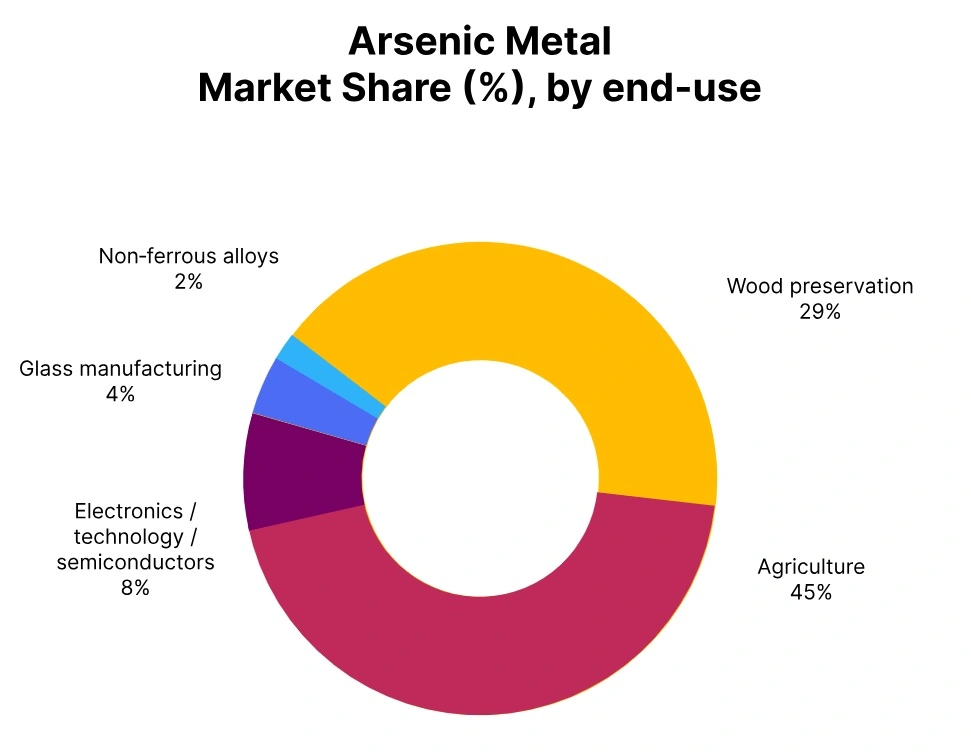
Arsenic Metal Market Share End Use

Historically, several events have caused significant fluctuations in Arsenic Metal prices

  • Environmental and Regulatory Constraints (2022–2023): Tighter environmental controls, particularly in China (a major arsenic producer), led to plant closures and stricter handling requirements due to arsenic’s toxicity. These factors constrained supply and added compliance costs, influencing global price increases.
  • Mining and Metallurgical Activity (2021–2022): Arsenic is often obtained as a byproduct of copper, gold, and lead refining. Fluctuations in base metal mining output—due to labor shortages, environmental regulations, and pandemic-related mine shutdowns—restricted arsenic availability, putting upward pressure on prices.
  • Electronics and Semiconductor Demand (2020–2021): The surge in global electronics and semiconductor production, especially during the pandemic-driven digital transformation, increased demand for high-purity arsenic used in gallium arsenide (GaAs) semiconductors. This demand uptick contributed to higher prices.

Why Price Watch™?

Price Watch™ is your trusted resource for tracking global arsenic metal price trends. Our platform delivers real-time data and expert analysis, offering deep insights into the key factors driving price fluctuations in the arsenic metal market. By monitoring critical events such as geopolitical tensions, supply chain disruptions, and economic shifts, Price Watch™ keeps you fully informed of market dynamics.

In addition, Price Watch™ provides detailed forecasts and updates on production capacities, enabling you to anticipate market changes and make well-informed decisions. With Price Watch™, you gain a competitive edge in understanding all the elements that influence arsenic metal prices worldwide. Stay ahead of the curve with Price Watch’s™ reliable, accurate, and timely arsenic metal market data.

Track Price Watch's™ arsenic metal price assessment on a weekly basis since 2015 onwards, along with short-term forecasts, and get access to the detailed report in a downloadable format.

Arsenic Metal Market Price Trend published by Price Watch™ reflect prevailing spot market conditions, derived from independent research, verified trade inputs, and proprietary market intelligence as of the publication date. Prices are published on the specified Incoterm and represent indicative base market levels, exclusive of applicable taxes, VAT, duties, tariffs, and other statutory charges. Actual transaction values may vary depending on volume, credit terms, contractual structure, and other negotiated conditions. Market prices are inherently subject to volatility, liquidity dynamics, regulatory changes, and evolving trade activity. The information provided is for reference and benchmarking purposes only and does not constitute an offer, recommendation, or guarantee of transactional outcomes. Users should exercise independent commercial judgment and assess their specific contractual, regulatory, tax, and application requirements before making business decisions. Price Watch™ assumes no liability for decisions taken based on this information.

• Raw Material Availability – Arsenic is often obtained as a by-product of smelting operations involving copper, lead, and gold ores. The availability and output of these base metals directly affect arsenic supply and pricing.

• Mining and Production Costs – Costs associated with the extraction, refining, and environmental management of arsenic impact its market price. These include labour, energy, safety measures, and compliance with environmental regulations.

• Environmental Regulations – Arsenic is toxic, and its production, handling, and disposal are strictly regulated. Stricter environmental laws and compliance costs can reduce supply and raise prices.

• Global Demand – Demand from sectors such as electronics (semiconductors, solar cells), wood preservation, agriculture (pesticides), and metallurgy can influence price trends.

• Geopolitical Factors – Countries with significant arsenic reserves or refining capacities (e.g., China, Russia) may affect global supply through trade policies, export restrictions, or production quotas.

• Substitute Materials and Technologies – Advances in or a shift toward arsenic alternatives (due to toxicity concerns) can reduce demand, impacting prices.

• Exchange Rates – As arsenic is traded globally, currency fluctuations (especially USD against other major currencies) can affect its price in international markets.

• Market Speculation and Stockpiling – Strategic stockpiling by governments or industries, and speculation in commodity markets, can create price volatility.

The availability and cost of raw materials such as high-carbon steel and alloy coatings directly affect arsenic metal production costs and pricing.

Arsenic metal prices tend to rise with inflation, primarily due to higher extraction and refining costs, but consistent demand from the semiconductor, alloy, and agricultural sectors helps stabilize pricing trends despite broader economic fluctuations.

Arsenic is a metalloid element with critical industrial applications, influencing sectors such as semiconductors, metallurgy, chemicals, and environmental technologies.

High purity arsenic is used as a dopant in compound semiconductors like gallium arsenide for high frequency and optoelectronic devices, while small amounts improve corrosion resistance and mechanical properties in metal alloys. It also serves as an intermediate in specialty chemicals, acts as a fining agent in glass and ceramics, and is studied for advanced electronic materials.

Due to its toxicity and regulatory oversight, arsenic’s supply, pricing, and trade are shaped by environmental controls, safety standards, and recycling potential, making market tracking essential for industries dependent on its unique chemical and physical properties.

Arsenic prices vary by region and market conditions. Prices are typically quoted per metric ton or per pound and fluctuate based on global supply, import/export flows, industrial demand, and currency exchange rates. Price-Watch™ provides real time price assessments across different global markets to help buyers and sellers make informed decisions.

Prices fluctuate due to changes in Chinese production, environmental regulations, seasonal smelter maintenance, feedstock availability, and demand from pharmaceuticals, electronics, and alloys. Exchange rates, logistics costs, and global economic conditions also influence trends.

Major consumers include pharmaceuticals, electronics, metallurgy, chemical & pigment industries, and research/specialty materials. Price-Watch™ analyses demand patterns across all these industries.

Arsenic is primarily obtained as a by product of the smelting of sulphide ores, especially arsenopyrite and other metal sulphide ores containing gold, copper, or lead. During smelting, arsenic is released as arsenic trioxide, which is then collected from flue gases. High purity arsenic metal is produced through reduction of arsenic trioxide with carbon or hydrogen, or by electrolytic deposition from arsenic containing solutions, allowing recovery of the metal in crystalline or powder form suitable for semiconductors, alloys, and specialized industrial applications.

China is the world’s largest exporter. Export volumes vary with domestic policies, environmental regulations, and international demand. Price-Watch™ tracks production levels, export flows and trade patterns to help businesses understand global supply chains and identify sourcing opportunities.

Supply generally meets demand, but disruptions may occur due to smelter shutdowns, environmental restrictions, or spikes in industrial consumption. Price-Watch™ monitors these supply demand imbalances to alert the market about potential shortages or surpluses.

Arsenic is graded by purity: industrial grade (~99%), high purity 99.99%, and ultra pure specialty forms. Higher purity grades cost more due to extra refining. Price-Watch™ provides separate price assessments for each grade to ensure market transparency.

When demand rises, for example: from pharmaceutical production or electronics manufacturing prices typically climb. Suppliers may prioritize certain customers, and lead times can extend. Price-Watch™ captures these market dynamics in real time.

Refining arsenic is energy intensive. Rising electricity, fuel, or chemical costs often get passed on to buyers. This is why prices in regions with cheaper electricity tend to be lower, a correlation that Price-Watch™ analyses in its price assessments & market reports.

Regional variations arise from import dependency, shipping costs, currency fluctuations, and local demand. Price-Watch™ tracks prices across all major regions to highlight these differences.

Forecasts depend on production capacity, Chinese export policies, industrial demand, and macroeconomic factors. Price-Watch™ regularly publishes detailed forecasts that project price movements for the next 12 months based on comprehensive analysis of supply additions, demand growth in key industries, seasonal patterns, and macroeconomic indicators. Our forecasts help businesses anticipate market conditions and plan accordingly.

Yes. Accurate forecasts allow businesses to optimize purchasing, negotiate contracts, and manage inventories. If Price-Watch™ forecasts predict a price increase in three months, you might choose to stock up now or lock in long term contracts at current rates, potentially saving thousands of dollars.

Events such as Chinese export restrictions, smelter shutdowns, environmental regulations, or economic shocks can cause supply shortages and price volatility. Price-Watch™ provides timely alerts when such events affect the market.

Price-Watch™ collects data from manufacturers, distributors, and buyers worldwide to publish regular price assessments, market reports, and forecasts. Our transparent methodology and comprehensive coverage make us a trusted source for understanding fair pricing and market trends in the Arsenic 99%min industry.