

For decades, published price benchmarks have provided the foundation for commodity procurement. Buyers use them to negotiate contracts, plan budgets and evaluate supplier offers.
Across industries, they have established a common pricing language that brings consistency to increasingly complex global supply chains.
That role remains essential. Benchmarks provide transparency, support long-term contracts and reveal broader market trends. They offer a reliable historical reference that enables buyers and sellers to transact against a common understanding of value.
But today’s commodity markets no longer move at the pace of benchmark publication cycles.
Markets Move Before Benchmarks Do
Commodity markets now respond to new information in days, and often within hours.
Feedstock costs react quickly to weather events, geopolitical developments, export restrictions and production changes.
A sudden disruption in palm kernel oil supply, an unexpected refinery outage or a shift in crude oil production can alter procurement costs well before a weekly benchmark reflects the change.
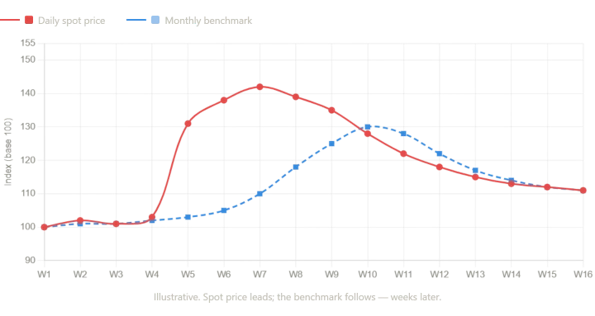
Supply disruptions amplify the effect. An unplanned shutdown at a major producer immediately reduces spot availability, tightening supply and reshaping negotiations. Suppliers price against current market conditions, not historical averages.
Freight markets introduce another layer of volatility. Vessel availability, freight rates, port congestion and shipment schedules evolve continuously, directly influencing delivered costs across regions.
Individually, these developments may appear incremental. Collectively, they can materially change the physical market before the next benchmark is published.
Where Negotiations Diverge
The disconnect becomes most apparent during commercial negotiations.
A procurement manager enters a discussion using the latest published benchmark as the reference point. The supplier responds using today’s market.
Feedstock costs may have risen since the benchmark was assessed. Production may have been disrupted by an unplanned outage. Available spot volumes may already be committed, while freight costs and competing bids continue to evolve.
Neither perspective is inherently wrong, they simply represent different points in time.
A benchmark reflects transactions completed over a defined reporting period. A supplier prices current availability and prevailing market conditions. As volatility increases, the gap between those two reference points becomes increasingly significant.
The result is not necessarily a pricing dispute, but an information gap.
Closing the Intelligence Gap
Historical benchmarks remain indispensable, but they are no longer sufficient on their own.
Modern procurement requires a second layer of intelligence to capture how markets evolve between benchmark publications.
Daily visibility into feedstock movements, plant operating rates, inventories, freight costs, trade flows and spot market activity provides the context needed to interpret benchmark prices accurately.
This is where Price Watch™ fits.
Rather than replacing benchmark indices, Price Watch™ complements them with specialist spot-market assessments and real-time supply-and-demand intelligence.
Its methodology is designed to capture current trading conditions across specific grades, regional markets and product variants, providing a market view that aligns more closely with actual procurement costs than broad market averages.
Unlike methodologies that rely on larger reporting windows, Price Watch™ continues to provide meaningful market intelligence even when liquidity is limited or trading activity is concentrated among a small number of transactions.
Transaction-level information, traded volumes and bid-offer dynamics help users distinguish between a genuine market shift and an isolated trade, a level of transparency that broader benchmark methodologies often cannot provide.
The result is a more complete picture of the market, enabling procurement teams to understand not only what the benchmark says, but why the market is moving.
Benchmark Data and Market Intelligence Serve Different Purposes
Historical benchmarks answer an important question: Where has the market traded?
Procurement decisions increasingly require another question to be answered: Where is the market today?
The distinction is critical.
Long-term contracts benefit from stable reference prices. Spot procurement depends on current supply availability, feedstock economics, inventory positions, freight conditions and regional demand.
The most effective procurement strategies therefore combine both perspectives: historical benchmarks for consistency and market intelligence for execution.
Together, they provide a more accurate understanding of market conditions than either can deliver independently.
Using the Right Tool for the Right Decision
Benchmarks remain the appropriate reference for contract settlements, financial instruments and cross-market comparability, where consistency is more important than immediacy.
Operational procurement presents a different challenge.
Inventory replenishment, opportunistic buying, supplier negotiations, corridor-level sourcing and short-term purchasing decisions require visibility into the market as it exists today rather than as it existed at the close of the previous reporting period.
Specialist spot assessments, combined with continuous supply-demand intelligence, provide procurement teams with that visibility.
They enable buyers to monitor changing fundamentals, evaluate supplier positions with greater confidence and respond more quickly to evolving market conditions.
The objective is not to replace benchmarks. It is to complement them with intelligence that reflects the pace of today’s commodity markets.
The Bottom Line
Commodity markets have become increasingly dynamic. Feedstock costs, production outages, freight availability, trade policy and regional supply-demand balances can reshape procurement conditions long before a benchmark captures the change.
Historical benchmarks remain an essential market reference and will continue to play a central role in commercial pricing.
But reference points alone are no longer enough.
Procurement leaders increasingly rely on continuous market intelligence to understand how supply, demand and spot market activity are evolving between benchmark publications.
By combining historical benchmarks with specialist spot assessments, they gain a clearer view of current market conditions and make decisions with greater speed and confidence.
Follow Price Watch™ on LinkedIn for real-time raw material insights, pricing trends, supply chain intelligence, and market updates shaping global commodity markets.