

Most people swallowing a prenatal vitamin or a farmer dosing a fish pond to prevent stunted growth have never once wondered where the folic acid in it actually came from.
Nearly all of it traces back to a cluster of chemical plants in Zhejiang and Shanghai provinces synthesizing the compound from p-aminobenzoic acid and a handful of other precursor chemicals.
China Continues to Anchor Global Folic Acid Supply
China dominates the global folic acid supply chain, accounting for over 35% of global production volume and commanding roughly 30% of global exports. Production is concentrated among a small set of manufacturers in Zhejiang, Jiangxi and Shanghai. The top five global players together holding close to 78% of the market.
That kind of concentration means a handful of Chinese factories, all running the same synthesis process effectively set the tone for global pricing. Where all that folic acid ends up is more varied than most assume.
Demand Softens Across Key End-Use Sectors
Feed grade is the single largest segment making up roughly 43% of global demand as folic acid is a critical additive in poultry and livestock feed – animals that can’t synthesize enough of it on their own with deficiency showing up as poor growth, reduced egg production and weakened immune response.
Pharmaceutical grade pulls just as hard in the other direction driven by folic acid’s role in prenatal supplements and anemia treatment and by fortification mandates now written into food policy in more than 85 countries.
Both of these demand streams are currently running cooler than usual, and that’s the real story behind the market’s flatness.
Long-Term Consumption Trends Remain Supportive
Globally, more than 84,000 metric tons of folic acid were manufactured last year with Asia-Pacific led by China’s roughly 29,000 metric tons – accounting for over half of that volume. The bigger structural trend hasn’t gone anywhere as rising birth rates and expanding maternal health programs across India and Southeast Asia pushed regional consumption up an estimated 18% over two years.
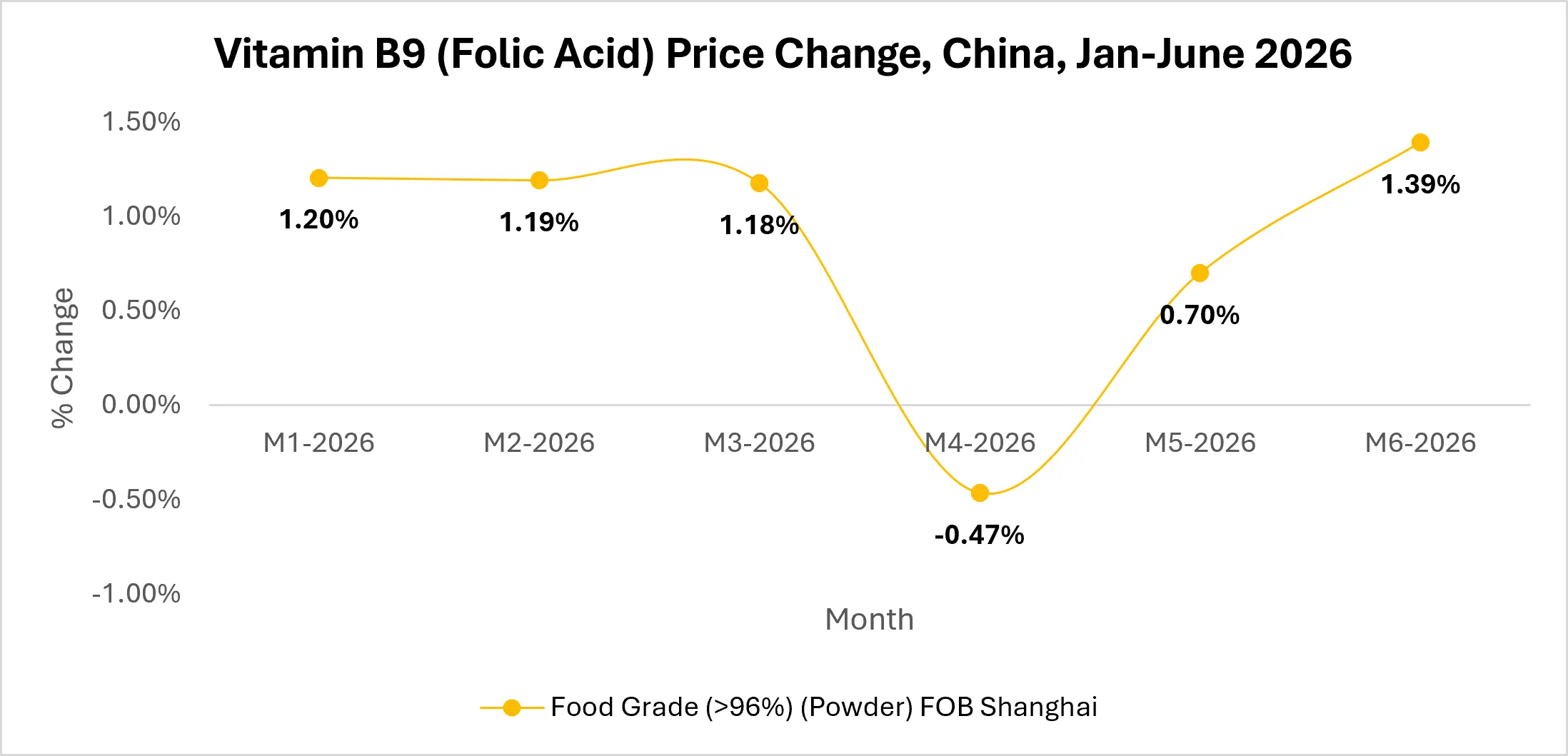
So the current flatness looks less like a ceiling and more like a pause. Chinese producers are holding output steady rather than competing aggressively on price while pharmaceutical and nutraceutical buyers work through existing inventory before committing to fresh purchases.
Source: Price Watch™ Vitamin B9 (Folic Acid) Prices
Folic Acid Market Outlook
For now, both sides of the market appear to be waiting for the next catalyst rather than creating one. The folic acid story reduced to its uncomfortable core for decades, the world let a single country’s chemical infrastructure become the default answer to a public health question.
Nobody planned it that way it simply happened, one cost-efficiency decision at a time, until some China’s provinces quietly became the reason fortified flour reaches shelves in Lagos and feed mills stay stocked in Vietnam.
The efficiency was real. So is the exposure. And the harder question isn’t whether China’s grip on folic acid production will loosen – It’s whether anyone outside China is actually building toward the day it does, or whether the whole system is just quietly hoping that day never comes?
Follow Price Watch™ on LinkedIn for real-time raw material insights, specialty chemical market trends, supply chain intelligence, and global commodity updates.