

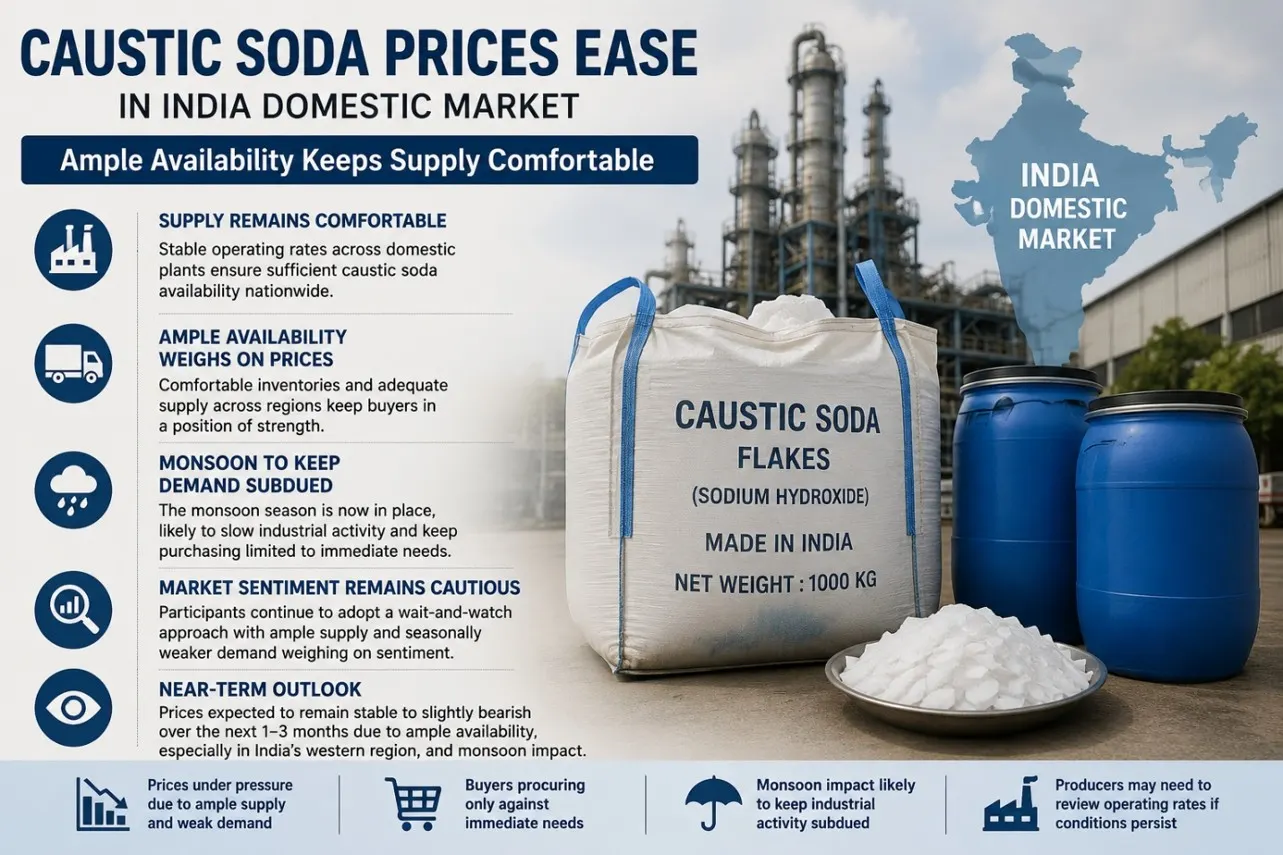
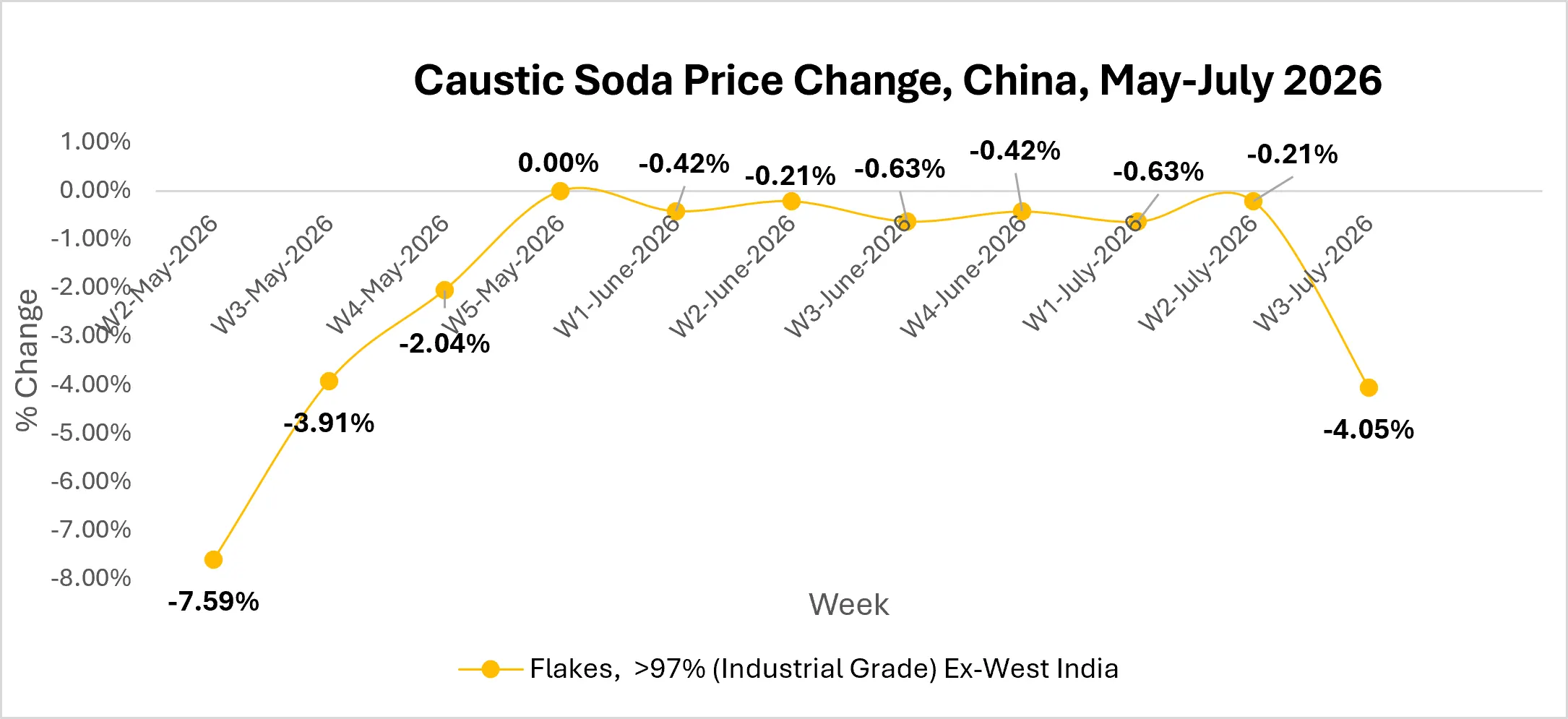
The Indian domestic caustic soda market continues to drift lower, with Q1 2026 assessments easing about 1.45% as comfortable supply outweighed demand even a roughly 7% geopolitics-driven spike in March faded quickly. Beneath the soft headline, the market is quietly repositioning for its biggest supply reshuffle in a decade.
Caustic Soda Capacity Is Racing Ahead of Consumption
India’s installed caustic soda capacity has reached roughly 6.7 million tonnes per annum, with exports absorbing barely 9% of it. DCM Shriram’s Jhagadia complex in Bharuch now the country’s largest single-site caustic facility at 2,225 TPD after an 850 TPD expansion operates alongside Grasim Industries, GACL, Epigral, Tata Chemicals, and Kutch Chemicals, keeping the western region of India persistently long on material and suppliers discounting aggressively to secure orders.
Source: Price Watch™ Caustic Soda Prices
And More Supply Is Coming
Adani’s Mundra Petrochemical has a 2,200 TPD chlor-alkali plant under execution with Nuberg EPC, tied to its 1-million-tonne PVC project. Indian Peroxide Limited targets an October 2026 start-up for its 400 TPD Dahej unit, while TGV SRAAC is expanding at Kurnool with thyssenkrupp nucera. Counting Reliance’s plans, nearly 2 million tonnes of new capacity could land on a market where global chlor-alkali utilization has already slipped to about 76%.
Source: Price Watch™ Caustic Soda Prices
Monsoon Keeps Caustic Soda Buyers on the Sidelines
Demand from textiles, dyes, soaps, and alumina remains need based as the monsoon slows industrial activity. With inventories comfortable, buyers procure only against immediate requirements and sellers keep sharpening offers to move volumes.
The Wildcard Few Are Pricing In
Adani and Abu Dhabi’s IHC have signed an $11.5-billion MoU for an integrated aluminium complex in Odisha, including a 4-million-tonne alumina refinery. Alumina is caustic soda’s single largest consumer. If that project advances on schedule, India’s entire caustic demand map gets redrawn.
Caustic Soda Market Outlook
Over the next three months, the market looks stable to slightly bearish: ample western-region availability, seasonal demand weakness, and no visible sign of producers trimming operating rates yet.
So here is the question worth asking. When 2 million tonnes of fresh supply collides with a demand inflection, who moves first producers cutting rates, exporters chasing Africa and Southeast Asia, or buyers who timed the bottom? That answer is already forming, one price point at a time and it will be visible in the data long before it appears in the headlines.
Follow Price Watch™ on LinkedIn for real-time raw material insights, chlor-alkali market trends, supply chain intelligence, and global commodity updates.