

Nickel prices in China traced a dramatic arc from April through June 2026. Prices surged 5.98% from April into mid-May, fuelled by Indonesian supply shocks and Middle East geopolitical risk.
Then came the reversal. A 4.9% decline followed through June as profit-taking and a historic inventory overhang reasserted themselves.
The market has now settled into cautious stability, caught between genuine supply constraints and stubborn surplus. Nickel is no longer just a stainless-steel input. It sits at the heart of defense supply chains, EV battery materials, and global energy transition strategy.
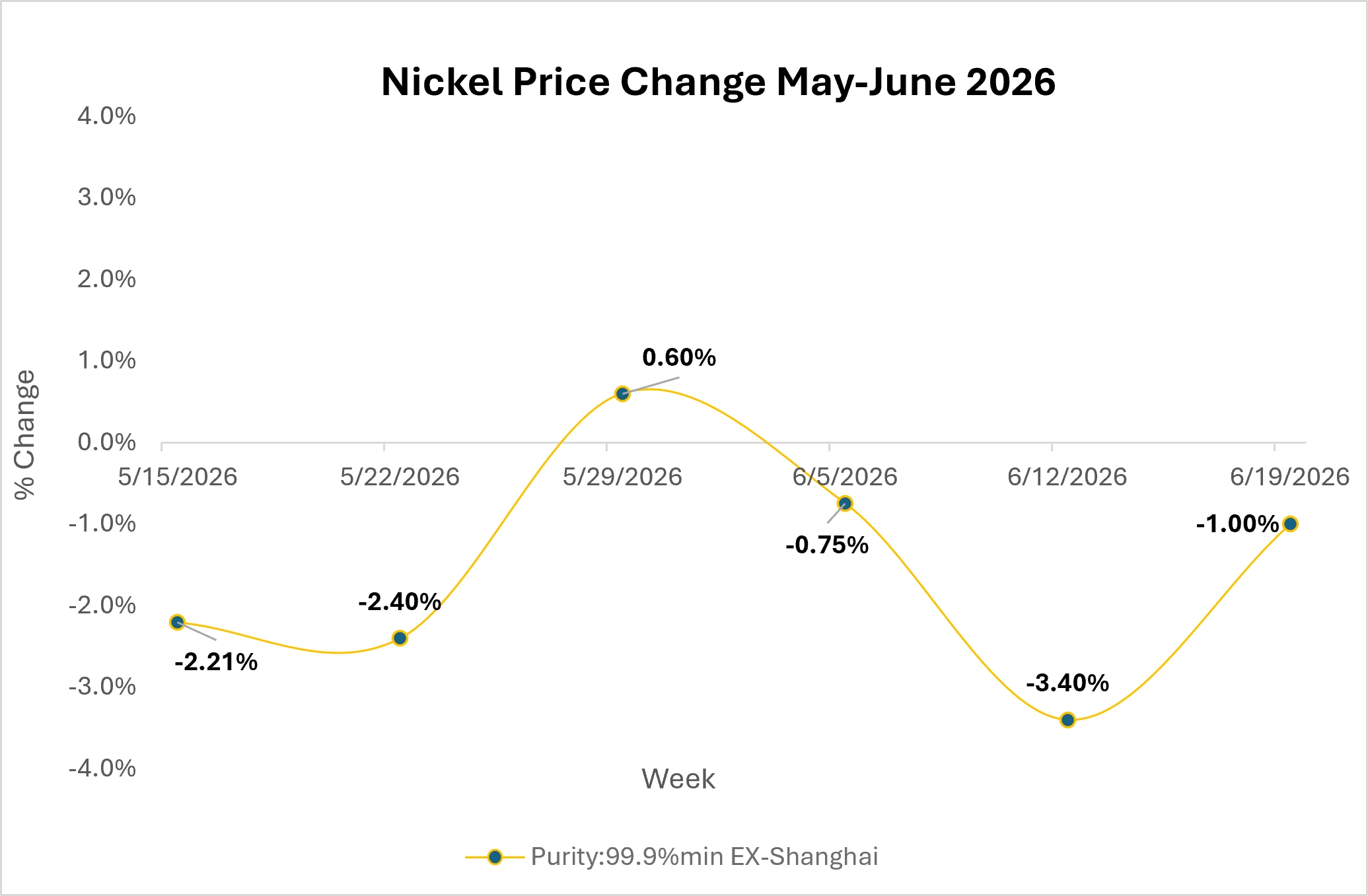
Source: Price Watch™ Nickel Prices
What Drove Nickel Price Swings?
- Indonesia’s Historic Supply Contraction
Indonesia slashed nickel ore mining quotas dramatically in 2026. One major producer received just 12 million wet metric tons, down from 42 million in 2025. When that quota ran out, the company halted ore production entirely.
The first net-negative shift in Indonesian supply in a decade sent markets sharply higher almost overnight.
- The Sulphur Crisis Squeezing Refinery Output
Over two-thirds of Indonesia’s sulphur imports come from the Middle East. The Iran conflict severed those supply lines, forcing High-Pressure Acid Leach processing facilities to cut output by at least 10%.
Tens of thousands of tonnes of refined nickel capacity faced curtailment risk, amplifying the supply scare significantly.
- Geopolitical Risk Premium Faded Fast
The Iran conflict initially pushed energy costs and risk premiums higher across base metals. However, as ceasefire signals emerged, those premiums faded quickly, triggering profit-taking and a sharp market correction.
Prices fell to their lowest level in nearly two months within days, reflecting rapidly improving geopolitical sentiment and reduced supply disruption concerns.
- Inventory Overhang Capped the Recovery
Combined global exchange inventories reached approximately 468,600 metric tons by mid-2026, the largest overhang since 2015, representing roughly six weeks of total global consumption.
Shanghai warehouse stocks nearly doubled since January 2026. With supply visibly available and downstream demand soft, buyers had no urgency to chase prices higher.
The Bottom Line for Investors and Industry
Two competing truths define this market. Indonesian supply constraints are structural and deepening. But the global inventory overhang is real and will not clear quickly.
Until one side wins convincingly, rangebound trading with an upward bias remains the most likely near-term outcome. The floor is firm. The ceiling is heavy.
Nickel Global Market Outlook
The global nickel market is entering a defining phase. Indonesian quota policy remains the most critical variable globally. Any further tightening will send immediate shockwaves through Chinese refinery throughput, which dominates global refined output.
Jakarta has signalled flexibility for now, but the structural direction is unmistakably toward tighter resource management.
In China, double-digit growth in stainless steel production continues to provide strong underlying demand for nickel, although inventory accumulation by state-linked buyers is masking true industrial consumption trends.
At the same time, financial restructuring and production uncertainty among several Western producers in Europe and North America are contributing to tighter global supply conditions.
Industry consensus points to stronger nickel fundamentals through the rest of 2026 and into 2027. EV battery demand, grid-scale energy storage growth, and global electrification continue to support structurally higher consumption over the coming decade.
The inventory overhang is expected to gradually clear, while the era of rapid Indonesian supply growth appears to be moderating. As these dynamics become more apparent, nickel is likely to reinforce its position as a strategically important metal.
Follow Price Watch™ on LinkedIn for real-time raw material insights, pricing trends, supply chain intelligence, and market updates shaping global commodity markets.