

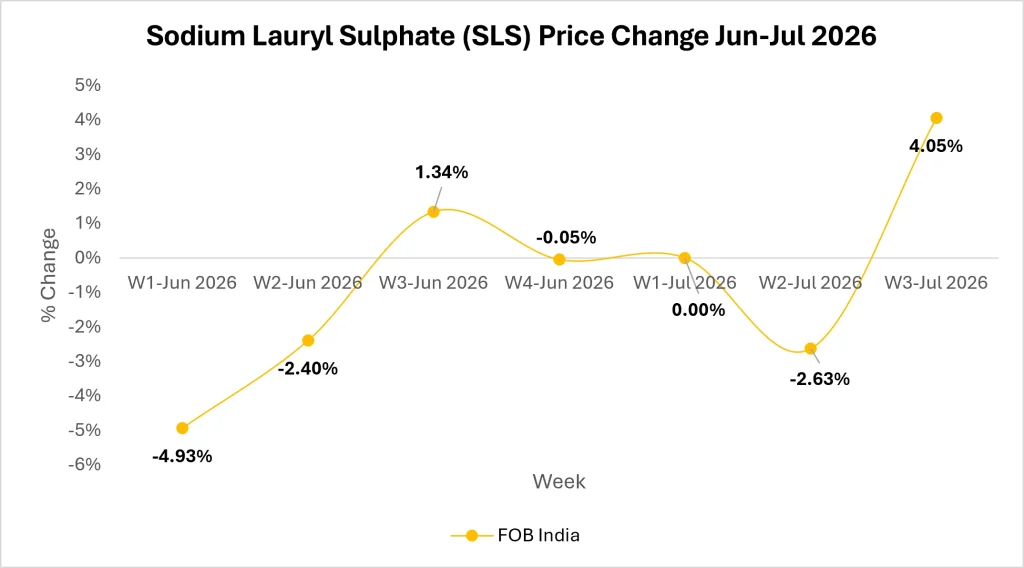
Something unusual appeared in the Sodium Lauryl Sulphate (SLS) price trend in India between W1 June and W3 July 2026. The market did not follow the typical pattern of a steady demand-led movement. Instead, FOB India moved through a short correction cycle, stabilized, slipped again, and then recovered sharply in the final week.
Sodium Lauryl Sulphate India Price Trend
FOB India SLS declined 5% in W1 June and another 2% in W2 June as buyers delayed replenishment and distributors worked through existing inventories.
Prices turned slightly positive in W3 June with a 1% recovery, remained unchanged through W4 June and W1 July, before declining again by 3% in W2 July.
The unexpected shift came in W3 July, when FOB India increased 4%, indicating that sellers regained pricing leverage after several weeks of cautious buying.
Key Developments in the Last 6 Weeks
- FOB India SLS declined 7% from W1 to W2 June, stabilized for two weeks, and then recovered 4% in W3 July as inventory pressure eased.
- The W2 July correction created a short buying opportunity for downstream users, but limited producer flexibility prevented further price erosion.
The movement was less about a sudden improvement in detergent demand and more about a temporary imbalance between available inventory, raw material replacement costs, and buyer restocking behavior.
Source: Price Watch™ SLS Prices
Personal Care, Detergents and Feedstock Pressure
Two value-chain factors shaped the recent SLS movement. First, downstream buyers in detergents, personal care, and home-care formulations adopted a hand-to-mouth purchasing strategy during June, limiting immediate price support.
However, reduced distributor inventories created a need for replenishment by mid-July, allowing producers to push offers higher.
Second, SLS producers faced uncertainty from upstream fatty alcohol costs. Any movement in palm-based feedstocks, freight costs, or imported raw material availability can quickly influence replacement costs because SLS margins are closely linked to feedstock volatility.
Sodium Lauryl Sulphate Market Outlook
FOB India SLS is likely to remain sensitive to inventory cycles and feedstock movements over the next quarter. Demand from detergents and personal care segments should provide stability, but buyers may continue avoiding large inventory builds unless raw material costs show a clearer direction.
The key factors to monitor are fatty alcohol pricing, import availability, and whether producers maintain tighter supply discipline after the July recovery.
The June correction looked temporary, but the July rebound raises a bigger question: if raw material costs rise again while buyers continue operating with low inventories, will SLS pricing move into a faster restocking-driven cycle across India’s detergent and personal care supply chains?
For continuous tracking of SLS price movements, raw material trends, and regional chemical market intelligence, follow Price Watch™.
Follow Price Watch™ on LinkedIn for real-time specialty chemical market insights, surfactant price trends, supply chain intelligence, and global commodity updates.