

The UAN Price story of 2026 began not in a fertilizer plant rather it began in the Strait of Hormuz. When the US-Israel-Iran conflict escalated in late February 2026, the world’s most strategically critical shipping corridor effectively closed.
Roughly 40% of global urea export routes and nearly 25% of global ammonia supply passed through that corridor. The immediate consequence was drastic surge in UAN FOB New Orleans prices.
The Middle East is not just a transit route for fertilizers; it is a producer. Iran, with its abundant low-cost natural gas, is a significant nitrogen exporter.
Removing that supply from the global pool while simultaneously choking the shipping lane created a double shock: fewer Nitrogen available, and those that were available cost more to move.
US domestic producers like CF Industries, already running at 97% utilisation, had no latent capacity to absorb the gap. The result was a rapid and violent price reset.
Why UAN Has Fallen Every Week Since June
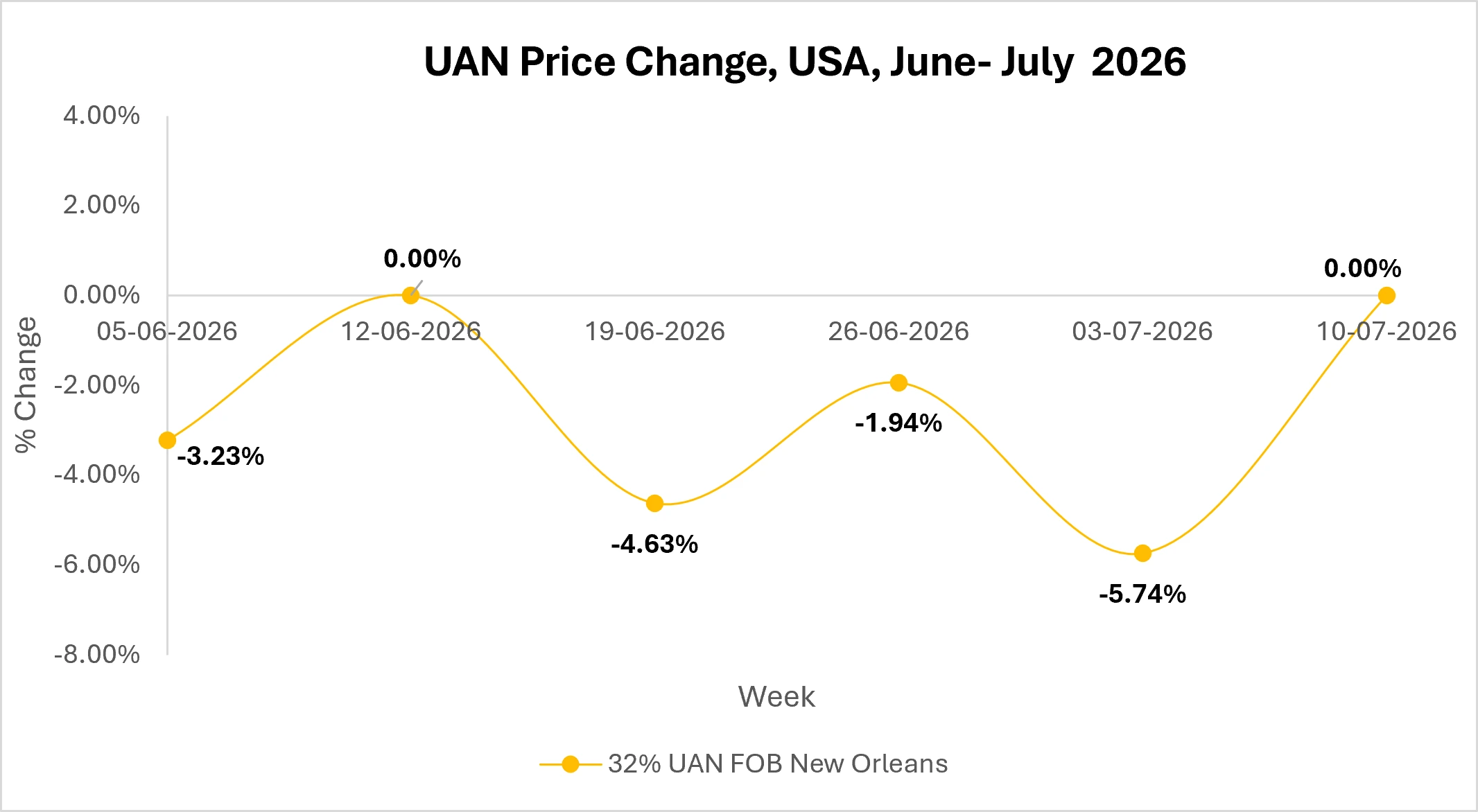
Source: Price Watch™ UAN Prices
From 05 June through 10 July 2026, UAN FOB New Orleans has moved in a single direction: down. It is a controlled, structural unwinding driven by three simultaneous forces.
First, the ceasefire. The US-Iran memorandum of understanding signed on 17 June 2026 opened a 60-day window to formalise the reopening of the Strait of Hormuz.. Ammonia futures softened. Urea FOB New Orleans fell over 50% from its April peak within weeks. UAN followed, with a lag.
Second, By June, the US corn planting season was over. Application demand which drove urgent Q1 buying had evaporated. Buyers stepped back. Retailers, who had over-stocked at peak prices, stopped bidding aggressively.
Third, Natural gas the primary cost input for UAN production eased to approximately in mid-2026 as record domestic production offset LNG export demand. Lower gas costs removed the floor that had kept prices elevated.
Three Variables That Own the UAN Price
Strip away the noise and UAN price is governed majorly by three variables. Anyone telling you otherwise is overcomplicating the picture.
- Natural Gas & Ammonia Cost
More than 70% of the variable cost to produce UAN is natural gas. The Haber-Bosch process converts natural gas to ammonia; ammonia is then upgraded to UAN. When natural gas prices surged in early 2025 to spiking levels during the Iran conflict before easing back toward, the entire UAN cost curve moved with it. It is the single most reliable leading indicator for where UAN is heading in 4 to 6 weeks.
- Geopolitical Supply Risk
The Strait of Hormuz is the world’s most consequential fertilizer chokepoint. Approximately 40% of global urea exports and nearly half of seaborne sulphur move through it. Any disruption military, diplomatic, or logistical cascades directly into nitrogen prices within days. Geopolitical risk is not an external variable. For UAN, it is a pricing mechanism.
- Corn Acreage & Seasonal Demand Cycles
The US corn crop is the dominant demand driver for UAN. Pre-planting nitrogen demand peaks in February–April; post-planting demand collapses through June–July. Fall application then creates the next demand pulse from August. The seasonal rhythm is structural and predictable, yet buyers routinely get caught on the wrong side of it by reacting to price rather than anticipating the cycle.
UAN Market Outlook
The current correction has further room to run, but not indefinitely. Over the next two to three months, UAN FOB New Orleans is expected to consolidate, with a floor emerging in August as fall application season pre-positioning begins. The base scenario could be prices trend lower through July, stabilise in August, and begin a measured recovery by September-October as Corn Belt retailers build fall inventory.
The upside risk is not yet neutralised. The US-Iran ceasefire remains a memorandum of understanding not a signed peace. A resumption of hostilities would reopen the Hormuz disruption and send nitrogen prices sharply higher with little warning. So the best we can do is watch how the UAN price reacts to global headwinds.
The Question Nobody Is Asking
If UAN prices are falling because the geopolitical risk premium is unwinding and yet Hormuz shipping is still running below pre-conflict levels how much of the current “correction” is real fundamental easing, and how much is just markets pricing in a ceasefire that hasn’t yet been fully delivered?
Follow Price Watch™ on LinkedIn for real-time fertilizer market insights, pricing trends, supply chain intelligence, and global commodity updates.