

Most women taking a Vitamin B8 (INOSITOL) supplement for PCOS, or farmers raising farmed fish and shrimp have never thought about where the compound actually comes from.
Nearly all of it traces back to the same place a cluster of extraction plants in China’s Shanghai and Zhejiang provinces processing one primary raw material corn.
China leads the global Vitamin B8 market with roughly 27% of global share and production is tightly clustered. The top few producers alone control about 73% of the global market between them.
That concentration means global Vitamin B8 pricing doesn’t distribute risk across dozens of competing countries. A handful of factories all drawing from the same agricultural base effectively set the price for everyone else.
Vitamin B8 Demand Expands
The Vitamin B8 ends up more varied than most assume. The fastest-growing demand is coming from the women’s health supplement market driven by clinical evidence that myo-inositol combined with D-chiro-inositol restores insulin sensitivity and ovarian function in PCOS patients.
But aquaculture pulls just as hard farmed fish cannot synthesize sufficient Vitamin B8 internally and deficiency causes fin erosion, stunted growth and liver damage. Both demand streams are now colliding with a more turbulent supply environment.
Over 12,000 metric tons of Vitamin B8 (INOSITOL) were produced globally in 2024. China’s new capacity additions alone in the same period exceeded 2,500 metric tons annually, representing a 12% increase in production capacity.
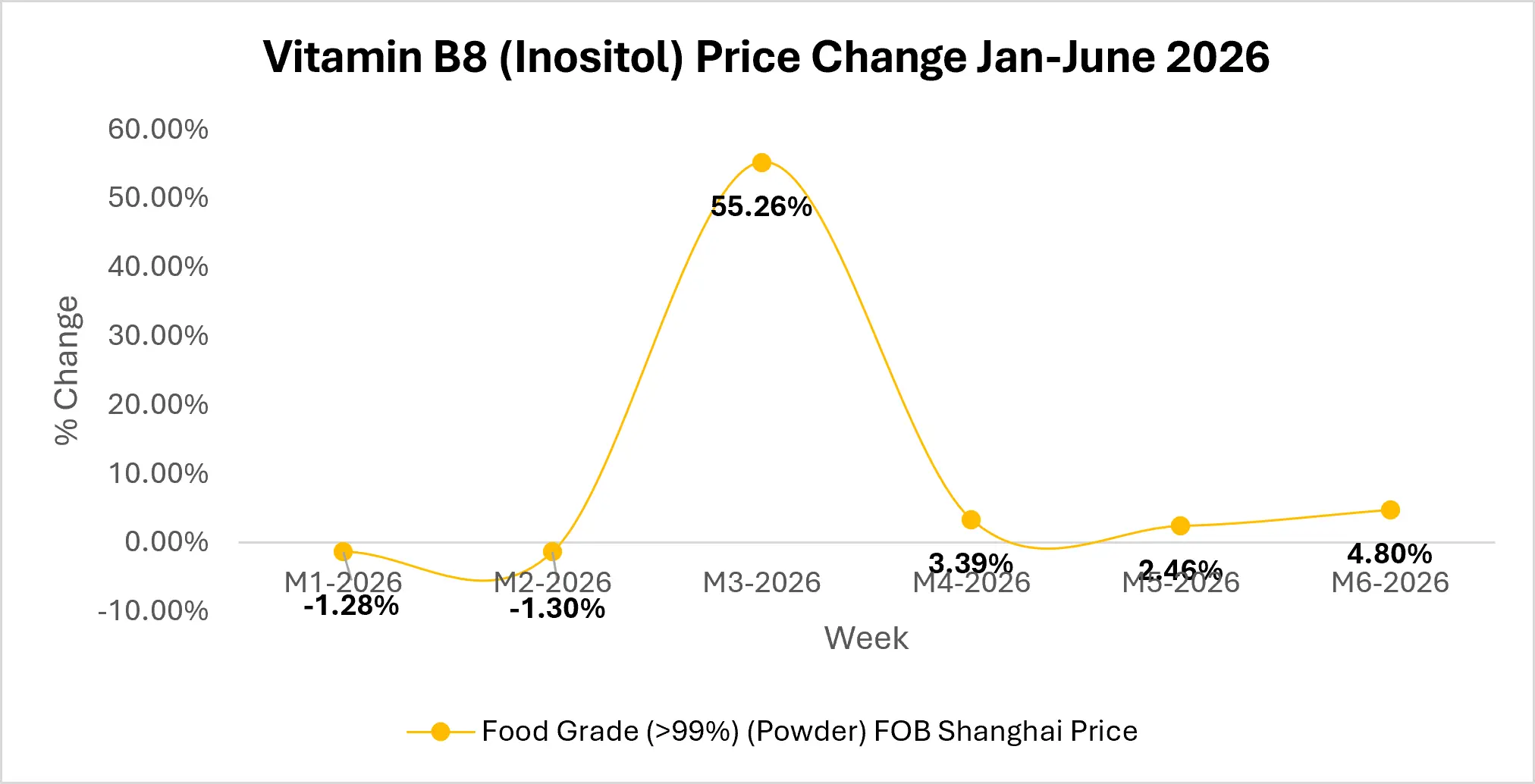
Source: Price Watch™ Vitamin B8 (INOSITOL) Prices
Vitamin B8 Market Outlook
The story of Vitamin B8 is ultimately a story about what happens when the world optimizes entirely for cost and forgets to ask about resilience.
Few factories in China should not determine whether a PCOS patient in London gets her supplement or whether a salmon farm in Norway hits its growth targets.
But that is precisely the situation the market has built for itself, quietly, over decades and nobody is close to unwinding it. The bigger question now arises – Who exactly is building the supply chain that catches them if China stumbles?
Follow Price Watch™ on LinkedIn for real-time raw material insights, pricing trends, supply chain intelligence, and market updates shaping global commodity markets.