Calcium Carbide Price Trend and Forecast

Weekly Update
|
Historical Data Since 2015
|
Forecast for 2026
  • Commodity Pricing

calcium carbide Price Trends by Country

cnChina
thThailand
phPhilippines
ngNigeria
egEgypt
saSaudi Arabia
sgSingapore
inIndia

Global calcium carbide Spot Market Prices, Trend Analysis and Forecast

Price Watch™ provides real-time price assessments and price forecasts for Calcium Carbide across top trading regions:

Calcium Carbide Regional Coverage    Calcium Carbide Grade and Country Coverage    Calcium Carbide Pricing Data Coverage Explanation   


Asia Calcium Carbide Pricing Analysis   


Calcium Carbide Size 50-80 MM FOB Prices at Shanghai Port, China  Weekly Price Update on Calcium Carbide Real-Time Export Prices from Shanghai Port, China to Global Markets   
Calcium Carbide Size 50-80 MM CIF prices at Bangkok Port, Thailand from China  Weekly Price Update on Calcium Carbide Real-Time Import Prices at Bangkok Port, Thailand from China 
Calcium Carbide Size 50-80 MM CIF prices at Manila Port, Philippines from China  Weekly Price Update on Calcium Carbide Real-Time Import Prices at Manila Port, Philippines from China 
Calcium Carbide Size 50-80 MM CIF prices at Singapore Port, Singapore from China  Weekly Price Update on Calcium Carbide Real-Time Import Prices at Singapore Port, Singapore from China 
Calcium Carbide Size 50-80 MM CIF prices at Nhava Sheva Port, India from China  Weekly Price Update on Calcium Carbide Real-Time Import Prices at Nhava Sheva Port, West India from China 
Middle East & Africa Calcium Carbide Pricing Analysis    Calcium Carbide Size 50-80 MM CIF prices at Apapa Port, Nigeria from China  Weekly Price Update on Calcium Carbide Real-Time Import Prices at Apapa Port, Nigeria from China 
Calcium Carbide Size 50-80 MM CIF prices at Alexandria Port, Egypt from China  Weekly Price Update on Calcium Carbide Real-Time Import Prices at Alexandria Port, Egypt from China 
Calcium Carbide Size 50-80 MM CIF prices at Jeddah Port, Saudi Arabia from China  Weekly Price Update on Calcium Carbide Real-Time Import Prices at Jeddah Port, Saudi Arabia from China 


Note:
In assessments structured as CIF [Importing Port] (Exporting Country), the country mentioned in brackets indicates the primary origin of supply (exporting country), while the named port refers to the destination port in the importing country. Other Incoterms (FOB, FD, EXW, etc.) should be interpreted in accordance with standard international trade definitions.

Calcium Carbide Price Trend Q1 2026

Calcium Carbide prices fluctuated across different areas during Quarter 1 of 2026. Prices in China have continued to rise overall, due mainly to high levels of export demand and continuous usage of Calcium Carbide from chemical, metallurgy and agricultural sources. Asia Pacific (Thailand, Egypt, Singapore, India) has also experienced an increase in Calcium Carbide pricing as a result of normal import patterns, stable downstream procurement, and ongoing industrial activity.

The oppositethe occurred in Philippines, Nigeria, and Saudi Arabia with the pricing pressure in these areas due to an average amount of industrial demand, adequate inventories, and conservative purchasing plans. Global reports of Geopolitical Tensions (Israel/United States/Iran) as well as regional concerns (Strait of Hormuz) have impacted the flow of trade on a global scale, freight costs as well as the general market sentiment. Therefore, all market participants have aggressively managed inventory levels and the resultant procurement; which had a major impact on price movement across this segment.

China: Calcium Carbide Export prices FOB Shanghai, China; Grade- Size 50-80 mm

The Calcium Carbide price in China ticked up by 0.3% over the first quarter of 2026 as the market finally found some solid ground. This slight bump came from a combination of better export numbers and reliable demand from chemical plants mostly for acetylene alongside steady consumption in the metal and farming sectors. Since production stayed mostly balanced and supply tightened a bit, the overall mood among traders started to turn around.

According to Price-Watch™ , in China, Calcium Carbide prices in March 2026 took a sharper turn, jumping 5.4% compared to February. This spike is caught up in a sudden wave of industrial work and a rush of new orders from downstream buyers looking to stock up. Meanwhile, the Calcium Carbide price trend in China is further squeezed by rising geopolitical friction near the Strait of Hormuz involving Israel, the US, and Iran. These tensions messed with global shipping and logistics, making it harder to move goods and helping to drive prices higher by the end of the month.

Thailand: Calcium Carbide Import prices CIF Bangkok Thailand; Grade- Size 50-80 mm

The Calcium Carbide price in Thailand ticked up by 0.8% during the first quarter of 2026 as the market maintained a steady pace. This slight growth is fuelled by reliable orders from chemical plants mainly for making acetylene alongside consistent demand in the metal and farming sectors. With steady imports flowing in from China and local stock levels staying balanced, the Calcium Carbide price trend in Thailand held its ground well throughout the start of the year.

In Thailand, Calcium Carbide prices in March 2026 took a sharper turn, jumping 5% compared to February. This spike is mostly due to a sudden rush of industrial work and cautious buyers looking to restock before any further disruptions. On top of that, rising friction near the Strait of Hormuz involving Israel, the US, and Iran began to rattle global trade. These tensions put a lot of pressure on shipping lanes and freight costs, making it harder to move goods and helping to push prices higher by the end of the month.

Philippines: Calcium Carbide import prices CIF Manila, Philippines; Grade- Size 50-80 mm

The Calcium Carbide price in the Philippines slipped by 1% during the first quarter of 2026, as the market dealt with a mix of slow industrial work and plenty of stock on hand. This weakness is largely driven by a cautious approach from buyers in the chemical, acetylene, and farming sectors, who held back on major orders. Even with enough supply to go around, the Calcium Carbide price trend in the Philippines stayed lean as users focused on managing their existing inventory.

However, the market saw a sudden shift toward the end of the quarter, as in the Philippines, Calcium Carbide prices in March 2026 jumped by 5% compared to February. This spike is triggered by rising geopolitical friction near the Strait of Hormuz involving Israel, the US, and Iran, which sparked fears of a total waterway closure. These tensions rattled global shipping lanes and sent import costs swinging, forcing local buyers to balance immediate supply needs against the reality of higher freight rates.

Nigeria: Calcium Carbide import prices CIF Apapa, Nigeria; Grade- Size 50-80 mm

The Calcium Carbide price in Nigeria slipped by 2% during the first quarter of 2026 as demand weakened across several key sectors. This dip is mostly due to slower consumption in chemical plants, metalwork, and farming, where buyers took a more cautious approach. With import costs weighing on the market and industries holding back on large orders, the overall Calcium Carbide price trend in Nigeria stayed under pressure throughout the start of the year.

However, the market saw a sharp turnaround by the end of the quarter, as in Nigeria, Calcium Carbide prices in March 2026 surged by 8% compared to February. This sudden rebound is triggered by a tightening of available supply and a rush of downstream users looking to restock their inventories. At the same time, growing friction near the Strait of Hormuz involving Israel, the US, and Iran began to rattle global trade. These tensions messed with shipping reliability and sent freight costs climbing, forcing Nigerian importers to navigate a more volatile market as the month wrapped up.

Egypt: Calcium Carbide import prices CIF Alexandria, Egypt; Grade- Size 50-80 mm

The Calcium Carbide price in Egypt climbed by 4% during the first quarter of 2026 compared to the final months of 2025. This growth is anchored by a steady need for the chemical in acetylene production, as well as consistent demand from the metallurgical and agricultural sectors. As import costs from China rose and logistical hurdles became more frequent, the Calcium Carbide price trend in Egypt maintained its upward momentum through the start of the year.

In Egypt, Calcium Carbide prices in March 2026 specifically rose by 3.8% over February levels. A big part of this push came from local buyers ramping up procurement and tightening their inventory management to avoid shortages. These moves are largely a reaction to rising geopolitical friction near the Strait of Hormuz involving Israel, the US, and Iran. The threat of a waterway closure sent freight rates swinging and added a layer of uncertainty to trade routes, forcing importers to pay a premium to secure their shipments.

Saudi Arabia: Calcium Carbide Import prices CIF Jeddah Saudi Arabia; Grade- Size 50-80 mm

The Calcium Carbide price in Saudi Arabia dipped by 0.5% during the first quarter of 2026, as the market settled into a period of quiet industrial activity. With supply and demand staying mostly in sync, helped along by steady shipments from China and well-managed local stocks, the Calcium Carbide price trend in Saudi Arabia stayed relatively flat for the start of the year.

However, things took a sharp turn toward the end of the quarter. In Saudi Arabia, Calcium Carbide prices in March 2026 jumped 6.4% compared to February as buyers rushed to restock and secure their supply. This sudden spike is a direct reaction to the heating geopolitical friction near the Strait of Hormuz involving Israel, the US, and Iran. The threat of the waterway closing sent shipping and freight costs through the roof, forcing the market to hike prices as trade route risks became harder to ignore.

Singapore: Calcium Carbide Import prices CIF Port of Singa Pore; Grade- Size 50-80 mm

In Q1 2026, Calcium Carbide price in Singapore has slightly increased compared to the previous quarter due to steady demand from chemical, acetylene, metallurgy, and agriculture sectors. Calcium Carbide price trend in Singapore has strengthened compared to the previous quarter, supported by stable imports from China and well-managed inventories.

Global geopolitical tensions, including Israel-US-Iran developments and potential Strait of Hormuz closure, have added uncertainty to freight and trade. Calcium Carbide price in March 2026 has risen by 5% compared to February 2026, while Q1 2026 has recorded a 1% increase compared to Q4 2025. Stronger downstream demand and restocking activities have supported this price growth.

India: Calcium Carbide import prices CIF Nhava Seva, India; Grade- Size 50-80 mm

In Q1 2026, Calcium Carbide price in India has increased compared to the previous quarter, supported by sustained demand from the chemical industry for acetylene production and consistent usage in metallurgy and agriculture. Calcium Carbide price trend in India has remained strong compared to the previous quarter, influenced by higher import costs from China and supply-side adjustments.

Geopolitical tensions involving Israel, the US, and Iran, alongside concerns over Strait of Hormuz closure, have affected freight costs and trade flows. Calcium Carbide price in March 2026 has surged by 19.3% compared to February 2026, while Q1 2026 has recorded a 6% increase compared to Q4 2025. Market participants have closely monitored downstream demand and inventory restocking to guide pricing.

Calcium Carbide Price Trend Analysis: Q4 2025

In Q4 2025, the global Calcium Carbide market has experienced a generally stable to slightly soft trend, with China maintaining its position as the key exporting country while supplying consistent volumes to major importing nations including India, Thailand, the Philippines, Nigeria, Egypt, Saudi Arabia, and Singapore.

Calcium Carbide price trend has remained influenced by balanced supply-demand dynamics, with subdued yet steady demand from the chemical industry, particularly acetylene production, along with support from metallurgy and agriculture sectors. Importing countries have witnessed cautious procurement behavior due to sufficient inventories and moderate downstream consumption.

However, towards the end of the quarter, Calcium Carbide prices in December 2025 have shown slight improvements compared to the previous month, supported by restocking activities and marginal strengthening in short-term demand fundamentals.

China: Calcium Carbide Export prices FOB Shanghai, China; Grade- Size 50-80 mm

The Calcium Carbide price in China dipped by 1.0% during the fourth quarter of 2025 as the market cooled off. This slight downward move is mostly due to quieter demand across the chemical industry especially for making acetylene along with slower activity in the metal and farming sectors. Since production levels are mostly kept in line with this cautious buying, the Calcium Carbide price trend in China stayed stable with only minor corrections throughout the period.

However, the year ended on a slightly different note, as in China, Calcium Carbide prices in December 2025 ticked up by 0.8% compared to November. This small end-of-year lift is backed by a short-term rush of buyers looking to secure their stocks before the new year. Despite those few busy weeks, the general market mood stayed cautiously steady, with only small price shifts as the quarter wrapped up.

Thailand: Calcium Carbide Import prices CIF Bangkok Thailand; Grade- Size 50-80 mm

The Calcium Carbide price in Thailand dipped by 1.1% during the fourth quarter of 2025 as the market moved into a quieter phase. This downward trend is mostly a result of stable shipments arriving from China and a domestic market where supply and demand are well-balanced. While industries like chemical manufacturing specifically acetylene production and agriculture kept up a steady pace, the demand isn’t quite strong enough to keep prices from drifting lower.

In Thailand, Calcium Carbide prices in December 2025 saw a modest recovery, ticking up by 1.9% compared to November. This late-quarter bump is supported by a slight tightening in regional supply and a sudden increase in procurement as buyers looked to secure stock. Despite the subdued feel of the quarter overall, this year-end activity helped the market find a bit of a floor as it headed into 2026.

Philippines: Calcium Carbide import prices CIF Manila, Philippines; Grade- Size 50-80 mm

In Q4 2025, Calcium Carbide price in Philippines has demonstrated a mild decline due to consistent inflows from China and moderate demand from downstream industries. Calcium Carbide price trend in Philippines has indicated stable yet cautious buying patterns from the chemical sector, particularly acetylene applications, along with limited support from metallurgy and agriculture.

Compared to the previous quarter, prices have decreased by 1%, reflecting balanced supply conditions and controlled inventory levels. Despite this, late-quarter demand has shown signs of recovery. Calcium Carbide prices in December 2025 have increased by 0.8% compared to the previous month, driven by improved import costs and restocking activities among end users.

Nigeria: Calcium Carbide import prices CIF Apapa, Nigeria; Grade- Size 50-80 mm

In Q4 2025, Calcium Carbide price in Nigeria has witnessed a significant decline, primarily due to reduced import costs from China and weaker downstream demand. Calcium Carbide price trend in Nigeria has reflected bearish sentiment as consumption from acetylene-based chemical industries, metallurgy, and agriculture sectors has remained subdued.

Compared to the previous quarter, prices have decreased by 8%, indicating oversupply and reduced purchasing momentum. Market participants have remained cautious amid economic uncertainties and currency fluctuations. Calcium Carbide prices in December 2025 have decreased by 2% compared to the previous month, as lower demand and sufficient inventories have continued to pressure pricing levels.

Egypt: Calcium Carbide import prices CIF Alexandria, Egypt; Grade- Size 50-80 mm

In Q4 2025, Calcium Carbide price in Egypt has shown a declining trend due to steady imports from China and moderate demand conditions across key sectors. Calcium Carbide price trend in Egypt has been influenced by cautious buying from the chemical industry, particularly acetylene production, along with stable demand from metallurgy and agriculture.

Compared to the previous quarter, prices have decreased by 3%, reflecting ample supply and limited upward pressure. However, market activity has improved toward the end of the quarter. Calcium Carbide prices in December 2025 have increased by 3.6% compared to the previous month, supported by stronger procurement and rising import costs.

Saudi Arabia: Calcium Carbide Import prices CIF Jeddah Saudi Arabia; Grade- Size 50-80 mm

In Q4 2025, Calcium Carbide price in Saudi Arabia has experienced a slight decline, driven by steady supply from China and balanced demand across downstream sectors. Calcium Carbide price trend in Saudi Arabia has remained relatively stable, with moderate consumption from acetylene-based chemical industries, as well as metallurgy and agriculture applications.

Compared to the previous quarter, prices have decreased by 2%, reflecting controlled market conditions and sufficient inventories. Despite this, minor fluctuations have been observed due to regional trade dynamics. Calcium Carbide prices in December 2025 have decreased by 1.8% compared to the previous month, indicating weaker demand and limited buying activity.

Singapore: Calcium Carbide Import prices CIF Port of Singa Pore; Grade- Size 50-80 mm

In Q4 2025, Calcium Carbide price in Singapore has recorded a slight decrease, influenced by stable imports from China and moderate downstream demand. Calcium Carbide price trend in Singapore has shown limited volatility, as demand from the chemical industry, particularly acetylene production, along with metallurgy and agriculture sectors, has remained consistent.

Compared to the previous quarter, prices have decreased by 1%, reflecting balanced supply-demand fundamentals. However, minor improvements have been observed toward the quarter’s end. Calcium Carbide prices in December 2025 have increased by 1% compared to the previous month, supported by marginal recovery in demand and restocking activities.

India: Calcium Carbide import prices CIF Nhava Seva, India; Grade- Size 50-80 mm

In Q4 2025, Calcium Carbide price in India has experienced a declining movement, influenced by moderated import volumes from China and softer downstream demand across acetylene-based chemical applications. Calcium Carbide price trend in India has reflected cautious procurement activities from end-use sectors such as metallurgy and agriculture, as buyers adjusted inventories amid sufficient supply.

Compared to the previous quarter, prices have decreased by 2%, indicating weaker sentiment in the domestic market. However, short-term fluctuations have persisted due to logistics and feedstock cost variations. Calcium Carbide prices in December 2025 have increased by 1.5% compared to the previous month, supported by improved buying interest and year-end restocking from the chemical industry, particularly in acetylene production.

In Q3 2025, Calcium Carbide prices showed varied trends across regions. China recorded a 0.5% decline, moderating from the 1.4% drop in Q2. Thailand saw a marginal 0.1% decrease, while the Philippines experienced a sharp 5% fall due to excess inventory and weak demand. Nigeria registered a solid 3% increase, driven by strong steel and agriculture demand. Egypt posted a 1% decline amid weak industrial activity.

Saudi Arabia noted a 1% rise, supported by steady steel and chemical consumption. Singapore witnessed a 1% drop due to oversupply and subdued demand. India saw a 3% increase, backed by a rebound in steel and agriculture sectors. Overall, Calcium Carbide price trends reflected regional disparities influenced by industrial performance and trade dynamics.

China: Calcium Carbide Export prices FOB Shanghai, China, Grade Size 50-80 mm.

In the third quarter of 2025, China’s calcium carbide price trend has decreased slightly by 0.5%, showing signs of stabilization after prior continuous declines. Demand from the chemical, steel, and agriculture industries has remained stable, but not very strong, as domestic consumption has grown higher, but remains below the previous year’s levels while having reduced inventories.

Exports have continued to be limited due to declining global steel production and a reduction in fertilizer production. Seasonal farm activities have helped provide some support, but oversupply in some provinces has continued to keep pressure on prices. Calcium carbide prices in China witnessed steadiness going into September 2025, but caution remains on the buyer side with transaction activity below normal and primarily driven by need-on demand basis.

Thailand: Calcium Carbide Import prices CIF Bangkok Thailand, Grade Size 50-80 mm.

According to Price-Watch™, during Q3 2025, Calcium carbide price in Thailand recorded a slight decline of 0.1% compared to Q2. The calcium carbide price trend in Thailand remained relatively stable despite slowdowns in the chemical and steel industries. Import volumes from China remained consistent, though local consumption weakened slightly amid reduced output in the metallurgy sector.

End-use industries, especially in agriculture, showed limited buying interest due to oversupplied inventories from the previous quarter. In Thailand, Calcium Carbide price in September 2025 indicated a flat trajectory with market participants adopting a wait-and-see approach amid uncertain economic signals and subdued industrial activity.

Philippines: Calcium Carbide import prices CIF Manila, Philippines, Grade Size 50-80 mm.

In Q3 2025, Calcium Carbide price in the Philippines experienced a notable 5% drop from the previous quarter, marking one of the steepest declines in the region. The calcium carbide price trend in the Philippines was impacted by lower downstream consumption in the chemical and agricultural sectors. Excess inventory carried forward from Q2, coupled with sluggish import demand, weighed heavily on prices.

Importers were cautious amid currency fluctuations and weaker regional demand. In Philippines, Calcium Carbide price in September 2025 reflected continued softness as buyers prioritized destocking over fresh purchases, keeping overall trade volumes restrained throughout the quarter.

Nigeria: Calcium Carbide import prices CIF Apapa, Nigeria, Grade Size 50-80 mm.

In Q3 2025, Calcium Carbide price in Nigeria saw a solid 3% increase over the previous quarter. The calcium carbide price trend in Nigeria was buoyed by a resurgence in steel and metallurgy operations and increased agricultural activities that boosted local demand. Imports from China remained consistent, but logistical challenges and port delays caused intermittent tightness in supply.

The chemical industry also played a supportive role in driving procurement during peak production periods. In Nigeria, Calcium Carbide price in September 2025 reflected bullish sentiment, as end-users rushed to replenish stocks in anticipation of further price hikes in the following quarter.

Egypt: Calcium Carbide import prices CIF Alexandria, Egypt, Grade Size 50-80 mm.

During the third quarter of 2025, Calcium carbide price trend in Egypt have dipped by approximately 1% compared to last quarter, signalling a mildly weak market tone. Demand from the metallurgy and chemical sectors remains weak, contributing to overall market softening. Import levels from China have remained steady, but domestic end-user demand has been muted and has prevented prices from increasing.

Agricultural end-user demand remains relatively unchanged, which has been an additional factor weighing down demand. Calcium carbide price in Egypt is minimal as of September 2025, with traders carrying low inventories and buyers unwilling to purchase due to macroeconomic uncertainty. The market remains quiet, influenced by caution, rather than momentum.

Saudi Arabia: Calcium Carbide Import prices CIF Jeddah Saudi Arabia, Grade Size 50-80 mm.

In the third quarter of 2025, the price of Calcium Carbide in Saudi Arabia rose by 1% compared to the previous quarter. The calcium carbide price trend in Saudi Arabia benefitted from increased consumption in steel manufacturing and consistent purchase levels of the chemical industry. Imports from China improved slightly in view of a creeping increase in demand from end use applications.

The agriculture sector saw moderate activity but steady operating conditions in steel and metallurgical applications have been needed to underpin the prices. The price of Calcium Carbide in September 2025 showed stable conditions in Saudi Arabia with participants’ optimism for further demand recovery in the fourth quarter.

Singapore: Calcium Carbide Import prices CIF Port of Singapore, Grade- Size 50-80 mm.

In Q3 2025, Calcium Carbide prices in Singapore have slipped by around 1% from the previous quarter, showing signs of weaker demand in the market. Consumption from the chemical and agriculture sectors has stayed muted, keeping the overall tone subdued. Imports from China have moved normally, but higher inventories have reduced fresh buying from downstream users.

The steel industry has also been running at lower capacity, adding to the slowdown. By September, Calcium carbide prices in Singapore have reflected this cautious sentiment, with traders trimming offers to keep sales moving. Recovery has been limited so far, as the market continues to adjust to slower activity and steady supply.

India: Calcium Carbide import prices CIF Nhava Seva, India, Grade- Size 50-80 mm.

In Q3 2025, Calcium Carbide prices in India have shown a modest upward move, rising about 3% from the previous quarter. The increase has been supported by renewed demand from the steel and metallurgy sectors, along with gradual restocking by downstream buyers in the chemical and agriculture industries. Imports from China have remained slow through the early part of the quarter but have improved later as port operations normalized, helping stabilize overall supply.

Toward the end of Q3, stronger buying activity has lifted sentiment slightly. Calcium Carbide prices in India have reflected a steady tone, with buyers adapting to revised cost levels and looking ahead to firmer industrial output in the coming months. The market has stayed firm but measured, showing confidence built more on recovery than on momentum.

According to the PriceWatch, In Q2 2025, the price of Calcium Carbide from China declined to USD 614 per ton, registering a 2% decrease compared to the previous quarter. This slight drop was influenced by reduced demand across key end-use industries such as chemicals, steel and metallurgy, and agriculture. A steady supply flow and lower input costs contributed to the downward price adjustment.

The steel and metallurgy sector, a major consumer of Calcium Carbide, experienced a moderate slowdown, impacting overall consumption levels. Additionally, agricultural demand remained subdued due to seasonal factors, further easing pressure on prices.

Despite the decline, the market remained relatively stable, with no significant supply disruptions. Overall, Q2 2025 reflected a mild softening in Calcium Carbide prices driven by balanced supply conditions and cautious buying across industrial sectors.

According to the PriceWatch, In Q2 2025, the price of Calcium Carbide (CIF India) imported from China fell to USD 672 per ton, marking a 4% decrease compared to the previous quarter. This decline was primarily driven by subdued demand across key end-use industries such as chemicals, steel and metallurgy, and agriculture.

Slower industrial activity and stable supply levels from Chinese producers contributed to the downward price trend. The steel and metallurgy sector, a significant consumer of Calcium Carbide, showed reduced procurement due to moderate production levels, while agricultural usage remained seasonally low.

Importers in India benefited from the softened international prices, which also reflected easing raw material costs. Overall, Q2 2025 witnessed a moderate decline in Calcium Carbide prices in the Indian market, shaped by a mix of global supply dynamics and weak downstream demand.

In Q1 2025, calcium carbide prices in China fell to 624 usd/ton, representing a 4% decrease from the previous quarter’s price of 647 usd/ton. This decline was due to reduced demand from key industries such as the chemical sector, steel manufacturing, and metallurgy. Slower industrial activity and seasonal maintenance contributed to lower calcium carbide consumption during this period.

Additionally, improved supply conditions and easing raw material costs helped drive prices down. Despite the decrease, calcium carbide remained essential for critical applications like acetylene production and steel desulfurization in early 2025.

In Q1 2025, calcium carbide prices in CIF India edged up to 702 per ton, reflecting a 1% increase from the previous quarter’s 694 per ton. This slight price rise was driven by consistent demand from key industries like chemicals, steel manufacturing, and metallurgy. Industrial activity remained steady, ensuring continued consumption of calcium carbide for uses such as acetylene production and steel desulfurization.

While supply conditions stayed largely stable, minor fluctuations in raw material costs influenced the pricing. Overall, the first quarter exhibited a stable market with a gradual increase in calcium carbide demand across India.

Calcium Carbide Price Trend Analysis: Q4 2024

In Q4 2024, calcium carbide prices in China held steady at 647 USD/ ton, unchanged from the previous quarter. This price stability indicated a balanced supply and demand scenario within major end-use sectors like the chemical industry, steel manufacturing, and metallurgy. Industrial operations continued at a consistent level, sustaining steady calcium carbide consumption for uses such as acetylene generation and steel desulfurization.

While market conditions remained stable, careful monitoring of raw material costs and supply chain dynamics was still necessary. Overall, the fourth quarter reflected a period of equilibrium in China’s calcium carbide market.

In Q4 2024, CIF India calcium carbide prices decreased to 694 per ton, reflecting a 4% decline from the previous quarter’s price of 724 per ton. This reduction was due to a slowdown in demand from key industries such as the chemical sector, steel manufacturing, and metallurgy. Seasonal factors and temporary production adjustments contributed to lower calcium carbide consumption during this period.

Additionally, easing raw material costs and improved supply availability helped bring prices down. Despite the decline, calcium carbide remained vital for applications like acetylene production and steel desulfurization throughout India in the final quarter of 2024.

In the third quarter of 2024, calcium carbide prices in China climbed to 647 usd/ton, representing a 5% increase compared to 615 usd/ton in the previous quarter. This rise was fueled by a recovery in demand from major industries, including chemicals, steel production, and metallurgy. Higher industrial output and increased production in these sectors led to greater consumption of calcium carbide for uses such as acetylene production and steel desulfurization.

Additionally, supply limitations and escalating raw material costs further pushed prices upward. Overall, Q3 2024 showed stronger market conditions and heightened demand for calcium carbide in China.

In Q3 2024, CIF India calcium carbide prices increased to 724 usd/ton, marking a 7% rise from the previous quarter’s price of 675 usd/ton. This price increase was driven by a resurgence in demand from key industries including the chemical sector, steel manufacturing, and metallurgy. Higher industrial activity and increased production in these sectors boosted calcium carbide consumption for critical uses such as acetylene generation and steel desulfurization.

Additionally, rising raw material costs and tighter supply conditions contributed to the upward price trend. Overall, the third quarter reflected strong market demand and increased calcium carbide consumption in India.

In Q2 2024, calcium carbide prices in China dropped to 615 USD/ ton, decreasing by approximately 3% from the previous quarter’s price of 633 USD/ton. This decline reflected a slowdown in demand from key end-use industries such as the chemical industry, steel production, and metallurgy. Factors like reduced industrial activity and seasonal maintenance in these sectors contributed to the decreased consumption of calcium carbide.

Additionally, improved supply conditions and lower raw material costs helped ease prices. Despite the price drop, calcium carbide remained essential for processes including acetylene production and steel desulfurization during the second quarter of 2024.

In Q2 2024, CIF India calcium carbide prices declined to 675 usd/ ton, representing a 2% decrease from the previous quarter’s price of 687 usd/ ton. This drop was influenced by a slight reduction in demand from key industries such as the chemical sector, steel manufacturing, and metallurgy. Seasonal factors and maintenance activities contributed to the lower consumption of calcium carbide during this period.

Additionally, improved supply conditions helped ease prices. Despite the decline, calcium carbide remained an essential material for applications like acetylene production and steel desulfurization in India throughout the second quarter of 2024.

In Q1 2024, calcium carbide prices in China averaged 633 USD/ ton, marking a 2% increase from the previous quarter’s price of 623 USD/ ton. This rise was driven by growing demand from key end-use industries, including the chemical industry, steel production, and metallurgy. Increased activity in these sectors contributed to stronger consumption of calcium carbide for processes like acetylene generation, steel desulfurization, and chemical manufacturing.

Despite some supply challenges, the market saw steady growth in prices as industries ramped up production following earlier slowdowns, reflecting a recovering industrial demand in early 2024.

In Q1 2024, CIF India calcium carbide prices rose to 687 USD/ ton, marking a 7% increase from the previous quarter’s price of 643 USD/ton. This price surge was driven by stronger demand from major end-use industries such as the chemical sector, steel manufacturing, and metallurgy.

Increased industrial activity and production levels in these sectors boosted the consumption of calcium carbide for applications like acetylene generation and steel desulfurization. Supply constraints and rising raw material costs also contributed to the price increase. Overall, the first quarter reflected a robust market and growing demand for calcium carbide in India.

Technical Specifications of Calcium Carbide Price Trends

Product Description

Calcium carbide is a greyish-black solid chemical widely used in various industrial applications. It is primarily produced by reacting high-purity lime (calcium oxide) with coke (carbon) at high temperatures in an electric arc furnace, making lime and coke the main feedstocks for its production. Calcium carbide reacts with water to produce acetylene gas, which is essential for welding, cutting, and chemical synthesis. It is also used in agriculture for fruit ripening and as a raw material in manufacturing chemicals such as calcium cyanamide. Its versatility and reactivity make it a vital industrial chemical.

Identifiers and Classification:

  • CAS No – 75-20-7
  • HS Code – 28491000
  • Molecular Formula – CaC2
  • Molecular Weight (in gm/mol) – 64.10 g/mol


Calcium Carbide Synonyms:

  • Calcium acetylide
  • Calcium dicarbide
  • Acetylenogen
  • Calcium ethynediide
  • Calcium dicarbide
  • Calcium percarbide


Calcium Carbide Grades Specific Price Assessment:

  • Size 50-80 mm


Calcium Carbide Global Trade and Shipment Terms

  • Quotation Terms:  25- 28 MT (Export-Import) 
  • Packaging Type: Iron Drum (100 Kg) (Export-Import) 


Incoterms Referenced in Calcium Carbide Price Reporting

Shipping Term  Location  Definition 
FOB Shanghai  Shanghai, China.  Calcium Carbide Export Price from China. 
CIF Bangkok (China)  Bangkok, Thailand.  Calcium Carbide import Price in Thailand from China. 
CIF Manila (China)  Manila, Philippines.  Calcium Carbide import Price in Philippines from China. 
CIF Nhava Seva (China)  Nhava Seva, India.  Calcium Carbide Import Price in India from China. 
CIF Apapa (China)  Apapa, Nigeria.  Calcium Carbide import price in Nigeria from China. 
CIF Alexandria (China)  Alexandria, Egypt.  Calcium Carbide import price in Egypt from China. 
CIF Jeddah (China)  Jeddah, Saudi Arabia.  Calcium Carbide import price in Saudi Arabia from China. 
CIF Port of Singapore (China)  Port of Singapore, Singapore.  Calcium Carbide import price in Singapore from China. 

*Quotation Terms refers to the quantity range specified for the Calcium Carbide being quoted or offered in a commercial transaction.

**Packaging Type refers to standard packaging size commonly used for Calcium Carbide packing, ease of handling, transportation, and storage in industrial and commercial applications.


Key Calcium Carbide Manufacturers

Manufacturer 
Wuhai TYWH Chemical Industry Co., Ltd 
Shizuishan Pengsheng Chemical Co., Ltd 
Qingdao Hisea Chem Co., Ltd. 
Henan Jinhe Industry Co., Ltd 
Wulanchabu City Royalty Chemical Industry Co., Ltd 

Calcium Carbide Industrial Applications

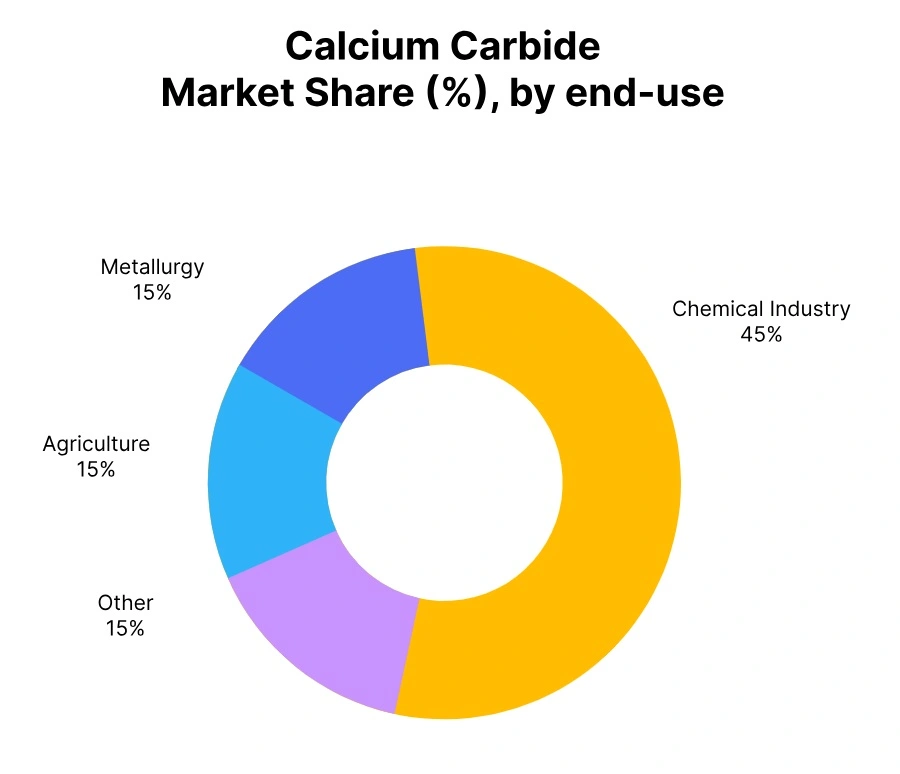
Calcium Carbide Market Share End use

Historically, several events have caused significant fluctuations in Calcium Carbide prices

  • Russia-Ukraine Conflict (2022): In 2022, the Russia-Ukraine conflict escalated rapidly, leading to widespread violence and international condemnation. Russia’s invasion resulted in substantial military and civilian casualties. Numerous cities were heavily damaged, and millions of people were displaced. The war disrupted global supply chains, impacting essential commodities.

In Ukraine, the need for calcium carbide, widely used in industrial and agricultural applications, increased for urgent infrastructure repairs and protecting crops. However, ongoing fighting hindered the production and distribution of such materials. Additionally, sanctions on Russia further limited access to industrial chemicals. The conflict remained a major geopolitical crisis throughout the year, with lasting consequences for both countries and the global economy.

  • Texas Winter Storm (2021): In February 2021, the Texas winter storm caused widespread power outages and severe disruptions. The freezing temperatures led to frozen pipes and damaged infrastructure. Calcium carbide was used extensively to generate acetylene gas for heating and welding repairs in emergency situations. Its role was crucial in restoring essential services and repairing broken water lines. However, supply shortages and transportation delays made accessing calcium carbide difficult during the crisis. The storm highlighted the importance of such industrial chemicals in disaster response and recovery efforts.
  • COVID-19 Pandemic (2020):   During the COVID-19 pandemic in 2020, calcium carbide played a role in disinfectant production and industrial applications. Its use in generating acetylene gas supported the manufacturing of medical equipment and infrastructure repairs amid lockdowns. Demand for calcium carbide increased as industries adapted to new safety protocols and urgent maintenance needs. However, supply chain disruptions caused delays in its availability. Despite challenges, calcium carbide remained important for supporting essential services and industrial processes during the global health crisis
  • Geopolitical Tensions (2018-2019): Between 2018 and 2019, rising geopolitical tensions affected global trade and industrial supply chains. Calcium carbide, essential for various manufacturing and agricultural processes, experienced fluctuating demand due to trade restrictions and tariffs. Some countries faced challenges in sourcing this chemical, which impacted production schedules and maintenance activities. Despite these difficulties, industries adapted by finding alternative suppliers or adjusting operations. The period highlighted how geopolitical conflicts could disrupt the availability and distribution of critical industrial materials like calcium carbide.
  • Shale Gas Boom (2010s): During the 2010s shale gas boom, calcium carbide was widely used in industrial processes supporting drilling and pipeline maintenance. Its demand increased as energy production expanded rapidly. Companies relied on calcium carbide for equipment repairs and safety measures. The boom highlighted calcium carbide’s importance in the growing energy sector.
  • Global Financial Crisis (2008-2009): During the 2008-2009 Global Financial Crisis, demand for calcium carbide declined due to slowed industrial production worldwide. Many manufacturers reduced operations, leading to lower consumption of this chemical. Supply chains were disrupted, and companies faced financial challenges. Despite this, calcium carbide remained vital for essential industrial and agricultural processes.
  • Hurricane Katrina (2005): After Hurricane Katrina in 2005, calcium carbide was used in emergency repairs and infrastructure restoration, especially for welding and cutting metal debris. Its supply was critical for rebuilding efforts in affected areas. However, transportation difficulties delayed delivery, highlighting the challenges of accessing industrial chemicals during natural disasters.

These events underscore the Calcium Carbide market’s vulnerability to global disruptions and highlight the need for continuous monitoring of supply-demand dynamics.

Why Price Watch™?

Price Watch™ is your trusted resource for tracking global calcium carbide price trends. Our platform delivers real-time data and expert analysis, offering deep insights into the key factors driving price fluctuations in the calcium carbide market. By monitoring critical events such as geopolitical tensions, supply chain disruptions, and economic shifts, Price Watch™ keeps you fully informed of market dynamics.

In addition, Price Watch™ provides detailed forecasts and updates on production capacities, enabling you to anticipate market changes and make well-informed decisions. With Price Watch™, you gain a competitive edge in understanding all the elements that influence calcium carbide prices worldwide. Stay ahead of the curve with Price Watch’s™ reliable, accurate, and timely calcium carbide market data.

Track Price Watch's™ calcium carbide price assessment on a weekly basis since 2015 onwards, along with short-term forecasts, and get access to the detailed report in a downloadable format.

Calcium Carbide Market Price Trend published by Price Watch™ reflect prevailing spot market conditions, derived from independent research, verified trade inputs, and proprietary market intelligence as of the publication date. Prices are published on the specified Incoterm and represent indicative base market levels, exclusive of applicable taxes, VAT, duties, tariffs, and other statutory charges. Actual transaction values may vary depending on volume, credit terms, contractual structure, and other negotiated conditions. Market prices are inherently subject to volatility, liquidity dynamics, regulatory changes, and evolving trade activity. The information provided is for reference and benchmarking purposes only and does not constitute an offer, recommendation, or guarantee of transactional outcomes. Users should exercise independent commercial judgment and assess their specific contractual, regulatory, tax, and application requirements before making business decisions. Price Watch™ assumes no liability for decisions taken based on this information.

Calcium carbide prices in the global market are influenced by several key factors. The cost of raw materials, mainly lime (calcium oxide) and coke (carbon), plays a significant role in production expenses. Because manufacturing is energy-intensive, changes in electricity prices also impact costs. Supply and demand fluctuations, driven by industries like steel, agriculture, and chemicals, affect pricing as well.

Environmental regulations can raise production costs by requiring cleaner technologies. Trade policies, such as tariffs and export restrictions, disrupt supply chains and influence prices. Technological improvements can lower costs, while currency exchange rates affect international trade prices, making calcium carbide pricing complex and variable.

Changes in global supply and demand significantly impact calcium carbide pricing trends. When demand from key industries like steel manufacturing, agriculture, and chemical production rises, calcium carbide prices tend to increase due to higher consumption. Conversely, a drop in demand leads to price declines. On the supply side, disruptions caused by raw material shortages, energy price hikes, or geopolitical tensions can reduce availability, pushing prices up.

Conversely, increased production capacity or improved technology can boost supply, easing prices. Thus, the balance between supply and demand directly influences calcium carbide’s market price, causing fluctuations based on economic conditions and industry needs worldwide.

Key regional differences in calcium carbide pricing arise from variations in raw material availability, energy costs, labor expenses, and environmental regulations. For example, regions with abundant lime and cheap electricity, such as China and India, often have lower production costs, resulting in more competitive prices. In contrast, areas with higher energy prices or stricter environmental laws may face higher costs.

These regional disparities affect procurement strategies, as companies often source calcium carbide from cost-effective regions to minimize expenses. However, logistics, trade tariffs, and supply reliability also influence decisions, leading buyers to balance price, quality, and delivery when planning procurement globally.

Calcium Carbide is a grayish-black chemical compound widely used as a key building block in industrial chemistry for producing acetylene gas, PVC, synthetic rubber, and various chemical intermediates. Its price directly impacts the cost of downstream products ranging from welding and cutting gases to fertilizers, plastics, and chemical intermediates used in agrochemicals and pharmaceuticals, making Calcium Carbide pricing a critical factor for manufacturers across multiple industries worldwide. Price-Watch™ tracks these prices to help businesses and consumers understand and stay updated with market trends.

Calcium Carbide prices vary by region. Prices are typically quoted per metric ton and change based on supply, demand, feedstock costs, and energy prices. Price-Watch™ provides real-time price assessments across different global markets to help buyers and sellers make informed decisions.

Calcium Carbide prices fluctuate due to changes in feedstock and production costs, primarily electricity, lime, and coke, which are essential for its manufacture. Energy price movements, production capacity utilization, and demand from key consuming industries such as acetylene production, PVC, synthetic rubber, and fertilizer manufacturing play a major role in pricing. Co-product and downstream chemical market dynamics, such as vinyl compounds and calcium cyanamide, can also influence price trends.

The largest buyers of Calcium Carbide are acetylene manufacturers, which use it as the primary raw material for producing acetylene gas for welding, cutting, and chemical synthesis. Following this, PVC and synthetic rubber producers account for significant demand, relying on acetylene-derived intermediates. Other major consumers include the fertilizer industry, which uses Calcium Carbide to produce calcium cyanamide, and steel manufacturers, who employ it as a desulfurizing agent. Additional demand comes from agrochemical, pharmaceutical, and specialty chemical producers that utilize Calcium Carbide derivatives in their processes, as well as industries involved in chemical intermediates for plastics, adhesives, and resins. Price-Watch™ analyses demand patterns across all these industries.

Calcium Carbide is primarily manufactured by heating a mixture of lime (CaO) and carbon (coke) in an electric arc furnace at high temperatures, typically above 2000 °C. The reaction produces Calcium Carbide (CaC₂), which is then cooled, crushed, and graded for industrial use. Major production takes place in integrated chemical and metallurgical plants, often located in countries with abundant electricity and raw materials such as China, India, and parts of Europe. Some producers also operate smaller specialized plants to supply niche industrial needs. The global supply is concentrated among a few large manufacturers, making Calcium Carbide markets sensitive to energy costs, plant capacity, and regional production dynamics.

Calcium Carbide trade is influenced by production capacity, regional demand, and energy availability. China is the world’s largest exporter, supplying significant volumes to Asia, Europe, and the Americas due to its large-scale production and relatively low electricity costs. Price-Watch™ tracks production levels, export flows and trade patterns to help businesses understand global supply chains and identify sourcing opportunities.

Global supply of Calcium Carbide generally meets overall demand, but regional shortages can occur due to plant shutdowns, electricity or raw material constraints, transportation bottlenecks, or sudden spikes in industrial activity. Maintenance turnarounds at major carbide production plants can temporarily tighten local markets, leading to price fluctuations.In addition, imbalances between production capacity and downstream acetylene, PVC, or fertilizer demand can create short-term supply pressures.

While the global market remains relatively stable, localized disruptions or energy cost spikes can impact availability and pricing in key industrial regions. Price-Watch™ monitors these supply-demand imbalances to alert the market about potential shortages or surpluses.

Calcium Carbide prices vary by grade, purity, and intended application. Industrial grade is the most common and is used for acetylene production, PVC intermediates, fertilizers, and steel desulfurization. Higher-purity grades, used in chemical synthesis, pharmaceutical intermediates, or specialty chemical applications, command premium prices due to stricter specifications, lower impurity levels, and certified quality control. Price-Watch™ provides separate price assessments for each grade to ensure market transparency.

When demand for Calcium Carbide rises sharply often due to increased activity in acetylene production, PVC, synthetic rubber, or fertilizer industries prices typically increase. Suppliers may prioritize long-term contract customers, while spot buyers face tighter availability, longer lead times, and premium pricing to secure supplies. Price-Watch™ captures these market dynamics in real-time.

Energy is a major cost component in Calcium Carbide production, as manufacturing requires extremely high temperatures in electric arc furnaces. When electricity, coal, or other energy costs rise, producers typically pass these costs on to buyers, making Calcium Carbide more expensive.

Feedstock costs, particularly lime and coke, are also influenced by regional energy prices and raw material availability. This is why Calcium Carbide prices in regions with cheaper electricity and abundant raw materials tend to be lower. Price-Watch™ analyses in its price assessments & market reports.

Regional price differences for Calcium Carbide are primarily influenced by the availability and cost of raw materials like lime (calcium oxide) and coke, regional electricity costs (since production is highly energy-intensive), local production capacity, and transportation infrastructure.

Areas close to production facilities or with abundant raw materials and low electricity costs generally have lower prices. In contrast, regions that rely on imports, have higher energy costs, or face logistical challenges typically experience higher prices. Price-Watch™ tracks prices across all major regions to highlight these differences.

The Calcium Carbide price outlook is influenced by electricity cost trends, availability and pricing of lime and coke, expansions or shutdowns of production plants, and the balance between regional supply and industrial demand, especially from acetylene, chemical intermediates, and steel industries. Seasonal demand fluctuations, infrastructure developments, import/export regulations, and broader macro-industrial growth indicators also play a key role. Regions with new capacity, efficient production, or strong local demand may see price stabilization or moderate increases, whereas energy-constrained or import-dependent regions could experience higher price volatility.

Price-Watch™ regularly publishes detailed forecasts that project price movements for the next 12 months based on comprehensive analysis of supply additions, demand growth in key industries, seasonal patterns, and macroeconomic indicators. Our forecasts help businesses anticipate market conditions and plan accordingly.

Absolutely. Accurate forecasting allows you to time your purchases better, negotiate contracts more effectively, and budget more accurately. If Price-Watch™ forecasts predict a price increase in three months, you might choose to stock up now or lock in long-term contracts at current rates, potentially saving thousands of dollars.

Global events can significantly affect Calcium Carbide supply and pricing because production is energy-intensive and relies on consistent access to lime, coke, and electricity. Natural disasters (like floods, storms, or earthquakes) can damage plants or disrupt logistics, while geopolitical tensions, trade restrictions, or export bans may limit cross-border supply. Industrial accidents or prolonged power outages at key production facilities can create sudden shortages. Additionally, economic slowdowns affecting steel, acetylene, and chemical industries can reduce demand, while rapid industrial growth or infrastructure projects in certain regions can trigger price spikes. Price-Watch™ provides timely alerts when such events affect the market.

Price-Watch™ collects data from manufacturers, distributors, and buyers worldwide to publish regular price assessments, market reports, and forecasts. Our transparent methodology and comprehensive coverage make us a trusted source for understanding fair pricing and market trends in the Calcium Carbide industry.