Calcium Formate Price Trend and Forecast

UNSPC code: 12352200
|
Weekly Update
|
Historical Data Since 2015
|
Forecast for 2026

calcium formate Price Trends by Country

cnChina
inIndia
idIndonesia
brBrazil
phPhilippines
trTurkey
vnVietnam
arArgentina
usUnited States

Global calcium formate Spot Market Prices, Trend Analysis and Forecast

𝐏𝐫𝐢𝐜𝐞 𝐖𝐚𝐭𝐜𝐡™ provides price assessments for Calcium Formate across top trading regions:

Asia-Pacific

  • Calcium Formate Industrial Grade (≥ 98% purity) FOB Shanghai, China
  • Calcium Formate Industrial Grade (≥ 98% purity) CIF JNPT(China), India
  • Calcium Formate Industrial Grade (≥ 98% purity) CIF JNPT(China), India
  • Calcium Formate Industrial Grade (≥ 98% purity) CIF Jakarta (China), Indonesia
  • Calcium Formate Industrial Grade (≥ 98% purity) CIF Manila (China), Philippines
  • Calcium Formate Industrial Grade (≥ 98% purity) CIF Haiphong (China), Vietnam


North America

  • Calcium Formate Industrial Grade (≥ 98% purity) CIF Houston (China), USA


Europe

  • Calcium Formate Industrial Grade (≥ 98% purity) CIF Mersin (China), Turkey


South America

  • Calcium Formate Industrial Grade (≥ 98% purity) CIF Santos (China), Brazil
  • Calcium Formate Industrial Grade (≥ 98% purity) CIF Buenos Aires (China), Argentina


Note:
In assessments structured as CIF [Importing Port] (Exporting Country), the country mentioned in brackets indicates the primary origin of supply (exporting country), while the named port refers to the destination port in the importing country. Other Incoterms (FOB, FD, EXW, etc.) should be interpreted in accordance with standard international trade definitions.

Calcium Formate Price Trend Q4 2025

In Q4 2025, the average price of Calcium Formate on the global market went up. This was because regional market conditions were mostly stable but a little bit firm. Balanced supply and demand, steady production rates, and controlled inventory levels in key markets all helped the overall trend. The upward trend was helped by small changes in the prices of raw materials and energy, as well as steady demand from the construction and feed additive sectors. Trade flow patterns and the usual slowdowns at the end of the year in some areas kept prices from rising too quickly. Instead, they rose slowly but steadily, with differences between regions affecting the overall market trend.

Calcium Formate prices increased in December 2025 due to year-end inventory restocking and steady demand from the construction and feed additive sectors.

China: Calcium Formate Export prices FOB Shanghai, China, Grade- Industrial Grade (≥ 98% purity

In Q4 2025, the price of Calcium Formate in China witnessed an upward trend. The rise was caused by strong domestic demand from the construction and feed additive industries, stable production rates, and manageable inventory levels. There were also small changes in the costs of raw materials. The small range showed that the market was stable but controlled. The price trend for Calcium Formate in China shows that supply and demand are balanced, with demand slowly pushing prices up. Downstream support made the path stronger. Prices stayed the same in December, this was mostly because producers were making changes to their year-end inventories, bulk purchases were finished before the holidays, and Shanghai’s market was kept in balance by steady operating rates. In December 2025, Calcium Formate prices increased by 1% due to slight increases in feedstock and energy costs provided upward pressure, keeping the market balanced yet firm.

India: Calcium Formate Imported prices CIF JNPT(China), India, Grade- Industrial Grade (≥ 98% purity)

Calcium Formate price in India showed a small downward trend in Q4 2025. The drop was mostly caused by enough supply in China, stable raw material costs, and moderate demand from the construction and feed sectors, which kept the overall market in balance. The narrow range showed that the market was stable and not very volatile. The Calcium Formate price trend in India shows that demand is stable and transportation costs are going down, which puts mild downward pressure on prices. Consistent patterns of buying also supported the trend that was already in place. In December 2026, the price of Calcium Formate in India remained mostly stable, with a slight increase of 1%, driven by year-end inventory restocking, stable logistics conditions, and steady downstream consumption. These factors helped maintain market balance towards the end of the month.

Brazil: Calcium Formate Imported prices CIF Santos (China), Brazil, Grade-Industrial Grade (≥ 98% purity)

Calcium Formate prices, as of Q4 2025, have been declining for CIF Santos prices in Brazil. Stable imports, lower shipping costs, and demand from construction and feed have kept the market balanced. This situation has led to stable price fluctuations in consistent trading conditions. Ongoing supply dynamics continue to push the Calcium Formate price trend in Brazil downward in Brazil. Active procurement has also maintained this trend. In December 2025, Calcium Formate prices in Brazil declined by 5% as lower freight costs and reduced export offers eased market pressures, resulting in a softer pricing environment.

Indonesia: Calcium Formate Imported prices CIF Jakarta (China), Indonesia, Grade-Industrial Grade (≥ 98% purity)

Calcium Formate price trend in Indonesia exhibited an upward trend in Q4 2025. Firm export price trends from China and consistent import demand from the feed and construction industries, which bolstered market sentiment, were the main drivers of the increase. In the midst of active trading conditions, the wide range showed mild changes. The Indonesian Calcium Formate price pattern is indicative of growing upward pressure from upstream cost factors. The upward trend was also supported by steady procurement activity. Short-term price stability was maintained by procurement cycle completions, stable shipping conditions, and balanced downstream consumption, all of which helped to stabilize the market in the final stages. In December 2025, Calcium Formate price increased by 1% as year‑end restocking and continued strong demand supported upward pressure, resulting in a modest increase.

Philippines: Calcium Formate Imported prices CIF Manila (China), Philippines, Grade-Industrial Grade (≥ 98% purity)

Calcium Formate price in Philippines exhibited an upward trend in Q4 2025. Firm export pricing trends from China and consistent import demand from the construction and feed industries, which supported general market sentiment, were the main drivers of the increase. In the midst of active trading conditions, the wide range showed mild changes. The Philippines’ Calcium Formate price trend is a reflection of rising upstream cost constraints. The upward trend was also supported by steady procurement activity. Procurement cycle completions, solid shipping circumstances, and balanced downstream consumption all helped to keep prices steady in the near term and stabilize the market as it closed. In December 2025, the price of Calcium Formate in Philippines remained stable, as slightly lower freight costs and reduced export offers alleviated market pressure.

Turkey: Calcium Formate Imported prices CIF Mersin (China), Turkey, Grade-Industrial Grade (≥ 98% purity)

In Q4 2025, Calcium Formate prices in Turkey exhibited a stable price trend. Rising export price trends from China, which were counterbalanced by falling freight costs and consistent import demand from the feed and construction industries, were the main factors supporting the market balance. The wide range suggested balanced trading conditions with controlled swings. The price trend of Calcium Formate in Turkey is indicative of conflicting market dynamics that uphold general stability. The steady trajectory was also supported by consistent buying practices. In December 2025, the price of Calcium Formate in Turkey increased by 5%, driven by higher freight costs and strong import offers from China.

Vietnam: Calcium Formate Imported prices CIF Haiphong (China), Vietnam, Grade-Industrial Grade (≥ 98% purity)

In Q4 2025, Calcium Formate price in Vietnam showed an upward price trend. Rising export pricing trends from China and consistent import demand from the feed and construction industries, which bolstered market optimism, were the main causes of the increase. In the midst of active trading conditions, the wide range showed mild changes. Calcium Formate price trend in Vietnam is a result of increasing upstream cost pressures. The upward trend was also supported by steady procurement activity. In December 2025, the price of Calcium Formate in Vietnam increased by 1%, supported by year-end restocking and slightly higher import offers from China.

Argentina: Calcium Formate Imported prices CIF Haiphong (China), Vietnam, Grade-Industrial Grade (≥ 98% purity)

In Q4 2025, Calcium Formate price trend in Argentina exhibited a downward price trend. While balanced demand from the construction and feed industries preserved overall market stability, the reduction was mainly caused by lower freight costs and consistent import availability, which negated the impact of rising export price trends from China. The wide range suggested stable trade conditions with controlled swings. Calcium Formate price in Argentina is indicative of mixed market dynamics, with downward pressure from logistical easing. The current trajectory was further supported by consistent procurement activity. In December 2025, the price of Calcium Formate in Argentina decreased by approximately 4%, as lower freight costs and sufficient inventory levels eased market pressure.

USA: Calcium Formate Imported prices CIF Houston (China), USA, Grade-Industrial Grade (≥ 98% purity)

In Q4 2025, Calcium Formate price in USA showed a downward price trend. While balanced demand from the construction and feed industries preserved overall market equilibrium, the reduction was mostly caused by lower freight costs and consistent import availability, which counteracted the effects of growing export price trends from China. The wide range suggested stable trade conditions with controlled swings. Calcium Formate price trend in the United States is indicative of mixed market dynamics, with downward pressure coming from logistical easing. The current trajectory was further supported by consistent procurement activity. In December 2025, the price of Calcium Formate in the USA fell by 4%, as sufficient inventories and lower freight costs alleviated market pressure.

Calcium Formate Price Trend Analysis: Q4 2025

The global Calcium Formate market saw an indication of decline in Q3 2025, with prices declining around 8–12%. Calcium Formate price decline was attributed largely to weaker demand from major end-use sectors such as construction, dry-mixed mortars, and animal feed, as well as favorable supply conditions from key producing regions such as China.

While production levels remained unchanged, high inventory levels in several markets and a lack of urgency in purchasing distributors and end-users put further downward pressure on pricing. A slow recovery in downstream consumption and a balanced supply-demand environment should help stabilize the market in the coming months.

China: Calcium Formate Export prices FOB Shanghai, China, Grade- Industrial Grade (98% min purity).

According to Price-Watch, in Q3 2025, Calcium Formate FOB prices in China were on a clear downward trajectory, with pricing in the month of September 2025 sitting between USD 400-500/MT. Calcium Formate price trend across the quarter was driven by healthy production levels occurring in major manufacturing regions in China, alongside subdued demand from downstream customer sectors like construction, dry-mixed mortars, and animal feed.

Despite slight shifts in feedstock costs for formic acid and lime, this had a minimal impact on pricing, as significant inventory levels in key markets dampened sentiment. Overall, pricing for Calcium Formate in China followed this trend, with prudent buying from domestic and international buying participants contributing to price reductions. A stable feedstock conditions combined with moderate linear demand recovery downstream supports some mild stabilization of Calcium Formate pricing in China entering Q4.

India: Calcium Formate import prices CIF JNPT, India, Grade- Industrial Grade (98% min purity).

According to Price-Watch, in the third quarter of 2025, India’s market for Calcium Formate CIF imports exhibited soft market patterns, largely driven by the overall decline in Calcium Formate prices originating from China. The decline in Calcium Formate price trend was attributed to ongoing production at major Chinese production hubs and weaker demand from downstream sectors, namely construction, dry-mixed mortars, and animal feeds.

Trading range prices for Calcium Formate CIF imports were USD 470–550/MT in September 2025, and freight movements and available inventories had some moderate upward effects on price moderation. Overall, it was clear that caution underpinned the Calcium Formate price trend across India on account of cautious buying and sufficient levels of availability, with continued steady supply from China and balanced downstream demand expected to bring mild stability over the next couple of months.

Brazil: Calcium Formate import prices CIF Santos, Brazil, Grade- Industrial Grade (98% min purity).

Calcium Formate CIF imports into Brazil showed soft market sentiment in Q3 2025, due to the falling FOB price trend from China. Calcium Formate price movement was impacted by steady production levels from major Chinese production hubs along with weaker offtake from end-use markets, including construction, dry-mixed mortars, and animal feed.

Import price levels for Calcium Formate ranged from USD 550–650/MT in September 2025, with freight, inventory, and shipping schedules impacting the overall price moderation. Domestic market levels in Brazil followed suit with soft conditions as demand remained muted and distributors were staying well stocked.

Indonesia: Calcium Formate import prices CIF Jakarta, Indonesia, Grade- Industrial Grade (98% min purity).

In the third quarter of 2025, the Calcium Formate CIF import price for Indonesia witnessed a softer set of market circumstances, which was largely driven by the overall downward trends in CIF price originating from China.

Calcium Formate price trend back toward China were influenced by steady production in the prominent Chinese manufacturing regions alongside lagging demand coming from construction, dry-mixed mortars, and animal feed markets.

CIF import price ranges for Calcium Formate as of September 2025 were in the range of USD 450–550/MT, with freight rates, inventory levels, and shipping times coinciding with moderate price rounding. Domestic market conditions in Indonesia were similar in their softness, with buyers cautious of purchasing products, and distributors featuring sustainable inventories.

Philippines: Calcium Formate import prices CIF Manila, Philippines, Grade- Industrial Grade (98% min purity).

In Q3 2025, imports of Calcium Formate on a CIF basis to the Philippines were indicative of a soft market by there being a lack of price support from the declining FOB price trend stemming from China. Calcium Formate price trend was driven by the steady production from numerous Chinese manufacturing facilities and recessed demand from key areas such as Construction, Dry-Mixed Mortars, and Animal Feeds.

CIF import price of Calcium Foramte levels in September 2025 ranged between USD 450-550/MT with upward price moderation being contributed by elevated ocean freight, inventory levels, and moderate shipping schedules. In the domestic market, similar levels of price softness can be seen with buyers remaining underwhelmed and distributors holding reasonable inventories.

Turkey: Calcium Formate import prices CIF Mersin, Turkey, Grade- Industrial Grade (98% min purity).

During the third quarter of 2025, the Turkish market for imports of Calcium Formate CIF continued to show signs of a soft market, buoyed largely by the lower FOB price trend from China. Calcium Formate price trend was driven by consistent production from Chinese production hubs and reduced demand from various downstream sectors such as construction, dry-mixed mortars, and animal feed.

Calcium Formate import prices in September 2025 ranged from USD 500–650/MT, with freight costs, inventory levels, and calendar queues all contributing to moderate price softening. Even the domestic market in Turkey mirrored this softness, as buyers were cautious and distributors held ample stocks.

Vietnam: Calcium Formate import prices CIF Haiphong, Vietnam, Grade- Industrial Grade (98% min purity).

In the third quarter of 2025, Vietnam’s Calcium Formate CIF imports demonstrated a weak market outlook, which was a result of the softening FOB price trend from China. The Calcium Formate price trend was influenced by strong production at several large production centers in China and weak downstream demand in construction, dry-mixed mortars, and animal feed.

In September 2025, the import prices of Calcium Formate were in the range of USD 450–550/MT, with transportation, inventory level, and shipment having a moderating influence. The domestic market in Vietnam also demonstrated similar weakness as buyers remained cautious and distributors were generally well stocked.

Argentina: Calcium Formate import prices CIF Buenos Aires, Argentina, Grade- Industrial Grade (98% min purity).

Imports of Calcium Formate CIF into Argentina in Q3 2025 showed evidence of a weak market sentiment primarily due to lowering FOB price trends from China. Calcium Formate price trend was dictated by steady production from major Chinese manufacturers as well as softer demand from downstream sectors such as construction, dry-mixed mortars, and animal feed.

Pricing for Calcium Formate imports in Argentina was at USD 550-650/MT in September 2025, and freight charges, as well as inventory levels and scheduling for shipments, were contributing factors for the moderation of prices. Domestic market conditions in Argentina exhibited a similar softness as buyers held back and distributors had adequate stocks.

USA: Calcium Formate import prices CIF Houston, USA, Grade- Industrial Grade (98% min purity).

The USA’s Calcium Formate CIF imports saw weaker market conditions in Q3 2025, driven primarily by the lower FOB price trend from China. Calcium Formate price trend in China was driven by steady production levels in many of the key manufacturing regions and the continued softening of downstream demand from the construction sector, dry-mixed mortars, and the animal feed industry.

Import prices for Calcium Formate averaged USD 550-650 per MT during the month of September 2025, with freight, stock levels, and shipping schedules contributing to steady price moderation. Similar market conditions were seen domestically in the USA, as consumers remained cautious while distributors had significant stocks.

According to the PriceWatch, In Q2 2025, Calcium Formate prices in the Chinese domestic market edged up by 1.53%, reaching USD 464 per metric ton. The moderate increase was supported by consistent demand from key downstream sectors such as construction and animal nutrition, which saw steady offtake during the quarter. Export activity remained stable, with shipments to Southeast Asia and Europe maintaining momentum.

Additionally, feedstock formic acid prices showed a slight firming trend, adding cost support for producers. While overall supply conditions were balanced, sellers adjusted offers upward amid steady transactional volumes and gradual recovery in construction-related demand. The Chinese market maintained a stable outlook during Q2, with limited volatility and modest price strengthening influenced by both domestic consumption and export market stability. 

According to the PriceWatch, In Q2 2025, Calcium Formate prices in India for Chinese-origin material declined by 2.80%, settling at USD 521 per metric ton. The price drop reflected lower export offers from China, which were influenced by a wellsupplied market and slight softening in overall procurement momentum.

Indian buyers remained cautious in their purchasing strategies, with limited bulk orders from industries such as cement additives and feed preservatives. Market participants focused on need-based buying, driven by subdued demand and comfortable inventory positions across major ports.

Additionally, stable freight rates ensured consistent import costs without any major logistical constraints. Competitive pricing from multiple Chinese exporters also contributed to a slight reduction in overall import values. The Indian market sentiment during Q2 remained soft, shaped by ample availability and restrained downstream consumption. 

The downward trend persisted into Q1 2025, with prices decreasing by 3.66% to USD 448/MT. The market remained under pressure due to subdued post-holiday demand and a sluggish construction sector. Extended factory closures during the Lunar New Year, along with limited activity in key downstream applications such as tile adhesives and cement additives, contributed to weak buying interest.

Despite a slight recovery in feedstock prices, ample product availability and aggressive pricing by smaller regional producers led to intensified competition, further dragging down market values. 

Prices dropped by 1.47% in Q1 2025, settling at USD 536/MT. The beginning of the year typically sees weaker demand, especially in the construction and feed sectors. High inventory levels in India, combined with continued overproduction from China, kept prices under pressure. While Chinese exporters continued offering attractive prices, Indian buyers were cautious due to soft demand, contributing to the continued decline in CIF prices. 

Calcium Formate Price Trend Analysis: Q4 2024

In Q4 2024, Calcium Formate prices declined by 2.72% and reached USD 465/MT. The drop was driven by seasonal demand reduction, with industrial and construction activity slowing down ahead of winter and year-end holidays. Lower energy and raw material costs also reduced production expenses, giving manufacturers room to cut prices.

Additionally, buyers remained hesitant to place large orders due to expectations of further price corrections and the preference to deplete existing inventories. Export orders, while steady, were insufficient to counterbalance weak domestic consumption, maintaining a bearish market tone. 

Prices saw a slight uptick of 0.37% in Q4 2024, reaching USD 544/MT. There was a minor recovery in demand as Indian importers began restocking in anticipation of the new year and a potential rebound in construction and industrial activity. However, the overall market remained cautious with slow growth. The competitive pricing from Chinese suppliers remained a key factor, but the price increase was limited, reflecting the ongoing oversupply conditions. 

Prices fell further by 3.63% in Q3 2024, reaching USD 478/MT. The market experienced continued bearishness amid persistently weak domestic demand, especially from the construction and concrete additive segments, which showed little sign of revival. High inventory levels among distributors and manufacturers kept procurement subdued.

Meanwhile, international demand remained tepid, with global buyers turning to lower-cost alternatives or sourcing from other countries offering competitive pricing. Although feedstock costs remained relatively unchanged, producers were compelled to lower prices to stimulate buying interest and reduce stockpiles. 

CIF prices dropped by 2.69%, reaching USD 542/MT in Q3 2024. The continued impact of the monsoon season on construction demand kept market conditions subdued. In addition, high inventory levels and a lack of significant buying interest from downstream sectors like cement and feed additives contributed to the price decline. Chinese suppliers, dealing with an oversupply situation, continued to offer low prices to maintain market share in India, reinforcing the downward pricing trend. 

Calcium Formate prices continued to decrease and reached USD 478/MT after 3.7% decline from Q1 to Q2 2024 due to a combination of factors. Persistent weak demand, primarily driven by the ongoing slowdown in the real estate sector, coupled with increased supply from expanded production capacity, contributed to lower prices. Intense competition among manufacturers, inventory management strategies, and potential geopolitical influences also played a role in the price decline. 

CIF prices decreased by 2.11%, settling at USD 557/MT during Q2 2024. The market continued to be affected by the monsoon season, which dampened construction activity. While animal feed demand showed some recovery, it was not enough to offset weaker demand from the construction and chemical sectors. The oversupply from Chinese manufacturers, coupled with high inventories in the Indian market, kept prices under pressure. Competitive pricing from China continued to weigh on the market. 

The price of Calcium Formate in China decreased by approximately 11.1% reaching USD 515/MT during the first quarter of 2024. There was an adequate supply of Calcium Formate available in the market, but overall demand was sluggish due to the impact of the real estate sector. Additionally, the Lunar New Year holiday in China typically results in a slowdown in economic activity, which contributed to reduced demand for industrial chemicals. 

In Q1 2024 prices saw a decline of 5.17%, reaching USD 569/MT. This was mainly due to a seasonal slowdown in construction and industrial activity, with reduced procurement activity during India’s financial year-end period. The subdued demand from the animal feed sector further pressured prices. Chinese manufacturers, facing excess stock, began offering aggressive pricing to clear inventory, adding to the downward pressure on CIF prices. 

Technical Specifications of Calcium Formate Price Trends

Product Description:

Calcium Formate is a white, crystalline salt with a strong affinity for moisture. This hygroscopic compound is commonly produced by reacting calcium hydroxide with formic acid. The combination of its hygroscopic nature and high-water solubility makes it suitable for a wide range of industrial applications.

Identifiers and Classification:

  • CAS No – 544-17-2
  • HS Code – 29151290
  • Molecular Formula – Ca(HCOO)2
  • Molecular Weight[g/mol] – 130.113


Calcium Formate Synonyms:

  • Calcium diformate
  • Formic acid calcium salt
  • Calcium methanoate
  • Calcium formiate
  • Formate of calcium


Calcium Formate Grades Specific Price Assessment:

  • Industrial Grade (98% min purity)


Calcium Formate Global Trade and Shipment Terms

  • Quotation Terms: 25-28 MT(Global), 10-15 MT(India)
  • Packaging Type: 25 kg Bags


Incoterms Referenced in Calcium Formate Price Reporting

Shipping Term  Location  Definition 
FOB Shanghai  Shanghai, China  Calcium Formate Export price from China 
CIF JNPT_China  Mumbai, India  Calcium formate import price in India from China 
CIF Santos_China  Santos, Brazil  Calcium formate import price in Brazil from China 
CIF Jakarta_China  Jakarta, Indonesia  Calcium formate import price in Indonesia from China 
CIF Manila_China  Manila, Philippines  Calcium formate import price in Philippines from China 
CIF Mersin_China  Mersin, Turkey  Calcium formate import price in Turkey from China 
CIF Haiphong_China  Haiphong, Vietnam  Calcium formate import price in Vietnam from China 
CIF Buenos Aires_China  Buenos Aires, Argentina  Calcium formate import price in Argentina from China 
CIF Houston_China  Houston, USA  Calcium formate import price in USA from China 

*Quotation Terms refers to the quantity range specified for the Calcium Formate being quoted or offered in a commercial transaction.

**Packaging Type refers to standard packaging size commonly used for Calcium Formate packing, ease of handling, transportation, and storage in industrial and commercial applications.


Key Calcium Formate Manufacturers

  • Lanxess
  • Perstorp 
  • Yuanwang Chemical 
  • Zibo Ruibao Chemical Co., Ltd. 
  • AOJIN Chemical 

Calcium Formate Industrial Applications

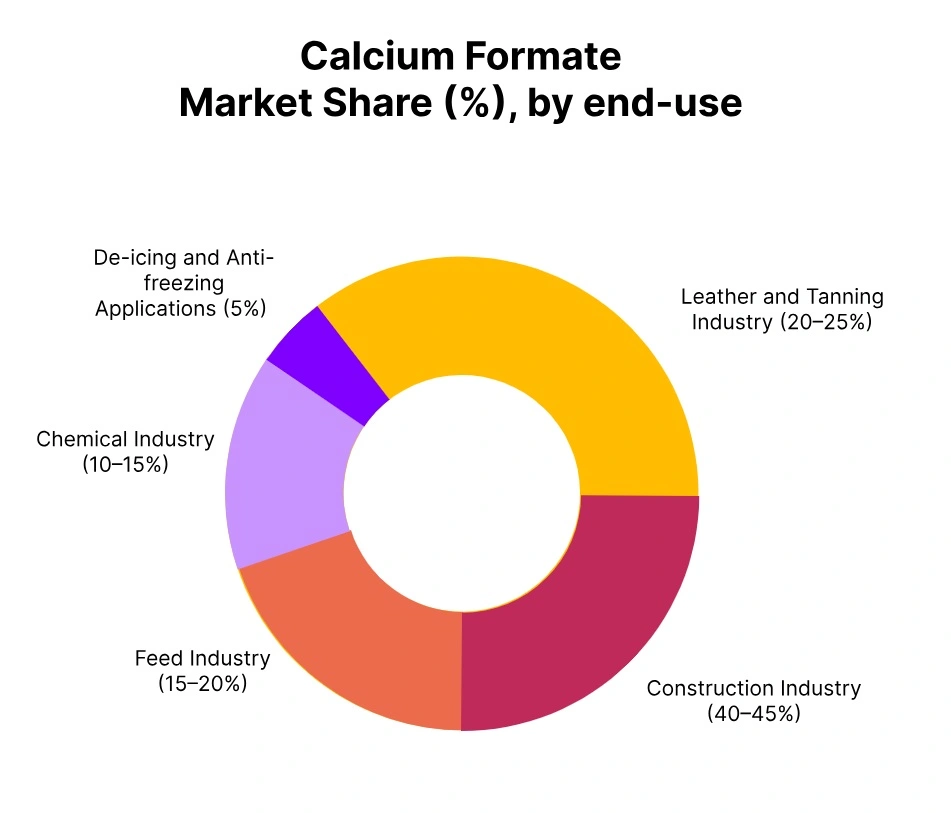
calcium formate market share end use

Historically, several events have caused significant fluctuations in Calcium Formate prices

  • 2023-2024: Economic Slowdown, Real Estate Market Weakness, and Lunar New Year: A renewed economic slowdown, weakness in the real estate market, and the impact of the Lunar New Year holiday on economic activity could have decreased demand for Calcium Formate, leading to lower prices.
  • 2021-2022: Supply Chain Disruptions, Rising Energy Costs, and Lunar New Year: Global supply chain disruptions, coupled with rising energy costs and the impact of the Lunar New Year holiday on economic activity, could have increased production costs for Calcium Formate and influenced demand, leading to price fluctuations. 
  • 2019-2020: COVID-19 Pandemic: The COVID-19 pandemic disrupted global supply chains and caused economic uncertainty, which could have impacted the demand for Calcium Formate and led to price fluctuations.   
  • 2017-2018: Increased Construction Activity: A period of increased construction activity, particularly in China and other emerging markets, could have driven up demand for Calcium Formate as a concrete additive, leading to higher prices.
  • 2015-2016: Global Economic Slowdown: A global economic slowdown, particularly in China, which is a major consumer of industrial chemicals, could have led to decreased demand for Calcium Formate, resulting in lower prices.  


These events underscore the Calcium Formate market’s vulnerability to global disruptions and highlight the need for continuous monitoring of supply-demand dynamics.

Why Price Watch™?

Price Watch™ is your trusted resource for tracking global calcium formate price trends. Our platform delivers real-time data and expert analysis, offering deep insights into the key factors driving price fluctuations in the calcium formate market. By monitoring critical events such as geopolitical tensions, supply chain disruptions, and economic shifts, Price Watch™ keeps you fully informed of market dynamics.

In addition, Price Watch™ provides detailed forecasts and updates on production capacities, enabling you to anticipate market changes and make well-informed decisions. With Price Watch™, you gain a competitive edge in understanding all the elements that influence calcium formate prices worldwide. Stay ahead of the curve with Price Watch’s™ reliable, accurate, and timely calcium formate market data.

Track Price Watch's™ calcium formate price assessment on a weekly basis since 2015 onwards, along with short-term forecasts, and get access to the detailed report in a downloadable format.

Calcium Formate Market Price Trend published by 𝐏𝐫𝐢𝐜𝐞 𝐖𝐚𝐭𝐜𝐡™ reflect prevailing spot market conditions, derived from independent research, verified trade inputs, and proprietary market intelligence as of the publication date. Prices are published on the specified Incoterm and represent indicative base market levels, exclusive of applicable taxes, VAT, duties, tariffs, and other statutory charges. Actual transaction values may vary depending on volume, credit terms, contractual structure, and other negotiated conditions. Market prices are inherently subject to volatility, liquidity dynamics, regulatory changes, and evolving trade activity. The information provided is for reference and benchmarking purposes only and does not constitute an offer, recommendation, or guarantee of transactional outcomes. Users should exercise independent commercial judgment and assess their specific contractual, regulatory, tax, and application requirements before making business decisions. 𝐏𝐫𝐢𝐜𝐞 𝐖𝐚𝐭𝐜𝐡™ assumes no liability for decisions taken based on this information.

Calcium Formate prices are influenced by several factors, including:

Raw material costs: The cost of formic acid and calcium carbonate, the primary raw materials used to produce Calcium Formate, significantly impacts pricing.

Energy costs: The cost of energy required for production can influence pricing.

Supply and demand: Fluctuations in supply and demand, driven by factors such as economic conditions, industry trends, and regulatory changes, can impact prices.

Geopolitical factors: Trade wars, sanctions, or disruptions in supply chains can affect pricing.

Environmental regulations: Changes in environmental regulations can impact production costs and pricing.

The availability of formic acid and calcium carbonate can significantly impact Calcium Formate prices. If there are shortages or disruptions in the supply of these raw materials, it can lead to higher production costs and, consequently, higher prices. Conversely, increased availability or lower prices for these raw materials can result in lower Calcium Formate prices.

The price outlook for Calcium Formate depends on various factors, including economic conditions, industry trends, and geopolitical events. While it’s difficult to predict with certainty, procurement heads can plan accordingly by:

Monitoring market trends: Keep track of global economic indicators, industry news, and regulatory changes that could impact Calcium Formate prices.

Diversifying suppliers: Having multiple suppliers can help mitigate the risk of price fluctuations and ensure a reliable supply.

Negotiating long-term contracts: Entering long-term contracts with suppliers can provide price stability and security of supply.

Exploring alternative sources: Consider alternative sources of Calcium Formate or substitute materials to reduce reliance on a single supplier or source.

Implementing cost-saving measures: Explore ways to optimize production processes and reduce waste to minimize costs.

The white, water-soluble inorganic salt of calcium and formic acid is called Calcium Formate (Ca (HCOO)₂). Animal feed as a preservative and acidity regulator, as well as the building industry for concrete, mortar, and dry-mix applications, are examples of downstream industries. Because Calcium Formate is frequently used as a setting and hardening accelerator in cement and concrete, particularly for low-temperature applications, its cost is a crucial consideration for producers in a variety of global businesses. 𝐏𝐫𝐢𝐜𝐞 𝐖𝐚𝐭𝐜𝐡™ tracks these prices to help businesses and consumers understand and stay updated with market trends.

Phenol prices vary by region. Prices are typically quoted per metric ton and change based on supply, demand, feedstock costs, and energy prices. 𝐏𝐫𝐢𝐜𝐞 𝐖𝐚𝐭𝐜𝐡™ provides real-time price assessments across different global markets to help buyers and sellers make informed decisions.

Prices for Calcium Formate vary because of shifts in the cost of feedstocks, especially calcium carbonate and formic acid, as well as fluctuations in the price of energy and crude oil, which affect total production costs. Utilization of production capacity and demand from important end-use sectors like animal feed and construction (for concrete additives) can influence market dynamics. Pricing patterns are also influenced by supply-demand balance, global capacity increases or plant shutdowns, and transportation and logistics expenses. Trade flows, import/export dynamics, and seasonal demand fluctuations particularly in building activities all have a big impact. The availability of feedstock, changing demand trends, and changing supply conditions in the main producing and consuming regions have all contributed to recent market outlooks.

The construction industry, which uses Calcium Formate extensively as a concrete accelerator and addition, and the animal feed business, which uses it as an acidifier and preservative, are the two biggest users of Calcium Formate. The textile processing, de-icing, and leather tanning industries provide additional demand. Chemical and specialist businesses also use it for specialized formulations. 𝐏𝐫𝐢𝐜𝐞 𝐖𝐚𝐭𝐜𝐡™ analyses demand patterns across all these industries.

The main method for producing Calcium Formate is to neutralize formic acid with calcium hydroxide or carbonate, producing Calcium Formate and water as a byproduct. It can also be created as a byproduct of the reaction that produces formate salts during the manufacture of pentaerythritol. Depending on the availability of feedstock and downstream demand, businesses in key regions usually conduct production in integrated plants and specialized chemical facilities.

Production capacity, regional demand balances, and feedstock availability specifically, formic acid and calcium-based raw materials are the main factors influencing the trade of Calcium Formate. Large-scale production helps China become the world’s top exporter, followed by major supply hubs in Europe like Germany and the Netherlands. Depending on domestic demand and surplus availability, other regions, such as Asia and portions of North America, also engage in international commerce. Regional capacity expansions or maintenance shutdowns, production economics, logistics and freight costs, and downstream demand from the construction and feed industries all affect export quantities. 𝐏𝐫𝐢𝐜𝐞 𝐖𝐚𝐭𝐜𝐡™ tracks production levels, export flows and trade patterns to help businesses understand global supply chains and identify sourcing opportunities.

Although regional shortages may arise from plant shutdowns, feedstock limitations (especially those related to the availability of formic acid), transportation bottlenecks, or abrupt increases in demand from the construction and feed sectors, supply usually corresponds with demand. Market availability may be momentarily tightened by maintenance turnarounds at pentaerythritol factories or production facilities. Pricing pressures may also result from changes in the economics of manufacturing and the supply of raw materials upstream. 𝐏𝐫𝐢𝐜𝐞 𝐖𝐚𝐭𝐜𝐡™ monitors these supply-demand imbalances to alert the market about potential shortages or surpluses.

Prices for Calcium Formate differ by grade according to application needs, particle size, and purity levels. While industrial grade Calcium Formate is used in building, leather processing, and other chemical applications, feed grade Calcium Formate is commonly employed in animal nutrition. Because of their improved performance qualities, lower impurity levels, and stricter quality requirements, higher-purity grades may fetch higher costs. Additionally, due to differences in handling, storage, and shipping needs, different physical forms, such as powder, granules, or prills, might affect cost. 𝐏𝐫𝐢𝐜𝐞 𝐖𝐚𝐭𝐜𝐡™ provides separate price assessments for each grade to ensure market transparency.

Prices usually rise when the demand for Calcium Formate increases rapidly, which is frequently caused by greater activity in the construction sector (concrete additives) or higher consumption in the animal feed business. While spot buyers may deal with limited availability, longer lead times, or higher prices to achieve quantities, suppliers may give preference to long-term contract clients. The availability of feedstock, especially formic acid, and overall plant running rates can limit production flexibility. .𝐏𝐫𝐢𝐜𝐞 𝐖𝐚𝐭𝐜𝐡™ captures these market dynamics in real-time.

A major expense in the manufacturing of Calcium Formate is energy. Prices for Calcium Formate often rise as a result of producers passing on rising natural gas, electricity, or steam costs to consumers. Upstream energy and chemical market developments also affect feedstock costs, especially for formic acid and calcium-based raw materials. Prices are therefore typically more competitive in areas with cheaper energy costs and easier access to raw materials. This is why prices in regions with cheaper energy and integrated petrochemical feedstocks tend to be lower, a correlation that 𝐏𝐫𝐢𝐜𝐞 𝐖𝐚𝐭𝐜𝐡™ analyses in its price assessments & market reports.

The availability and cost of feedstock, energy prices, transportation and logistics costs, import/export dynamics, the state of the acetone market, and the strength of regional derivative demand all affect Calcium Formate prices by region. Prices are often lower in areas with integrated petrochemical complexes and favorable feedstock economics than in areas with limited local production or greater logistical expenses. 𝐏𝐫𝐢𝐜𝐞 𝐖𝐚𝐭𝐜𝐡™ tracks prices across all major regions to highlight these differences.

The future for the Calcium Formate market is dependent on a number of factors, including energy prices, production capacity expansions and plant turnarounds, feedstock pricing trends (especially for formic acid and calcium-based raw materials), and demand growth in important consuming industries like construction and animal feed. Important factors include regional supply-demand balances, trade flows, seasonal activity in the building industry, and logistical expenses. The trajectory of the market is also shaped by broader macroeconomic data that impact manufacturing activity. 𝐏𝐫𝐢𝐜𝐞 𝐖𝐚𝐭𝐜𝐡™ regularly publishes detailed forecasts that project price movements for the next 12 months based on comprehensive analysis of supply additions, demand growth in key industries, seasonal patterns, and macroeconomic indicators. Our forecasts help businesses anticipate market conditions and plan accordingly.

Absolutely. Accurate forecasting allows you to time your purchases better, negotiate contracts more effectively, and budget more accurately. If 𝐏𝐫𝐢𝐜𝐞 𝐖𝐚𝐭𝐜𝐡™ forecasts predict a price increase in three months, you might choose to stock up now or lock in long-term contracts at current rates, potentially saving thousands of dollars.

Events that affect the production and logistics of Calcium Formate, such as natural catastrophes, trade disputes, manufacturing accidents, disruptions in the supply of feedstock, or economic downturns, can result in supply shortages and price volatility. Market dynamics can be greatly impacted by changes in construction or feed demand, transportation constraints, plant shutdowns or force majeure announcements at important manufacturing sites, and disruptions in the availability of formic acid. Market uncertainty has also been exacerbated by global disruptions like pandemics and trade crises that impact supply flows. 𝐏𝐫𝐢𝐜𝐞 𝐖𝐚𝐭𝐜𝐡™ provides timely alerts when such events affect the market.

𝐏𝐫𝐢𝐜𝐞 𝐖𝐚𝐭𝐜𝐡™ collects data from manufacturers, distributors, and buyers worldwide to publish regular price assessments, market reports, and forecasts. Our transparent methodology and comprehensive coverage make us a trusted source for understanding fair pricing and market trends in the Calcium Formate industry.