

Carbon Fibre Price Trend and Forecast

UNSPC code: 13111507
|
âźł Weekly Update
|
Historical Data Since 2015
|
Forecast for 2026
  • Commodity Pricing

carbon fibre Price Trends by Country

mxMexico
trTurkey
inIndia
krSouth Korea
myMalaysia

Global carbon fibre Spot Market Prices, Trend Analysis and Forecast

Price-Watch’s most active coverage of Carbon Fibre price assessment:

  • Industrial Grade Fibre Standard Modulus Tow (12K) FOB Busan, South Korea
  • Industrial Grade Fibre Standard Modulus Tow (12K) CIF Port Klang (South Korea), Malaysia
  • Industrial Grade Fibre Standard Modulus Tow (12K) CIF Nhavasheva (South Korea), India
  • Industrial Grade Fiber Standard Modulus Continuous Tow 50K (Epoxy-Compatible) FOB Manzanillo, Mexico
  • Industrial Grade Fiber Standard Modulus Continuous Tow 50K (Epoxy-Compatible) CIF Mersin (Mexico), Turkey
  • Industrial Grade Fiber Standard Modulus Continuous Tow 50K (Epoxy-Compatible) CIF Nhavasheva (Mexico), India

Carbon Fibre Price Trend Q3 2025

In Q3 2025, the global market for industrial-grade, standard modulus carbon fibre continuous tow has been experiencing a moderate correction across major regions. In Mexico, Carbon Fibre price trends have softened amid subdued activity in wind-energy and industrial composite sectors, while supply has remained stable. Turkey has seen a decline with easing prices reflecting slightly weaker demand in automotive and industrial applications.

In India, Carbon Fibre prices have been under pressure due to muted domestic demand and cautious liquidity management, though supply chains have remained steady. Overall, the market is navigating a consolidation phase, characterized by measured price adjustments, stable availability, and cautious inventory management, with short-term trends expected to remain balanced.

Mexico

Carbon Fibre Industrial Grade Fiber Standard Modulus Continuous Tow 50K (Epoxy-Compatible) FOB Manzanillo Grade Price Trend.

In Q3 2025, Carbon fibre continuous tow in Mexico has been declining, averaging around USD 14635/MT, down about 2.4% from the previous quarter. The drop has been driven by slower activity in wind-energy and industrial composite sectors, along with cautious buyer restocking. Supply has been stable, supported by steady production and capacity expansions, keeping availability adequate.

Carbon Fibre price trend continuous Tow 50K in Mexico have decreased by 4% in September 2025, while raw material and energy costs have remained stable, and international competition has been adding pressure on prices. Buyers have been deferring long-term orders amid uncertainty. Overall, the market has been in a consolidation phase, awaiting demand recovery in the coming months.

Tukey

Carbon Fibre Industrial Grade Fiber Standard Modulus Continuous Tow 50K (Epoxy-Compatible) CIF Mersin (Mexico) Grade Price Trend.

In Q3 2025, Turkey has been experiencing a 2% decline in CIF imports of carbon fibre continuous tow from Mexico compared to the previous quarter, reflecting a slight softening in demand from the automotive and industrial sectors. Carbon Fibre price trend continuous Tow 50K in Turkey have been falling by 4% in September 2025, easing procurement costs for buyers.

Supply has been remaining sufficient, ensuring stable market availability despite the reduction in import volumes. The market has been adjusting gradually as manufacturers have been managing inventories cautiously and moderating end-user consumption. Overall, the quarter has been showing a moderate market correction, with short-term stability expected to continue.

India

Carbon Fibre Industrial Grade Fiber Standard Modulus Continuous Tow 50K (Epoxy-Compatible) CIF Nhava Sheva (Mexico) Grade Price Trend.

In Q3 2025, India’s continuous‑tow carbon fibre market has been experiencing a quarter-on-quarter decline of around 2%, primarily due to subdued domestic demand and limited liquidity among downstream users. The 50K grade has been most impacted, with Carbon Fibre price trend falling by approximately 4% in September 2025 to the range of USD 14100–14200/MT, reflecting ongoing cost adjustments ahead of a potential demand rebound. Supply chain conditions have remained relatively stable, preventing any significant shortages despite the softening in prices.

Manufacturers have been exercising caution in managing inventories, responding to uncertainty in key end-use sectors such as automotive components and wind-turbine blade production. Overall, the market is undergoing a moderate correction, with short-term conditions expected to remain steady rather than volatile.

South Korea

Carbon Fibre Industrial Grade Fibre Standard Modulus Tow (12K) FOB Busan Grade Price Trend

In Q3 2025, South Korea’s carbon-fibre market has been experiencing a modest recovery, with prices for 12K grade material having been improving by around 4% quarter-on-quarter to reach about 20620 USD/MT. Demand has been strengthening from hydrogen-fuel tank manufacturing, EV lightweighting, and wind-energy components, helping stabilize overall sentiment after a subdued first half.

In September 2025, however, Carbon Fibre price trends have been slipping by roughly 2% compared with August, reflecting temporary softness in monthly procurement and cautious inventory management among downstream converters. Despite persistent competition from low-cost suppliers, stable aerospace and industrial applications have been supporting a gradual normalization of prices through the quarter.

Malaysia

Carbon Fibre Industrial Grade Fibre Standard Modulus Tow (12K) CIF Port Klang (South Korea) Grade Price Trend

According to Price-Watch, In Q3 2025, Malaysia’s imported prices for 12K grade carbon fibre have been showing a steady upward trend, having increased by around 4% quarter-on-quarter to reach about 20760 USD/MT (CIF Port Klang). Demand from industrial composites, pressure-vessel producers, and auto-component manufacturers has been remaining firm throughout the quarter, supporting the overall improvement.

However, in September 2025, Carbon Fibre price trends have been declining by around 2% from August, as buyers have been adjusting inventories and moderating their monthly procurement. Overall, Malaysia’s imported 12K market has been demonstrating greater stability, with demand and import activity continuing to strengthen over the quarter.
Carbon Fibre Price Trend Analysis: Q2 2025

According to PriceWatch, In Q2 2025, the carbon fibre continuous tow 50K (FOB Mexico) market has been exhibiting an upward trend, averaging around USD 14988 per MT, reflecting a 0.7% increase from the previous quarter. The price improvement has been supported by recovering demand from the wind energy and industrial composites sectors, as several delayed projects have been resuming and new orders have been picking up. Supply has been stable, but tighter availability in certain regions has been creating upward pressure on spot prices.

Stable precursor and energy costs have been helping maintain predictable production expenses, while global freight improvements have been facilitating smoother exports. Additionally, buyers have been returning to the market cautiously, balancing inventory levels with expected price gains. Overall, the market has been reflecting renewed confidence and gradual recovery, signalling a positive outlook for the second half of 2025.

According to PriceWatch, In Q2 2025, the carbon fibre continuous tow 50K CIF Nhava Sheva (Mexico) market has been witnessing a gradual upward trend, with prices inching higher from the previous quarter. The improvement has been driven by a modest recovery in domestic demand and stable supply conditions, as manufacturers and buyers have been cautiously restocking inventories.

Market activity has been supported by steady production in Mexico, while buyers have been balancing procurement amid cost considerations. Overall, the quarter has been reflecting a measured price recovery, with the market navigating a stable environment ahead of potential stronger demand in subsequent quarters. 

According to PriceWatch, In Q1 2025, Carbon fibre continuous tow 50K (FOB Mexico) market has been showing limited price movement, averaging around USD 14886 per MT, with a slight 0.2 % decline quarter-on-quarter. The market has been facing restrained buying activity as downstream manufacturers have been optimizing inventories and delaying fresh orders. Production in Mexico has been running at steady levels, maintaining supply without creating shortages. Stable costs for PAN precursor and energy have been helping producers manage expenses despite soft demand. International competition has been influencing pricing dynamics, keeping offers competitive. Overall, the market has been remaining subdued, reflecting a cautious industry sentiment while awaiting renewed project activity later in 2025. 

According to PriceWatch, In Q1 2025, the market for industrial-grade continuous tow carbon fibre 50K CIF Nhava Sheva (Mexico) has been showing a mild softening in prices, influenced not only by subdued domestic demand but also by freight and supply-chain factors. Rising ocean and air freight rates, coupled with logistical delays and higher cross-border transport costs from Mexico, have subtly impacted landed costs for buyers. While raw-material and production costs remained relatively stable, these freight-related pressures have encouraged cautious purchasing and limited aggressive restocking. As a result, the market has experienced a modest price decline, reflecting a combination of demand moderation and supply-chain considerations, with participants maintaining a measured approach while awaiting stronger demand in upcoming quarters. 

Carbon Fibre Price Trend Analysis: Q4 2024

According to PriceWatch, In Q4 2024, Carbon fibre continuous tow 50K (FOB Mexico) market has been witnessing a slight decline of around 1% from the previous quarter, averaging near USD 14923/MT. The slowdown has been driven by weaker export demand and cautious procurement from downstream composite manufacturers. Supply levels have remained stable, but excess inventory across major consuming regions has been putting downward pressure on prices. Additionally, rising logistics costs and moderate currency fluctuations have been influencing trade sentiment. Competition from Asian suppliers has been intensifying, further impacting market confidence. Overall, the market has been experiencing a mild correction phase, awaiting demand recovery in early 2025. 

According to PriceWatch, In Q4 2024, the market for industrial-grade continuous tow carbon fibre 50K CIF Nhava Sheva (Mexico) has been experiencing a modest decline, with prices dropping by around 1.7% from the previous quarter. The softening has been influenced by cautious buyer activity, as end-users balanced inventory levels ahead of the year-end and monitored fluctuations in raw-material and energy costs. Freight and logistics conditions also contributed, with seasonal shipping pressures and year-end port congestion subtly affecting landed costs.

Despite these factors, supply from Mexico has remained stable, ensuring adequate availability for the Indian market. Overall, the quarter reflected a controlled market adjustment, with buyers adopting a measured procurement approach amid moderate pricing pressures, setting the stage for potential stabilization in the following quarter.

According to PriceWatch, In Q3 2024, carbon fibre continuous tow 50K (FOB Mexico) prices have been showing a mild downward adjustment, averaging around USD 15067 per MT, down by 1.18 % from the previous quarter. The market has been under pressure from subdued demand in the wind energy and automotive composites sectors, where project activity has been slowing and procurement has been cautious. Producers in Mexico have been maintaining stable output levels, resulting in sufficient supply and limited upward momentum.

Meanwhile, steady PAN precursor and energy costs have been keeping overall production expenses manageable. International buyers have been negotiating for lower prices as competition from Asian suppliers has been intensifying. Freight rates have remained stable, supporting cost-efficient exports. Overall, the market has been exhibiting a phase of mild correction and consolidation, with sentiment expected to improve gradually as new projects resume toward the end of the year. 

According to PriceWatch, In Q3 2024, the market for industrial‑grade, standard‑modulus carbon‑fibre continuous tow 50K CIF Nhava Sheva (Mexico) has been experiencing a modest downward shift, with prices easing by about 0.5% compared to the prior quarter and settling around USD 15371/MT. The downward shift has been influenced by softer demand from end-users in the composites and renewable energy sectors, alongside cautious inventory management.

Freight and supply-chain considerations, including longer transit times and logistical planning, have also subtly impacted procurement decisions. Despite the price correction, supply from Mexican production has remained stable, ensuring adequate availability. The quarter reflects a measured market adjustment rather than a sharp downturn, with buyers adopting a cautious approach. Overall, the market is in a consolidation phase while awaiting stronger demand signals in the coming months.

According to PriceWatch, In Q2 2024, Carbon fibre continuous tow 50K prices have been declining, averaging around USD 15246 per MT, reflecting a 2 % drop from the previous quarter. The market has been experiencing slower demand from the wind energy and infrastructure sectors, as several projects have been postponed or scaled down due to cost pressures and delayed installations. At the same time, producers have been maintaining stable output levels, resulting in higher inventories and easing supply conditions.

PAN precursor costs have remained steady, while improved freight and logistics have been further softening export offers. Composite manufacturers have been adopting a cautious procurement approach, focusing on inventory utilization rather than fresh bookings. Overall, the carbon fibre industry has been going through a phase of price correction and demand moderation, though sentiment has been expected to recover in the second half of the year with new project restarts and stable raw material trends. 

According to PriceWatch, In Q2 2024, the market for 50K continuous-tow carbon fibre CIF Nhava Sheva (Mexico) has been experiencing a softening of around 2%, with prices easing from approximately USD 15452/MT. The decline reflects subdued demand from key end-use sectors, including wind-energy and industrial composites, as buyers have been cautious with procurement. Supply has remained generally stable, but manufacturers and importers have been moderating orders amid market uncertainty.

Weak activity in automotive and renewable-energy applications has contributed to the slowdown in offtake. Industry reports indicate that global producers have been witnessing restrained demand in the first half of 2024. Overall, the quarter represents a tactical market adjustment rather than a structural downturn, with participants awaiting clearer demand signals before resuming aggressive buying.

According to PriceWatch, In Q1 2024, Carbon fibre continuous tow 50K (FOB Mexico) prices have been improving from the previous quarter, rising by around 1% to reach USD 15576 per MT. Demand has been strengthening across industrial sectors, particularly in wind energy and infrastructure, which have been driving consistent consumption of large-tow carbon fibre. Production in Mexico has been operating at stable rates, supported by ongoing capacity expansions aimed at meeting growing global demand.

At the same time, composite manufacturers have been showing steady procurement interest, while stable availability of PAN precursor material has been maintaining market balance. The overall market has been reflecting a firm yet moderate upward trend, indicating that supply has been keeping pace with demand. Consequently, the carbon fibre market in Q1 2024 has been maintaining a positive and stable outlook, supported by sustained industrial activity and firm downstream consumption. 

According to PriceWatch, In Q1 2024, the market for 50K continuous-tow carbon fibre CIF Nhava Sheva (Mexico) has been experiencing an upward trend, with prices rising by approximately 2% from the previous quarter to around USD 15758/MT. The increase has been driven by steady demand from key end-use sectors, including automotive and industrial composites, as manufacturers resumed procurement following the year-end slowdown.

Supply from Mexico has remained stable, but buyers have been competing for available volumes amid ongoing production planning and logistical considerations. Freight rates and shipping availability have also influenced landed costs, contributing to the upward movement in prices. Overall, the quarter reflects a modest recovery in the market, with participants cautiously increasing purchases in anticipation of sustained demand in subsequent quarters.

Technical Specifications of Carbon Fibre Price Trends

Product Description

Carbon fibre is a high-performance material composed primarily of carbon atoms bonded together in long chains. It is known for its exceptional strength-to-weight ratio, high stiffness, and superior chemical and thermal resistance. The fibres are produced through a controlled oxidation and carbonization process, resulting in a lightweight yet extremely durable structure. Carbon fibre exhibits low thermal expansion, excellent fatigue resistance, and good electrical conductivity. It is commonly available in various forms such as tow, fabric, and prepreg, suitable for advanced manufacturing and composite production processes.

Identifiers and Classification:

  • CAS Number: 308068-56-6
  • HS Code – 68151090
  • Molecular Formula- C(pure carbon)
  • Molecular Weight[g/mol]- 12.01 g/mol


Carbon Fibre Synonyms:

  • Carbon Tow
  • Carbon Filament
  • Carbon Tow
  • Carbon Yarn
  • CF Fiber
  • PAN-based Carbon Fiber
  • Carbon Filament Yarn


Carbon Fibre Grades Specific Price Assessment:

  • Industrial Grade Fiber Standard Modulus Continuous Tow 50K (Epoxy-Compatible) FOB Manzanillo Grade Price Trend
  • Industrial Grade Fiber Standard Modulus Continuous Tow 50K (Epoxy-Compatible) CIF Mersin (Mexico) Grade Price Trend
  • Industrial Grade Fiber Standard Modulus Continuous Tow 50K (Epoxy-Compatible) CIF Nhava sheva (Mexico) Grade Price Trend
  • Industrial Grade Fibre Standard Modulus Tow (12K) FOB Busan Grade Price Trend
  • Industrial Grade Fibre Standard Modulus Tow (12K) CIF Port Klang (South Korea) Grade Price Trend
  • Industrial Grade Fibre Standard Modulus Tow (12K) CIF Nhavasheva (South Korea) Grade Price Trend


Carbon Fiber Global Trade and Shipment Terms

  • Quotation Terms: 15-20 MT
  • Packaging Type: 3–4 kg/Spool


Incoterms Referenced in Carbon Fibre Price Reporting

Shipping Term  Location  Definition 
FOB Manzanillo  Manzanillo (Mexico)  Carbon fibre export price from Mexico 
FOB Busan  Busan (South Korea)  Carbon fibre export price from South Korea 
CIF Mersin (Mexico)  Mersin (Turkey)  Carbon fibre import price in the Turkey from Mexico 
CIF Nhava sheva (Mexico)  Nhava Sheva (India)  Carbon fibre import price in the India from Mexico 
CIF Port Klang (South Korea)  Port Klang (Malaysia)  Carbon fibre import price in the Malaysia from South Korea 
CIF Nhavasheva (South Korea)  Nhava Sheva (India)  Carbon fibre import price in the India from South Korea 

*Quotation Terms refers to the quantity range specified for the Carbon Fibre being quoted or offered in a commercial transaction.

**Packaging Type refers to standard packaging size commonly used for Carbon Fibre packing, ease of handling, transportation, and storage in industrial and commercial applications.

Carbon Fibre Manufacturers and their brands

Brand Name  Manufacturers 
TANSOME®  Hyosung Advanced Materials 
ZOLTEK™ PX  ZOLTEK (A Toray Company) 

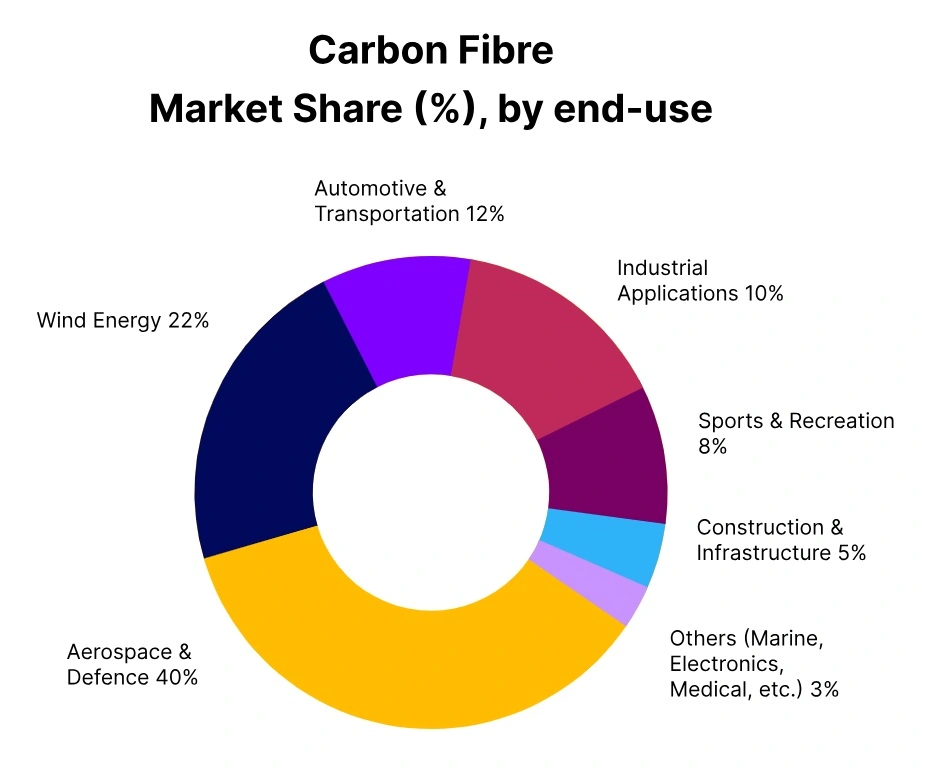
Carbon Fibre Industrial Applications

carbon fibre market share end use

Historically, several events have caused significant fluctuations in Carbon Fibre prices

  • Energy Price Shock and Precursor Constraints (2021–2022): During 2021–2022, rising global energy prices placed considerable upward pressure on the carbonisation process, one of the most energy-intensive stages in carbon fibre manufacturing. Simultaneously, environmental regulations and power rationing in China reduced precursor production, tightening the supply of key raw materials. This coincided with a broad recovery in demand across aerospace, wind energy, and industrial applications, intensifying procurement challenges. Lead times extended across the market as producers navigated high energy costs and limited feedstock availability. These conditions triggered significant cost-driven price increases, highlighting the sector’s sensitivity to energy and precursor volatility. The period is recognised as a major supply-side constraint phase for carbon fibre.
  • Pandemic-Induced Supply Chain Disruptions (2020): The onset of the COVID-19 pandemic disrupted every stage of the carbon fibre production cycle, from precursor output to spinning, carbonisation, and transportation. Many production facilities operated at constrained capacity due to labour shortages, operational restrictions, and temporary shutdowns, significantly limiting fibre availability. Global logistics delays and elevated freight costs further increased overall production and delivery expenses. Despite a temporary slowdown in aerospace, demand from wind energy, construction reinforcement, and industrial sectors remained steady. This mismatch between constrained supply and stable demand led to noticeable price increases and prolonged market volatility. The pandemic marked a period of structural disruption for the carbon fibre industry.
  • Strong Demand Growth in Wind Energy (2017–2019): Between 2017 and 2019, the carbon fibre market experienced a significant demand surge driven primarily by rapid expansion in global wind energy installations. Large-tow carbon fibre, widely used in turbine blade manufacturing, saw consistent demand that exceeded available production capacity. This imbalance created persistent supply tightness across industrial-grade fibre. Additional consumption from the automotive lightweighting sector and pressure-vessel applications added further pressure to the supply chain. As manufacturers struggled to keep pace, carbon fibre prices experienced steady upward momentum. This period is viewed as one of the strongest demand-driven price escalation phases for carbon fibre.

Why PriceWatch?

PriceWatch is your trusted resource for tracking global carbon fibre price trends. Our platform delivers real-time data and expert analysis, offering deep insights into the key factors driving price fluctuations in the carbon fibre market. By monitoring critical events such as geopolitical tensions, supply chain disruptions, and economic shifts, PriceWatch keeps you fully informed of market dynamics.

In addition, PriceWatch provides detailed forecasts and updates on production capacities, enabling you to anticipate market changes and make well-informed decisions. With PriceWatch, you gain a competitive edge in understanding all the elements that influence carbon fibre prices worldwide. Stay ahead of the curve with PriceWatch’s reliable, accurate, and timely carbon fibre market data.

Track PriceWatch's carbon fibre price assessment on a weekly basis since 2015 onwards, along with short-term forecasts, and get access to the detailed report in a downloadable format.

Data Collection and Sources​

  • Real-Time Market Data: PriceWatch aggregates real-time pricing data from a diverse range of sources, including global commodity exchanges, industry reports, and proprietary databases. This ensures that our assessments reflect the most current market conditions.
  • On-the-Ground Intelligence: Our team gathers insights directly from key market participants, including producers, suppliers, traders, and end-users, across major Cotton fibre production hubs. This ground-level intelligence is crucial for understanding localized market dynamics.
  • Supply Chain Monitoring: We track the entire Cotton fibre supply chain, from raw material availability to production and distribution channels. This includes monitoring feedstock prices, production capacities, and transportation logistics.

Event Tracking and Impact Analysis​

  • Geopolitical Tensions: PriceWatch continuously monitors global geopolitical developments, such as conflicts or trade disputes, which can significantly impact Cotton fibre prices. Our analysis includes potential disruptions to supply chains and their immediate and long-term effects on pricing.
  • Natural Disasters and Climate Events: We assess the impact of natural disasters, such as hurricanes or winter storms, on Cotton production facilities, particularly in vulnerable regions like India, China, USA, Pakistan and Brazil. These events are factored into our price forecasts and supply outlooks.
  • Economic Shifts: PriceWatch evaluates macroeconomic trends, including global economic growth, inflation rates, and sector-specific demand (e.g., textile and apparel), to predict shifts cotton demand and corresponding price movements.

Production Capacity and Supply Analysis

  • Current Production Monitoring: We maintain a comprehensive database of global cotton production facilities, tracking their operational status, maintenance schedules, and output levels. This allows us to assess current supply availability accurately.
  • Future Capacity Projections: Our research includes detailed forecasts of upcoming cotton production capacities, factoring in new plant constructions, expansions, and technological advancements. This helps in predicting future supply trends and potential price stabilization.

Demand Forecasting

  • Sectoral Demand Analysis: PriceWatch provides in-depth analysis of demand trends across key sectors, including automotive, and construction. We track year-on-year demand growth and project future consumption patterns based on economic indicators and industry developments.
  • Global Demand Dynamics: Our methodology considers regional demand variations and how they influence global cotton pricing. This includes understanding the impact of shifts in manufacturing bases, trade policies, and environmental regulations.

Pricing Model Development

  • Dynamic Pricing Models: PriceWatch utilizes advanced econometric models to forecast Cotton fibre prices, incorporating real-time data, historical trends, and projected market conditions. Our models are continuously refined to enhance accuracy and predictive power.
  • Scenario Analysis: We conduct scenario-based assessments to evaluate potential future market conditions. This includes best-case, worst-case, and most likely scenarios, helping our clients prepare for a range of market outcomes.

Reporting and Client Support

  • Comprehensive Reports: Our clients receive detailed reports that include current price assessments, future price forecasts, and in-depth analysis of market drivers. These reports are designed to be actionable, providing clear insights and recommendations.
  • Ongoing Support: PriceWatch offers continuous updates and personalized support to our clients, ensuring they have the most up-to-date information to make informed decisions. Our experts are available to discuss specific market developments and provide tailored advice.

This research methodology ensures that PriceWatch delivers the most accurate, timely, and actionable Cotton fibre pricing assessments, helping our clients stay ahead of market trends and make informed business decisions.

Carbon Fibre Market Price Trend provided by PriceWatch is a base price and excludes VAT/Taxes, discounts, or offers. The information herein is accurate to the best of our knowledge as of the date indicated and is provided solely for the convenience of our customers as a reference for carbon fibre. PriceWatch disclaims any warranties or representations regarding the accuracy of results derived from this information. It is the sole responsibility of the user to assess the suitability of the product for their specific application. This document does not constitute an endorsement to use the product in violation of any applicable patent rights.

Carbon fibre tow refers to a bundle of continuous carbon filaments held together with minimal twist. It is classified by filament count such as 3K, 6K, 12K, 24K, and 50K with higher filament counts typically used for industrial applications and lower counts preferred for aerospace or high-performance uses.

PAN-based tow dominates the market due to its superior tensile strength, consistency, and suitability for structural applications. Pitch-based tow offers higher modulus and thermal conductivity but is costlier and used in niche segments like aerospace, satellites, and specialized industrial components.

Prices are determined by precursor (PAN or pitch) costs, conversion and energy expenses, production capacity utilization, tow size, surface treatment, mechanical properties, and demand trends in end-use industries such as automotive, aerospace, sporting goods, pressure vessels, and wind energy.