Cobalt Price Trend and Forecast

UNSPC code: 27111601
|
Weekly Update
|
Historical Data Since 2015
|
Forecast for 2026
  • Commodity Pricing

cobalt Price Trends by Country

cnChina
nlNetherlands
usUnited States

Global cobalt Spot Market Prices, Trend Analysis and Forecast

Price Watch™ provides real-time price assessments and price forecasts for Cobalt across top trading regions:

Cobalt Regional Coverage Cobalt Grade and Country Coverage Cobalt Pricing Data Coverage Explanation
Asia-Pacific Cobalt Pricing Analysis Cobalt Ex Shanghai, China Weekly Price Update on Cobalt Real-Time Domestic Ex Shanghai Prices in China
North America Cobalt Pricing Analysis Cobalt Delivered Prices at Baltimore, USA Weekly Price Update on Cobalt Real-Time Delivered Prices in Baltimore, USA
Europe Cobalt Pricing Analysis Cobalt FD Prices at Rotterdam, Netherlands Weekly Price Update on Cobalt Real-Time FD Prices in Rotterdam, Netherlands

Cobalt Price Trend Q1 2026

In Q1 2026 the price of cobalt metal continued to rise compared to prices in Q4 2025 due primarily to supply constraints caused by limited exports and logistical delays in Congo (DRC). These limitations resulted in tighter availability of cobalt, as well as an ongoing market deficit.

Additionally, with inventories reducing in many major usage regions (e.g., EV battery manufacturers), strong demand for EV batteries and aerospace/industrial applications (which have remained constant throughout this period), prices have remained strong on a sustained basis, and there will be continued bullish sentiment and strengthening market positions relative to prior periods.

China: Cobalt Export prices Ex Shanghai, China; Grade – Purity:99.8%min

According to Price-Watch™ , in Q1 2026, the price trend of Cobalt Metal in China showed a strong upward momentum, recording an estimated 32.07% increase compared to Q4 2025. This surge was primarily driven by tight supply from key producers like the Democratic Republic of Congo, logistical bottlenecks, and limited domestic inventories, which collectively constrained availability and pushed prices higher.

At the same time, resilient demand from high end battery applications, specialty alloys, and aerospace sectors helped absorb metal supply, reinforcing the bullish trend. China’s cobalt prices rose by about 0.77% in March 2026, mainly due to tighter supply of cobalt raw materials from the DRC and a sharp decline in China’s cobalt imports. Recent news around export restrictions, falling inventories, and supply-chain uncertainty supported prices despite only moderate demand from the EV battery sector.

Netherlands: Cobalt Domestically Traded prices FD Rotterdam, Netherlands; Grade – Purity:99.8%min

Cobalt prices in the Netherlands rose significantly by 25.38% in Q1 2026, caused by global supply tightness and high levels of industrial demand. The tightness has been created by export restrictions from major cobalt producers like the Democratic Republic of Congo, which limited the availability of cobalt feedstock to European Battery Manufacturers and specialty alloy producers who are looking for needed stock due to reductions of their inventory levels.

In March 2026, cobalt prices in the Netherlands increased by 1.38% primarily as a result of global supply tightness created by DRC Export Restrictions and increasing expectations for stronger demand in the European Battery Sector. The recent increases in industrial energy and logistics costs and new long-term battery metal supply contracts also contributed to the bullish sentiment in the overall European market for metal materials.

USA: Cobalt Domestically Traded prices Del Baltimore, USA; Grade – Purity:99.8%min

In Q1 2026, the U.S. Cobalt Metal market experienced a robust 16.02% increase from Q4 2025, reflecting a continued bullish price trend of Cobalt Metal driven by tight supply and strong demand across key sectors. Supply constraints, particularly from the Democratic Republic of Congo, have limited raw material flow, keeping U.S. inventories lean, while sustained procurement by electric vehicle battery manufacturers and aerospace alloy producers has intensified upward price momentum. U.S. cobalt prices rose 2.56% in March 2026 mainly due to tighter global supply after the DRC imposed export quotas and Chinese cobalt inventories declined, creating supply chain concerns.

At the same time, the U.S. pushed strategic battery metal sourcing deals and domestic refining expansion, supporting bullish sentiment despite moderate EV demand growth.

Cobalt Price Trend Analysis: Q4 2025

In Q4 2025, the global Cobalt metal market experienced a generally positive trend, driven by strong demand and tightening supply conditions across key regions. Robust consumption from major end-use sectors such as rechargeable batteries, superalloys, and catalysts prompted buyers to increase procurement amid anticipated growth in electric vehicle production.

Constrained output from some producing countries and logistical challenges contributed to tighter availability, supporting upward price momentum. Import-dependent markets faced competitive sourcing pressures with suppliers commanding premium pricing, while regions with domestic production saw prices strengthen as downstream industries ramped up purchases.

Consequently, market participants increasingly adopted forward-buying strategies to secure material, resulting in the global Cobalt metal market reflecting solid demand fundamentals and constrained supply conditions, ultimately leading to rising prices and an optimistic outlook heading into early 2026.

China: Cobalt Export prices Ex Shanghai, China; Grade – Purity:99.8%min

According to Price-Watch™ , in Q4 2025, the Cobalt metal market in China recorded a 40.25% price increase compared to Q3 2025, reflecting a strong upward trend amid bullish market sentiment. Demand from the battery manufacturing, electric vehicle, and specialty alloy sectors remained robust, providing significant support to prices, while upstream production from cobalt mining and refining operations faced tight supply conditions, limiting immediate availability.

Producers generally operated at near-full capacity, but logistical bottlenecks and cautious inventory management kept the market slightly constrained. In December 2025, prices were further supported as downstream industries accelerated procurement ahead of anticipated 2026 demand growth, and export demand from global battery manufacturers remained solid.

Overall, the Cobalt market in China exhibited tight supply fundamentals coupled with strong demand, driving a substantial quarterly price increase as the market entered early 2026.

Netherlands: Cobalt Domestically Traded prices FD Rotterdam, Netherlands; Grade – Purity:99.8%min

In Q4 2025, cobalt metal prices in the Netherlands rose sharply by 51.92% compared to Q3 2025, marking a strong upward trend across the European market. Demand from downstream sectors such as battery materials, superalloys, and electroplating remained robust, driven by electric vehicle production and energy storage projects, prompting buyers to secure larger volumes and adopt proactive procurement strategies.

Supply from major exporting countries, particularly the Democratic Republic of Congo and Russia, faced logistical and regulatory constraints, tightening stocks and contributing to price pressures. Upstream production showed some volatility, while extended lead times and elevated freight costs amplified import-linked pricing.

In December 2025, prices continued climbing as manufacturers prioritized cobalt for early 2026 production, resulting in tight supply conditions and vigorous demand that fuelled the pronounced price increase.

USA: Cobalt Domestically Traded prices Del Baltimore, USA; Grade – Purity:99.8%min

In Q4 2025, cobalt metal prices in the USA rose sharply by 28.77% compared to Q3 2025, driven by strong demand from the battery, aerospace, and specialty alloy sectors, which outpaced supply growth. Buyers accelerated procurement toward the end of the year, aiming to secure material amid tighter import availability from African and Asian sources, while domestic production remained stable but limited in volume.

Traders managed leaner inventories and adopted firm pricing strategies, reflecting market scarcity, and moderate freight costs were increasingly incorporated into purchasing decisions. In December 2025, prices strengthened further as short-term restocking intensified and domestic consumption remained robust, while export activity stayed secondary.

Overall, the U.S. cobalt market experienced strong demand-driven momentum, constrained supply, and heightened buyer activity, leading to a significant price surge entering early 2026.

Cobalt prices demonstrated an upward trend in Q3 2025, driven by tight global supply amid export bans in the Democratic Republic of Congo and recovering demand in the electric vehicle and energy storage industries. Cobalt prices increased, with suggestions that prices would continue to increase into Q4.

The market reacted positively regarding conditions alleviating oversupply concerns and geopolitical risks, while high-performance battery applications continue to create cobalt demand, albeit with LFP battery substitution still occurring. Overall, the outlook remains cautiously optimistic because supply continues to constrain price.

China: Cobalt Export prices Ex Shanghai, China, Grade- 99.8%min.

In the third quarter of 2025, China’s cobalt price trend witnessed a 6.9% increase from the second quarter due to light restocking activity and slight improvements in demand from downstream sectors such as EV batteries and electronics. This demand spike, along with continuing supply constraints from the Democratic Republic of Congo’s export restrictions, supported a slight price increase for cobalt, especially cobalt hydroxide and refined cobalt products.

However, the price gains have been tempered by historically high domestic inventories and continued downward pressure in the market due to global transitions away from cobalt as batteries switch to cobalt-free chemistries such as LFP. The increase of 5.32% in Cobalt prices in China in September 2025 can be attributed to tighter supply from increased environmental regulations on mining and refining activities.

Additionally, an uptick in the stainless-steel market increased demand, contributing to increased price levels. Consequently, cobalt prices in China demonstrated limited strength through Q3 with further constraints in place to force prices to rally substantially.

Netherlands: Cobalt Export prices FD Rotterdam, The Netherlands, Grade- 99.8%min.

According to Price-Watch™ , In Q3 2025, the cobalt price trend in Netherlands has experience a 7.73% price increase compared to Q2, driven by tightening global supply due to export restrictions, especially from the Democratic Republic of Congo, and sustained demand from the battery and specialty alloy sectors. This positive price trend of cobalt reflects ongoing inventory drawdowns and supply chain pressures, which have been pushing Cobalt prices upward.

While demand in Europe remains strong, especially for EV battery production, logistical challenges and potential shifts in battery chemistry may introduce some volatility. The 4.55% increase in cobalt prices in the Netherlands in September 2025 can be attributed to tightened global supply chains due to export restrictions from major producing countries. Additionally, rising demand from the stainless steel and electric vehicle sectors further pressured prices upward.

USA: Cobalt Export prices DEL Baltimore, The USA, Grade- 99.8%min.

In Q3 2025, the cobalt price trend in U.S. saw a 3.99% price increase from Q2, driven by tightening supply from the Democratic Republic of Congo’s extended export ban and escalating U.S. China trade tensions that disrupted cobalt trade flows.

This supply constraint, combined with sustained demand from the electric vehicle sector, contributed to the positive price trend of cobalt. With prices rising sharply over the past year, market outlook remains bullish, signalling ongoing opportunities and challenges for producers, consumers, and investors in the cobalt space.

The 4.16% increase in cobalt prices in the USA during September 2025 has also reflected rising demand in industries such as stainless-steel manufacturing and automotive production, which rely heavily on cobalt. Additionally, supply chain disruptions or increased production costs have contributed to the price surge, tightening market availability and pushing prices upward.

According to the PriceWatch, In Q2 2025, cobalt prices surged by $29,330 per metric ton, Ex Shanghai a 32.92% rise driven by geopolitical disruption and tariff impacts. The Democratic Republic of Congo, the world’s top cobalt producer, suspended exports earlier this year, sharply tightening global supply. Meanwhile, escalating U.S. China trade tensions led to new tariffs on Chinese cobalt products and reciprocal export controls from China, further straining supply chains. These pressures forced Western manufacturers to diversify sourcing, often at higher costs.

While Chinese stockpiles and Indonesian production offered some relief, buyers prioritized security over price. The market also responded to uncertainty over future supply as the DRC considers a quota based export system. Overall, the price spike reflects not just short term scarcity but a broader restructuring of cobalt supply under geopolitical and trade pressures suggesting continued volatility ahead.

In the first quarter of 2025, cobalt experienced a notable price decline, dropping by $22,067 per metric ton, Ex-Shanghai which represents a 2.06% decrease. This downturn reflects a combination of factors including easing supply chain constraints, moderated demand from key sectors such as electric vehicle manufacturing, and possibly increased inventory levels.

While cobalt remains a critical component in battery technology, the price adjustment suggests market participants are recalibrating expectations amid shifting economic conditions and raw material availability. This price movement may impact both producers and consumers by influencing production costs and investment strategies in the cobalt supply chain going forward.

Cobalt Price Trend Analysis: Q4 2024

In Q4 2024, cobalt prices experienced a notable decline, dropping by $22,531 per metric ton, Ex-Shanghai which represents a 3.71% decrease compared to the previous quarter. This price reduction reflects weakening demand pressures, possibly due to a slowdown in key end markets such as electric vehicle production and battery manufacturing. Additionally, increased supply from mining expansions or stockpile releases may have contributed to the downward trend.

Market sentiment could also be influenced by broader economic uncertainties, including inflation concerns and geopolitical factors affecting commodity markets. Overall, the significant price drop signals a cautious outlook for cobalt in the near term, prompting stakeholders to closely monitor demand-supply dynamics and potential shifts in global trade flows.

In Q3 2024, cobalt prices experienced a significant decline, dropping by $23,400 per metric ton, Ex-Shanghai which corresponds to a 12.95% decrease. This sharp fall suggests a combination of factors such as weakening demand from key industries like electric vehicle manufacturing, increased supply from major producers, or shifts in market sentiment possibly influenced by macroeconomic conditions or geopolitical developments.

The price correction may reflect a temporary oversupply or concerns about slower growth in cobalt-intensive technologies. Market participants should closely monitor inventory levels, production forecasts, and end-user demand to better understand the potential for price stabilization or further volatility in the coming quarters.

In Q2 2024, cobalt prices experienced a significant decline, dropping by $26,800 per metric ton, Ex-Shanghai which represents a 5.12% decrease compared to the previous quarter. This downward trend reflects a combination of factors, including weakening demand from the electric vehicle and electronics sectors, where cobalt is a critical component, as well as potential easing of supply chain constraints.

Additionally, increased production from key cobalt-producing regions may have contributed to an oversupply in the market, further pressuring prices. The price correction signals a period of market adjustment, prompting stakeholders to reassess supply strategies and demand forecasts for the remainder of the year.

In Q1 2024, cobalt experienced a significant price decline, dropping by $28,331 per metric ton, Ex-Shanghai which equates to an 8.29% decrease. This sharp fall reflects a combination of weakening demand pressures and possibly increased supply or inventory levels in the market. The price adjustment indicates caution among buyers, likely driven by concerns over slower growth in key end-use sectors such as electric vehicle manufacturing and electronics.

Additionally, macroeconomic uncertainties and shifts in commodity markets may have contributed to the downward trend. Overall, the decrease suggests a more cautious outlook for cobalt in the near term, with market participants closely monitoring demand recovery and supply chain dynamics.

Technical Specifications of Cobalt Price Trends

Product Description

Cobalt is a hard, lustrous, silver-grey metal known for its exceptional strength, high temperature stability, and corrosion resistance. It is primarily used in the production of high-performance alloys, particularly in the aerospace, energy, and defence industries. Cobalt enhances the durability and performance of superalloys used in jet engines, gas turbines, and power plants. It also plays a vital role in rechargeable battery technologies, magnetic materials, and catalytic processes. Its unique properties make cobalt indispensable in applications requiring reliability under extreme conditions.

Identifiers and Classification:

  • HS Code – 260500


Cobalt Grades Specific Price Assessment:

  • 99.8%min


Cobalt Global Trade and Shipment Terms

  • Quotation Terms (Product & Country Specific): 10-15 MT
  • Packaging Type (Product & Country Specific): 250kg Steel drum


Incoterms Referenced in Cobalt Price Reporting

Shipping Term  Location  Definition 
Ex Shanghai  Shanghai, China  Cobalt Export price from China 
Del Baltimore  Baltimore, USA  Domestically Traded Cobalt price in USA 
FD Rotterdam  Rotterdam, Netherlands  Domestically Traded Cobalt price in Netherlands 

*Quotation Terms refers to the quantity range specified for the Cobalt being quoted or offered in a commercial transaction.

**Packaging Type refers to standard packaging size commonly used for Cobalt packing, ease of handling, transportation, and storage in industrial and commercial applications.


Key Cobalt Manufacturers

Manufacturer 
CMOC Group Ltd 
Jinchuan Group Co., Ltd 
Norilsk Nickel 
Vale Canada Ltd 
Electra Battery Materials 

Cobalt Industrial Applications

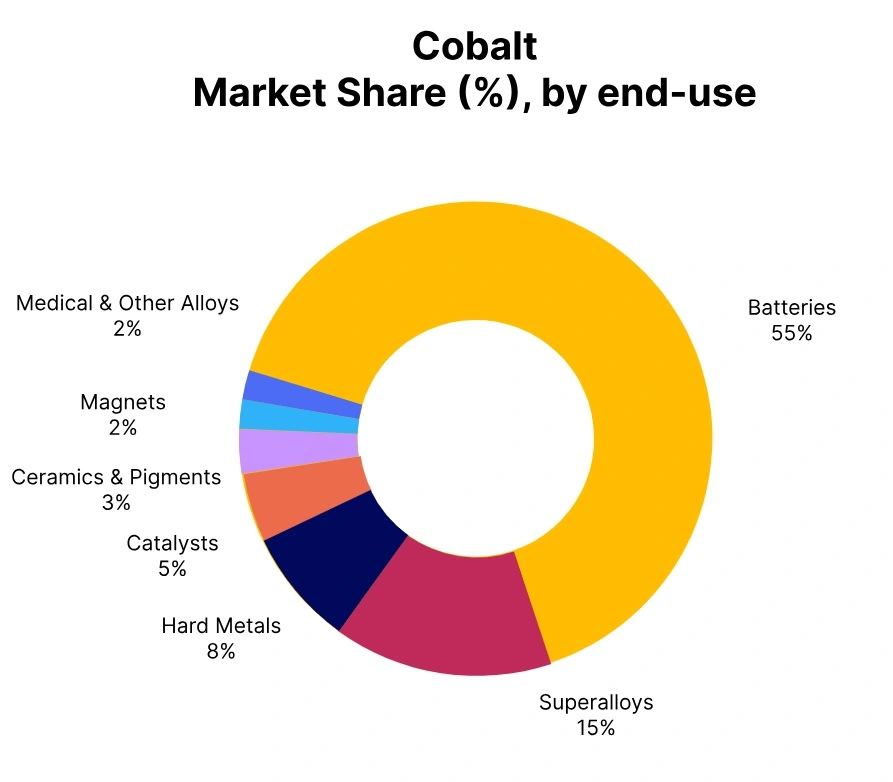
cobalt market share end use

Historically, several events have caused significant fluctuations in Cobalt prices

  • Global Supply Chain and Logistical Disruptions (2022–2023): Ongoing shipping bottlenecks, rising energy costs, and pandemic-related labour shortages impacted the mining and refining of cobalt, exacerbating supply-demand imbalances and price volatility.
  • Supply Concentration and Political Instability (2021–2022): The majority of cobalt supply originates from the Democratic Republic of the Congo (DRC), where political instability, regulatory uncertainties, and ethical concerns regarding artisanal mining practices disrupted supply, contributing to price fluctuations.
  • Electric Vehicle (EV) Boom (2020–2021): The rapid expansion of the electric vehicle market significantly increased demand for lithium-ion batteries, where cobalt is a key component. This surge in demand led to upward pressure on cobalt prices.

Why Price Watch™?

Price Watch™ is your trusted resource for tracking global cobalt price trends. Our platform delivers real-time data and expert analysis, offering deep insights into the key factors driving price fluctuations in the cobalt market. By monitoring critical events such as geopolitical tensions, supply chain disruptions, and economic shifts, Price Watch™ keeps you fully informed of market dynamics.

In addition, Price Watch™ provides detailed forecasts and updates on production capacities, enabling you to anticipate market changes and make well-informed decisions. With Price Watch™, you gain a competitive edge in understanding all the elements that influence cobalt prices worldwide. Stay ahead of the curve with Price Watch’s™ reliable, accurate, and timely cobalt market data.

Track Price Watch's™ cobalt price assessment on a weekly basis since 2015 onwards, along with short-term forecasts, and get access to the detailed report in a downloadable format.

Cobalt Market Price Trend published by Price Watch™ reflect prevailing spot market conditions, derived from independent research, verified trade inputs, and proprietary market intelligence as of the publication date. Prices are published on the specified Incoterm and represent indicative base market levels, exclusive of applicable taxes, VAT, duties, tariffs, and other statutory charges. Actual transaction values may vary depending on volume, credit terms, contractual structure, and other negotiated conditions. Market prices are inherently subject to volatility, liquidity dynamics, regulatory changes, and evolving trade activity. The information provided is for reference and benchmarking purposes only and does not constitute an offer, recommendation, or guarantee of transactional outcomes. Users should exercise independent commercial judgment and assess their specific contractual, regulatory, tax, and application requirements before making business decisions. Price Watch™ assumes no liability for decisions taken based on this information.

Raw Material Availability – Cobalt is primarily mined as a byproduct of copper and nickel mining. Limited supply, particularly from major producers like the Democratic Republic of the Congo (DRC), heavily impacts prices.

Global Demand – Cobalt is essential in lithium-ion batteries used in electric vehicles (EVs), electronics, and energy storage systems. Rising demand from the EV sector can drive prices upward.

Geopolitical Stability – Political unrest or regulatory changes in cobalt-producing countries, especially the DRC, can disrupt supply chains and increase prices.

Environmental and Ethical Regulations – Increasing focus on ethical sourcing and environmental standards can influence supply chain operations and production costs, affecting prices.

Processing and Refining Costs – Cobalt requires extensive refining, often done in specific countries like China. Changes in energy, labor, and processing costs influence the final market price.

Market Speculation and Investment Trends – Commodities trading and speculation by investors can lead to short-term price volatility.

Exchange Rates – As cobalt is traded globally, fluctuations in currency values—especially USD, which is the standard trading currency—affect prices in different markets.

Technological Developments – Innovations in battery technology or alternative materials that reduce cobalt dependence can impact long-term demand and pricing.

The availability and cost of raw materials such as high-carbon steel and alloy coatings directly affect cobalt production costs and pricing.

Cobalt prices generally rise with inflation, driven by higher extraction and processing costs. However, demand from the battery, electronics, and electric vehicle industries plays a key role in sustaining price levels, often amplifying price movements beyond typical inflationary trends.

Cobalt is a transition metal with vital applications across batteries, aerospace, alloys, chemicals, and renewable energy technologies. High-purity cobalt is essential in lithium-ion battery cathodes for electric vehicles, electronics, and grid storage, while small additions improve strength, wear resistance, and corrosion resistance in superalloys used in jet engines and high-performance tooling. It also serves as a precursor for specialty chemicals, pigments, catalysts, and magnetic materials. Due to concentrated global supply, ethical sourcing concerns, and environmental regulations, cobalt’s production, pricing, and trade are closely monitored, making market intelligence crucial for industries relying on its unique electrochemical, mechanical, and thermal properties.

Cobalt prices vary by region and market conditions. Prices are typically quoted per metric ton or per pound and fluctuate based on global supply, import/export flows, industrial demand, and currency exchange rates. Price Watch™ provides real time price assessments across different global markets to help buyers and sellers make informed decisions.

Prices fluctuate due to changes in Chinese production, environmental regulations, seasonal smelter maintenance, feedstock availability, and demand from pharmaceuticals, electronics, and alloys. Exchange rates, logistics costs, and global economic conditions also influence trends.

Major consumers include pharmaceuticals, electronics, metallurgy, chemical & pigment industries, and research/specialty materials. Price Watch™ analyses demand patterns across all these industries.

Cobalt is primarily obtained as a by-product of the extraction of copper and nickel from their ores, especially cobaltite, smaltite, and nickel-copper sulphide ores. During refining, cobalt is separated from other metals through hydrometallurgical or pyrometallurgical processes. It is recovered by leaching with acids, followed by purification using solvent extraction or precipitation, and then reduced to metallic cobalt using hydrogen or other reducing agents. High-purity cobalt is also produced via electrolytic refining, yielding the metal in crystalline or powder form suitable for batteries, superalloys, catalysts, and specialized industrial applications.

China is the world’s largest exporter. Export volumes vary with domestic policies, environmental regulations, and international demand. Price Watch™ tracks production levels, export flows and trade patterns to help businesses understand global supply chains and identify sourcing opportunities.

Supply generally meets demand, but disruptions may occur due to smelter shutdowns, environmental restrictions, or spikes in industrial consumption. Price Watch™ monitors these supply demand imbalances to alert the market about potential shortages or surpluses.

Cobalt is graded by purity: industrial grade (~99.8%), high purity 99.99%, and ultra pure specialty forms. Higher purity grades cost more due to extra refining. Price Watch™ provides separate price assessments for each grade to ensure market transparency.

When demand rises, for example: from pharmaceutical production or electronics manufacturing prices typically climb. Suppliers may prioritize certain customers, and lead times can extend. Price Watch™ captures these market dynamics in real time.

Refining Cobalt is energy intensive. Rising electricity, fuel, or chemical costs often get passed on to buyers. This is why prices in regions with cheaper electricity tend to be lower, a correlation that Price Watch™ analyses in its price assessments & market reports.

Regional variations arise from import dependency, shipping costs, currency fluctuations, and local demand. Price Watch™ tracks prices across all major regions to highlight these differences.

Forecasts depend on production capacity, Chinese export policies, industrial demand, and macroeconomic factors. Price Watch™ regularly publishes detailed forecasts that project price movements for the next 12 months based on comprehensive analysis of supply additions, demand growth in key industries, seasonal patterns, and macroeconomic indicators. Our forecasts help businesses anticipate market conditions and plan accordingly.

Yes. Accurate forecasts allow businesses to optimize purchasing, negotiate contracts, and manage inventories. If Price Watch™ forecasts predict a price increase in three months, you might choose to stock up now or lock in long term contracts at current rates, potentially saving thousands of dollars.

Events such as Chinese export restrictions, smelter shutdowns, environmental regulations, or economic shocks can cause supply shortages and price volatility. Price Watch™ provides timely alerts when such events affect the market.

Price Watch™ collects data from manufacturers, distributors, and buyers worldwide to publish regular price assessments, market reports, and forecasts. Our transparent methodology and comprehensive coverage make us a trusted source for understanding fair pricing and market trends in the Cobalt industry.