Crude Oil Price Trend and Forecast

UNSPC code: 15101508
|
Weekly Update
|
Historical Data Since 2015
|
Forecast for 2026
  • Commodity Pricing

crude oil Price Trends by Country

euEurope
usUnited States
opecOPEC
inIndia

Global crude oil Spot Market Prices, Trend Analysis and Forecast

Price Watch™ provides price assessments for Crude oil across top trading regions:

North America

  • West Texas Intermediate (WTI)
  • Western Canadian Select (WCS)


Europe

  • Brent Oil


Middle East & Africa

  • Dubai Fateh
  • OPEC Basket
  • Nigeria


Note:
In assessments structured as CIF [Importing Port] (Exporting Country), the country mentioned in brackets indicates the primary origin of supply (exporting country), while the named port refers to the destination port in the importing country. Other Incoterms (FOB, FD, EXW, etc.) should be interpreted in accordance with standard international trade definitions.

Crude Oil Price Trend Q1 2026

In Q1 2026, global Crude Oil market maintained a strong upward trajectory throughout the first quarter as escalating geopolitical crises severely compromised supply security. In North America, the USA and Canada initially reacted to the Venezuela crisis, which restricted heavy crude flows and forced a strategic shift toward domestic production. As the quarter progressed, the focus intensified on rising friction between the US and Iran, leading to a slight decrease in global risk appetite.

The situation reached a critical turning point in March with the commencement of the US-Iran war, which created a significant risk premium across the OPEC basket and the UAE. Europe faced heightened anxiety over maritime stability and Mediterranean shipping routes, while Russia and Nigeria saw a surge in demand as refineries sought reliable geographical alternatives to avoid the conflict-stricken Middle East.

The global Crude Oil market recorded an exceptionally robust performance during the first quarter of 2026 due to growing geopolitical risks that have led to insecurity in oil supplies. The USA and Canada made efforts to address the crisis in Venezuela, which led to reduced flow of heavy crude oil and forced a pivot to local oil production for these two nations.

During the quarter, the main concern became the increasing tensions between the USA and Iran and consequently a reduction in global risk appetite. The matter took an urgent turn during March, when the war between the USA and Iran broke out, thus contributing to an increase in the risk premium in the OPEC basket and the UAE. There is increased fear of sea traffic in Europe, while Russia and Nigeria experienced high demands for crude oil due to refinery seeking geographically secure areas to source crude from rather than the Middle East.

Europe : Crude Oil Price Trend Q1 2026

In Q1 2026, the Crude Oil price in Europe followed a consistent upward trend as regional energy security became a major concern. Early in the quarter, rising US-Iran tensions caused uncertainty across global energy markets and reduced confidence in maritime supply stability.

The situation intensified sharply in March when the US-Iran war began, pushing Brent prices up by 38.20% during the month. The Crude Oil price trend in Europe remained strongly bullish, recording an overall quarterly increase of nearly 23% as buyers prioritized secure North Sea crude supplies. In March 2026, crude oil prices in Europe surged due to fears of Middle Eastern shipping disruptions and tightening global supply availability.

Crude oil prices in Europe showed a steady increase trend during Q1 2026 as the issue of energy security rose to be a top priority for the region. At the beginning of the quarter, increased tension between the US and Iran resulted in increased uncertainty in energy markets across the globe as well as decreased maritime security concerns.

In March 2026, Crude oil prices in Europe tensions between the two has risen significantly with the US-Iran war starting, resulting in a sharp 38.20% increase in Brent prices for the month. Crude oil price trend in Europe is extremely bullish during Q1 2026, showing a total rise of almost 23% during the quarter.

USA : Crude Oil Price Trend Q1 2026

According to Price-Watch™ , in Q1 2026, the Crude Oil price in the USA moved upward as the market adjusted to shifting geopolitical risks and disrupted global trade flows. The unstable situation in Venezuela initially forced domestic refiners to alter sourcing strategies and increase reliance on local production. Rising US-Iran tensions further supported bullish market sentiment during the quarter.

The outbreak of the US-Iran war in March triggered a significant market rally, resulting in a 32.40% monthly increase in WTI prices. The Crude Oil price trend in the USA remained positive overall, recording quarterly gains of nearly 25%. In March 2026, crude oil prices in the USA climbed sharply as refiners responded to growing supply uncertainty and stronger domestic demand.

In Q1 2026, Crude Oil price in the USA experienced an uptrend due to the changes in geopolitical risks and international shipping. Crude Oil price trend in the USA with the unstable situation in Venezuela, the need for refiners to change their supply chain to rely on domestic output is evident. Furthermore, rising tensions between the USA and Iran also played an important role in the positive market sentiment throughout the first quarter.

The occurrence of the USA-Iranian war in March contributed greatly to a rally in the market, which led to an impressive 32.40% rise in the WTI price per month. In March 2026, Crude Oil prices in the USA witnessed a positive trend, achieving gains of nearly 25% within the three months.

OPEC : Crude Oil Price Trend Q1 2026

In Q1 2026, the Crude Oil price in the OPEC region increased sharply as member nations faced extreme geopolitical uncertainty and supply-related risks. Venezuela’s production struggles initially influenced market sentiment, while escalating US-Iran tensions kept volatility elevated throughout the quarter. The start of the US-Iran war in March became a major catalyst, driving the OPEC Basket price up by 66.89% during the month.

The Crude Oil price trend in the OPEC region remained strongly bullish, posting an overall quarterly increase of roughly 28%. In March 2026, crude oil prices in the OPEC region surged significantly as regional warfare threatened production infrastructure, export terminals, and tanker movement across major Gulf shipping routes.

The Crude Oil price in OPEC rose substantially during Q1 2026 due to the extreme level of geopolitical risk that faced OPEC member states at this time. Venezuela’s production problems contributed to the market conditions initially, while US-Iran tensions continued to cause volatility through the entire quarter.

The onset of the US-Iran war in March is a key trigger for rising prices, with the OPEC Basket rising by 66.89% in March. The Crude Oil price trend in OPEC is extremely bullish for the quarter, rising by approximately 28%. In March 2026, Crude Oil price in OPEC rose sharply amid threats to production, shipping, and exports due to regional warfare.

UAE : Crude Oil Price Trend Q1 2026

In Q1 2026, the Crude Oil price in the United Arab Emirates rose substantially due to increasing geopolitical tensions and the country’s strategic export position. Dubai Fateh crude remained highly sensitive to rising friction between the US and Iran during the early months of the quarter. While brief periods of stability caused temporary market slowdowns, the outbreak of the US-Iran war in March pushed prices sharply higher by 70.69%.

The Crude Oil price trend in the United Arab Emirates stayed strongly upward throughout the quarter, with overall gains reaching approximately 31%. In March 2026, crude oil prices in the United Arab Emirates surged dramatically as traders reacted to severe maritime risks and export disruptions across the Gulf region.

Canada : Crude Oil Price Trend Q1 2026

In Q1 2026, the Crude Oil price in Canada strengthened as North American demand increased for geographically secure energy supplies. Western Canadian Select prices benefited from disruptions linked to Venezuela and tightening global supply conditions caused by rising geopolitical tensions. Early US-Iran friction reduced global risk appetite and increased reliance on Canadian crude production.

The outbreak of the US-Iran war in March fundamentally shifted trade priorities, leading to a 56.65% monthly price increase. The Crude Oil price trend in Canada remained firmly positive during the quarter, recording overall growth of nearly 21%. In March 2026, crude oil prices in Canada surged as American refiners accelerated procurement of reliable regional crude alternatives.

Nigeria : Crude Oil Price Trend Q1 2026

In Q1 2026, the Crude Oil price in Nigeria increased steadily as international buyers searched for reliable light sweet crude outside the conflict-prone Middle East. Bonny Light crude remained attractive due to stable export availability and favorable refining characteristics. Rising US-Iran tensions supported global crude benchmarks throughout the quarter and maintained strong export demand.

Although the market stabilized briefly during periods of lower escalation, the outbreak of the US-Iran war in March caused prices to jump by 39.49%. The Crude Oil price trend in Nigeria stayed strongly positive, ending the quarter with gains exceeding 24%. In March 2026, crude oil prices in Nigeria surged as buyers prioritized geographically safer crude supplies with lower geopolitical exposure.

Russia : Crude Oil Price Trend Q1 2026

In Q1 2026, the Crude Oil price in Russia increased as global refiners shifted toward alternative crude suppliers outside the Middle East. Russian Urals crude initially benefited from disruptions affecting Venezuelan exports and tightening international supply conditions. Rising tensions between the US and Iran kept market sentiment bullish despite relatively stable regional production levels.

The start of the US-Iran war in March significantly altered trade flows and triggered a 57.75% increase in prices during the month. The Crude Oil price trend in Russia remained positive overall, with quarterly gains reaching approximately 21%. In March 2026, crude oil prices in Russia surged due to growing global demand for stable non-Middle Eastern crude supplies.

Crude Oil Price Trend Analysis: Q4 2025

In Q4 2025, Crude Oil prices globally showed a generally softening trend as market fundamentals remained balanced with steady production levels across key producing regions. Demand from major economies such as Asia, Europe, and North America stayed moderate, supported by stable industrial activity and transportation needs. However, the presence of abundant supply in the global market limited significant price recovery.

Trade flows remained consistent, and geopolitical conditions do not cause major disruptions during the quarter. Overall, the global crude oil market remained stabilized, with slight downward pressure observed across most major benchmarks toward the end of December 2025.

During Q4 2025, the Crude Oil prices around the world exhibited a relatively easing pattern in terms of market fundamentals, where the production trends are stable in all key producing areas. The demand trends on behalf of the big consumers, including Asia, Europe, and North America, continued to remain moderate thanks to a relatively stable industrial sector and transportation services.

Nonetheless, due to the availability of ample supply in the market, there is no room left for prices to bounce back higher. There are no significant trade imbalances in the quarter, nor any geopolitical tensions.

Europe: Crude Oil Price Trend Q4 2025

In Q4 2025, the Crude Oil price in Europe showed a slightly softening trend as stable refinery operations and balanced regional demand maintained overall market stability. Transportation and industrial consumption remained moderate, while abundant global crude supply restricted stronger price growth. The Crude Oil price trend in Europe remained mildly bearish, with the market recording an overall quarterly decline of approximately 2.59%.

In December 2025, crude oil prices in Europe decreased by nearly 2.59% due to comfortable inventory levels, steady imports, and limited seasonal demand growth. Despite softer pricing sentiment, the European crude market remained stabilized throughout the quarter with controlled volatility and balanced supply-demand fundamentals.

The Crude Oil price in Europe exhibited slight softening in Q4 2025 on the back of efficient refinery activities and relatively balanced regional demand levels, thereby sustaining overall stability in the market. Transport and industry utilization is relatively moderate for the period, whereas high global crude oil availability restrained any significant increase in price levels.

The Crude Oil price trend in Europe during Q4 2025 is relatively bearish, as the market witnessed an overall fall in prices by around 2.59% for the quarter. In December 2025, Crude Oil price in Europe decrease stood at roughly 2.59%, owing to adequate stockpile levels and steady imports amid low seasonality growth.

USA: Crude Oil Price Trend Q4 2025

In Q4 2025, the Crude Oil price in the USA followed a gradual softening trend due to stable domestic production and moderate fuel demand across key sectors. Refinery utilization remained steady, while seasonal slowdowns in transportation fuel consumption slightly weakened market sentiment. The Crude Oil price trend in the USA stayed moderately bearish during the quarter, recording an overall decline of approximately 2.72%.

According to Price-Watch™ , in December 2025, crude oil prices in the USA decreased by nearly 2.72% as abundant domestic supply and comfortable inventory levels kept pricing pressure under control. Despite softer market conditions, the overall crude market remained stabilized with steady industrial demand and consistent export activity supporting market fundamentals.

The Crude Oil price in the USA in Q4 2025 is subject to a mild softening trend due to relatively constant production levels within the country, along with adequate fuel demands. There is no increase in refinery activities in the US, while slight decreases in fuel usage by transport vehicles during the period contributed to mild pessimism on the market.

The Crude Oil price trend in the USA is bearish in Q4 2025 at 2.72%. In December 2025, Crude Oil price in the USA fell by about 2.72% because of sufficient domestic production and adequate stock levels.

OPEC : Crude Oil Price Trend Q4 2025

In Q4 2025, the Crude Oil price in the OPEC region moved slightly downward as steady production levels across member countries maintained a well-supplied market environment. Demand from major importing regions remained stable but lacked strong recovery momentum, limiting price improvements during the quarter. The Crude Oil price trend in the OPEC region remained mildly negative, recording an overall quarterly decline of around 4.66%.

In December 2025, crude oil prices in the OPEC region declined by approximately 4.66% as abundant global supply and moderate international demand continued to pressure pricing sentiment. Despite these conditions, the OPEC crude market remained relatively stabilized with balanced supply-demand dynamics throughout the quarter.

In the quarter ending in December 2025, the Crude Oil price in the OPEC region experienced some slight decline, owing to steady production rates in the countries making up the organization, ensuring adequate supplies of oil. Demand from importing areas is steady and showed little or no signs of recovery, hindering growth of prices in the quarter.

There is a negative Crude Oil price trend in the OPEC region, with an overall decrease of roughly 4.66% in the quarter. In December 2025, crude oil prices in the OPEC region fell by roughly 4.66% owing to oversupply of oil on the international market and moderate demands.

UAE : Crude Oil Price Trend Q4 2025

In Q4 2025, the Crude Oil price in the United Arab Emirates recorded a slightly declining trend amid stable regional demand and consistent export activity toward Asian markets. Refinery operations in key importing countries remained steady, supporting regular crude offtake during the quarter. However, abundant Middle Eastern supply restricted stronger pricing gains.

The Crude Oil price trend in the United Arab Emirates remained moderately soft, with the market witnessing an overall quarterly decline of approximately 2.82%. In December 2025, crude oil prices in the United Arab Emirates fell by around 2.82% due to comfortable supply availability and balanced trade flows. Overall, the market remained stabilized with controlled volatility and steady export operations.

Canada : Crude Oil Price Trend Q4 2025

In Q4 2025, the Crude Oil price in Canada experienced a noticeable softening trend due to stable production levels and logistical constraints impacting transportation flows. Demand from refining sectors remained moderate, while export activities continued steadily throughout the quarter. Abundant North American crude supply further added downward pressure on market sentiment.

The Crude Oil price trend in Canada remained mildly bearish, recording an overall quarterly decline of approximately 4.76%. In December 2025, crude oil prices in Canada decreased by nearly 4.76% as transportation challenges and excess supply conditions weakened pricing momentum. Despite softer market conditions, the Canadian crude sector remained stabilized with balanced refinery demand and controlled fluctuations.

Nigeria : Crude Oil Price Trend Q4 2025

In Q4 2025, the Crude Oil price in Nigeria showed a mild downward trend despite stable export demand from Europe and Asia. Production levels remained consistent during the quarter, ensuring uninterrupted cargo availability and steady export activity. However, abundant global crude supply slightly weighed pricing sentiment and limited stronger recovery.

The Crude Oil price trend in Nigeria remained relatively stable overall, recording a quarterly decline of approximately 1.62%. In December 2025, crude oil prices in Nigeria declined by nearly 1.62% as moderate international demand and sufficient global supply pressured market fundamentals. Even with softer prices, the Nigerian crude market remained stabilized due to balanced export demand from key importing regions.

Russia : Crude Oil Price Trend Q4 2025

In Q4 2025, the Crude Oil price in Russia experienced a more noticeable softening trend compared to other benchmarks due to stable export flows and moderate international buying interest. Demand from Asian markets remained steady but lacked enough strength to support higher pricing momentum. The presence of abundant global crude supply further pressured market sentiment during the quarter.

The Crude Oil price trend in Russia stayed moderately bearish, recording an overall quarterly decline of approximately 5.69%. In December 2025, crude oil prices in Russia fell by nearly 5.69% as comfortable supply conditions and slower demand growth weakened pricing dynamics. Despite softer prices, the Russian crude market remained stabilized overall.

The global crude oil market in Q3 2025 showed muted movement, reflecting uneven growth across major regions and cautious sentiment amid persistent macroeconomic and trade headwinds. In the United States, WTI prices rose modestly by 0.5% as refinery maintenance curtailed supply, though ample shale output maintained high inventories and tempered upward momentum.

Export progress remained subdued due to tariffs and limited competitiveness, while hurricanes caused short-lived logistical disruptions with minimal price impact. In Europe, Brent crude was nearly static, gaining just 0.1% by September 2025 as weak demand, strong non-OPEC supply, and elevated storage capped Crude Oil price trend advances despite OPEC+ restraint. Economic sluggishness, reduced speculative activity, and trade frictions kept traders wary.

In contrast, OPEC’s Basket outperformed, climbing 3.88% on the back of disciplined production management, seasonal demand growth in Asia and the Middle East, and supply disruptions in non-OPEC regions.

Cohesion within OPEC supported market fundamentals, lifting sentiment even as global economic uncertainty lingered. Overall, the quarter highlighted a globally balanced but cautious oil environment one sustained by supply restraint rather than robust demand recovery, with most markets hesitating to break from their restrained trajectory.

USA: Crude Oil Price Trend Q3 2025

WTI reflected a subdued Crude Oil price trend in Q3 2025, marking a slight increase of 0.5% by September 2025. The quarter’s advance was primarily attributed to routine refinery turnarounds, which temporarily reduced crude supply and helped stabilize prices despite persistent headwinds.

US export activity saw only minimal improvement as trade barriers and tariffs especially from Asian importers continued to limit the competitiveness of American crude. Inventories remained ample, with strong shale output replenishing Cushing stocks and tempering the potential for a more robust rally.

OPEC+ policies offered underlying support, but the effect on global balances was softened by tepid demand and lacklustre economic growth. Hurricane disruptions in the Gulf of Mexico briefly impacted logistics yet did not fundamentally alter the Crude Oil price trend. By September 2025, sentiment remained cautious, with traders wary of ongoing macroeconomic volatility and unresolved trade disputes.

Europe: Crude Oil Price Trend Q3 2025

Brent crude trading showed overall stability during the third quarter of 2025, ending up 0.1% in September. The mood across markets has been flat, reflecting underlying economic headwinds and ongoing fallout from trade wars, which continued to weigh on global demand.

A supply cut by OPEC+ members has been outweighed by increased non-OPEC production and ample inventories across Europe and the Mediterranean, which created a ceiling on prices. The summer travelling season and seasonal refinery turnarounds provided modest support for crude consumption, but a weaker demand picture from China and the Asia-Pacific acted to offset this.

Despite various geopolitical events creating some short-term volatility, Brent’s established status as the crude benchmark and diversity of supply kept any significant price movements in check. Traders continued to be cautious in the face of macroeconomic uncertainty, maintaining a limited level of speculative trading.

OPEC: Crude Oil Price Trend Q3 2025

OPEC Basket prices posted a solid Crude Oil price trend improvement in Q3 2025, climbing 3.88% by September 2025. This advance was supported by continued cohesion among OPEC members, whose disciplined production management successfully trimmed excess supply and helped rebalance market fundamentals.

Seasonal surges in global fuel demand especially across the Middle East and Asia coincided with tighter export availability, amplifying upward momentum through the quarter. Several non-OPEC supply interruptions, in regions affected by sanctions or civil unrest, further constrained flows and bolstered prices.

While trade friction persisted, incremental progress in select negotiations opened short-term windows for renewed interest from key Asian importers. Regional refinery maintenance added to the drawdown in stocks, amplifying the Crude Oil price trend.

Despite macroeconomic uncertainties and fluctuating risk appetite among speculative traders, OPEC’s basket sustained its recovery by September 2025. The quarter concluded with optimism and firm buying interest, though watchful eyes remained trained on policy risks and the evolving global demand landscape.

India: Crude Oil Price Trend Q3 2025

According to Price-Watch, in the third quarter of 2025, the Indian Basket continued an aggressive upward trajectory in crude oil price trends, increasing by 4.03% in September 2025. Factors contributing to this rally included an uptick in domestic industrial activity, a surge of demand for fuels during the monsoon season, as well as some opportunistic import activity into Indian markets capitalizing on supply tightness from the ongoing events in upstream markets.

Indian refiners have taken advantage of OPEC+ supply shrinking and spot available supply, while considerations like certain Middle East disruptions and reinstated sanctions on some oil exporters have also exacerbated the upward price pressure.

The depreciating rupee has led to higher landed costs for imports and increased local prices. The crude oil price trend remained stable as blending and purchasing flexibility further supported purchasing even with uncertainty in global trade and demand weakened in key economies and partners.

Overall, Indian Basket prices reflect ongoing supportive buying sentiment and renewed optimism in the market heading into the fourth quarter of 2025.

In Q2 2025, Crude Oil prices globally experienced a downward trend during the early part of the quarter, as demand from major economies remained moderate and production levels stayed steady. The presence of abundant supply in the global market further weighed on prices, limiting growth during this period.

However, as the quarter progressed, seasonal demand improved, particularly from transportation and industrial sectors, supporting a strong recovery. Most key benchmarks recorded notable increases in June 2025. Overall, the global crude oil market remained stabilized, with a clear shift from early softness to stronger pricing toward the end of the quarter.

Europe : Crude Oil Price Trend Q2 2025

In Q2 2025, Brent Crude Oil prices in Europe followed a downward trend during most of the quarter, reflecting balanced demand from transportation and industrial sectors along with steady refinery operations. Market sentiment remained cautious as consumption patterns stayed moderate across the region.

The presence of abundant supply in the global market further influenced pricing dynamics, limiting upward movement. However, towards the end of the quarter, stronger seasonal demand supported a rebound in prices. Prices ranged between USD 62.29–78.25 per barrel, with a notable increase of 10.90% recorded in June 2025. Overall, the market remained stabilized despite earlier softness.

USA : Crude Oil Price Trend Q2 2025

In Q2 2025, WTI Crude Oil prices in the USA experienced a declining trend for most of the quarter due to steady domestic production and moderate fuel demand. Refinery activity remained consistent, while transportation fuel consumption showed limited growth initially. The availability of abundant supply in the market kept prices under pressure.

However, improved seasonal demand towards June supported a recovery in pricing. Prices ranged between USD 60.39–74.94 per barrel, with an increase of 10.55% observed in June 2025. Despite fluctuations, the US crude oil market remained stabilized with improving sentiment at the quarter’s end.

OPEC : Crude Oil Price Trend Q2 2025

According to Price-Watch™ , in Q2 2025, OPEC Crude Oil prices showed a downward trend during the early part of the quarter as production levels remained steady across member countries. Demand from key importing regions stayed moderate, contributing to a balanced market environment. The presence of abundant supply globally limited price recovery during this period.

However, towards June, improved consumption patterns supported a strong rebound in prices. Prices ranged between USD 62.10–75.61 per barrel, with an increase of 10.58% recorded in June 2025. Overall, the OPEC crude oil market remained stabilized with late-quarter improvement.

UAE : Crude Oil Price Trend Q2 2025

In Q2 2025, Dubai Fateh Crude Oil prices in the UAE followed a declining trend initially, influenced by stable export flows and moderate demand from Asian markets. Regional refinery operations remained steady, ensuring consistent offtake. However, abundant supply in the Middle East market kept prices under pressure during most of the quarter.

Toward the end of the quarter, stronger seasonal demand supported a recovery in pricing. Prices ranged between USD 60.16–75.21 per barrel, with an increase of 8.73% observed in June 2025. Overall, the UAE crude oil market remained stabilized with improved momentum later.

Canada : Crude Oil Price Trend Q2 2025

In Q2 2025, WCS Crude Oil prices in Canada showed a declining trend through much of the quarter, influenced by steady production levels and consistent export flows to the USA. Demand from refining sectors remained moderate, while logistical factors affected market movement. The presence of abundant supply in the North American region kept prices subdued initially.

However, a strong recovery is observed towards June due to improved seasonal demand. Prices ranged between USD 49.15–65.83 per barrel, with a significant increase of 12.90% recorded in June 2025. The market overall remained stabilized despite earlier declines.

Nigeria : Crude Oil Price Trend Q2 2025

In Q2 2025, Bonny Light Crude Oil prices in Nigeria experienced a downward trend during the initial months, supported by steady production and moderate export demand. Market sentiment remained balanced as consistent cargo availability ensured stable trade flows. However, abundant supply in the global market limited price growth during this period.

Towards the end of the quarter, stronger demand from Europe and Asia supported a price rebound. Prices ranged between USD 61.71–77.75 per barrel, with an increase of 11.12% observed in June 2025. Overall, the market remained stabilized with late-quarter recovery.

Russia : Crude Oil Price Trend Q2 2025

In Q2 2025, Ural Crude Oil prices in Russia followed a declining trend during most of the quarter, influenced by steady export volumes and moderate demand from international markets. Trade flows remained consistent, supporting overall market stability. However, abundant supply in the global market kept pricing under pressure initially. Toward June, improved buying interest, particularly from Asian markets, supported a recovery in prices.

Prices ranged between USD 55.61–71.27 per barrel, with an increase of 9.25% recorded in June 2025. Overall, the Russian crude oil market remained stabilized with improved momentum at the quarter’s end.

In the first quarter of 2025, crude oil edged up by 1.63% on the back of OPEC+ maintaining deep output cuts and as colder winter weather in North America and Europe lifted heating‑fuel consumption. Sustained sanctions on Russian and Iranian exports also tightened available supply, and by the end of March 2025 the benchmark WTI FOB price stood at USD 71.83 per barrel.

Crude Oil Price Trend Analysis: Q4 2024

In the fourth quarter of 2024, prices fell by 7.28% as post‑pandemic demand growth stalled and non‑OPEC production remained high, keeping markets well supplied. Expectations of a seasonal lift from winter fuel use were muted by milder‑than‑normal weather and cautious buying ahead of year‑end budget reviews, leaving benchmarks under pressure.

In the third quarter of 2024, the market slipped by 6.70% amid clear signs of a global demand slowdown most notably from cooling industrial activity in China and sluggish recovery in Europe which dented consumption outlooks. At the same time, elevated crude inventories in key hubs such as Cushing, Oklahoma, exacerbated bearish sentiment, outweighing sporadic supply disruptions elsewhere.

In the second quarter of 2024, prices climbed by 5.35%, driven by OPEC+’s decision to extend voluntary production cuts into the period and by spring refinery maintenance that temporarily constrained available crude throughput. That tightening of supply coincided with the Northern Hemisphere’s peak summer driving season, boosting gasoline consumption, and underpinning futures.

In the first quarter of 2024, according to PriceWatch, crude oil prices dipped by 1.08% as softer economic growth expectations in major consuming regions weighed on demand forecasts, while a firmer U.S. dollar made barrels more expensive for buyers holding other currencies. Concerns over potential Federal Reserve rate hikes and lingering inventory builds in storage hubs further tempered upside, even as geopolitical tensions in the Middle East provided intermittent support.

Technical Specifications of Crude Oil Price Trends

Product Description 

Crude oil is a natural, unrefined petroleum product found beneath the Earth’s surface. It consists of a complex mixture of hydrocarbons and organic compounds, including carbon, hydrogen, sulfur, nitrogen, and oxygen. Crude oil is classified into different grades based on its density (light or heavy) and sulfur content (sweet or sour). Light crude is preferred for its higher yield of valuable products, while heavy crude requires more intensive refining.

Crude oil is the primary raw material for gasoline, diesel, jet fuel, lubricants, and petrochemicals used in plastics, fertilizers, and pharmaceuticals. It is a vital energy source and plays a crucial role in industries like transportation, manufacturing, and energy generation. The price of crude oil is highly influenced by geopolitical events, economic cycles, and natural disasters, making it a key economic indicator. Despite the rise of renewable energy, crude oil remains central to global energy markets.

Identifiers and Classification: 

  • CAS No – 8002-05-9
  • HS Code – 2709


Crude Oil Synonyms:

  • Crude oil
  • Petroleum
  • Rock oil
  • Fossil oil
  • Black gold
  • Texas Tea


Crude Oil Grades Specific Price Assessment:

  • WTI
  • Brent
  • OPEC Basket
  • Indian Basket


Crude Oil Global Trade and Shipment Terms 

  • Quotation Terms (Product & Country Specific): Bulk
  • Packaging Type (Product & Country Specific): Tanker

*Quotation Terms refers to the quantity range specified for the DMAC being quoted or offered in a commercial transaction.

**Packaging Type refers to standard packaging size commonly used for DMAC packing, ease of handling, transportation, and storage in industrial and commercial applications.

Key Crude Oil Manufacturers

Manufacturers
Saudi Arabian Oil Group
Exxon Mobil Corporation
Chevron Corporation
PetroChina Company Limited
Shell Petroleum N.V. (Royal Dutch Shell)
Total Energies SE
ConocoPhillips Company
China National Offshore Oil Corporation
British Petroleum (BP p.l.c.)
Petróleo Brasileiro S.A.
Equinor ASA
China Petroleum & Chemical Corporation
The Abu Dhabi National Energy Company
The Southern Company
Kuwait Petroleum Corporation
Abu Dhabi National Oil Company
Lukoil Oil Company
Gazprom PJSC (Public Joint Stock Company Gazprom)
Occidental Petroleum Corporation
Rosneft Oil Company (OAO Rosneft)

Crude Oil Industrial Applications

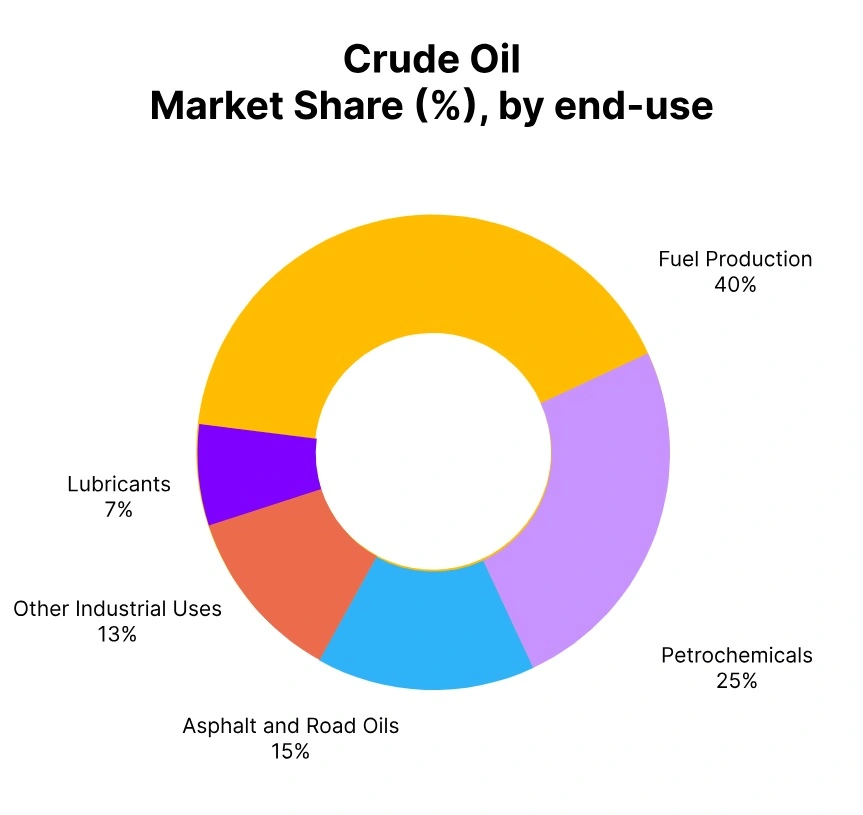
crude oil market share end use

Historically, several events have caused significant fluctuations in Crude Oil prices

  • Russian Invasion of Ukraine (February–March 2022): In late February 2022, Russia’s full‑scale invasion of Ukraine sent crude oil prices soaring above $100 per barrel for the first time since 2014. Markets reacted to the sudden threat of major supply disruptions from one of the world’s largest exporters, compounded by swift Western sanctions that choked off Russian oil flows and forced buyers to scramble for alternative sources
  • COVID‑19 Pandemic and Saudi–Russia Price War (March–April 2020): As the COVID‑19 pandemic collapsed global fuel demand in early 2020, Saudi Arabia and Russia broke down talks on coordinated cuts and unleashed a price war in March. Crude prices plunged by around 65% in Q1 2020, suffering their worst rout since the 1991 Gulf War, and WTI futures famously went negative in April when storage capacity ran out, forcing holders to pay buyers to take oil off their hands.
  • OPEC+ Production Cut Agreement (November 2016): Facing a supply glut and collapsing prices, OPEC and non‑OPEC partners agreed on November 30, 2016, to cut combined output by about 1.2 million barrels per day their first coordinated reduction since 2008. That decision immediately reversed months of declines, driving oil prices up by over 10% as markets snapped back in relief.

Why Price Watch™?

Price Watch™ is your trusted resource for tracking global crude oil price trends. Our platform delivers real-time data and expert analysis, offering deep insights into the key factors driving price fluctuations in the crude oil market. By monitoring critical events such as geopolitical tensions, supply chain disruptions, and economic shifts, Price Watch™ keeps you fully informed of market dynamics.

In addition, Price Watch™ provides detailed forecasts and updates on production capacities, enabling you to anticipate market changes and make well-informed decisions. With Price Watch™, you gain a competitive edge in understanding all the elements that influence crude oil prices worldwide. Stay ahead of the curve with Price Watch’s™ reliable, accurate, and timely crude oil market data.

Track Price Watch's™ crude oil price assessment on a weekly basis since 2015 onwards, along with short-term forecasts, and get access to the detailed report in a downloadable format.

Crude Oil Market Price Trend published by Price Watch™ reflect prevailing spot market conditions, derived from independent research, verified trade inputs, and proprietary market intelligence as of the publication date. Prices are published on the specified Incoterm and represent indicative base market levels, exclusive of applicable taxes, VAT, duties, tariffs, and other statutory charges. Actual transaction values may vary depending on volume, credit terms, contractual structure, and other negotiated conditions. Market prices are inherently subject to volatility, liquidity dynamics, regulatory changes, and evolving trade activity. The information provided is for reference and benchmarking purposes only and does not constitute an offer, recommendation, or guarantee of transactional outcomes. Users should exercise independent commercial judgment and assess their specific contractual, regulatory, tax, and application requirements before making business decisions. Price Watch™ assumes no liability for decisions taken based on this information.

Crude Oil is a naturally occurring fossil fuel that is refined into essential products such as petrol, diesel, jet fuel, and petrochemicals. It plays a vital role in powering transportation, industries, and global trade. Its price matters because it directly affects fuel costs, logistics, and the pricing of everyday goods. Any fluctuation in Crude Oil prices can influence inflation and economic stability worldwide. Price Watch™ tracks these prices to help businesses and consumers understand market trends and make informed decisions.

Crude Oil prices vary depending on benchmarks such as Brent Crude Oil, WTI Crude Oil, and Dubai Fateh. Prices are typically quoted per barrel and change frequently due to global supply-demand conditions, geopolitical developments, and market sentiment. Regional factors and oil quality also influence pricing differences. The presence of abundant supply can keep prices stabilized, while strong demand may push them higher. Price Watch™ provides real-time price assessments across major global markets, helping buyers and sellers stay updated and make well-informed decisions.

Crude Oil prices are influenced by global demand, supply conditions, and economic activity. Demand from transportation, aviation, and industrial sectors plays a key role in determining price direction. On the supply side, production levels from major oil-producing countries and global trade flows impact availability. Seasonal demand variations and geopolitical developments also contribute to price fluctuations. The market often remains stabilized when demand and supply are balanced, while any disruption can lead to volatility. Price Watch™ analyzes these factors to provide accurate insights into market trends.

The transportation sector is the largest consumer of Crude Oil, using fuels like petrol, diesel, and jet fuel across road, air, and sea transport. The petrochemical industry also consumes large volumes to produce plastics, chemicals, and synthetic materials. Other major users include manufacturing, agriculture, and construction sectors. In some regions, Crude Oil is also used for power generation. Its widespread applications make it a key input across multiple industries. Price Watch™ analyzes demand patterns across these sectors to provide a comprehensive understanding of consumption trends.

Crude Oil is formed over millions of years from the remains of ancient marine organisms subjected to high pressure and temperature beneath the Earth’s surface. It is found in underground reservoirs both on land and offshore. Major producing regions include the Middle East, North America, Russia, and Africa. Extraction involves drilling wells and using advanced technology to bring oil to the surface. After extraction, it is transported to refineries for processing. Price Watch™ tracks production levels and regional supply trends to provide insights into global availability.

Saudi Arabia is one of the largest exporters of Crude Oil, followed by countries such as Russia, the United States, Iraq, and the United Arab Emirates. These nations have significant reserves and production capacities, allowing them to supply oil to global markets. Export volumes vary depending on domestic demand, production targets, and international trade conditions. Geopolitical factors also influence export patterns. Price Watch™ tracks export flows, production levels, and trade dynamics to help businesses understand global supply chains and sourcing opportunities.

Global supply of Crude Oil is generally sufficient to meet demand, as major producing countries maintain consistent production levels. However, temporary imbalances can occur due to geopolitical tensions, production adjustments, or sudden demand changes. The presence of abundant supply often helps stabilize the market and prevents sharp price increases. At the same time, disruptions in production or logistics can create short-term shortages. Price Watch™ monitors these supply-demand dynamics to alert the market about potential tightness or surplus conditions.

Crude Oil is classified based on density and sulfur content, commonly referred to as light or heavy, and sweet or sour. Light and sweet Crude Oil is easier to refine and produces higher-value products, making it more expensive. Heavy and sour grades require more processing and are usually priced lower. Common benchmarks include Brent Crude Oil, WTI Crude Oil, and Dubai Fateh. Differences in quality, transportation costs, and regional demand contribute to price variations. Price Watch™ provides separate price assessments for different grades to ensure market transparency.

When demand for Crude Oil rises sharply, prices typically increase as buyers compete for available supply. This situation often occurs during strong economic growth, increased travel activity, or seasonal consumption peaks. Suppliers may try to increase production, but adjustments take time, leading to temporary market tightness. As a result, prices may become more volatile, and buyers could face higher procurement costs. Price Watch™ captures these market dynamics in real time, helping stakeholders respond effectively to changing demand conditions.

Crude Oil prices are closely linked to the broader energy market, including natural gas, coal, and renewable energy sources. Changes in fuel demand, power generation needs, and energy consumption patterns can influence Crude Oil pricing. Higher energy demand typically supports price increases, while lower demand may lead to a slight decrease. The growing shift toward renewable energy is also shaping long-term demand trends. Price Watch™ analyzes these energy market interactions to provide a comprehensive view of Crude Oil pricing dynamics.

Crude Oil prices vary across regions due to factors such as transportation costs, refining capacity, local demand, and infrastructure availability. Oil produced in remote or landlocked areas may be priced lower due to higher logistics costs. Import duties, taxes, and trade policies also contribute to regional price differences. Additionally, variations in oil quality and access to global markets influence pricing. Price Watch™ tracks prices across all major regions to highlight these differences and provide a clear understanding of global market variations.

The outlook for Crude Oil prices depends on global economic growth, production strategies of major oil-producing countries, and demand from key industries. Seasonal consumption patterns and geopolitical stability also play important roles in shaping price trends. If supply remains balanced with demand, prices are likely to remain stabilized, while disruptions could lead to volatility. Price Watch™ regularly publishes detailed forecasts based on supply-demand analysis, seasonal trends, and macroeconomic indicators to help businesses anticipate market conditions.

Accurate Crude Oil price forecasts can significantly benefit businesses by helping them plan procurement, manage budgets, and reduce financial risks. By understanding expected price movements, companies can decide when to purchase or secure long-term contracts. For example, if prices are expected to increase, businesses may choose to buy in advance to avoid higher costs. Forecasting also supports better operational planning and cost control. Price Watch™ provides reliable forecasts that help businesses stay competitive and make informed strategic decisions.

Global events such as geopolitical conflicts, natural disasters, trade restrictions, and economic downturns can disrupt Crude Oil production and supply chains. For example, tensions in oil-producing regions or disruptions in key shipping routes can reduce supply and lead to price increases. On the other hand, economic slowdowns can reduce demand, causing prices to stabilize or show a slight decrease. Events like pandemics and policy changes also influence market conditions. Price Watch™ provides timely alerts when such events impact the market.

Reliable Crude Oil price information is available through trusted market intelligence platforms that collect data from producers, traders, and distributors worldwide. Accurate and transparent pricing is essential for making informed business decisions and understanding market trends. These platforms provide regular updates, detailed reports, and forecasts. Price Watch™ collects and analyzes global data to publish comprehensive price assessments, making it a trusted source for Crude Oil market insights.