

The global Acetic Acid market is shaped by a concentrated production base, capital-intensive assets, and supply chains that transmit disruptions far beyond the facility.
GIO Tracker delivers daily asset-level intelligence on Acetic Acid plants covering capacity, production process, feedstock dependency, operational status, and outage history across all major producing regions. From plant utilisation rates to total production loss by cause, every data point has been captured at the facility level and updated every day. Access the operational intelligence, disruption signals, and pricing impact data needed to stay ahead of supply shifts before they reach the market.
Acetic Acid stands at the core of numerous chemical value chains, serving as the essential building block for vinyl acetate monomer (VAM), purified terephthalic acid (PTA), and a broad spectrum of downstream derivatives. As the primary feedstock for these processes, Acetic Acid directly drives the production of paints, adhesives, polyester fibres, PET resins, and specialty chemicals, profoundly influencing coating markets, packaging films, textiles, and consumer goods.
Acetic acid production is capital-intensive and operationally sensitive, with disruptions at the Acetic Acid stage rarely contained locally and instead rippling through derivative chains with amplified effects. Supply shocks at this foundational level cascade swiftly across VAM-dependent emulsions, PTA polyester supply, and acetate ester applications, reshaping trade dynamics, escalating costs for derivative manufacturers, and constraining regional availability in ways that endure far beyond the originating outage.
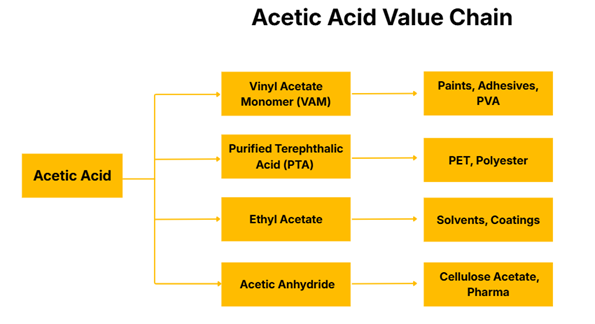
Acetic Acid supply is concentrated, capital-intensive, and slow to replace. When capacity goes offline, price reactions are nonlinear. Get GIO Tracker for early warning on nonlinear Acetic Acid supply shocks across the chemical value chain.
Put GIO Tracker to work across your portfolio to surface those stress points early, quantify at plant-level how outages will ripple through VAM, PTA, ethyl acetate, and key end-use sectors, and turn hidden operational risk into visible, actionable signals before it cascades across the derivatives chain.
Global Overview
Global acetic acid production reached approximately 19+ million tons in 2025, up modestly from 2024, concentrated in methanol carbonylation-dominant regions like Asia (China: ~13M tons); North America (USA: ~4M tons). GIO Tracker provides plant-level visibility across 50+ facilities, tracking capacity shifts and disruptions to forecast supply risks amid steady capacity growth and vulnerability to outages.
The Global Acetic Acid GIO Tracker delivers structured, plant-level operational intelligence across major producing regions. Built on historical tracking since 2015, it monitors 50+ facilities worldwide, combining capacity, utilization, and real-time disruption signals to reveal supply flashpoints in concentrated acetic acid markets that drive VAM, PTA, and downstream chemical derivatives.
Tracks 30+ plants across the region, including more than 30 methanol carbonylation complexes in key coastal clusters. Monitors feedstock disruptions, environmental compliance shutdowns, and typhoon risks that tighten regional and global acetic acid supply flows.
Provides integrated visibility on major acetic acid units across the U.S. and Canada. Tracks turnarounds, hurricane outages, and capacity shifts amid petrochemical demand surges, identifying tightness before regional prices react.
Tracks 5+ plants under intensifying energy transition pressures across major European chemical hubs. Issues real-time alerts on natural gas shortages, carbon compliance shutdowns, and feedstock substitution tests that materially tighten acetic acid supply flows.
Covers growth hubs across the Gulf and key African producers, including integrated methanol-acetic complexes and new greenfield developments. Monitors water and gas risks, feedstock availability, and construction-driven expansions across 3+ sites.
Asia Pacific
Europe
North America
South America
Middle East & Africa
China
India
Germany
France
United Kingdom
USA
Canada
Brazil
Argentina
Saudi Arabia
UAE
Asia Pacific
Europe
North America
South America
Middle East & Africa
China
India
Germany
France
United Kingdom
USA
Canada
Brazil
Argentina
Saudi Arabia
UAE