

Acetone G.I.O Tracker: Plant-Level Capacity and Daily Disruption Tracking & Impact Assessment Since 2015

Overview

The global acetone market is defined by a concentrated production base, capital-intensive infrastructure, and supply chains that are highly susceptible to disruptions.

The GIO Tracker offers daily, asset-level insights into acetone facilities, tracking key factors such as capacity, feedstock dependencies, production processes, operational status, and historical outage data across major production regions. Acetone, a vital raw material to produce acetoneic resins, solvents, and plastics, is significantly influenced by fluctuations in propylene and benzene prices. Despite environmental concerns regarding acetone’s volatility, long-term demand remains strong, particularly due to growth in industries such as automotive, construction, and cosmetics, alongside ongoing initiatives to adopt more sustainable production methods and enhance operational efficiency.

10+ Countries
30+ Production Facilities
40+ Operating Companies
10+ MMTPA Annual Capacity Tracked

Acetone Downstream Impact Mapping

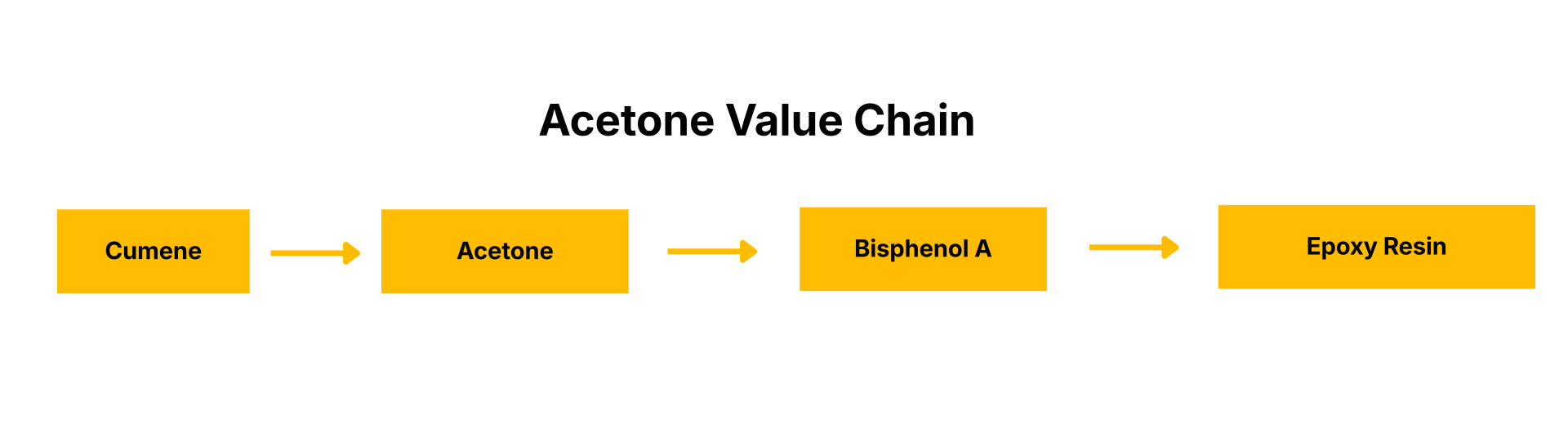
Acetone serves as a critical chemical in various industrial processes, acting as both a solvent and an intermediate in the production of essential products like plastics, pharmaceuticals, and synthetic fibers. As a key output of the petrochemical industry, acetone directly influences a wide range of downstream markets, including coatings, adhesives, and cleaning agents, shaping the cost structure and availability of these products. Its production is highly reliant on petrochemical feedstocks, making it vulnerable to fluctuations in raw material supply and energy costs. Disruptions in acetone production, whether due to supply chain issues or refinery outages, can rapidly ripple across industries, inflating production costs for downstream manufacturers, altering trade flows, and affecting the availability of critical chemicals in ways that can persist long after the initial disruption.
About Acetone G.I.O Tracker


Strategic Visibility – Acetone G.I.O Tracker

The acetone supply chain is defined by high concentration, significant capital investment, and limited operational flexibility. When production capacity is disrupted, price fluctuations can behave nonlinearly, impacting multiple downstream sectors.

By implementing GIO Tracker, early warning signals for nonlinear acetone supply disruptions across the petrochemical value chain can be captured.

Utilizing GIO Tracker across your portfolio allows for the identification of emerging stress points, quantification of the impact of plant-level outages, and assessment of how these disruptions will affect downstream industries such as coatings, adhesives, pharmaceuticals, and the production of methyl methacrylate (MMA). This enables the transformation of latent operational risks into visible, actionable insights, facilitating proactive risk management before disruptions cascade through the acetone market and its critical end-use sectors.

Price Watch™ Acetone G.I.O Tracker Coverage

Global Overview

Global Acetone production reached 7M tons in 2025, increased 5% from 2024, dominant region like Asia Pacific (China: ~5M tons; South Korea: ~1M ton). The acetone industry plays a pivotal role in various downstream sectors, including BPA production, epoxy resins, and nylon fibers. Acetone is a key raw material in the production of Bisphenol A (BPA), which is used in making polycarbonate plastics and epoxy resins for applications in automotive, electronics, and coatings.

Additionally, acetone is essential in the production of epoxy resins, which are widely used in adhesives, coatings, and electrical insulation. Furthermore, it contributes to the production of nylon fibers, which are vital for textiles, automotive parts, and industrial applications.

The Global Acetone GIO Tracker offers invaluable insights into disruptions in acetone supply, allowing stakeholders in these downstream industries to proactively address risks and ensure smooth production processes, minimizing the impact of supply chain challenges in these critical markets.

Asia Pacific Acetone Plant Tracking

Monitors over 30 acetone production facilities across the region, providing essential insights into disruptions such as environmental shutdowns, power rationing, and seismic risks that could affect production and strain both regional and global acetone supply chains. By tracking these risks, the system delivers early warnings, enabling stakeholders to proactively address potential supply disruptions and effectively manage operational challenges within the highly concentrated and interconnected acetone market.

  • China Acetone Plant Tracking: Covers 20+ facilities representing about 35% of global capacity (3M+ tpa), providing daily updates on disruptions such as shutdowns, feedstock shortages, and regulatory-driven plant conversions. These factors indicate shifts in national supply that can impact global Acetone prices, enabling stakeholders to anticipate potential disruptions and make informed decisions in a market subject to regional challenges and regulatory influences.
  • South Korea Acetone Plant Tracking: Monitors 2+ Acetone production plants, representing approximately 5% of global capacity over (1M tpa), providing real-time updates on disruptions such as production stoppages, shutdowns, feedstock shortages, regulatory changes, and capacity expansions that support India’s growth in Acetone production and BPA manufacturing. These insights help stakeholders stay ahead of potential supply disruptions and understand the impacts on the global Acetone market.

North America Acetone Plant Tracking

The North America Acetone Plant Tracking monitors 5+ acetone production facilities, providing insights into production trends, feedstock availability, and operational status. This helps industries like BPA production, epoxy resins, and nylon fibers anticipate disruptions and track capacity shifts, ensuring better decision-making and stable supply chains in acetone-dependent sectors.

  • U.S. Acetone Plant Tracking: Monitors 5+ acetone production plants in the USA, representing over 10% of global acetone capacity, with a total capacity exceeding by (1M tpa). This tool provides critical insights into production trends, feedstock availability, and plant operations. It enables stakeholders to anticipate disruptions in the acetone supply chain, assess capacity shifts, and make informed strategic decisions in downstream industries such as BPA manufacturing, epoxy resins, and nylon fiber production.

Europe Acetone Plant Tracking

Monitors 5+ acetone production facilities in the region, this system delivers critical insights into feedstock shortages, regulatory changes, and capacity expansions, highlighting potential disruptions in acetone production. Early risk detection helps stakeholders take proactive actions to manage supply chain interruptions and operational challenges in the consolidated acetone market.

  • Germany Acetone Plant Tracking: Monitors Acetone production
    facilities (over 0.5M tpa), represent approximately 3% of the global acetone share. The system provides early warnings about feedstock supply disruptions, regulatory-induced shutdowns, and capacity expansions that could affect regional Acetone supply. It helps stakeholders predict changes in supply and make informed decisions in the interconnected acetone market.
  • Belgium Acetone Plant Tracking: Monitors Acetone production facilities (over 0.5M tpa), represent approximately 2% of the global acetone share. providing early warnings on feedstock supply disruptions, regulatory-driven shutdowns, and capacity expansions that impact regional Acetone supply. This system helps stakeholders anticipate shifts in supply and make informed decisions in the interconnected acetone market.

Middle East & Africa Butadiene Plant Tracking

Monitors around 2 plants across the region, providing essential insights into disruptions like refinery maintenance, logistical challenges, and regulatory changes that can affect production and limit both regional and global butadiene flows.

  • Saudi Arabia Butadiene Plant Tracking: Monitors around 2 acetone production facilities, with a capacity of around 0.1M tpa, tracking supply constraints, scheduled maintenance, and seasonal operational slowdowns that contribute to regional supply tightness.

Why Acetone G.I.O Tracker

Acetone G.I.O Tracker – Comprehensive Market Coverage & Intelligence Dashboard

Asset-Level Facility Intelligence

Regional Coverage

Asia Pacific

  • Acetone Capacity (Ktpa) at plant-level by Feedstock Type and Production Process – Asia Pacific
  • Acetone Capacity (Ktpa) at plant-level by Product Type and Unit Type – Asia Pacific
  • Count of Acetone Plants with overall operational capacity – Asia Pacific
  • Acetone Plants by Capacity (Ktpa) and Current Status – Asia Pacific
  • Acetone Plant details (location, region, year of commissioning) – Asia Pacific
  • Announced and Upcoming Acetone Plants with Capacity – Asia Pacific

North America

  • Acetone Capacity (Ktpa) at plant-level by Feedstock Type and Production Process – North America
  • Acetone Capacity (Ktpa) at plant-level by Product Type and Unit Type – North America
  • Count of Acetone Plants with overall operational capacity – North America
  • Acetone Plants by Capacity (Ktpa) and Current Status – North America
  • Acetone Plant details (location, region, year of commissioning) – North America
  • Announced and Upcoming Acetone Plants with Capacity – North America

Europe

  • Acetone Capacity (Ktpa) at plant-level by Feedstock Type and Production Process – Europe
  • Acetone Capacity (Ktpa) at plant-level by Product Type and Unit Type – Europe
  • Count of Acetone Plants with overall operational capacity – Europe
    Acetone Plants by Capacity (Ktpa) and Current Status – Europe
  • Acetone Plant details (location, region, year of commissioning) – Europe
  • Announced and Upcoming Acetone Plants with Capacity – Europe

Middle East & Africa

  • Acetone Capacity (Ktpa) at plant-level by Feedstock Type and Production Process – Middle East & Africa
  • Acetone Capacity (Ktpa) at plant-level by Product Type and Unit Type – Middle East & Africa
  • Count of Acetone Plants with overall operational capacity – Middle East & Africa
  • Acetone Plants by Capacity (Ktpa) and Current Status – Middle East & Africa
  • Acetone Plant details (location, region, year of commissioning) – Middle East & Africa
  • Announced and Upcoming Acetone Plants with Capacity – Middle East & Africa

Country-Level Coverage

China

  • Acetone Capacity (Ktpa) at plant-level by Feedstock Type and Production Process – China
  • Acetone Capacity (Ktpa) at plant-level by Product Type and Unit Type – China
  • Count of Acetone Plants with overall operational capacity – China
  • Acetone Plants by Capacity (Ktpa) and Current Status – China
  • Acetone Plant details (location, region, year of commissioning) – China
  • Announced and Upcoming Acetone Plants with Capacity – China

India

  • Acetone Capacity (Ktpa) at plant-level by Feedstock Type and Production Process – India
  • Acetone Capacity (Ktpa) at plant-level by Product Type and Unit Type – India
  • Count of Acetone Plants with overall operational capacity – India
  • Acetone Plants by Capacity (Ktpa) and Current Status – India
  • Acetone Plant details (location, region, year of commissioning) – India
  • Announced and Upcoming Acetone Plants with Capacity – India

South Korea

  • Acetone Capacity (Ktpa) at plant-level by Feedstock Type and Production Process – South Korea
  • Acetone Capacity (Ktpa) at plant-level by Product Type and Unit Type – South Korea
  • Count of Acetone Plants with overall operational capacity – South Korea
  • Acetone Plants by Capacity (Ktpa) and Current Status – South Korea
  • Acetone Plant details (location, region, year of commissioning) – South Korea
  • Announced and Upcoming Acetone Plants with Capacity – South Korea

Taiwan

  • Acetone Capacity (Ktpa) at plant-level by Feedstock Type and Production Process – Taiwan
  • Acetone Capacity (Ktpa) at plant-level by Product Type and Unit Type – Taiwan
  • Count of Acetone Plants with overall operational capacity – Taiwan
  • Acetone Plants by Capacity (Ktpa) and Current Status – Taiwan
  • Acetone Plant details (location, region, year of commissioning) – Taiwan
  • Announced and Upcoming Acetone Plants with Capacity – Taiwan

Thailand

  • Acetone Capacity (Ktpa) at plant-level by Feedstock Type and Production Process – Thailand
  • Acetone Capacity (Ktpa) at plant-level by Product Type and Unit Type – Thailand
  • Count of Acetone Plants with overall operational capacity – Thailand
  • Acetone Plants by Capacity (Ktpa) and Current Status – Thailand
  • Acetone Plant details (location, region, year of commissioning) – Thailand
  • Announced and Upcoming Acetone Plants with Capacity – Thailand

Singapore

  • Acetone Capacity (Ktpa) at plant-level by Feedstock Type and Production Process – Singapore
  • Acetone Capacity (Ktpa) at plant-level by Product Type and Unit Type – Singapore
  • Count of Acetone Plants with overall operational capacity – Singapore
  • Acetone Plants by Capacity (Ktpa) and Current Status – Singapore
  • Acetone Plant details (location, region, year of commissioning) – Singapore
  • Announced and Upcoming Acetone Plants with Capacity – Singapore

Japan

  • Acetone Capacity (Ktpa) at plant-level by Feedstock Type and Production Process – Japan
  • Acetone Capacity (Ktpa) at plant-level by Product Type and Unit Type – Japan
  • Count of Acetone Plants with overall operational capacity – Japan
  • Acetone Plants by Capacity (Ktpa) and Current Status – Japan
  • Acetone Plant details (location, region, year of commissioning) – Japan
  • Announced and Upcoming Acetone Plants with Capacity – Japan

Germany

  • Acetone Capacity (Ktpa) at plant-level by Feedstock Type and Production Process – Germany
  • Acetone Capacity (Ktpa) at plant-level by Product Type and Unit Type – Germany
  • Count of Acetone Plants with overall operational capacity – Germany
  • Acetone Plants by Capacity (Ktpa) and Current Status – Germany
  • Acetone Plant details (location, region, year of commissioning) – Germany
  • Announced and Upcoming Acetone Plants with Capacity – Germany

Finland

  • Acetone Capacity (Ktpa) at plant-level by Feedstock Type and Production Process – Finland
  • Acetone Capacity (Ktpa) at plant-level by Product Type and Unit Type – Finland
  • Count of Acetone Plants with overall operational capacity – Finland
  • Acetone Plants by Capacity (Ktpa) and Current Status – Finland
  • Acetone Plant details (location, region, year of commissioning) – Finland
  • Announced and Upcoming Acetone Plants with Capacity – Finland

Spain

  • Acetone Capacity (Ktpa) at plant-level by Feedstock Type and Production Process – Spain
  • Acetone Capacity (Ktpa) at plant-level by Product Type and Unit Type – Spain
  • Count of Acetone Plants with overall operational capacity – Spain
  • Acetone Plants by Capacity (Ktpa) and Current Status – Spain
  • Acetone Plant details (location, region, year of commissioning) – Spain
  • Announced and Upcoming Acetone Plants with Capacity – Spain

Belgium

  • Acetone Capacity (Ktpa) at plant-level by Feedstock Type and Production Process – Belgium
  • Acetone Capacity (Ktpa) at plant-level by Product Type and Unit Type – Belgium
  • Count of Acetone Plants with overall operational capacity – Belgium
  • Acetone Plants by Capacity (Ktpa) and Current Status – Belgium
  • Acetone Plant details (location, region, year of commissioning) – Belgium
  • Announced and Upcoming Acetone Plants with Capacity – Belgium

Italy

  • Acetone Capacity (Ktpa) at plant-level by Feedstock Type and Production Process – Italy
  • Acetone Capacity (Ktpa) at plant-level by Product Type and Unit Type – Italy
  • Count of Acetone Plants with overall operational capacity – Italy
  • Acetone Plants by Capacity (Ktpa) and Current Status – Italy
  • Acetone Plant details (location, region, year of commissioning) – Italy
  • Announced and Upcoming Acetone Plants with Capacity – Italy

Poland

  • Acetone Capacity (Ktpa) at plant-level by Feedstock Type and Production Process – Poland
  • Acetone Capacity (Ktpa) at plant-level by Product Type and Unit Type – Poland
  • Count of Acetone Plants with overall operational capacity – Poland
  • Acetone Plants by Capacity (Ktpa) and Current Status – Poland
  • Acetone Plant details (location, region, year of commissioning) – Poland
  • Announced and Upcoming Acetone Plants with Capacity – Poland

USA

  • Acetone Capacity (Ktpa) at plant-level by Feedstock Type and Production Process – USA
  • Acetone Capacity (Ktpa) at plant-level by Product Type and Unit Type – USA
  • Count of Acetone Plants with overall operational capacity – USA
  • Acetone Plants by Capacity (Ktpa) and Current Status – USA
  • Acetone Plant details (location, region, year of commissioning) – USA
  • Announced and Upcoming Acetone Plants with Capacity – USA

Saudi Arabia

  • Acetone Capacity (Ktpa) at plant-level by Feedstock Type and Production Process – Saudi Arabia
  • Acetone Capacity (Ktpa) at plant-level by Product Type and Unit Type – Saudi Arabia
  • Count of Acetone Plants with overall operational capacity – Saudi Arabia
  • Acetone Plants by Capacity (Ktpa) and Current Status – Saudi Arabia
  • Acetone Plant details (location, region, year of commissioning) – Saudi Arabia
  • Announced and Upcoming Acetone Plants with Capacity – Saudi Arabia

Daily Operations Tracker

Regional Tracking

Asia Pacific

  • Total Operational Capacity (Ktpa) at plant level
  • Total Disrupted Capacity (Ktpa) and Production Loss (Kt) at plant level
  • Plant Outage Duration (Start Date and End Date)
  • Disruption Cause and Impact on Price
  • Plant Disruption by disruption type (Permanent or Temporary)

Europe

  • Total Operational Capacity (Ktpa) at plant level
  • Total Disrupted Capacity (Ktpa) and Production Loss (Kt) at plant level
  • Plant Outage Duration (Start Date and End Date)
  • Disruption Cause and Impact on Price
  • Plant Disruption by disruption type (Permanent or Temporary)

North America

  • Total Operational Capacity (Ktpa) at plant level
  • Total Disrupted Capacity (Ktpa) and Production Loss (Kt) at plant level
  • Plant Outage Duration (Start Date and End Date)
  • Disruption Cause and Impact on Price
  • Plant Disruption by disruption type (Permanent or Temporary)

Middle East & Africa

  • Total Operational Capacity (Ktpa) at plant level
  • Total Disrupted Capacity (Ktpa) and Production Loss (Kt) at plant level
  • Plant Outage Duration (Start Date and End Date)
  • Disruption Cause and Impact on Price
  • Plant Disruption by disruption type (Permanent or Temporary)

Country-wise Tracking

China

  • Total Operational Capacity (Ktpa) at plant level
  • Total Disrupted Capacity (Ktpa) and Production Loss (Kt) at plant level
  • Plant Outage Duration (Start Date and End Date)
  • Disruption Cause and Impact on Price
  • Plant Disruption by disruption type (Permanent or Temporary)

India

  • Total Operational Capacity (Ktpa) at plant level
  • Total Disrupted Capacity (Ktpa) and Production Loss (Kt) at plant level
  • Plant Outage Duration (Start Date and End Date)
  • Disruption Cause and Impact on Price
  • Plant Disruption by disruption type (Permanent or Temporary)

Taiwan

  • Total Operational Capacity (Ktpa) at plant level
  • Total Disrupted Capacity (Ktpa) and Production Loss (Kt) at plant level
  • Plant Outage Duration (Start Date and End Date)
  • Disruption Cause and Impact on Price
  • Plant Disruption by disruption type (Permanent or Temporary)

South Korea

  • Total Operational Capacity (Ktpa) at plant level
  • Total Disrupted Capacity (Ktpa) and Production Loss (Kt) at plant level
  • Plant Outage Duration (Start Date and End Date)
  • Disruption Cause and Impact on Price
  • Plant Disruption by disruption type (Permanent or Temporary)

Japan

  • Total Operational Capacity (Ktpa) at plant level
  • Total Disrupted Capacity (Ktpa) and Production Loss (Kt) at plant level
  • Plant Outage Duration (Start Date and End Date)
  • Disruption Cause and Impact on Price
  • Plant Disruption by disruption type (Permanent or Temporary)

Singapore

  • Total Operational Capacity (Ktpa) at plant level
  • Total Disrupted Capacity (Ktpa) and Production Loss (Kt) at plant level
  • Plant Outage Duration (Start Date and End Date)
  • Disruption Cause and Impact on Price
  • Plant Disruption by disruption type (Permanent or Temporary)

Thailand

  • Total Operational Capacity (Ktpa) at plant level
  • Total Disrupted Capacity (Ktpa) and Production Loss (Kt) at plant level
  • Plant Outage Duration (Start Date and End Date)
  • Disruption Cause and Impact on Price
  • Plant Disruption by disruption type (Permanent or Temporary)

Germany

  • Total Operational Capacity (Ktpa) at plant level
  • Total Disrupted Capacity (Ktpa) and Production Loss (Kt) at plant level
  • Plant Outage Duration (Start Date and End Date)
  • Disruption Cause and Impact on Price
  • Plant Disruption by disruption type (Permanent or Temporary)

Finland

  • Total Operational Capacity (Ktpa) at plant level
  • Total Disrupted Capacity (Ktpa) and Production Loss (Kt) at plant level
  • Plant Outage Duration (Start Date and End Date)
  • Disruption Cause and Impact on Price
  • Plant Disruption by disruption type (Permanent or Temporary)

Italy

  • Total Operational Capacity (Ktpa) at plant level
  • Total Disrupted Capacity (Ktpa) and Production Loss (Kt) at plant level
  • Plant Outage Duration (Start Date and End Date)
  • Disruption Cause and Impact on Price
  • Plant Disruption by disruption type (Permanent or Temporary)

Spain

  • Total Operational Capacity (Ktpa) at plant level
  • Total Disrupted Capacity (Ktpa) and Production Loss (Kt) at plant level
  • Plant Outage Duration (Start Date and End Date)
  • Disruption Cause and Impact on Price
  • Plant Disruption by disruption type (Permanent or Temporary)

Poland

  • Total Operational Capacity (Ktpa) at plant level
  • Total Disrupted Capacity (Ktpa) and Production Loss (Kt) at plant level
  • Plant Outage Duration (Start Date and End Date)
  • Disruption Cause and Impact on Price
  • Plant Disruption by disruption type (Permanent or Temporary)

Belgium

  • Total Operational Capacity (Ktpa) at plant level
  • Total Disrupted Capacity (Ktpa) and Production Loss (Kt) at plant level
  • Plant Outage Duration (Start Date and End Date)
  • Disruption Cause and Impact on Price
  • Plant Disruption by disruption type (Permanent or Temporary)

USA

  • Total Operational Capacity (Ktpa) at plant level
  • Total Disrupted Capacity (Ktpa) and Production Loss (Kt) at plant level
  • Plant Outage Duration (Start Date and End Date)
  • Disruption Cause and Impact on Price
  • Plant Disruption by disruption type (Permanent or Temporary)

Saudi Arabia

  • Total Operational Capacity (Ktpa) at plant level
  • Total Disrupted Capacity (Ktpa) and Production Loss (Kt) at plant level
  • Plant Outage Duration (Start Date and End Date)
  • Disruption Cause and Impact on Price
  • Plant Disruption by disruption type (Permanent or Temporary)
  • Plant Disruption by disruption type (Permanent or Temporary)

Frequently Asked Questions – Acetone G.I.O Tracker

What is the Acetone GIO Tracker?

The Acetone GIO Tracker is an advanced operational intelligence platform that provides real-time monitoring of acetone production, disruptions, capacity, supply risks, and price impacts across key production regions globally.

What does the Acetone GIO Tracker monitor?

It tracks key parameters such as acetone production capacity (Mtpa), production processes, feedstock dependencies, operational status, capacity expansions, plant startups and shutdowns, maintenance turnarounds, restarts, outage durations, and the quantification of production losses at the individual plant level.

How often is the data updated?

The Acetone GIO Tracker updates operational statuses and disruption signals daily, providing up-to-date visibility into global acetone supply trends and any emerging risks.

How is production loss calculated?

Production losses are assessed by evaluating the impacted capacity, the duration of outages, and the operational status of the plant, providing an accurate estimation of the total production loss (Mtpa) for comprehensive risk and impact analysis.

Does the Acetone GIO Tracker cover global or regional markets?

The platform offers global coverage, providing detailed insights into regional and country-specific markets, including Asia-Pacific, Europe, North America, Middle East & Africa.

Who benefits from the Acetone GIO Tracker?

The platform benefits acetone producers, raw material procurement teams, commodity traders, supply chain risk managers, and strategic planners, helping them anticipate shifts in acetone supply and pricing risks.

How does it differ from country-level Acetone production reports?

Unlike national production reports, the Acetone GIO Tracker monitors individual acetone production facilities, enabling early detection of supply disruptions and potential risks before they are reflected in aggregate national data.

How does it assist in managing Acetone supply risks?

The tracker supports proactive decision-making by quantifying production losses, monitoring outage durations, and assessing downstream impacts on industries such as BPA production, epoxy resins, and nylon fibers, thus enabling better management of supply chain risks.

Can I analyse Acetone alongside other petrochemical commodities?

Yes, the Acetone GIO Tracker uses a standardized plant-level framework, allowing users to analyse acetone disruptions, capacity shifts, and supply risks in comparison to other petrochemical commodities, facilitating comprehensive cross-commodity risk assessments.

Get Full Access to Acetone Intelligence Subscribe to unlock facility-level data, daily disruption alerts and full G.I.O Tracker coverage.

UPGRADE NOW