

The global Ammonia market is characterized by a concentrated production base, capital-intensive infrastructure, and interconnected supply chains where disruptions can extend well beyond the Haber–Bosch production unit.
GIO Tracker delivers daily asset-level intelligence on Ammonia facilities covering capacity, production process, feedstock dependency, operational status, and outage history across all major producing regions. From ammonia synthesis utilisation rates to total production loss by cause, every data point is captured at the facility level and updated every day. Access the operational intelligence, disruption signals, and pricing impact data needed to stay ahead of supply shifts before they reach the market.
Ammonia sits at the core of fertilizer and industrial value chains, serving as the foundational input from which the broader agriculture, refrigeration, and chemical industries derive their essential functionality. As the primary output of the Haber-Bosch process, Ammonia directly influences urea, ammonium nitrate, ammonium sulfate, and a wide range of downstream nitrogen-based products.
Its production is inherently capital-intensive and operationally rigid, meaning that capacity losses at the Ammonia stage are rarely absorbed quickly and tend to propagate through the value chain with outsized force. Supply disruptions at the Ammonia stage transmit rapidly across fertilizer-dependent crop cycles, explosives manufacturing, refrigeration systems, and industrial applications, altering trade flows, inflating input costs for fertilizer blenders and chemical producers, and tightening regional availability in ways that can persist well beyond the initial outage.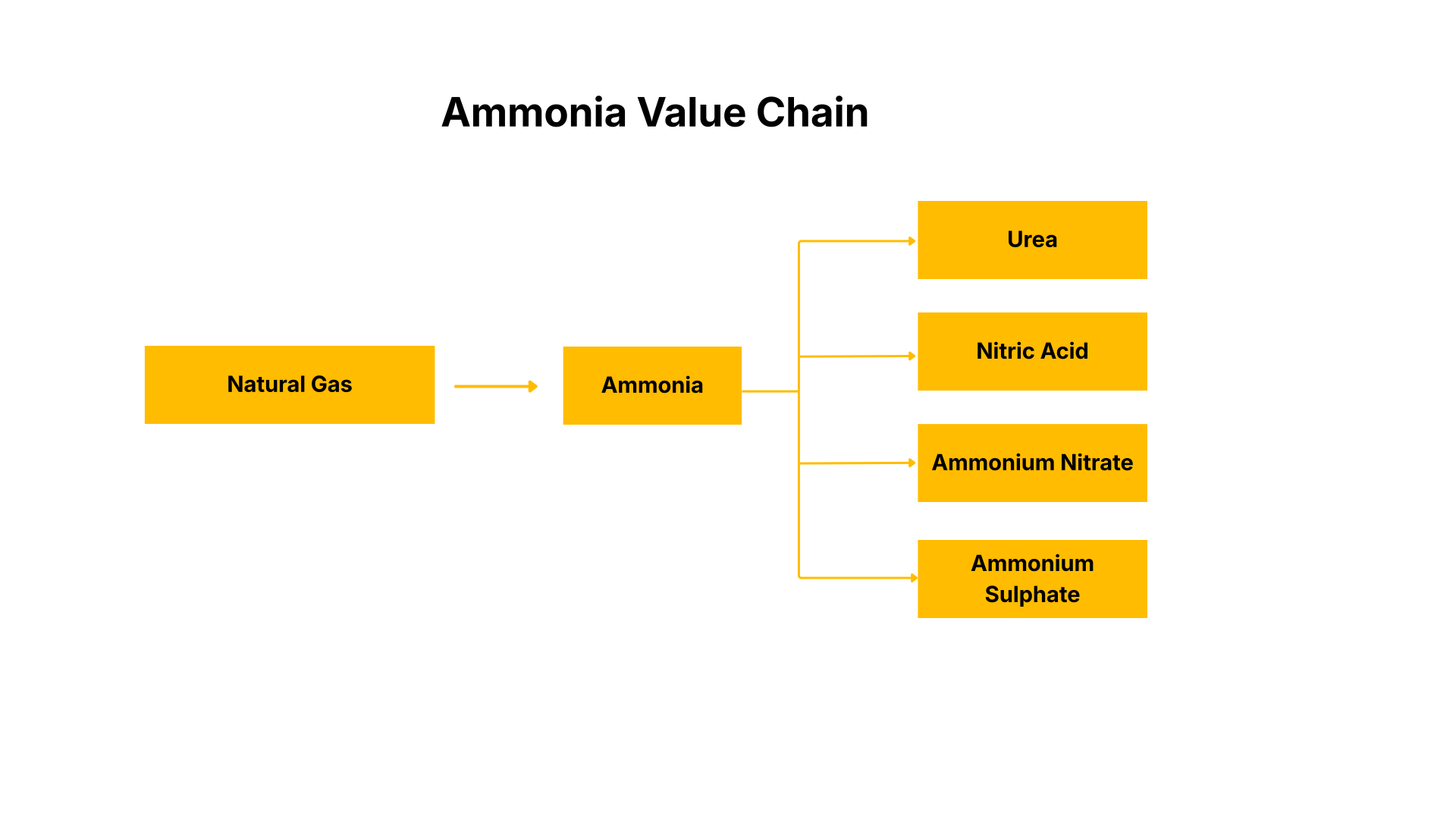
Ammonia supply is concentrated, capital-intensive, and slow to replace. When capacity goes offline, price reactions are nonlinear. Get GIO Tracker for early warning on nonlinear Ammonia supply shocks across the fertilizer and industrial value chain.
Put GIO Tracker to work across your portfolio to surface those stress points early, quantify at plant-level how outages will ripple through urea, ammonium nitrate, refrigeration, and key end-use sectors, and turn hidden operational risk into visible, actionable signals before it cascades across the agricultural and chemical value chain.
Global Overview
Global Ammonia production reached over 150+ million tons in 2025, concentrated in natural gas-dominant regions like Asia (China/India: 63+ Mtpa combined), North America (USA/Trinidad: 25+ Mtpa combined), Europe (Russia/Germany: 13+ Mtpa combined) and Middle East & Africa (Iran/Saudi Arabia: 12M+ tons combined). GIO Tracker provides plant-level visibility across 250+ facilities, tracking capacity shifts and disruptions to forecast supply risks amid steady capacity growth and vulnerability to outages.
The Global Ammonia GIO Tracker delivers structured, plant-level operational intelligence across major producing regions. Built on historical tracking since 2015, it monitors 250+ facilities worldwide, combining capacity, utilization, and real-time disruption signals to reveal supply flashpoints in concentrated Ammonia markets that drive global fertilizers, explosives, and industrial applications.
Tracks 120+ plants across the region in key fertilizer and industrial clusters. Monitors environmental shutdowns, natural gas feedstock shortages, and monsoon risks that tighten regional and global ammonia flows.
Tracks 40+ plants across the region in key fertilizer and industrial clusters. Monitors environmental shutdowns, natural gas feedstock shortages, and monsoon risks that tighten regional and global ammonia flows.
Tracks 40+ plants under intensifying energy transition pressures across major European fertilizer hubs. Issues real-time alerts on natural gas shortages, carbon compliance shutdowns, and hydrogen supply disruptions that materially tighten ammonia flows.
Tracks 50+ plants across the region in key fertilizer and industrial clusters. Monitors environmental shutdowns, natural gas feedstock shortages, and monsoon risks that tighten regional and global ammonia flows.
Monitors 2+ facilities across the region. Monitors environmental shutdowns, natural gas feedstock shortages, and monsoon risks that tighten regional and global ammonia flows.
Asia Pacific
Europe
North America
Middle East & Africa
South America
China
India
Iran
Japan
Nepal
USA
Canada
Egypt
Kuwait
Russia
Germany
UK
Netherlands
Belgium
Italy
France
Spain
Czech Republic
Brazil
Asia Pacific
Europe
North America
Middle East & Africa
South America
China
India
Nepal
Iran
Japan
Canada
USA
Egypt
Kuwait
Belgium
Czech Republic
France
Germany
Italy
Netherlands
Russia
Spain
UK
Brazil
Nigeria
UAE
Bahrain
Iran
Saudi Arabia
Libya
Qatar
South Africa
Lithuania
Russia
Germany
UK
Slovakia
Poland
Georgia
Bulgaria
Hungary
Ukraine
Estonia
Netherlands
Norway
Belgium
Italy
France