

The global Butadiene market is characterized by a concentrated production base and capital-intensive assets, resulting in significant exposure to disruptions that can propagate across the entire supply chain.
GIO Tracker delivers daily asset-level intelligence on Butadiene facilities covering capacity, production process, feedstock dependency, operational status, and outage history across all major producing regions. The global demand for butadiene is intrinsically linked to the automotive sector, and its supply is subject to fluctuations in crude oil prices. Although environmental concerns exist due to its carcinogenic nature, the long-term demand for butadiene remains robust, particularly in emerging markets, accompanied by ongoing efforts to develop more sustainable and efficient production methodologies.
Butadiene’s downstream impact has been significant, as it serves as a key raw material in various industries, particularly in the production of synthetic rubber, plastics, and other chemicals. Its primary downstream applications include the manufacture of styrene-butadiene rubber (SBR) and butadiene rubber (BR), which are crucial in the automotive sector for tire production. These products directly influence the automotive and transportation industries by contributing to the production of durable, high-performance tires.
Additionally, butadiene is used in the production of acrylonitrile butadiene styrene (ABS), a widely used plastic in consumer goods, electronics, and automotive parts. The demand for butadiene in these industries drives economic growth, particularly in regions with robust automotive and manufacturing sectors, such as North America and Asia-Pacific.
However, fluctuations in butadiene supply, often linked to oil price volatility, can have ripple effects across these downstream industries, influencing production costs, product pricing, and overall industry stability. Moreover, environmental regulations and concerns regarding the carcinogenic nature of butadiene are pushing for more sustainable production methods, which could reshape its downstream impact in the future.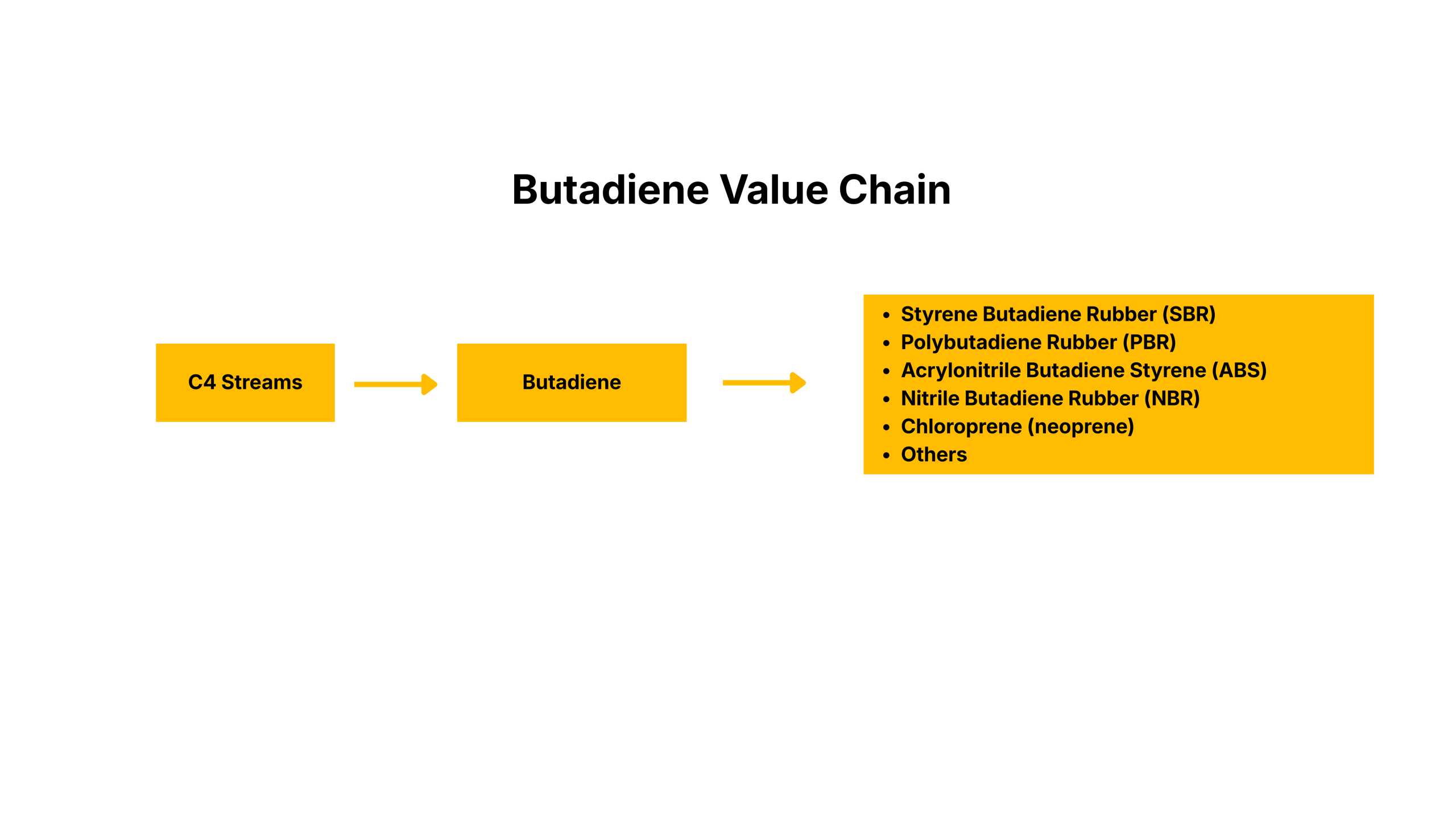
Butadiene supply is characterized by high concentration, capital intensity, and slow adaptability. When production capacity is taken offline, price fluctuations often exhibit nonlinear behaviour.
Implement GIO Tracker to gain early warning signals for nonlinear butadiene supply disruptions across the petrochemical value chain.
By utilizing GIO Tracker across your portfolio, you can identify emerging stress points, quantify the impact of outages at the plant level, and assess how these disruptions will affect downstream sectors, including synthetic rubber production, automotive, and plastics. This enables the transformation of hidden operational risks into visible, actionable insights, allowing for proactive risk management before these disruptions propagate throughout the butadiene market and its key end-use industries.
Global Overview
Global Butadiene production reached 14 million tonnes in 2025, Increased by approximately by 2% from 2024, dominant regions like Asia (China: ~5M tons; South Korea: ~1M ton).
The Global Butadiene GIO Tracker delivers structured, plant level operational intelligence across major producing regions, built on historical monitoring since 2015. It tracks 100+ facilities worldwide, integrating capacity, utilization, and real time disruption signals to pinpoint supply vulnerabilities in concentrated butadiene markets. This enables early detection of emerging supply flashpoints, helping stakeholders forecast risks in the butadiene value chain and respond proactively to potential disruptions affecting downstream industries such as synthetic rubber, automotive, and plastics manufacturing.
Tracks 80+ plants across the region, it provides critical insights into factors such as environmental shutdowns, power rationing, and seismic risks that can disrupt production and tighten both regional and global merchant butadiene flows. By tracking these risks, the system offers early warnings, enabling stakeholders to better anticipate supply disruptions and manage operational challenges in the highly concentrated and interconnected butadiene market.
North America Butadiene Plant Tracking monitors over 10 plants across the region, providing critical insights into disruptions such as refinery maintenance, logistical challenges, and policy changes that can affect production and tighten both regional and global butadiene flows. This system offers early warnings, enabling stakeholders to anticipate supply disruptions and make informed decisions in a complex and interconnected butadiene market.
Tracks over 20 plants across the region, offering vital insights into disruptions such as refinery maintenance, logistical issues, and regulatory changes that can impact production and constrain both regional and global butadiene flows.
Monitors more than 3 plants across the region, providing essential insights into disruptions like refinery maintenance, logistical challenges, and regulatory changes that can affect production and limit both regional and global butadiene flows.
Tracks 1+ facilities region-wide, delivering critical visibility into refinery outages, logistics bottlenecks, and regulatory impacts affecting local/global butadiene supply flows.
Asia Pacific
North America
South America
Middle East & Africa
China
India
Singapore
South Korea
Taiwan
Thailand
Japan
Vietnam
Malaysia
Indonesia
Philippines
Germany
France
Austria
Spain
Belgium
Italy
UK
Netherlands
Russia
USA
Canada
Brazil
Saudi Arabia
Asia Pacific
Europe
North America
South America
Middle East & Africa
China
Taiwan
Japan
India
Singapore
Vietnam
Indonesia
Thailand
Malaysia
Philippines
Germany
Netherlands
Belgium
France
Italy
Spain
Austria
UK
Russia
USA
Canada
Brazil
Saudi Arabia