
The global phenol market is characterized by a concentrated production base, capital-intensive assets, and supply chains sensitive to disruptions.
GIO Tracker offers daily asset-level insights into phenol facilities, tracking capacity, feedstock dependency, production processes, operational status, and outage history across key producing regions. Phenol, a key raw material in the production of plastics, resins, and synthetic Fibers, is heavily influenced by fluctuations in benzene and propylene prices. While environmental concerns exist due to phenol’s toxicity, robust long-term demand persists, especially in emerging markets, with ongoing efforts focused on sustainable production practices and efficiency improvements.
Phenol is a critical raw material in the production of bisphenol-A (BPA), which is used in the manufacturing of polycarbonate plastics, epoxy resins, and phenolic resins-materials widely employed in the electronics, automotive, and construction industries. Additionally, phenol plays a vital role in the production of nylon fibers.
The demand for phenol significantly contributes to economic activity across these sectors. However, fluctuations in phenol supply, often influenced by changes in benzene and propylene prices, can affect production costs and pricing. Furthermore, increasing environmental concerns regarding phenol’s toxicity are driving the adoption of more sustainable production methods.
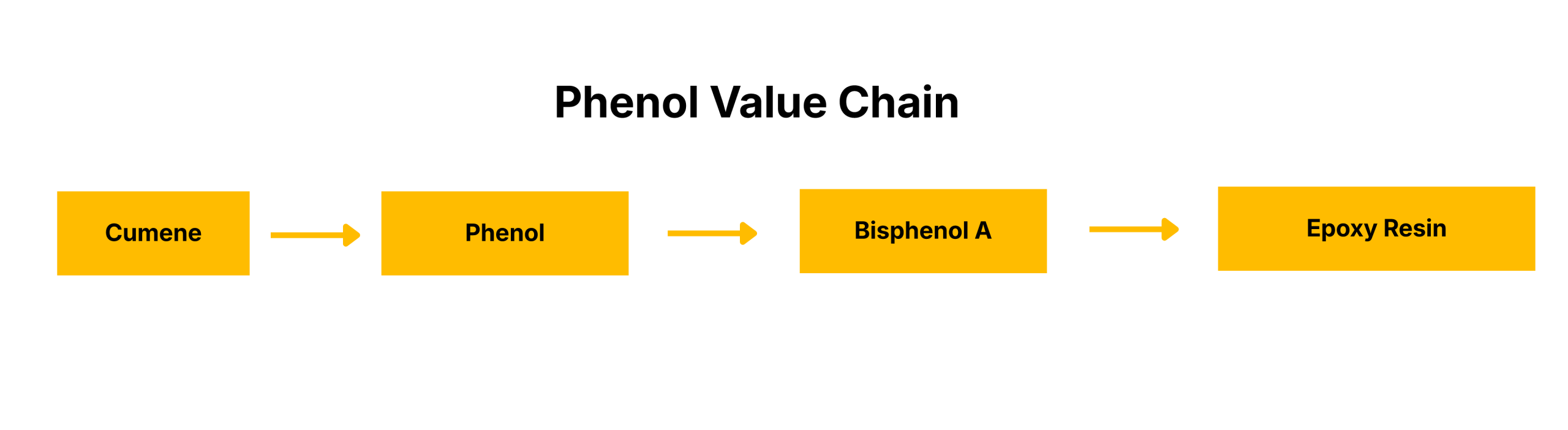
The phenol supply chain is characterized by high concentration, substantial capital investment, and limited flexibility. When production capacity is disrupted, price fluctuations often exhibit nonlinear behaviour, impacting multiple downstream sectors.
By implementing GIO Tracker, early warning signals for nonlinear phenol supply disruptions across the petrochemical value chain can be obtained.
Utilizing GIO Tracker across your portfolio allows for the identification of emerging stress points, quantification of the impact of plant-level outages, and assessment of how these disruptions will affect downstream industries such as BPA production, epoxy resins, and nylon fibers. This enables the conversion of latent operational risks into visible, actionable insights, facilitating proactive risk management before disruptions propagate throughout the phenol market and its key end-use industries.
Global Overview
Global Phenol production reached 9M tons in 2025, down 5% from 2024, dominant region like Asia Pacific (China: ~5M tons; South Korea: ~1M ton). The Global Phenol GIO Tracker provides structured, plant-level operational intelligence across major producing regions, built on historical monitoring since 2015. It tracks 50+ facilities worldwide, integrating capacity, utilization, and real-time disruption signals to identify supply vulnerabilities in concentrated phenol markets. This enables early detection of emerging supply risks, helping stakeholders forecast potential disruptions in the BPA production, epoxy resins, and nylon fibers value chains, and respond proactively to challenges impacting downstream industries.
Tracks 35+ phenol production facilities across the region, providing key insights into disruptions like environmental shutdowns, power rationing, and seismic risks that can impact production and tighten both regional and global phenol supply chains. By monitoring these risks, the system offers early warnings, helping stakeholders proactively address supply disruptions and navigate operational challenges in the concentrated and interconnected phenol market.
North America Phenol Plant Tracking monitors over phenol production facilities, providing key insights into production trends, feedstock availability, and operational status. This tracking system helps stakeholders anticipate disruptions and assess capacity shifts in the region’s phenol supply chain, supporting better decision-making in industries such as BPA production, epoxy resins, and nylon fibers.
Monitors more than 5 phenol production facilities across the region, collectively accounting for approximately 15% of global phenol capacity and surpassing 2 million tonnes per annum (tpa). This system provides essential intelligence on disruptions such as feedstock shortages, regulatory shifts, and capacity expansions that impact production and strain regional and global phenol supply chains. Through early risk detection, it enables stakeholders to implement proactive measures against supply interruptions and manage operational challenges in the highly consolidated phenol market.
Monitors more than 3 plants across the region, providing essential insights into disruptions like refinery maintenance, logistical challenges, and regulatory changes that can affect production and limit both regional and global butadiene flows.
Asia Pacific
North America
Europe
Middle East & Africa
China
India
South Korea
Taiwan
Thailand
Singapore
Japan
Germany
France
Finland
Spain
Belgium
Italy
Poland
Czech Republic
USA
Saudi Arabia
South Africa
Asia Pacific
Europe
North America
Middle East & Africa
China
India
Taiwan
South Korea
Japan
Singapore
Thailand
Germany
France
Finland
Italy
Spain
Poland
Czech Republic
Belgium
USA
Saudi Arabia
South Africa