

The global salt market is characterized by a highly integrated production base, significant capital investments, and supply chains sensitive to fluctuations.
The GIO Tracker provides daily, asset-level insights into Salt facilities, monitoring production capacity, feedstock dependencies (primarily brine and rock salt deposits), operational status, plant outages, and maintenance histories across major production regions. Salt is a critical feedstock in the production of chlorine, caustic soda, soda ash, and de-icing products, and is significantly impacted by shifts in the prices of crude oil and energy inputs.
GIO tracker helps industry players manage supply chain risks, optimize procurement strategies, and maintain production continuity amidst global market volatility. By providing detailed disruption insights, it supports proactive decision-making for businesses dependent on salt, ensuring resilience in operations and mitigating potential market shocks in key sectors.
Salt is an essential raw material in a wide range of industries, including chemicals, food processing, agriculture, deicing, and pharmaceuticals. Disruptions in salt production, caused by feedstock shortages (such as brine or rock salt), plant outages, utility disruptions, or regulatory changes, can lead to increased raw material costs, supply shortages, extended procurement cycles, and operational inefficiencies. In the chemical industry, salt is used as a feedstock for producing chlorine, caustic soda, and other vital chemicals.
The food industry relies on salt for preservation, seasoning, and flavour enhancement, while agriculture uses it for animal feed and crop production. In the deicing sector, salt is crucial for winter road maintenance. Growing environmental concerns are driving the shift toward eco-friendly alternatives to traditional deicing salt and pushing for more sustainable salt production methods, influencing long-term market trends and supply chain dynamics.
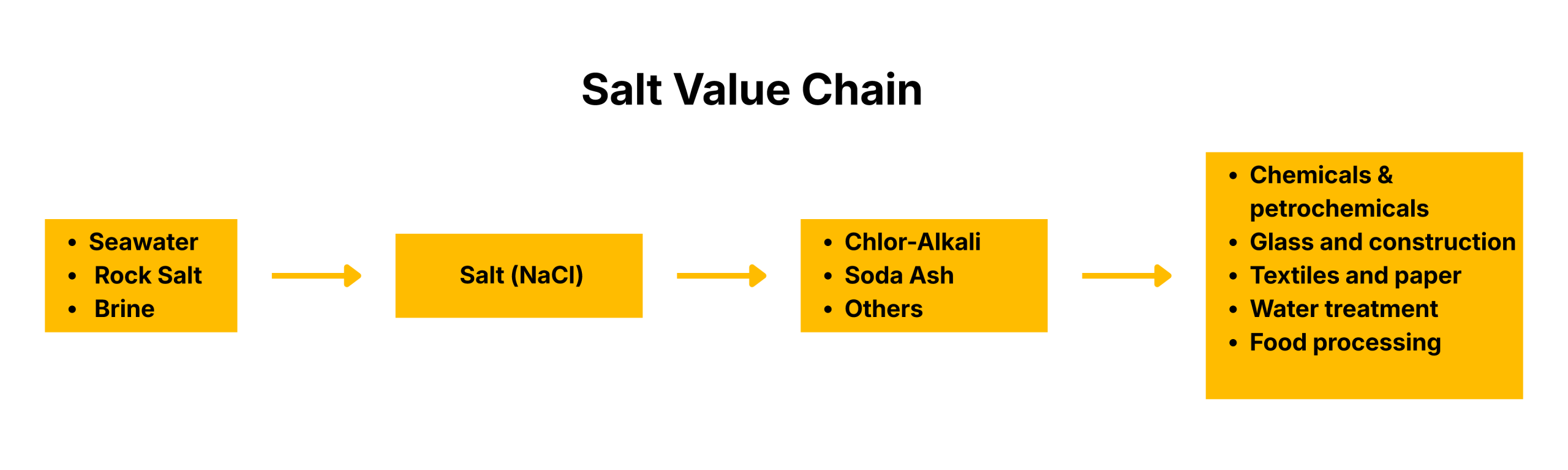
Salt production is a capital-intensive process, relying on key sources such as rock salt, brine, and seawater, making the market particularly sensitive to feedstock availability, weather conditions, and price volatility. Production is also vulnerable to operational disruptions, feedstock shortages, and fluctuations in costs. Any plant shutdowns, capacity reductions, or regulatory changes can create price instability and supply uncertainty for important downstream products like chlorine, caustic soda, and industrial-grade salt, which are used across chemicals, food preservation, deicing, and agricultural industries. The Global Salt Tracker offers plant-level insights and disruption alerts, allowing stakeholders to anticipate supply disruptions, manage procurement risks, optimize profit margins, and strengthen resilience throughout the global salt supply chain. This visibility enables businesses to effectively navigate market fluctuations and make informed strategic decisions.
Global Overview
Global salt production is over 290 million tonnes in 2025, marking a relatively stable growth compared to 2024. The Salt Industry GIO Tracker provides real-time, plant-level operational insights, with a particular focus on downstream market exposure.
Monitoring over 170 salt production facilities worldwide, including major producers in Asia-Pacific (China: 45M+ tpa; India:15M+ tpa) and North America (USA: 30M+ tpa), the tracker integrates data on nameplate capacity, operating rates, feedstock dependencies (including brine and rock salt), and disruption signals. It identifies vulnerabilities within the salt supply chain, impacting industries such as food processing, chemicals, de-icing, water treatment, and agriculture.
By tracking supply risks, outages, price fluctuations, and transportation bottlenecks, the tracker enables proactive decision-making, supports supply chain resilience, and fosters stability in global salt markets.
The Asia-Pacific Salt Industry Plant Tracker monitors over 60 salt production facilities, providing insights into operational risks, supply-demand balances, and capacity expansion. It aids businesses in forecasting market tightness, price fluctuations, and supply disruptions, supporting risk management and supply chain resilience for industries like chemical production, food processing, and de-icing.
The North America Salt Industry Plant Tracker monitors over 40 Salt production facilities, it assists businesses in forecasting market constraints, price volatility, and potential supply disruptions, thereby enhancing risk management and strengthening supply chain resilience in industries such as chemical production, food processing, and de-icing.
The Europe Salt Industry Plant Tracker monitors approximately 50 salt production facilities helping businesses anticipate market constraints, price fluctuations, and potential supply disruptions. This supports improved risk management and bolsters supply chain resilience across industries such as chemical production, food processing, and de-icing.
The MEA Salt Industry Plant Tracker monitors over 35 salt production facilities, enabling businesses to anticipate market constraints, price fluctuations, and potential supply disruptions. This enhances risk management and strengthens supply chain resilience across key industries, including chemical production, food processing, and de-icing.
Asia Pacific
North America
Europe
Middle East & Africa
China
India
Pakistan
Taiwan
Thailand
Bangladesh
Japan
Vietnam
Australia
Indonesia
Germany
France
Ireland
Spain
Belgium
Poland
Denmark
Italy
Switzerland
UK
Austria
Netherlands
Russia
Turkey
USA
Mexico
Canada
Bahamas
Iran
Saudi Arabia
Egypt
Algeria
South Africa
Israel
Cuba
Botswana
Tunisia
Asia Pacific
Europe
North America
Middle East & Africa
China
Taiwan
Japan
Australia
India
Bangladesh
Pakistan
Vietnam
Indonesia
Thailand
Germany
Netherlands
Belgium
France
Spain
Italy
Switzerland
UK
Austria
Denmark
Poland
Turkey
Russia
Ireland
USA
Mexico
Canada
Bahamas
Saudi Arabia
Iran
Egypt
South Africa
Israel
Algeria
Botswana
Cuba
Tunisia