

Vinyl Acetate Monomer (VAM) G.I.O Tracker: Plant-Level Capacity and Daily Disruption Tracking & Impact Assessment Since 2015

Overview

The global vinyl acetate monomer (VAM) market is characterized by a concentrated production base, capital-intensive plants, and supply chains vulnerable to ethylene and acetic acid price volatility.

The GIO Tracker provides daily, asset-level insights into VAM facilities, tracking capacity, feedstock dependencies (ethylene, acetic acid, oxygen via Pd catalyst), production processes, operational status, and historical outages across major regions like Asia, Europe, and North America. VAM, a key raw material for polyvinyl acetate, EVA copolymers, adhesives, paints, and coatings, sees pricing closely tied to ethylene and acetic acid costs amid energy pressures and capacity shifts in China. Long-term demand remains robust, driven by construction, packaging, and automotive growth, with advances in catalyst efficiency and bio-based routes enhancing sustainability.

20++ Countries
10++ Production Facilities
20++ Operating Companies
6+ MMTPA Annual Capacity Tracked

Vinyl Acetate Monomer (VAM) Downstream Impact Mapping

Vinyl acetate monomer (VAM) is a critical raw material used in industries such as construction, automotive, and packaging, primarily in products like polyvinyl acetate (PVA), adhesives, paints, and coatings.

Disruptions in VAM production, caused by factors such as feedstock shortages, plant shutdowns, or regulatory changes, can significantly impact these downstream sectors, resulting in supply shortages and price fluctuations. Industries like construction materials, automotive components, and textile finishing are particularly sensitive to changes in VAM supply. Additionally, growing environmental concerns are driving the adoption of more sustainable production methods, which could alter market dynamics. The shift towards eco-friendly production could influence pricing, supply chain stability, and procurement strategies, potentially reshaping the global VAM supply chain in the years to come.
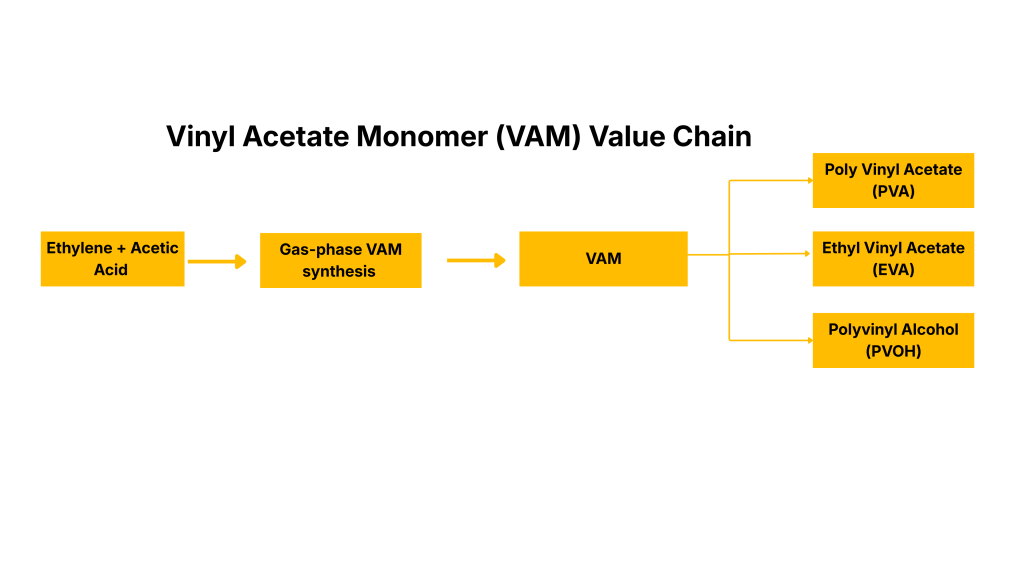
VAM Value Chain

Strategic Visibility – Vinyl Acetate Monomer (VAM) G.I.O Tracker

VAM supply is concentrated and feedstock-dependent, making it vulnerable to disruptions that can lead to significant price fluctuations. The GIO Tracker provides early alerts on potential supply shocks, helping industries like construction, automotive, and packaging manage risks.

Utilizing GIO Tracker across your portfolio allows for the identification of emerging stress points, quantification of the impact of plant-level outages, and assessment of how these disruptions will affect downstream industries.

By monitoring plant-level disruptions and assessing their impact on downstream applications like PVA, adhesives, and coatings, the tracker enables proactive decisions to maintain stability and navigate evolving feedstock and regulatory changes in the VAM supply chain.

Price Watch™ Vinyl Acetate Monomer (VAM) G.I.O Tracker Coverage

Global Overview

Global VAM production surpassed 6+ million tonnes in 2025, marking a 3% increase from 2024. The VAM G.I.O Tracker provides real-time, plant-level operational intelligence, focusing on the downstream impacts of VAM production. By monitoring over 20 facilities worldwide, particularly in key regions like Asia Pacific (China: 2M+ tpa) and North America (USA: 1M+ tpa), the tracker integrates data on capacity, utilization, and disruption signals to identify risks in VAM supply chains that affect critical downstream industries. These industries include construction (for adhesives and coatings), automotive (for PVA-based components), packaging, and textiles, where disruptions in VAM production can directly affect the availability and pricing of key products such as polyvinyl acetate (PVA), paints, and coatings. The tracker enables early detection of supply risks, allowing industry players to anticipate potential disruptions and proactively adjust strategies to mitigate their impact across the value chain.

Asia Pacific VAM Plant Tracking

Tracker monitors 15+ facilities in the region, tracking risks like feedstock shortages, plant outages, and regulatory changes that could disrupt production. By providing early warnings, it helps industries manage potential disruptions and maintain a steady supply of Vinyl Acetate Monomer. Sectors like adhesives, paints and coatings, and PVA production benefit from this real-time tracking, ensuring stable supply chains and reducing production downtime.

  • China VAM Plant Tracking: Monitors 10+ production facilities and capacity over 2+ million tonnes per annum (tpa), representing around 40% of global capacity. The system tracks disruptions like feedstock shortages, plant outages, and regulatory changes, impacting regional supply and pricing. It helps industry players address challenges in sectors such as adhesives, paints and coatings, and polyvinyl acetate (PVA) production.

North America VAM Plant Tracking

Tracker monitors 5+ facilities in the region It delivers early alerts to manage disruptions and secure VAM supply continuity. Adhesives, paints/coatings, and PVA producers benefit from real-time intelligence, minimizing downtime and stabilizing supply chains.

  • USA VAM Plant Tracking: Monitors 3+ production facilities and capacity over 1 million tonnes per annum (tpa), accounting for more than 10% of global capacity. It tracks disruptions such as feedstock shortages, plant shutdowns, and regulatory changes, which affect regional supply and pricing. This helps industry players navigate challenges in sectors like adhesives, paints and coatings, and polyvinyl acetate (PVA) production.

Europe VAM Plant Tracking

Tracker monitors 3+ facilities in the region, delivering early warnings to manage operational disruptions and ensure uninterrupted VAM supply. Adhesives, paints/coatings, and PVA manufacturers leverage real-time data to optimize production schedules, reduce downtime, and enhance supply chain resilience.

  • Germany VAM Plant Tracking: Monitors 2+ production facilities and capacity of 0.5+ million tonnes per annum (tpa) and tracks disruptions like feedstock shortages, plant shutdowns, and regulatory changes, helping industries such as adhesives, paints/coatings, and PVA production manage supply and pricing challenges.

Middle East & Africa VAM Plant Tracking

Tracker monitors facilities in the region, providing early alerts to manage operational disruptions and maintain a continuous VAM supply. Adhesives, paints/coatings, and PVA producers utilize real-time data to optimize production, minimize downtime, and strengthen supply chain resilience.

  • Saudi Arabia VAM Plant Tracking: Monitors production facilities and capacity around 0.3+million tonnes per annum (tpa). The tracker tracks disruptions like feedstock shortages, plant shutdowns, and regulatory changes, helping industries such as adhesives, paints/coatings, and PVA production manage supply and pricing challenges.

Why Vinyl Acetate Monomer (VAM) G.I.O Tracker

Vinyl Acetate Monomer (VAM) G.I.O Tracker – Comprehensive Market Coverage & Intelligence Dashboard

Asset-Level Facility Intelligence

Regional Coverage

Asia Pacific

  • VAM Capacity (Ktpa) at plant-level by Feedstock Type and Production Process – Asia Pacific
  • VAM Capacity (Ktpa) at plant-level by Product Type and Unit Type – Asia Pacific
  • Count of VAM Plants with overall operational capacity – Asia Pacific
  • VAM Plants by Capacity (Ktpa) and Current Status – Asia Pacific
  • VAM Plant details (location, region, year of commissioning) – Asia Pacific
  • Announced and Upcoming VAM Plants with Capacity – Asia Pacific

North America

  • VAM Capacity (Ktpa) at plant-level by Feedstock Type and Production Process – North America
  • VAM Capacity (Ktpa) at plant-level by Product Type and Unit Type – North America
  • Count of VAM Plants with overall operational capacity – North America
  • VAM Plants by Capacity (Ktpa) and Current Status – North America
  • VAM Plant details (location, region, year of commissioning) – North America
  • Announced and Upcoming VAM Plants with Capacity – North America

Europe

  • VAM Capacity (Ktpa) at plant-level by Feedstock Type and Production Process – Europe
  • VAM Capacity (Ktpa) at plant-level by Product Type and Unit Type – Europe
  • Count of VAM Plants with overall operational capacity – Europe
  • VAM Plants by Capacity (Ktpa) and Current Status – Europe
  • VAM Plant details (location, region, year of commissioning) – Europe
  • Announced and Upcoming VAM Plants with Capacity – Europe

Middle East & Africa

  • VAM Capacity (Ktpa) at plant-level by Feedstock Type and Production Process – Middle East & Africa
  • VAM Capacity (Ktpa) at plant-level by Product Type and Unit Type – Middle East & Africa
  • Count of VAM Plants with overall operational capacity – Middle East & Africa
  • VAM Plants by Capacity (Ktpa) and Current Status – Middle East & Africa
  • VAM Plant details (location, region, year of commissioning) – Middle East & Africa
  • Announced and Upcoming VAM Plants with Capacity – Middle East & Africa

Country-Level Coverage

China

  • VAM Capacity (Ktpa) at plant-level by Feedstock Type and Production Process – China
  • VAM Capacity (Ktpa) at plant-level by Product Type and Unit Type – China
  • Count of VAM Plants with overall operational capacity – China
  • VAM Plants by Capacity (Ktpa) and Current Status – China
  • VAM Plant details (location, region, year of commissioning) – China
  • Announced and Upcoming VAM Plants with Capacity – China

South Korea

  • VAM Capacity (Ktpa) at plant-level by Feedstock Type and Production Process – South Korea
  • VAM Capacity (Ktpa) at plant-level by Product Type and Unit Type – South Korea
  • Count of VAM Plants with overall operational capacity – South Korea
  • VAM Plants by Capacity (Ktpa) and Current Status – South Korea
  • VAM Plant details (location, region, year of commissioning) – South Korea
  • Announced and Upcoming VAM Plants with Capacity – South Korea

Taiwan

  • VAM Capacity (Ktpa) at plant-level by Feedstock Type and Production Process – Taiwan
  • VAM Capacity (Ktpa) at plant-level by Product Type and Unit Type – Taiwan
  • Count of VAM Plants with overall operational capacity – Taiwan
  • VAM Plants by Capacity (Ktpa) and Current Status – Taiwan
  • VAM Plant details (location, region, year of commissioning) – Taiwan
  • Announced and Upcoming VAM Plants with Capacity – Taiwan

Singapore

  • VAM Capacity (Ktpa) at plant-level by Feedstock Type and Production Process – Singapore
  • VAM Capacity (Ktpa) at plant-level by Product Type and Unit Type – Singapore
  • Count of VAM Plants with overall operational capacity – Singapore
  • VAM Plants by Capacity (Ktpa) and Current Status – Singapore
  • VAM Plant details (location, region, year of commissioning) – Singapore
  • Announced and Upcoming VAM Plants with Capacity – Singapore

Germany

  • VAM Capacity (Ktpa) at plant-level by Feedstock Type and Production Process – Germany
  • VAM Capacity (Ktpa) at plant-level by Product Type and Unit Type – Germany
  • Count of VAM Plants with overall operational capacity – Germany
  • VAM Plants by Capacity (Ktpa) and Current Status – Germany
  • VAM Plant details (location, region, year of commissioning) – Germany
  • Announced and Upcoming VAM Plants with Capacity – Germany

USA

  • VAM Capacity (Ktpa) at plant-level by Feedstock Type and Production Process – USA
  • VAM Capacity (Ktpa) at plant-level by Product Type and Unit Type – USA
  • Count of VAM Plants with overall operational capacity – USA
  • VAM Plants by Capacity (Ktpa) and Current Status – USA
  • VAM Plant details (location, region, year of commissioning) – USA
  • Announced and Upcoming VAM Plants with Capacity – USA

Saudi Arabia

  • VAM Capacity (Ktpa) at plant-level by Feedstock Type and Production Process – Saudi Arabia
  • VAM Capacity (Ktpa) at plant-level by Product Type and Unit Type – Saudi Arabia
  • Count of VAM Plants with overall operational capacity – Saudi Arabia
  • VAM Plants by Capacity (Ktpa) and Current Status – Saudi Arabia
  • VAM Plant details (location, region, year of commissioning) – Saudi Arabia
  • Announced and Upcoming VAM Plants with Capacity – Saudi Arabia

Daily Operations Tracker

Regional Tracking

Asia Pacific

  • Total Operational Capacity (Ktpa) at plant level
  • Total Disrupted Capacity (Ktpa) and Production Loss (Kt) at plant level
  • Plant Outage Duration (Start Date and End Date)
  • Disruption Cause and Impact on Price
  • Plant Disruption by disruption type (Permanent or Temporary)

Europe

  • Total Operational Capacity (Ktpa) at plant level
  • Total Disrupted Capacity (Ktpa) and Production Loss (Kt) at plant level
  • Plant Outage Duration (Start Date and End Date)
  • Disruption Cause and Impact on Price
  • Plant Disruption by disruption type (Permanent or Temporary)

North America

  • Total Operational Capacity (Ktpa) at plant level
  • Total Disrupted Capacity (Ktpa) and Production Loss (Kt) at plant level
  • Plant Outage Duration (Start Date and End Date)
  • Disruption Cause and Impact on Price
  • Plant Disruption by disruption type (Permanent or Temporary)

Middle East & Africa

  • Total Operational Capacity (Ktpa) at plant level
  • Total Disrupted Capacity (Ktpa) and Production Loss (Kt) at plant level
  • Plant Outage Duration (Start Date and End Date)
  • Disruption Cause and Impact on Price
  • Plant Disruption by disruption type (Permanent or Temporary)

Country-wise Tracking

China

  • Total Operational Capacity (Ktpa) at plant level
  • Total Disrupted Capacity (Ktpa) and Production Loss (Kt) at plant level
  • Plant Outage Duration (Start Date and End Date)
  • Disruption Cause and Impact on Price
  • Plant Disruption by disruption type (Permanent or Temporary)

Taiwan

  • Total Operational Capacity (Ktpa) at plant level
  • Total Disrupted Capacity (Ktpa) and Production Loss (Kt) at plant level
  • Plant Outage Duration (Start Date and End Date)
  • Disruption Cause and Impact on Price
  • Plant Disruption by disruption type (Permanent or Temporary)

South Korea

  • Total Operational Capacity (Ktpa) at plant level
  • Total Disrupted Capacity (Ktpa) and Production Loss (Kt) at plant level
  • Plant Outage Duration (Start Date and End Date)
  • Disruption Cause and Impact on Price
  • Plant Disruption by disruption type (Permanent or Temporary)

Singapore

  • Total Operational Capacity (Ktpa) at plant level
  • Total Disrupted Capacity (Ktpa) and Production Loss (Kt) at plant level
  • Plant Outage Duration (Start Date and End Date)
  • Disruption Cause and Impact on Price
  • Plant Disruption by disruption type (Permanent or Temporary)

Germany

  • Total Operational Capacity (Ktpa) at plant level
  • Total Disrupted Capacity (Ktpa) and Production Loss (Kt) at plant level
  • Plant Outage Duration (Start Date and End Date)
  • Disruption Cause and Impact on Price
  • Plant Disruption by disruption type (Permanent or Temporary)

USA

  • Total Operational Capacity (Ktpa) at plant level
  • Total Disrupted Capacity (Ktpa) and Production Loss (Kt) at plant level
  • Plant Outage Duration (Start Date and End Date)
  • Disruption Cause and Impact on Price
  • Plant Disruption by disruption type (Permanent or Temporary)

Saudi Arabia

  • Total Operational Capacity (Ktpa) at plant level
  • Total Disrupted Capacity (Ktpa) and Production Loss (Kt) at plant level
  • Plant Outage Duration (Start Date and End Date)
  • Disruption Cause and Impact on Price
  • Plant Disruption by disruption type (Permanent or Temporary)

Frequently Asked Questions – Vinyl Acetate Monomer (VAM) G.I.O Tracker

What is the VAM GIO Tracker?

The VAM GIO Tracker is an asset-level operational intelligence platform that monitors global vinyl acetate monomer (VAM) production capacity, disruptions, production loss, and price impacts across key VAM-producing regions.

What does the VAM GIO Tracker monitor?

It tracks VAM capacity (Mtpa), production processes, feedstock dependency, operational status, capacity additions, plant commissioning, shutdowns, maintenance turnarounds, restarts, outage duration, and quantified production loss at the facility level.

How frequently is the data updated?

Plant-level operational status and disruption signals are updated daily to provide real-time visibility into global VAM supply developments.

How is production loss calculated?

Each VAM disruption is assessed based on affected capacity, outage duration, and operating status to estimate measurable production loss (Mtpa), enabling structured impact analysis across global supply chains.

Does the VAM GIO Tracker cover global or regional markets?

It provides global coverage with structured regional and country-level drill-down across Asia-Pacific, Europe, North America, and other key VAM-producing regions.

Who benefits from the VAM GIO Tracker?

VAM producers, raw material procurement teams, commodity traders, supply chain risk managers, and strategy teams use the platform to anticipate VAM supply shifts, pricing risks, and supply chain vulnerabilities.

How does it differ from country-level VAM production reports?

Unlike aggregated national statistics, the VAM GIO Tracker monitors individual VAM production facilities, enabling early identification of supply risks and disruptions before they appear in official production data.

How does it help manage VAM supply risk?

By quantifying production loss, tracking outage duration, and mapping downstream exposure to VAM-dependent industries like adhesives, paints/coatings, and PVA production, the platform supports proactive procurement, trading, and strategic planning decisions.

Can I analyse VAM alongside other materials and commodities?

Yes. The VAM GIO Tracker applies a consistent plant-level intelligence framework that allows users to compare VAM disruptions, capacity shifts, and supply risks alongside other chemical and polymer value chains. Standardized metrics such as capacity (Mtpa), outage duration, and production loss enable cross-commodity risk comparison and identification of ripple effects across global supply chains.

Get Full Access to Vinyl Acetate Monomer (VAM) Intelligence Subscribe to unlock facility-level data, daily disruption alerts and full G.I.O Tracker coverage.

UPGRADE NOW