Ilmenite Price Trend and Forecast

UNSPC code: 15121902
|
Weekly Update
|
Historical Data Since 2015
|
Forecast for 2026
  • Commodity Pricing

ilmenite Price Trends by Country

cnChina
mzMozambique

Global ilmenite Spot Market Prices, Trend Analysis and Forecast

𝐏𝐫𝐢𝐜𝐞 𝐖𝐚𝐭𝐜𝐡™ provides price assessments for Ilmenite across top trading regions:

Asia-Pacific

  • Ilmenite Purity:52%min CIF Qingdao (Mozambique), China


Africa

  • Ilmenite Purity:52%min FOB Mozambique, Mozambique


Note: In assessments structured as CIF [Importing Port] (Exporting Country), the country mentioned in brackets indicates the primary origin of supply (exporting country), while the named port refers to the destination port in the importing country. Other Incoterms (FOB, FD, EXW, etc.) should be interpreted in accordance with standard international trade definitions.

Ilmenite Price Trend Q4 2025

In Q4 2025, the worldwide Ilmenite market saw a decline in price as a result of lower global demand which resulted in an overall downward trend in ilmenite price in each of these regions. China has been affected by an oversupply of ilmenite and slow rate of titanium dioxide production in addition to an overall declining market for all ilmenite products while the market in Mozambique has been negatively impacted by low export quotations being offered and by the decline in import inquiries from other countries.

Overall ilmenite feedstock supplies have been generally available worldwide; however, there has been a general lack of economic activity in the construction and coatings industries worldwide, resulting in the overall economic activity in the Ilmenite industry being less than what would be expected worldwide. There have been some areas of stability throughout various industrial segments, but overall, the ilmenite market experienced a marked decline and going forward into the new year will be cautiously viewed as positive.

China: Ilmenite Import prices CIF Qingdao, China; Purity:52%min.

According to Price-Watch™ , In Q4 2025, ilmenite prices trend in China declined by 6.26% compared to Q3, reflecting a sharper weakening in market sentiment. The downturn was driven by continued subdued demand from the titanium dioxide and pigment industries, cautious procurement by downstream buyers, and rising domestic inventories amid steady production.

Export activity remained limited, and slower manufacturing output further constrained price support. By December, Ilmenite prices in China fell an additional -2.97%, as elevated inventories and soft end-user demand maintained downward pressure. Overall, the ilmenite market in China during Q4 2025 exhibited a bearish trend, with mild stabilization expected in early 2026 as downstream orders gradually recover.

Mozambique: Ilmenite Export prices FOB Mozambique, Africa; Purity:52%min.

In Q4 2025, ilmenite prices trend in Mozambique declined by -7.33% compared to Q3, driven by weaker global titanium dioxide demand, cautious downstream procurement, and elevated feedstock inventories, which limited price support despite stable mining and export operations.

The market saw continued pressure from oversupply and subdued industrial activity, particularly in Asia and Europe, while minor logistical and energy cost variations had little impact on overall pricing. In December 2025, Ilmenite prices in Mozambique fell further by -3.19%, reflecting persistent soft demand from major importers and delayed purchases amid high inventories. Overall, the Q4 market exhibited a pronounced declining trend, with expectations of moderate stabilization in early 2026 as downstream demand gradually recovers.

Ilmenite Price Trend Analysis: Q4 2025

In Q3 2025, the global Ilmenite market displayed a mixed trend, with overall prices declining slightly by around 0.13% from the previous quarter. While some regions witnessed stable demand from the pigment and welding industries, others faced mild downward pressure due to subdued titanium dioxide production activity. In China, marginal oversupply and cautious buying sentiment kept market conditions soft, whereas Mozambique saw relatively firm export offers supported by consistent overseas inquiries.

Weakness in global construction and coatings demand, coupled with moderate feedstock availability, led to limited price fluctuations overall. Despite regional variations, the market largely remained balanced, ending the quarter with a marginal decline and a cautiously neutral outlook.

China: Ilmenite Import prices CIF Qingdao, China, Purity:52%min.

According to PriceWatch, in the third quarter of 2025, Ilmenite prices in China decreased by 0.30% compared to the previous quarter, indicating a minor decline in market sentiment. The modest weakening has primarily been a result of stable, and conservative, demand from the titanium dioxide and welding electrode markets, along with steady supply conditions. While raw material and energy prices have been stable, limited export demand, and conservative consumption downstream limited price action.

Producers continued to operate at normal production levels, and end-users were cautious regarding procurement levels, given stock levels appeared balanced. Overall, the market had a mildly bearish tone, with Ilmenite pricing marginally lower than the previous quarter. In September 2025, Ilmenite prices in China fell by 2.43%, primarily due to weaker demand from both pigment and titanium dioxide sectors due to softer manufacturing activity. Stable local supply levels and build in inventories of Ilmenite also put pressure on prices as export demand remained limited.

Mozambique: Ilmenite Export prices FOB Mozambique, Africa, Purity:52%min.

In Q3 2025, the Ilmenite price trend in Mozambique rose slightly at 0.03% relative to the previous quarter’s prices indicating a stable market with very little serious volatility in the pricing. This slight uptick has been attributed to steady demand from international titanium dioxide producers and continuing shipments to the Asian markets, primarily China and India. Supported by stable mining operations with balanced inventories led to stable pricing.

Adjustments relating to transportation and energy finally resulted in the slight price increase. Overall, the market remained neutral to mildly positive during the quarter, and pricing did demonstrate limited, albeit steady, improvement. In September, however, Ilmenite prices in Mozambique saw a decline of 2.24%. The decline in pricing has largely been attributed to weaker demand from larger consuming countries as well as slower-than-expected demand in global titanium dioxide production.

According to the PriceWatch, In Q2 2025, ilmenite prices experienced a modest increase of $360.75 per metric ton, CIF Qingdao reflecting a 0.39% rise compared to the previous quarter. This price movement signals a slow but steady recovery in the market, driven by improving demand in downstream sectors such as automotive and coatings, alongside constrained supply conditions.

While the first quarter saw soft demand and high inventory levels that pressured prices, Q2 benefited from gradual restocking and production stabilization. Spot prices in major markets like Malaysia and the U.S. averaged between $332 and $336 per metric ton, suggesting a cautiously optimistic outlook as the titanium dioxide (TiO₂) sector begins to regain momentum. 

In Q1 2025, the price trend of ilmenite experienced a notable decline, dropping by $359.33 per metric ton, CIF Qingdao which equates to a 3.58% decrease from the previous quarter. This downward trend reflects a combination of subdued global demand, particularly from the titanium dioxide pigment and welding industries, and increased supply from major producers such as Australia and Mozambique.

The global market also faced pressure from lower-than-expected industrial activity in China, one of the key consumers of ilmenite. Additionally, macroeconomic uncertainties and cautious buying behaviour contributed to the softer pricing. As a result, market sentiment remained bearish throughout the quarter, signalling potential adjustments in production strategies among suppliers if the trend persists. 

Ilmenite Price Trend Analysis: Q4 2024

In Q4 2024, ilmenite prices experienced a notable decline, dropping by $372.66 per metric ton, CIF Qingdao which corresponds to a 5.01% decrease. This downturn reflects shifting market dynamics, possibly driven by reduced demand in key industrial sectors such as titanium dioxide production or steel manufacturing.

Additionally, factors like increased supply, changes in export policies, or broader economic uncertainties may have contributed to the price softness. This decline could impact profitability for producers and prompt buyers to reassess procurement strategies, potentially signalling a more cautious market outlook heading into 2025. 

In Q3 2024, ilmenite experienced a notable price decline, decreasing by $392.33 per metric ton, CIF Qingdao which translates to a 1.75% drop compared to the previous quarter. This downward trend suggests a potential softening in demand or an oversupply in the market, possibly driven by fluctuations in the titanium dioxide pigment industry or shifts in global mining outputs.

The price adjustment could also reflect broader economic factors such as changes in production costs, currency volatility, or evolving trade policies impacting key producing regions. Market participants should monitor these dynamics closely, as continued price pressure might influence profitability and investment decisions within the ilmenite supply chain. 


In Q2 2024, ilmenite prices experienced a noticeable decline, dropping by $399.33 per metric ton, CIF Qingdao which corresponds to a 1.07% decrease. This downward movement suggests a subtle weakening in demand or an increase in supply within the market during the period. Factors such as shifts in the titanium dioxide pigment industry, fluctuations in global production, or changes in import-export dynamics could have contributed to this price adjustment.

While the percentage drop appears modest, the significant absolute decrease in price per ton indicates potential challenges for producers and traders, possibly prompting a reassessment of supply strategies or cost management to maintain profitability in a slightly softer market environment. 

In the first quarter of 2024, ilmenite prices experienced a notable decline, dropping by $403.66 per metric ton, CIF Qingdao which corresponds to a 1.54% decrease. This downward trend suggests a softening demand or an oversupply in the market, possibly influenced by fluctuations in downstream industries such as titanium dioxide production or changes in global economic conditions.

The price adjustment may reflect shifting trade dynamics, input cost variations, or inventory corrections as suppliers and buyers recalibrate to current market realities. Overall, this modest decline highlights the ongoing volatility and sensitivity of the ilmenite market to broader industrial and economic factors. 


Technical Specifications of Ilmenite Price Trends

Product Description

Ilmenite is a titanium iron oxide mineral (FeTiO₃) and a key source of titanium dioxide (TiO₂), widely utilized across industrial, chemical, and manufacturing sectors. Renowned for its high titanium content and magnetic properties, ilmenite is primarily processed to produce TiO₂ pigment, which is essential in paints, plastics, papers, and coatings due to its brightness and opacity.

In addition to its role in pigment production, ilmenite is used in the welding industry as a fluxing agent and in the creation of high-performance alloys for aerospace and defence applications. Its natural abundance and chemical stability also make it valuable in environmental remediation and emerging energy technologies.

Identifiers and Classification:

  • HS Code – 261400


Ilmenite Synonyms:

  • Ilmenite
  • Titanium iron oxide
  • Titanium ore
  • Titanium-iron oxide
  • Titaniferous iron ore
  • Iron titanium oxide


Ilmenite Grades Specific Price Assessment:

  • Ilmenite Purity:52%min. Price Trend


Ilmenite Global Trade and Shipment Terms

  • Quotation Terms (Product & Country Specific): 10000-15000 MT
  • Packaging Type (Product & Country Specific): Bulk


Incoterms Referenced in Ilmenite Price Reporting

Shipping Term  Location  Definition 
CIF Qingdao  Qingdao, China  Ilmenite Export price from China 
FOB Mozambique  Mozambique, Africa  Domestically Traded Ilmenite price in Africa 

Quotation Terms refers to the quantity range specified for the Ilmenite being quoted or offered in a commercial transaction.

Packaging Type refers to standard packaging size commonly used for Ilmenite packing, ease of handling, transportation, and storage in industrial and commercial applications.

Key Ilmenite Manufacturers

Manufacturer 
Kenmare Resources – Moma Titanium Minerals Mine 
Rio Tinto – Richards Bay Minerals 
Lomon Billions Group (LB Group Co., Ltd.) 
Anning Tietai (Sichuan Anning Iron and Titanium Co. Ltd.) 

Ilmenite Industrial Applications

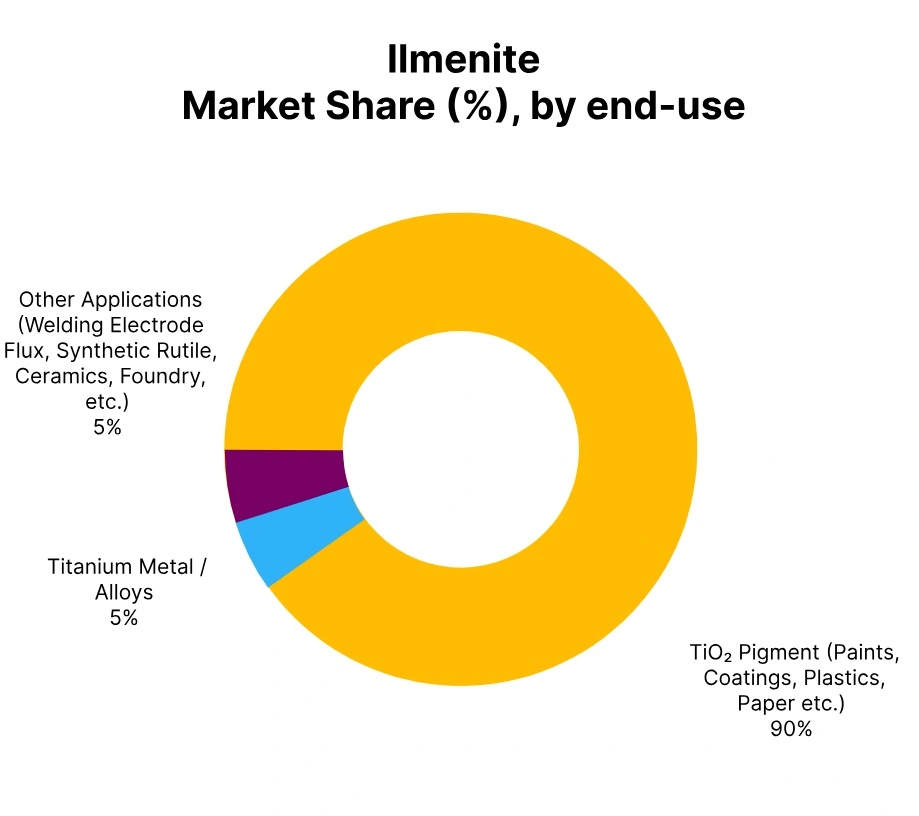
ilmenite market share end use

Historically, several events have caused significant fluctuations in Ilmenite prices

  • Energy Costs & Logistics Inflation (2022–2023): The global energy crisis, particularly in Europe and Asia, significantly impacted ilmenite mining and processing costs. Rising fuel and shipping costs, coupled with labor shortages and inflation across supply chains, contributed to elevated ilmenite prices during this period.
  • Supply Disruptions & Export Controls (2021–2022): Major ilmenite-producing countries such as India, Vietnam, and Mozambique faced regulatory changes and logistical challenges. India, for instance, continued restrictions on private mining of beach sand minerals, including ilmenite, constraining global supply and putting upward pressure on prices. 
  • Pigment Industry Demand & Post-COVID Recovery (2020–2021): As global economic activity recovered from the COVID-19 downturn, demand for titanium dioxide (TiO₂)—a key end-use of ilmenite in paints, plastics, and coatings—rebounded. This led to increased consumption of ilmenite, supporting upward price movement amidst tightening supply chains. 

Why Price Watch™?

Price Watch™ is your trusted resource for tracking global ilmenite price trends. Our platform delivers real-time data and expert analysis, offering deep insights into the key factors driving price fluctuations in the ilmenite market. By monitoring critical events such as geopolitical tensions, supply chain disruptions, and economic shifts, Price Watch™ keeps you fully informed of market dynamics.

In addition, Price Watch™ provides detailed forecasts and updates on production capacities, enabling you to anticipate market changes and make well-informed decisions. With Price Watch™, you gain a competitive edge in understanding all the elements that influence ilmenite prices worldwide. Stay ahead of the curve with Price Watch’s™ reliable, accurate, and timely ilmenite market data.

Track Price Watch's™ ilmenite price assessment on a weekly basis since 2015 onwards, along with short-term forecasts, and get access to the detailed report in a downloadable format.

Ilmenite Market Price Trend published by 𝐏𝐫𝐢𝐜𝐞 𝐖𝐚𝐭𝐜𝐡™ reflect prevailing spot market conditions, derived from independent research, verified trade inputs, and proprietary market intelligence as of the publication date. Prices are published on the specified Incoterm and represent indicative base market levels, exclusive of applicable taxes, VAT, duties, tariffs, and other statutory charges. Actual transaction values may vary depending on volume, credit terms, contractual structure, and other negotiated conditions. Market prices are inherently subject to volatility, liquidity dynamics, regulatory changes, and evolving trade activity. The information provided is for reference and benchmarking purposes only and does not constitute an offer, recommendation, or guarantee of transactional outcomes. Users should exercise independent commercial judgment and assess their specific contractual, regulatory, tax, and application requirements before making business decisions. 𝐏𝐫𝐢𝐜𝐞 𝐖𝐚𝐭𝐜𝐡™ assumes no liability for decisions taken based on this information.

Raw Material Availability – Ilmenite is a primary ore of titanium and is mined from hard rock deposits or heavy mineral sands. Variations in ore grade, mining conditions, and resource depletion can affect availability and influence pricing.

Supply and Demand – Ilmenite demand is largely driven by the titanium dioxide (TiO₂) pigment industry (used in paints, plastics, paper) and titanium metal production. Surges or drops in demand from these sectors directly impact pricing. Seasonal or cyclical trends in construction and consumer goods also affect demand.

Production and Processing Costs – Ilmenite must often be processed through upgrading methods such as chloride or sulfate route beneficiation to produce high-grade feedstock. The energy, labor, and chemical costs associated with this refining process can substantially influence prices.

Environmental Regulations – Stricter environmental controls, especially concerning mining waste management and emissions from processing plants, can increase production costs and reduce effective supply, thereby pushing prices up.

Global Trade Policies & Tariffs – Export restrictions or tariffs, especially by major producers like India, Mozambique, or China, can shift global supply dynamics. Anti-dumping duties and import restrictions in key consuming countries also affect market pricing.

Geopolitical Risks and Regional Instability – Ilmenite production is concentrated in a few regions (e.g., Africa, Australia, India). Political instability, conflict, or policy uncertainty in these regions can disrupt supply chains and impact global prices.

Technological Advancements – Innovations in extraction, beneficiation, or recycling can shift supply curves and potentially lower production costs, affecting market prices over time.

Exchange Rates – As ilmenite is globally traded, fluctuations in currency (e.g., Australian Dollar, Indian Rupee, U.S. Dollar) affect export competitiveness and international pricing.

Market Competition and Substitutes – The presence of alternative feedstocks like rutile and synthetic rutile can influence ilmenite demand. Competitive dynamics between producers also determine pricing strategies.

The availability and cost of raw materials such as high-carbon steel and alloy coatings directly affect Ilmenite production costs and pricing.

Ilmenite prices tend to rise with inflation, influenced by escalating energy, transportation, and processing costs, while sustained demand from the pigment, welding, and aerospace industries helps anchor pricing amid broader economic fluctuations.

Ilmenite is a titanium-iron oxide mineral (FeTiO₃) primarily used in the production of titanium dioxide (TiO₂) pigments, titanium metal, and welding electrodes. Its price matters because it directly affects industries relying on titanium dioxide for paints, coatings, plastics, paper, and specialty chemicals. 𝐏𝐫𝐢𝐜𝐞 𝐖𝐚𝐭𝐜𝐡™ tracks ilmenite prices to help businesses and consumers stay updated with market trends.

Ilmenite prices vary by grade, TiO₂ content, particle size, and region. Prices are typically quoted per metric ton and fluctuate based on titanium feedstock availability, global demand for TiO₂, shipping costs, and currency exchange rates. 𝐏𝐫𝐢𝐜𝐞 𝐖𝐚𝐭𝐜𝐡™ provides real-time price assessments across global markets to help buyers and sellers make informed decisions.

Prices fluctuate due to mining output, TiO₂ pigment demand, global industrial activity, and production capacities of major ilmenite suppliers. Logistics costs, trade policies, and macroeconomic conditions also influence market trends.

Major consumers include paint and coatings manufacturers, plastics and paper industries, welding electrode producers, and titanium metal producers. 𝐏𝐫𝐢𝐜𝐞 𝐖𝐚𝐭𝐜𝐡™ analyzes demand patterns across all these sectors.

Ilmenite is mined from heavy mineral sands or extracted as a byproduct of other mineral operations. After mining, it undergoes beneficiation to increase TiO₂ content before being supplied to pigment and titanium producers.

Australia, South Africa, and Canada are among the largest exporters, followed by India and Norway. Export volumes fluctuate with mining production policies, TiO₂ demand, and international trade dynamics. 𝐏𝐫𝐢𝐜𝐞 𝐖𝐚𝐭𝐜𝐡™ tracks production levels, export flows, and trade patterns to help businesses understand global supply chains and sourcing opportunities.

Supply generally meets demand, but shortages may occur due to mine closures, environmental restrictions, or spikes in pigment production. 𝐏𝐫𝐢𝐜𝐞 𝐖𝐚𝐭𝐜𝐡™ monitors these supply-demand imbalances to alert the market about potential surpluses or shortages.

Ilmenite grades are classified by TiO₂ content, iron content, and physical characteristics. Higher TiO₂ content or specialty grades cost more due to beneficiation requirements and stricter quality standards. 𝐏𝐫𝐢𝐜𝐞 𝐖𝐚𝐭𝐜𝐡™ provides separate price assessments for each grade to ensure market transparency.

When demand rises, for example, due to a surge in TiO₂ pigment production, prices typically climb. Suppliers may prioritize certain contracts, and lead times can extend. 𝐏𝐫𝐢𝐜𝐞 𝐖𝐚𝐭𝐜𝐡™ captures these market dynamics in real-time.

Processing ilmenite into TiO₂ pigments or titanium metal is energy-intensive. Rising electricity, fuel, or chemical costs often get passed on to buyers. Regions with lower energy costs tend to have more competitive ilmenite pricing, a correlation analyzed by 𝐏𝐫𝐢𝐜𝐞 𝐖𝐚𝐭𝐜𝐡™.

Regional variations arise from local mining output, import dependency, shipping distances, currency fluctuations, and regional industrial demand. 𝐏𝐫𝐢𝐜𝐞 𝐖𝐚𝐭𝐜𝐡™ tracks prices across major regions to highlight these differences.

Forecasts depend on mining capacity, TiO₂ pigment demand, global industrial activity, and macroeconomic factors. 𝐏𝐫𝐢𝐜𝐞 𝐖𝐚𝐭𝐜𝐡™ regularly publishes detailed forecasts projecting price movements for the next 12 months based on supply additions, demand growth, seasonal trends, and economic indicators. These forecasts help businesses anticipate market conditions and plan accordingly.

Yes. Accurate forecasts allow businesses to optimize purchasing, negotiate contracts, and manage inventories. If 𝐏𝐫𝐢𝐜𝐞 𝐖𝐚𝐭𝐜𝐡™ predicts a price increase, you might choose to stock up or secure long-term contracts at current rates, potentially saving significant costs.

Events such as mine shutdowns, export restrictions, labor strikes, or economic shocks can cause supply shortages and price volatility. 𝐏𝐫𝐢𝐜𝐞 𝐖𝐚𝐭𝐜𝐡™ provides timely alerts when such events affect the market.

𝐏𝐫𝐢𝐜𝐞 𝐖𝐚𝐭𝐜𝐡™ collects data from mines, distributors, and buyers worldwide to publish regular price assessments, market reports, and forecasts. Its transparent methodology and comprehensive coverage make it a trusted source for understanding fair pricing and market trends in the ilmenite industry.