𝐏𝐫𝐢𝐜𝐞 𝐖𝐚𝐭𝐜𝐡™ develops methodologies designed to reflect actual market trading conditions and deliver price assessments that are reliable, representative, and free from distortion. Prices are assessed using currencies, volume units, locations, and product specifications that follow established industry standards and market practices.
𝐏𝐫𝐢𝐜𝐞 𝐖𝐚𝐭𝐜𝐡™ publishes prices for physical markets traded openly, as defined in its specifications and methodology guides. Trading periods are selected in consultation with market participants to ensure they capture meaningful liquidity and trading activity. Only transactions that meet minimum requirements for volume, delivery timing, and product specifications are considered in the assessment process.
These methodologies are developed in alignment with the principles set out by the International Organization of Securities Commissions (IOSCO).
Where market liquidity is limited, or where market conditions require it, 𝐏𝐫𝐢𝐜𝐞 𝐖𝐚𝐭𝐜𝐡™ determines the tradable price range using the structured and transparent process set out in this methodology.
𝐏𝐫𝐢𝐜𝐞 𝐖𝐚𝐭𝐜𝐡™ continuously develops, reviews, and revises its methodologies through ongoing consultation with market participants to ensure our assessments remain relevant and reflective of current market conditions.
Information Sources:
𝐏𝐫𝐢𝐜𝐞 𝐖𝐚𝐭𝐜𝐡™ gathers information from market participants regarding:
Spot transactions that meet our specification criteria
Spot bid and offer levels
Prices of related commodities
Relevant freight costs and logistics factors
Principles of Methodology
– Transaction Evaluation
𝐏𝐫𝐢𝐜𝐞 𝐖𝐚𝐭𝐜𝐡™ considers all arm’s-length transactions that meet defined specification criteria on an equal basis and designs its assessments to provide reliable and representative indicators of prevailing market values.
– Specifications and Standards
𝐏𝐫𝐢𝐜𝐞 𝐖𝐚𝐭𝐜𝐡™ applies product specifications, trading terms, and conditions that are consistent with established industry conventions and standard market practices, ensuring relevance to physical market activity.
– Data Verification
𝐏𝐫𝐢𝐜𝐞 𝐖𝐚𝐭𝐜𝐡™ subjects all transaction data to rigorous verification procedures and excludes data that cannot be validated, is inconsistent, or reflects non-repeatable or atypical market conditions.
– Normalization Process
Where necessary, 𝐏𝐫𝐢𝐜𝐞 𝐖𝐚𝐭𝐜𝐡™ applies standardized normalization processes to align data with typical volumes (quotation terms), delivery periods, and other assessment parameters.
– Timeliness and Finality
𝐏𝐫𝐢𝐜𝐞 𝐖𝐚𝐭𝐜𝐡™ publishes price assessments that are final at the time of publication. 𝐏𝐫𝐢𝐜𝐞 𝐖𝐚𝐭𝐜𝐡™ does not make retrospective amendments based on information received after applicable cut-off times.
– Review and Revision
𝐏𝐫𝐢𝐜𝐞 𝐖𝐚𝐭𝐜𝐡™ periodically reviews its methodologies to ensure they remain appropriate, representative, and aligned with prevailing market conditions. Revisions, where required, are implemented in a controlled and transparent manner, with material changes documented and communicated in accordance with established governance processes.
Components of Methodology
1) Market Definition & Assessment Design
Market Definition and Scope of Assessment
Assessment Objective
Reference unit, currency, and commercial conventions
2) Assessment Timing, Data Universe & Intake Controls
Assessment Structure, Timing, and Publication Framework
Market Data Universe and Collection Framework
Eligible submitters and submission channels
3) Data Quality, Hierarchy & Liquidity Controls
Data Quality Controls and Exclusion Criteria
Data Hierarchy and Weighting Principles
Liquidity Thresholds and Alternative Assessment Procedures
Concentration Risk and Key Submitter Dependency Controls
4) Assessor Judgment, Review & Price Formation
Assessor Judgment Framework and Escalation Controls
Internal review and approval of assessments
5) Transparency, Governance & Accountability
Transparency, Disclosure, and Market Communication
Audit Trail, Record Retention, and Evidentiary Standards
Methodology Governance, Review, and Change Management
Components of Methodology
1) Market Definition & Assessment Design
Market Definition and Scope of Assessment
Each assessment clearly defines the physical market being evaluated, including the commodity or product, grade or specification, quality parameters, delivery location, delivery terms, delivery period, reference unit, and currency. This ensures that assessments are unambiguous, comparable, and representative of the intended segment of the physical market.
Assessment Objective
The intended economic purpose of each assessment is specified, including whether it reflects spot or forward physical market value and the typical commercial conditions prevailing in the defined market.
Commercial Conventions and Reference Parameters
Applicable commercial conventions, including units of measurement, pricing basis, and market norms, are documented to ensure consistency with established industry practice and comparability across assessments.
2) Assessment Timing & Data, Input Controls
Assessment Structure, Timing, and Publication Framework
Each assessment clearly defines the physical market being evaluated, including the commodity or product, grade or specification, quality parameters, delivery location, delivery terms, delivery period, reference unit, and currency. This ensures that assessments are unambiguous, comparable, and representative of the intended segment of the physical market.
Market Data Universe
The types of market data eligible for consideration are specified, including concluded and reported transactions, firm bids and offers, and other relevant market information, in a manner consistent with the structure of the underlying physical market.
Eligible Submitters and Submission Channels
The categories of entities permitted to submit market data and the approved submission mechanisms are defined to ensure traceability, accountability, and integrity of submitted information.
Data Verification and Confirmation Procedures
Verification practices are applied to support the bona fide nature and accuracy of submitted market data, including the use of corroboration from back-office or operational functions where appropriate.
3) Data Quality, Hierarchy & Liquidity Controls
Data Quality Controls and Exclusion Criteria
Objective standards are applied to assess the credibility, integrity, and representativeness of market data. These standards define the circumstances under which non-bona fide, non-arm’s-length, anomalous, or otherwise non-representative data may be excluded from an assessment.
Commercial Conventions and Reference Parameters
Applicable commercial conventions, including units of measurement, pricing basis, and market norms, are documented to ensure consistency with established industry practice and comparability across assessments.
Liquidity Thresholds
The sufficiency of transaction data is evaluated for each assessment. Where appropriate, transaction data thresholds are applied, or the rationale for the absence of fixed thresholds is documented, having regard to market structure and liquidity characteristics.
Alternative Assessment Procedures
Procedures applicable during periods of low liquidity or absence of transactions are defined, including the use of bids and offers, related market indicators, or estimation techniques, subject to defined controls, documentation, and review.
Concentration Risk and Key Submitter Dependency Controls
Controls are applied to address risks arising where market data for an assessment is materially influenced by one or a limited number of reporting entities. These include enhanced scrutiny, corroboration, and escalation procedures.
4) Assessor Judgment & Review
An assessor is a qualified market analyst responsible for collecting, validating, analysing, and applying methodology to determine and publish a price assessment.
Assessor Judgment Framework
The exercise of professional judgment is governed through explicit criteria defining when judgment may be applied, the factors guiding its use, and the requirement for contemporaneous documentation.
Consistency and Oversight of Assessors
Procedures are maintained to ensure consistency in the application of methodologies across assessors, including training standards, supervisory oversight, and periodic review of assessor competence.
Internal Review and Approval of Assessments
Price assessments are subject to internal supervisory review and approval prior to publication to confirm adherence to the methodology and the appropriate application of judgment.
5) Transparency and Market Disclosure
Transparency, Governance & Accountability
Explanatory information is published, to the extent reasonable and without delaying publication, to support market understanding of how assessments are developed, including liquidity context, data composition, and the use of judgment where applicable.
Audit Trail and Record Retention
Contemporaneous records are maintained of all market data, assessor judgments, exclusions, approvals, and related documentation. Such records are retained for a minimum period consistent with IOSCO principles.
Methodology Governance and Internal Review
Governance arrangements are in place for the oversight of methodologies, including defined internal review and approval processes and review frequencies to ensure continued relevance and integrity.
Methodology Change Management
Structured procedures govern the implementation of material methodological changes, including advance notice, stakeholder consultation where appropriate, and transparent communication of changes.
Complaints Handling and Accountability Mechanisms
Written procedures are maintained for receiving, investigating, resolving, and retaining records of complaints relating to the assessment process, ensuring timely, independent, and fair resolution.
Regulatory Cooperation and External Audit
Relevant audit trails and documentation are made readily available to market authorities in accordance with applicable law, and an independent external auditor is appointed to periodically review and report on adherence to IOSCO principles.
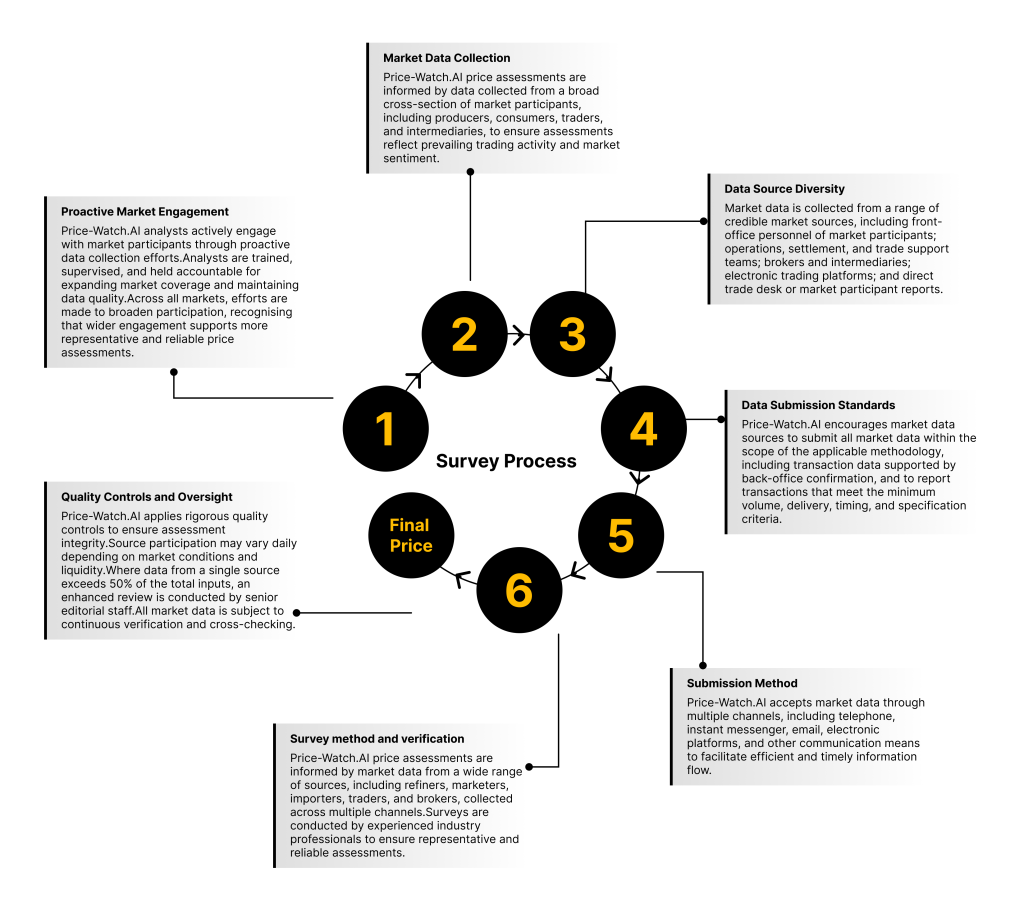
Survey Process
1) Proactive Market Engagement
𝐏𝐫𝐢𝐜𝐞 𝐖𝐚𝐭𝐜𝐡™ analysts actively engage with market participants through proactive data collection efforts. Analysts are trained, supervised, and held accountable for expanding market coverage and maintaining data quality. Across all markets, efforts are made to broaden participation, recognising that wider engagement supports more representative and reliable price assessments.
2) Market Data Collection
𝐏𝐫𝐢𝐜𝐞 𝐖𝐚𝐭𝐜𝐡™ price assessments are informed by data collected from a broad cross-section of market participants, including producers, consumers, traders, and intermediaries, to ensure assessments reflect prevailing trading activity and market sentiment.
3) Data Source Diversity
Market data is collected from a range of credible market sources, including front-office personnel of market participants; operations, settlement, and trade support teams; brokers and intermediaries; electronic trading platforms; and direct trade desk or market participant reports.
4) Data Submission Standards
𝐏𝐫𝐢𝐜𝐞 𝐖𝐚𝐭𝐜𝐡™ encourages market data sources to submit all market data within the scope of the applicable methodology, including transaction data supported by back-office confirmation, and to report transactions that meet the minimum volume, delivery, timing, and specification criteria.
5) Submission Method
𝐏𝐫𝐢𝐜𝐞 𝐖𝐚𝐭𝐜𝐡™ accepts market data through multiple channels, including telephone, instant messenger, email, electronic platforms, and other communication means to facilitate efficient and timely information flow.
6) Survey method and verification
𝐏𝐫𝐢𝐜𝐞 𝐖𝐚𝐭𝐜𝐡™ price assessments are informed by market data from a wide range of sources, including refiners, marketers, importers, traders, and brokers, collected across multiple channels. Surveys are conducted by experienced industry professionals to ensure representative and reliable assessments.
7) Quality Controls and Oversight
𝐏𝐫𝐢𝐜𝐞 𝐖𝐚𝐭𝐜𝐡™ applies rigorous quality controls to ensure assessment integrity. Source participation may vary daily depending on market conditions and liquidity. Where data from a single source exceeds 50% of the total inputs, an enhanced review is conducted by senior editorial staff. All market data is subject to continuous verification and cross-checking.
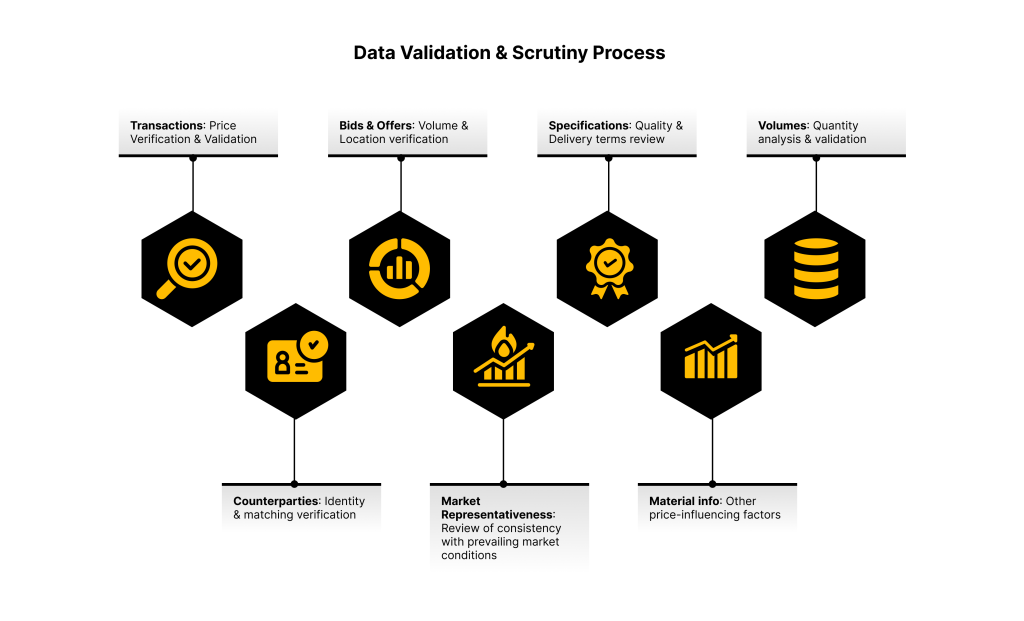
Data Validation & Scrutiny Process
All market inputs are subject to a structured and documented review process to ensure accuracy, integrity, and representativeness. Transaction data is verified and validated for price integrity, while reported bids and offers are reviewed to confirm appropriate volumes and delivery locations. Product specifications are examined to ensure consistency with defined quality parameters and delivery terms.
Counterparty details are validated to confirm identity and transaction matching, and reported volumes are analysed to assess quantity accuracy and commercial relevance. In addition, material information that may influence price formation is reviewed to ensure appropriate market context.
Finally, all inputs are assessed for market representativeness to determine whether they reflect prevailing and repeatable market conditions prior to inclusion in the price assessment process.
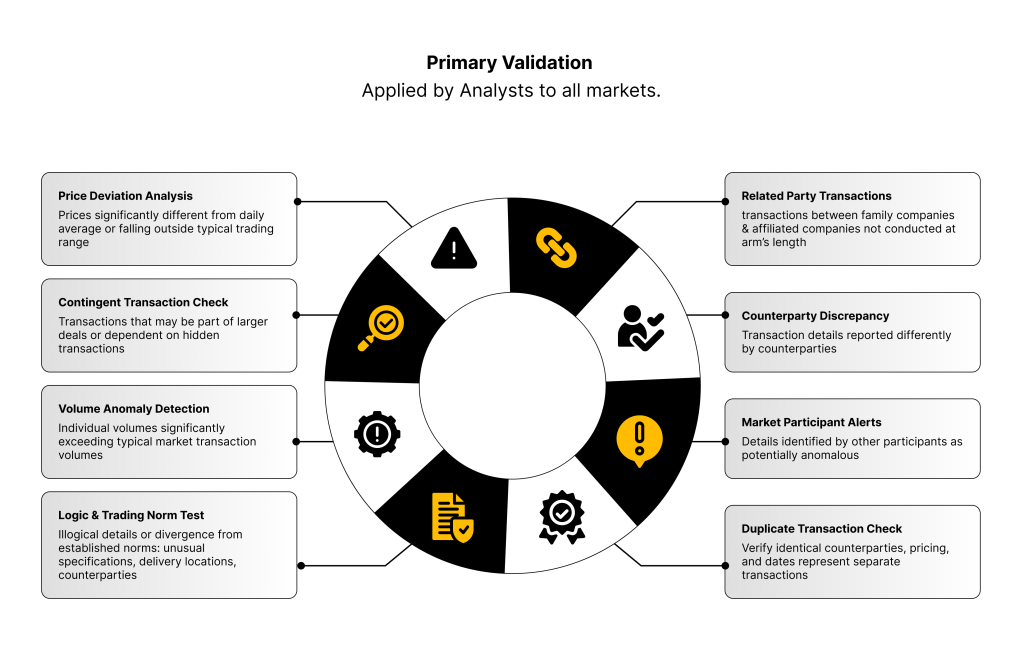
Primary Validation
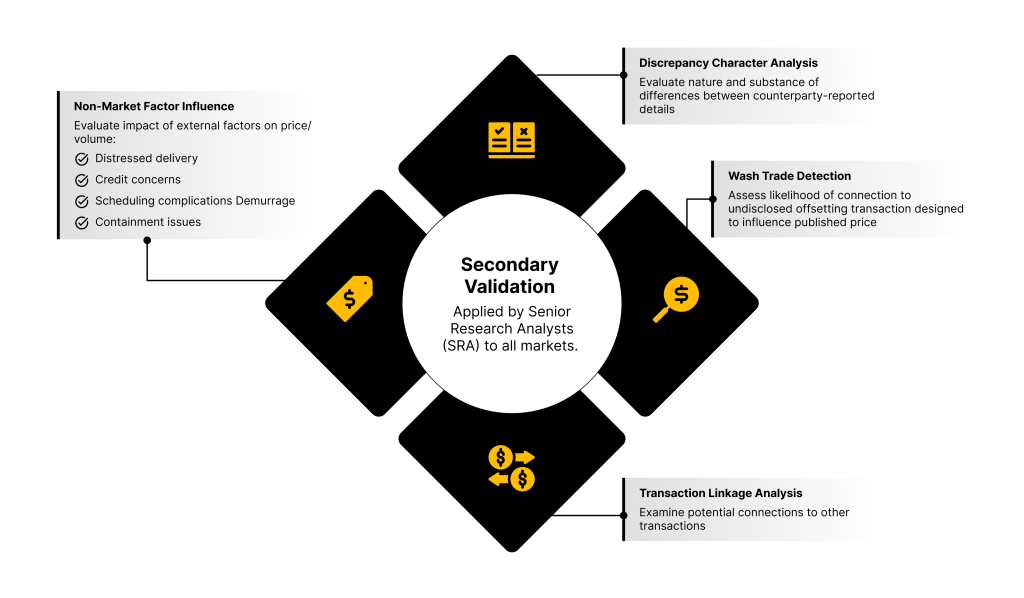
Secondary Validation
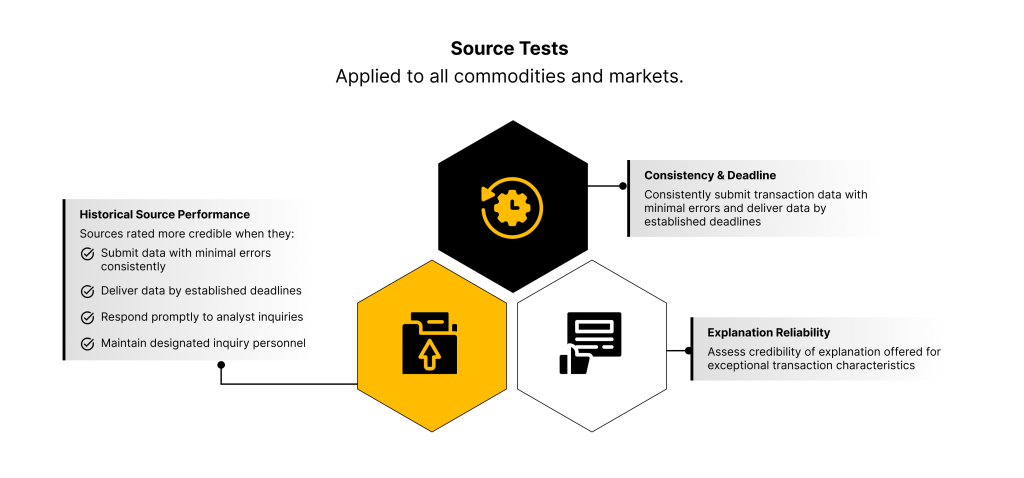
Source Tests
Assessment Guidelines
1) Low-Liquidity Assessment Procedures
When transaction data is insufficient or unavailable, 𝐏𝐫𝐢𝐜𝐞 𝐖𝐚𝐭𝐜𝐡™ analysts perform market value assessments using informed judgment based on verified market information.
Market Information Sources Include:
Completed deals
Bids & offers
Export-import data
Tenders
Spread trades
Exchange trades
Supply & demand data
Other relevant inputs
Key Principle: The assessment process is rigorous, repeatable, and uses widely accepted valuation methods aligned with physical commodity traders’ internal processes.
2) Volume & Transaction Data Thresholds
𝐏𝐫𝐢𝐜𝐞 𝐖𝐚𝐭𝐜𝐡™ typically does not set minimum thresholds based solely on the number of transactions, as this may lead to unreliable assessments and overlooks differences in transportation infrastructure across commodity markets.
Instead, price assessments are analysed on the basis of:
Individual accepted transactions
Total transaction volumes
Transactions setting lowest or highest prices
Other relevant price and volume-related factors
Note: Requirements vary by product and are detailed in product-specific methodology documents.
3) Corrections to Assessments
Corrections issued for:
Clerical mistakes
Calculation errors
Misapplication of methodology
Non-Retroactive: Market assessments remain unchanged following publication, irrespective of information received thereafter.
4) Ethics & Compliance
𝐏𝐫𝐢𝐜𝐞 𝐖𝐚𝐭𝐜𝐡™ operates according to best practices with comprehensive compliance procedures.
Weekly assessments show the typical tradable range based on verified transactions, providing a realistic view of market prices throughout the week.
Price Range Structure
Low: Minimum Price
Medium: Fair Value Midpoint
High: Maximum Price
Range Width Indicates: Market volatility, logistics variations, and product differences
3) Assessment Priorities (in Order):
Typical repeatable transactions between unrelated market participants
Standardized atypical transactions with equivalent market value
Bids and offers for typical specifications
Movements in related markets
When Data is limited, assessments are calculated using established relationships:
Manufacturing economics
Product linkages
Freight costs
Forward markets
Liquid Markets: Focus on majority of trades, excluding outlier transactions that don’t reflect market consensus
4) Product Quotations
Quotation Basis:
Terms of delivery
Location of delivery
Product specifications
Standards Used: Incoterms (International Commercial Terms) published by International Chamber of Commerce)
Note: VAT not included in assessments
Unit & Conversions: USD/MT
Why USD/MT?
Standard in commodity markets
Ensures clear price comparisons
Historical data continuity
Conversion Standards:
Currency: Proprietary tool with current exchange rates
Weight: International standards & industry norms
Considers specific gravity & product characteristics
Foreign Exchange Rates:
Data Source: Fxtop exchange rates
Aligned with weekly assessment timing (Friday 6:00 PM IST)
Exchange Rate Methodology:
Mid-market bid/offer mean
Captured around publication time
Not daily averages
Used for historical prices
Exchange Rate Timing:
Charts: Preliminary rates (early publication day)
Historical: Final weekly/monthly rates
Disclaimer: Rates serve as reference; actual bank rates may differ
Regional Coverage:
Quotation Basis:
Asia Pacific: India, China, Japan, South Korea, Vietnam, Taiwan, Malaysia, Indonesia, Philippines and others
Europe: Germany, Netherlands, UK, Poland, Spain, Belgium and others
North America: USA, Canada, Mexico
South America: Brazil, Peru, Chile, Paraguay and others
Oceania: Australia and New Zealand
Africa: Egypt, Morocco, South Africa and others
Note: Country and regional coverage is product-dependent and has been continuously expanded in line with product scope expansion and the development of new and evolving price assessments.
Publication Date & Schedule
Every Friday: at 6:00 PM IST (7:30 AM EST) Weekly Publication Time
50+: Minimum Number of Weekly Price Assessments per Year
2-Week Break: Late December/ Early January
Special Circumstances:
Exceptions may occur due to public holidays (Holidays Observed in Accordance with the Indian Calendar)
Assessments may be compiled 1-2 days in advance (clearly indicated)
Publication date not altered for holidays
Deadlines set to reflect market close prices accurately
Spot Price Assessments
1) Key Assessment Principles
Global: Coverage across all major commodity regions
Comprehensive: Full week market view with verified transactions
Standardised: Consistent USD/MT pricing with clear conversions
Weekly assessments show the typical tradable range based on verified transactions, providing a realistic view of market prices throughout the week.
Price Range Structure
Low: Minimum Price
Medium: Fair Value Midpoint
High: Maximum Price
Range Width Indicates: Market volatility, logistics variations, and product differences
3) Assessment Priorities (in Order):
Typical repeatable transactions between unrelated market participants
Standardized atypical transactions with equivalent market value
Bids and offers for typical specifications
Movements in related markets
When Data is limited, assessments are calculated using established relationships:
Manufacturing economics
Product linkages
Freight costs
Forward markets
Liquid Markets: Focus on majority of trades, excluding outlier transactions that don’t reflect market consensus
4) Product Quotations
Quotation Basis:
Terms of delivery
Location of delivery
Product specifications
Standards Used: Incoterms (International Commercial Terms) published by International Chamber of Commerce)
Note: VAT not included in assessments
Unit & Conversions: USD/MT
Why USD/MT?
Standard in commodity markets
Ensures clear price comparisons
Historical data continuity
Conversion Standards:
Currency: Proprietary tool with current exchange rates
Weight: International standards & industry norms
Considers specific gravity & product characteristics
Foreign Exchange Rates:
Data Source: Fxtop exchange rates
Aligned with weekly assessment timing (Friday 6:00 PM IST)
Exchange Rate Methodology:
Mid-market bid/offer mean
Captured around publication time
Not daily averages
Used for historical prices
Exchange Rate Timing:
Charts: Preliminary rates (early publication day)
Historical: Final weekly/monthly rates
Disclaimer: Rates serve as reference; actual bank rates may differ
Regional Coverage:
Quotation Basis:
Asia Pacific: India, China, Japan, South Korea, Vietnam, Taiwan, Malaysia, Indonesia, Philippines and others
Europe: Germany, Netherlands, UK, Poland, Spain, Belgium and others
North America: USA, Canada, Mexico
South America: Brazil, Peru, Chile, Paraguay and others
Oceania: Australia and New Zealand
Africa: Egypt, Morocco, South Africa and others
Note: Country and regional coverage is product-dependent and has been continuously expanded in line with product scope expansion and the development of new and evolving price assessments.
Publication Date & Schedule
Every Friday: at 6:00 PM IST (7:30 AM EST) Weekly Publication Time
50+: Minimum Number of Weekly Price Assessments per Year
2-Week Break: Late December/ Early January
Special Circumstances:
Exceptions may occur due to public holidays (Holidays Observed in Accordance with the Indian Calendar)
Assessments may be compiled 1-2 days in advance (clearly indicated)
Publication date not altered for holidays
Deadlines set to reflect market close prices accurately
Historical Prices Methodology
– Core Methodology Components
Historical spot prices compiled from verified market data including transaction prices, bid/offer ranges, and reported deals from producers, consumers, traders, and distributors
– Data Sourcing and Verification:
Pricing assessment team gathers data from various market participants worldwide with comprehensive verification processes.
– Data Sources:
Actual transaction prices
Bid/offer ranges
Producer deals
Consumer transactions
Trader and distributor data
– Verification Process:
Buyer and seller confirmation
Consistency checks across sources
Internal analyst review
Filter anomalies and outliers
– Aggregation and Averaging Techniques:
Historical prices derived through systematic aggregation to smooth volatility and reveal meaningful trends.
Weekly: Averaging to smooth daily fluctuations
Monthly: Long-term trend analysis
Interpolation: For missing data with clear labelling
Transparency: In instances where missing data necessitates interpolation based on previous or nearest available prices, all assumptions applied are explicitly disclosed.
Data Exclusion Standards
Data Quality & Integrity
𝐏𝐫𝐢𝐜𝐞 𝐖𝐚𝐭𝐜𝐡™ follows strict assessment standards to ensure data quality and integrity. Analysts actively identify and exclude any anomalous market information from the assessment process.
Thorough Verification: Multiple source verification of market transactions, bids, and offers to ensure accuracy and reliability of all data points.
Preference to Arms-Length transactions: Only transactions between independent parties are considered, ensuring market prices reflect genuine commercial activity.
Firm Data Requirement: Non-firm bids or offers are disregarded. Repeated non-firm submissions from the same party may be excluded entirely.
Data Sources:
What Data Gets Excluded:
Market data that does not meet defined quality, verification, or representativeness criteria is excluded from the assessment process.
Non-Representative Deals: Transactions ignoring the best bid or offer available in the market
Partial Disclosure: Incomplete market activity information that doesn’t provide full transparency
Questionable Transactions: Any deals where reasonable doubts exist about their market representativeness
Continuous Monitoring: All instances of anomalous data are documented and regularly reviewed for patterns to maintain the reliability of price assessments.
Price Reporting Governance & Oversight Program
𝐏𝐫𝐢𝐜𝐞 𝐖𝐚𝐭𝐜𝐡™ ensures consistent application of judgment by analysts across different markets and personnel transitions through comprehensive training and oversight.
– Core Governance Principles
Stakeholder Engagement: Ongoing communication with industry participants ensures methodologies align with market realities.
Transparency: Formal consultation processes with clear timelines and published stakeholder feedback
Continuous Improvement: Regular reviews ensure methodologies remain accurate and representative of evolving markets
– Training & Oversight Program
Global Price Reporting Manual: Delineates comprehensive guidelines for the exercise of judgment in price assessments
Cross-Training Program: Personnel trained across different markets to ensure adequate coverage during holidays or leave periods
Senior Research Analysts: Rotate between markets to monitor adherence to best practices and ensure consistency
Daily Mentoring & Approval: Experienced analysts provide daily guidance, especially for less liquid markets. SRAs review and approve all assessments daily
Review & Changes to Methodology
1) Review of Methodology
𝐏𝐫𝐢𝐜𝐞 𝐖𝐚𝐭𝐜𝐡™ maintains continuous processes to ensure accuracy and faithful representation of commodity markets.
Continuous Review
SRAs and analysts regularly review methodologies
Ongoing communication with industry participants
Integrated into routine market reporting activities
Comprehensive Annual Review
Formal reviews of all methodologies at least annually
SRAs and management reassess market coverage
Analysis of market viability factors
Review Evaluation Factors
Market Liquidity: Current trading volumes and activity levels
Data Availability: Reliability and accuracy of information
Data Quality: Consistency and quality of market data
Industry Utilization: Extent of assessment usage by market
Reviews Determine Whether To:
Maintain Current Methodologies
Discontinue Assessments
Introduce New Assessments
2) Changes to Methodology
Formal proposals to amend methodologies emerge from ongoing evaluations and stakeholder consultations.
– Identification
Material changes identified through internal evaluations and external stakeholder consultations
– Internal Proposal
Senior Research Analyst submits proposal to management for evaluation and approval
– Initial Announcement:
Proposed amendments announced in relevant 𝐏𝐫𝐢𝐜𝐞 𝐖𝐚𝐭𝐜𝐡™ report, including:
Nature and rationale of changes
Procedure for submitting comments
Deadlines for feedback submissions
Publication of stakeholder comments
– Consultation Period
𝐏𝐫𝐢𝐜𝐞 𝐖𝐚𝐭𝐜𝐡™allows sufficient time for market participants to analyse and respond
– Active Engagement
𝐏𝐫𝐢𝐜𝐞 𝐖𝐚𝐭𝐜𝐡™actively engages with industry to foster acceptance of changes (while recognizing universal agreement cannot be assured)
– Internal Review & Decision
Management conducts internal review and renders decision on methodology amendment
– Final Announcement
Formal announcement of decision published, including implementation date