Methyl Methacrylate (mma) Price Trend and Forecast

UNSPC code: 12164501
|
Weekly Update
|
Historical Data Since 2015
|
Forecast for 2026

methyl methacrylate (mma) Price Trends by Country

krSouth Korea
sgSingapore
deGermany
bdBangladesh
brBrazil
cnChina
egEgypt
inIndia

Global methyl methacrylate (mma) Spot Market Prices, Trend Analysis and Forecast

Price Watch™ provides real-time price assessments and price forecasts for Methyl Methacrylate (MMA) across top trading regions:

Methyl Methacrylate (MMA) Regional Coverage  Methyl Methacrylate (MMA) Grade and Country Coverage  Methyl Methacrylate (MMA) Pricing Data Coverage Explanation 
Asia-Pacific Methyl Methacrylate (MMA) Pricing Analysis  Methyl Methacrylate (MMA) Liquid (Purity: 99.8%) FOB Prices at Busan Port, South Korea  Weekly Price Update on Methyl Methacrylate (MMA) Real-Time Export Prices from Busan Port, South Korea to Global Markets 
Methyl Methacrylate (MMA) Liquid (Purity: 99.8%) FOB Prices at Shanghai Port, China  Weekly Price Update on Methyl Methacrylate (MMA) Real-Time Export Prices from Shanghai Port, China to Global Markets 
Methyl Methacrylate (MMA) Liquid (Purity: 99.8%) FOB Prices at Jurong Port, Singapore  Weekly Price Update on Methyl Methacrylate (MMA) Real-Time Export Prices from Jurong Port, Singapore to Global Markets 
Methyl Methacrylate (MMA) Liquid (Purity: 99.8%) CIF Prices at Nhava Sheva Port, West India. Importing from Singapore  Weekly Price Update on Methyl Methacrylate (MMA) Real-Time Import Prices at Nhava Sheva Port, West India, from Singapore 
Methyl Methacrylate (MMA) Liquid (Purity: 99.8%) CIF Prices at Nhava Sheva Port, West India. Importing from China  Weekly Price Update on Methyl Methacrylate (MMA) Real-Time Import Prices at Nhava Sheva Port, West India, from China 
Methyl Methacrylate (MMA) Liquid (Purity: 99.8%) Ex-Mumbai, India  Weekly Price Update on Methyl Methacrylate (MMA) Real-Time Domestic Ex-Mumbai Prices in India 
Methyl Methacrylate (MMA) Liquid (Purity: 99.8%) CIF Prices at Chittagong Port, Bangladesh. Importing from Singapore  Weekly Price Update on Methyl Methacrylate (MMA) Real-Time Import Prices at Chittagong Port, Bangladesh, from Singapore 
Europe Methyl Methacrylate (MMA) Pricing Analysis  Methyl Methacrylate (MMA) Liquid (Purity: 99.8%) FD Prices at Hamburg, Germany  Weekly Price Update on Methyl Methacrylate (MMA) Real-Time FD Prices in Hamburg, Germany 
Africa Methyl Methacrylate (MMA) Pricing Analysis  Methyl Methacrylate (MMA) Liquid (Purity: 99.8%) CIF Prices at Alexandria Port, Egypt. Importing from China  Weekly Price Update on Methyl Methacrylate (MMA) Real-Time Import Prices at Alexandria Port, Egypt, from China 
North America Methyl Methacrylate (MMA) Pricing Analysis  Methyl Methacrylate (MMA) Liquid (Purity: 99.8%) CIF Prices at Santos Port, Brazil. Importing from China  Weekly Price Update on Methyl Methacrylate (MMA) Real-Time Import Prices at Santos Port, Brazil, from China 


Note: In assessments structured as CIF [Importing Port] (Exporting Country), the country mentioned in brackets indicates the primary origin of supply (exporting country), while the named port refers to the destination port in the importing country. Other Incoterms (FOB, FD, EXW, etc.) should be interpreted in accordance with standard international trade definitions.

Methyl Methacrylate (MMA) Price Trend Q1 2026

During Q1 2026, the Methyl Methacrylate (MMA) market saw an impressive increase in its prices, rising by about 10% due to significant consumer interest from the fields of coatings, adhesives, automotive, construction, and acrylic sheets.

The mma market is stable because end-users are ramping up their purchasing activities and restocking their inventories in anticipation of more mma price trend increases in the coming weeks. Costs of feedstocks continued to be high and helped in keeping MMA manufacturing economical.

Inventory shortages from different markets also contributed to supply side pressures. Plants’ operations continued at controlled capacity as producers managed their output based on the improvement in demand.

Export optimism also remained high because of solid demand from different continents such as Asia, Europe, and America where availability is becoming tighter due to logistics issues. Furthermore, political instability in areas like the Iran-Israel situation and problems in the Strait of Hormuz affected sea transport.

South Korea: MMA Export prices FOB Busan, South Korea: Grade – Liquid (Purity: 99.8%)

There is a noticeable rise in the MMA prices in the South Korea market in Q1 2026, with FOB Busan prices rising by roughly 11.4% from Q4 2025 levels. Factors driving the MMA price trend in South Korea include the growing demand for MMA from buyers in the coatings, adhesive, and acrylic sheets industries. There has been considerable activity on the buying front as buyers continue to restock in anticipation of further increases in prices.

Buyers’ sentiments have grown positive due to rising demand for exports and limited supply. Producers in the market are operating at controlled capacity as they aim to meet rising demand without creating excessive inventory. Feedstock prices have stayed strong, ensuring solid cost support for MMA producers.

Moreover, supply disruptions caused by tensions in the Middle East region have contributed to tight supplies and logistic challenges. In March 2026, MMA prices in South Korea surged sharply, posting gains of roughly 39.4%.

China: MMA Export prices FOB Shanghai, China: Grade – Liquid (Purity: 99.8%)

Methyl Methacrylate (MMA) price in China during Q1 2026 have been experiencing an excellent upward trajectory, where the prices for FOB Shanghai have gone up by roughly 13.2% relative to Q4 2025. Factors influencing the MMA price trend in China include demand for MMA products from the coatings, adhesives, and acrylic sheets manufacturing industries. There have been restocking efforts by buyers who are expecting higher prices to take advantage of the supply situation.

The bullish market sentiment is attributable to rising demands for exports and reduced supplies owing to the controlled production processes adopted by producers. This strategy by producers ensures that they do not experience any surplus stocks since there have been improvements in demand trends.

Prices of feedstocks have been steady, thus offering robust cost support for MMA production. Moreover, the Middle East crisis has disrupted feedstock supply chain systems and logistics worldwide, hence making MMA feeds tight. In March 2026, MMA price in China experienced a substantial spike of about 41.2% owing to increased purchasing activities and supply limitations.

Singapore: MMA Export prices FOB Jurong, Singapore: Grade – Liquid (Purity: 99.8%)

The MMA prices in Singapore in Q1 2026 has been witnessing a strong upward trend, with FOB Jurong prices having increased by approximately 9.5% compared to Q4 2025. MMA prices have been rising as demand from coatings, adhesives, and acrylic processing industries has been steadily improving across regional markets. Buyers have been actively restocking inventories to secure supply amid expectations of further price increases.

MMA price trend in Singapore has been strengthening as export demand has been increasing and supply availability has been tightening. Producers have been maintaining controlled operating rates to align output with improving demand conditions and avoid inventory pressure. Feedstock costs have been remaining firm, providing consistent cost support to MMA production.

Additionally, the ongoing Middle East conflict has been disrupting feedstock supply chains and global logistics, further tightening availability. In March 2026, MMA prices in Singapore have surged by 36.7%, driven by strong buying activity and supply-side constraints.

Germany: MMA Domestically Traded prices FD Hamburg, Germany: Grade – Liquid (Purity: 99.8%)

The MMA prices in Germany market in Q1 2026 has been witnessing a strong upward trend, with FD Hamburg levels increasing by approximately 17.4% compared to Q4 2025. The overall MMA price trend in Germany has been driven by significantly improving demand from coatings, automotive, construction, and acrylic sheet applications across the region.

Buyers have been actively restocking inventories to secure supply amid expectations of further price increases. Market sentiment has strengthened as import availability has tightened and supply chains have faced intermittent constraints. Producers and suppliers have been maintaining controlled operating rates to align output with improving demand conditions and prevent inventory build-up.

Feedstock costs have remained firm, providing strong cost support to MMA production. Additionally, the ongoing Middle East conflict has disrupted feedstock supply chains and global logistics, further tightening availability. In March 2026, MMA prices in Germany recorded a sharp surge of around 59.4%, driven by strong buying activity and persistent supply-side constraints.

Bangladesh: MMA Imported prices CIF Chittagong, Bangladesh from Singapore: Grade – Liquid (Purity: 99.8%)

The MMA prices in Bangladesh market in Q1 2026 has been witnessing a strong upward trend, with CIF Chittagong prices having increased by approximately 9.0% compared to Q4 2025. MMA price trend in Bangladesh has been rising as demand from coatings, adhesives, and industrial manufacturing sectors has been steadily improving across the domestic market.

Buyers have been actively restocking inventories to secure supply amid expectations of further price increases. Market sentiment has been strengthening as import availability has been tightening and logistics have been facing intermittent disruptions. Importers have been maintaining controlled procurement activity to align with improving consumption trends and avoid inventory pressure.

Feedstock costs have been remaining firm, providing strong cost support to MMA pricing. Additionally, the ongoing Middle East conflict has been disrupting feedstock supply chains and global shipping routes, further tightening availability. In March 2026, MMA prices in Bangladesh have surged by 36.5%, driven by strong buying activity and supply-side constraints.

Brazil: MMA Imported prices CIF Santos, Brazil from China: Grade – Liquid (Purity: 99.8%)

The MMA prices in Brazil market in Q1 2026 has been witnessing a strong upward trend, with CIF Santos prices having increased by approximately 9.1% compared to Q4 2025. MMA price trend in Brazil has been rising as demand from coatings, adhesives, automotive, and acrylic sheet applications has been steadily improving across the region. Buyers have been actively restocking inventories to secure supply amid expectations of further price increases.

Market sentiment has been strengthening as import availability has been tightening and supply chains have been facing intermittent disruptions. Importers have been maintaining controlled procurement activity to align with improving consumption trends and avoid inventory pressure. Feedstock costs have been remaining firm, providing strong cost support to MMA production.

Additionally, the ongoing Middle East conflict has been disrupting feedstock supply chains and global logistics, further tightening availability. In March 2026, MMA prices in Brazil have surged by 42.0%, driven by strong buying activity and supply-side constraints.

Egypt: MMA Imported prices CIF Alexandria, Egypt from China: Grade – Liquid (Purity: 99.8%)

The MMA prices in Egypt in Q1 2026 has been witnessing a strong upward trend, with CIF Alexandria prices having increased by approximately 13.1% compared to Q4 2025. MMA price trend in Egypt has been rising as demand from coatings, adhesives, and construction-related applications has been steadily improving across the domestic market.

Buyers have been actively restocking inventories to secure supply amid expectations of further price increases. Market sentiment has been strengthening as import availability has been tightening and logistics have been facing intermittent disruptions. Importers have been maintaining controlled procurement activity to align with improving consumption trends and avoid inventory pressure.

Feedstock costs have been remaining firm, providing strong cost support to MMA production. Additionally, the ongoing Middle East conflict has been disrupting feedstock supply chains and global shipping routes, further tightening availability. In March 2026, MMA prices in Egypt have surged by 36.7%, driven by strong buying activity and supply-side constraints.

India: MMA Domestically Traded prices Ex-Mumbai, India: Grade – Liquid (Purity: 99.8%, Bulk)

According to Price-Watch™, the Methyl Methacrylate (MMA) prices in India market in Q1 2026 has been witnessing a strong upward trend, with Ex-Mumbai bulk levels increasing by approximately 28.2% compared to Q4 2025. The overall MMA price trend in India has been driven by significantly improving demand from coatings, adhesives, automotive, and acrylic sheet manufacturing sectors.

Buyers have been actively restocking inventories to secure supply amid expectations of further price increases. Market sentiment has strengthened as domestic consumption has picked up and import availability has tightened. Producers and suppliers have been maintaining controlled operating rates to align output with improving demand conditions and avoid inventory pressure build-up.

Feedstock costs have remained firm, providing strong cost support to MMA production. Additionally, the ongoing Middle East conflict has disrupted feedstock supply chains and global logistics, further tightening availability. In March 2026, Methyl Methacrylate prices in India recorded a sharp surge of around 47.8%, driven by strong buying activity and persistent supply-side constraints.

Methyl Methacrylate (MMA) Price Trend Analysis: Q4 2025

In the fourth quarter of 2025, the Methyl Methacrylate (MMA) market witnessed a downtrend across major global regions on account of moderate consumption from the coatings, adhesives, and acrylics industry sectors. Market sentiment is steady to bearish, with buyers being cautious and maintaining procurement activities based on their requirements owing to availability of adequate inventories.

Costs of raw materials do not witness any significant change and do not provide any cost-based push to MMA prices. Production capacity utilization levels are steady as producers ensured that no overproduction took place amidst steady market conditions.

Export demand sentiments also remained steady too cautious with buyers preferring to adopt a wait-and-watch policy owing to competitive offers in the global markets.

South Korea: MMA Export prices FOB Busan, South Korea: Grade – Liquid (Purity: 99.8%)

In MMA price in South Korea in Q4 2025, there is a slight softness or stability trend due to the fall in the price level based on FOB Busan basis by about 2.1% when compared with Q3 2025 period. The MMA price trend in South Korea has become easier since the demand in the market from applications such as coatings, adhesives, and acrylic sheets manufacturers has remained low.

Buyers have been employing cautious purchasing approach due to sufficient stocks. Sentiment among market players has been balanced since the consumption activities have been stable but unable to create positive momentum for prices.

Manufacturers have kept their operation rates controlled to match the demand levels in the market. Feedstocks have maintained their stability with little impact on the price movements. In December 2025, MMA prices in South Korea market have been stable with no change (0.0%).

China: MMA Export prices FOB Shanghai, China: Grade – Liquid (Purity: 99.8%)

The MMA prices in China market during Q4 2025 have seen a trend of softening, with the FOB Shanghai prices seeing a drop of about 2.4% from their levels in Q3 2025. The MMA price trend in China has experienced a downturn owing to the moderate demand from sectors such as coatings, adhesives, and acrylic sheets production.

Buyers have adopted a cautious approach in their purchasing needs due to the availability of adequate inventory in the domestic market. The sentiments in the market have remained subdued owing to stable downstream usage that is unable to support an uptrend in prices.

Manufacturers maintained low plant operating rates in line with weak demand levels. The feedstock prices have remained unchanged, providing little support to the pricing of MMA. In December 2025, MMA prices in China saw a small drop of about 0.6%.

Singapore: MMA Export prices FOB Jurong, Singapore: Grade – Liquid (Purity: 99.8%)

The MMA prices in Singapore in Q4 2025 has seen a trend of weakening, whereby the FOB Jurong price levels are reported to be down by roughly 4.8% from Q3 2025 levels. The MMA price trend in Singapore has been on a downward trajectory owing to low demand in the sectors of coatings, adhesives, and downstream acrylics manufacturing.

Purchasing has also been quite conservative and has been based on actual requirements while sufficient stock availability has been evident in the regional market. The sentiments have also remained negative owing to lackluster export demand and stable downstream demand that have not been sufficiently robust to boost prices.

The operating rates have also been managed to correspond with weak demand and avoid any build-up in inventories. The feedstock prices have also not changed, thus providing little support for prices. In December 2025, MMA prices in the Singapore market have fallen by a small margin of 0.8% primarily due to weak seasonal demand and conservative purchases in the Asian region.

Germany: MMA Domestically Traded prices FD Hamburg, Germany: Grade – Liquid (Purity: 99.8%)

The MMA prices in Germany for Q4 2025 have seen a downward pressure trend, with prices of FD Hamburg falling by about 10.4% when compared to Q3 2025. MMA price trend in Germany have seen a downward trend since the demand from sectors such as coatings, automotive, construction, and acrylic sheet production has been weak.

Consumers have been using cautious purchasing approaches, which has led to purchases based on needs while supply in the market is sufficient. The market sentiment has been poor since consumer use of MMA has been weak, leading to fewer orders coming into the market.

Companies that manufacture and distribute MMA have been operating at low operating rates due to weak demand to avoid having surplus inventories. The prices of feedstocks have remained steady, providing little to no support to prices. In Germany, MMA prices in December 2025 have seen a small fall of 0.2%, primarily due to seasonality and weak demand in the market.

Bangladesh: MMA Imported prices CIF Chittagong, Bangladesh from Singapore: Grade – Liquid (Purity: 99.8%)

The MMA prices in Bangladesh market in Q4 2025 has been witnessing a softening trend, with CIF Chittagong prices having decreased by approximately 4.2% compared to Q3 2025. MMA price trend in Bangladesh has been declining as demand from coatings, adhesives, and industrial manufacturing sectors has been relatively moderate.

Buyers have been adopting cautious procurement strategies, with purchasing activity largely remaining need-based amid sufficient import availability in the market. Market sentiment has been staying subdued as downstream consumption has been stable but not strong enough to support price recovery.

Importers have been maintaining controlled procurement activity to manage inventory levels efficiently. Feedstock costs have remained largely stable, offering limited support to pricing. In December 2025, MMA prices in Bangladesh have shown a slight decline of 0.6%, driven mainly by seasonal demand softness and cautious buying activity across end-use sectors.

Brazil: MMA Imported prices CIF Santos, Brazil from China: Grade – Liquid (Purity: 99.8%)

The MMA prices in Brazil market in Q4 2025 has been witnessing a softening trend, with CIF Santos prices having decreased by approximately 8.9% compared to Q3 2025. MMA price trend in Brazil has been declining as demand from coatings, adhesives, automotive, and acrylic sheet manufacturing sectors has been relatively moderate.

Buyers have been adopting cautious procurement strategies, with purchasing activity largely remaining need-based amid sufficient import availability in the market. Market sentiment has been staying subdued as downstream consumption has been stable but not strong enough to support price recovery.

Importers have been maintaining controlled procurement activity to manage inventory levels efficiently. Feedstock costs have remained largely stable, offering limited support to pricing. In December 2025, MMA prices in Brazil have shown a sharper decline of 3.7%, driven mainly by seasonal demand weakness and reduced buying activity across end-use industries.

Egypt: MMA Imported prices CIF Alexandria, Egypt from China: Grade – Liquid (Purity: 99.8%)

The MMA prices in Egypt market in Q4 2025 has been witnessing a softening to stable trend, with CIF Alexandria prices having decreased by approximately 3.4% compared to Q3 2025. MMA price trend in Egypt has been declining as demand from coatings, adhesives, and construction-related applications has been relatively moderate.

Buyers have been adopting cautious procurement strategies, with purchasing activity largely remaining need-based amid sufficient import availability in the market. Market sentiment has been staying subdued as downstream consumption has been stable but not strong enough to support price recovery.

Importers have been maintaining controlled procurement activity to manage inventory levels efficiently. Feedstock costs have remained largely stable, offering limited directional support to pricing. In December 2025, MMA prices in Egypt have shown a slight increase of 0.2%, supported by selective restocking and marginal improvement in buying activity.

India: MMA Domestically Traded prices Ex-Mumbai, India: Grade – Liquid (Purity: 99.8%, Bulk)

The MMA prices in India market in Q4 2025 has been witnessing a softening trend, with Ex-Mumbai bulk levels decreasing by approximately 2.9% compared to Q3 2025. The overall MMA price trend in India has eased as demand from coatings, adhesives, automotive, and acrylic sheet manufacturing sectors has remained relatively moderate.

Buyers have been adopting cautious, need-based procurement strategies amid sufficient inventory availability in the domestic market. Market sentiment has stayed subdued as downstream consumption has remained stable but not strong enough to support price recovery.

Producers have continued maintaining controlled operating rates to align output with weaker demand conditions and avoid inventory build-up. Feedstock costs have remained largely stable, offering limited cost-side support to MMA production. In December 2025, MMA prices in India recorded a slight decline of around 0.4%, driven mainly by seasonal demand softness and cautious buying activity across end-use sectors.

In Q3 2025, the global MMA price trend has been largely downward across most regions, with prices having been continuously declining due to weaker demand from key industries like automotive, construction, and electronics. The MMA price trend has been influenced by a combination of factors such as overcapacity in production and slower-than-expected recovery in consumer spending.

The MMA price trend has shown significant declines, especially in countries like South Korea and Germany, where procurement activity has remained low. Supply has been largely stable, but demand has continued to underperform, contributing to the ongoing price reductions. Overall, the MMA price trend has reflected the broader economic challenges, with only a few regions like Brazil having seen slight price increases due to supply constraints.

South Korea: Methyl Methacrylate (MMA) Export prices FOB Busan, South Korea, Grade Liquid (Purity: 99.8%).

In South Korea, MMA export prices have been decreasing by 8.3% in Q3 2025, with prices having been ranging between 1320–1340 USD. The MMA price trend in South Korea has been driven by weak demand from key downstream industries such as automotive and construction. The MMA price trend has continued to decline as industrial production has been slower than expected, and procurement activities have been limited.

The MMA price trend has been reflecting a market under pressure, where supply has remained stable but demand from major sectors has been insufficient to prevent further price reductions. As the quarter progressed, the MMA price trend in South Korea has indicated ongoing challenges due to low procurement and global economic uncertainty. In September 2025, MMA prices in South Korea have decreased by 1.1%.

The price decline has been driven by weak demand from downstream Polymethyl Methacrylate (PMMA) and coatings sectors, where consumption has slowed amid reduced manufacturing activity across East Asia. Despite steady feedstock Acetone and Methanol prices, producers have faced limited cost support as supply levels have remained comfortable.

China: Methyl Methacrylate (MMA) Export prices FOB Shanghai, China, Grade Liquid (Purity: 99.8%).

According to the Price-Watch AI, in China, MMA export prices have been showing a decline of 6.0% in Q3 2025. The MMA price trend in China has been influenced by a combination of reduced demand and oversupply in the market. While supply levels have remained consistent, the MMA price trend has continued downward as key industries have shown weak procurement activity.

The MMA price trend has been reflecting a global slowdown in manufacturing and production, particularly in the automotive and construction sectors. Despite stable supply, the MMA price trend in China has continued to show declines as international and domestic demand has remained lower than expected, keeping prices under pressure. In September 2025, MMA prices in China have been decreased by 1.0%.

The downward trend has been primarily due to soft demand from the PMMA, adhesives, and coatings industries, where production rates have been curtailed due to weak downstream consumption. Feedstock costs for Acetone and Hydrogen Cyanide have remained stable, providing limited cost pressure for producers.

Singapore: Methyl Methacrylate (MMA) Export prices FOB Jurong, Singapore, Grade Liquid (Purity: 99.8%).

In Singapore, MMA export prices have been falling by 8.7% in Q3 2025. The MMA price trend in Singapore has been showing a significant decline due to weakened demand from both regional and international markets. The MMA price trend has been driven by low procurement activity, particularly from the automotive and electronics sectors, which have not been picking up as expected.

The MMA price trend in Singapore has been reflecting broader market conditions, where weak industrial activity and slow economic recovery have led to lower-than-anticipated demand. Despite stable supply levels, the MMA price trend has continued to decline, with prices having dropped further as a result of ongoing market challenges. In September 2025, MMA prices in Singapore decreased by 1.1% from the previous month.

The decline has been supported by weak regional offtake and reduced export inquiries from India and Bangladesh. Despite steady feedstock Methanol and Acetone costs, MMA producers in Singapore have faced oversupply conditions due to sluggish PMMA demand and limited activity in the coatings sector.

Germany: Methyl Methacrylate (MMA) Domestically Traded prices FD Hamburg, Germany, Grade Liquid (Purity: 99.8%).

In Germany, MMA domestically traded prices have been dropping by 10.9% in Q3 2025. The MMA price trend in Germany has been experiencing one of the sharpest declines, reflecting weaker demand and economic uncertainty in the region. The MMA price trend has been largely influenced by reduced purchasing from key industries like automotive, construction, and consumer electronics.

Supply has remained steady, but the MMA price trend has shown significant downward movement due to low procurement activity. The MMA price trend in Germany has indicated a market under significant pressure, where economic slowdowns and weak demand have kept prices falling throughout the quarter.

In September 2025, MMA prices in Germany decreased by 4.9%, reflecting the sharpest decline among major regions. Demand from the European coatings and construction industries has weakened significantly, while imports from Asia have increased due to competitive pricing. Feedstock Acetone prices have softened in line with reduced crude oil values, further lowering cost support for MMA producers.

Bangladesh: Methyl Methacrylate (MMA) Imported prices CIF Chittagong, Bangladesh from Singapore, Grade Liquid (Purity: 99.8%).

In Bangladesh, MMA imported prices have been seeing a decline of 7.6% in Q3 2025. The MMA price trend in Bangladesh has been driven by weak demand from local industries such as construction and packaging, which have not been recovering as quickly as expected.

The MMA price trend has shown a consistent downward movement as procurement from these sectors has remained subdued. The MMA price trend has been reflecting broader regional challenges, where slow economic recovery and low industrial activity have kept prices under pressure.

Despite stable supply, the MMA price trend in Bangladesh has continued to be negative, as demand has failed to pick up in the quarter. In September 2025, MMA prices in Bangladesh decreased by 1.3%. The price fall has been influenced by cheaper imports from Singapore, where weaker FOB levels have reduced landed costs. Downstream demand in Bangladesh has remained subdued as construction and coatings industries have operated below capacity.

Brazil: Methyl Methacrylate (MMA) Imported prices CIF Santos, Brazil from China, Grade Liquid (Purity: 99.8%).

In Brazil, MMA imported prices have been increasing by 2.1% in Q3 2025. The MMA price trend in Brazil has been an exception to the broader downward movement, reflecting tight supply conditions and stronger-than-expected demand from the local market. The MMA price trend has been influenced by limited imports and strong demand in key sectors such as packaging and consumer goods, which have supported price increases.

The MMA price trend in Brazil has shown a slight positive shift, indicating that while the global market has been facing slowdowns, local conditions have been somewhat more favourable. The increase in Brazil has been driven by regional supply constraints and higher procurement activity compared to other regions.

In September 2025, MMA prices in Brazil decreased by 3.8%. The fall has been primarily driven by weaker Chinese export prices and reduced demand from Brazilian coatings manufacturers. Importers in Brazil have faced comfortable inventory levels, prompting reduced spot activity.

Egypt: Methyl Methacrylate (MMA) Imported prices CIF Alexandria, Egypt from China, Grade – Liquid (Purity: 99.8%).

In Egypt, MMA imported prices have been decreasing by 5.8% in Q3 2025. The MMA price trend in Egypt has been reflecting a decline in demand from the packaging and construction industries. The MMA price trend has been influenced by slower industrial activity, as key sectors have not been seeing the expected rebound.

Despite stable supply, the MMA price trend in Egypt has shown a downward movement, with prices having continued to fall as procurement has remained low. The MMA price trend in Egypt has mirrored broader regional trends, where weak economic conditions and low demand have kept prices under pressure throughout the quarter. In September 2025, MMA prices in Egypt have decreased by 2.2%.

The decline has stemmed from weaker export offers from Chinese suppliers and subdued downstream activity in Egypt’s coatings and plastics sectors. Importers have limited purchases to essential volumes amid stagnant construction activity. Freight rates have remained steady, while adequate regional supply further has constrained price recovery.

India: Methyl Methacrylate (MMA) Domestically Traded prices Ex-Mumbai, India: Grade – Liquid (Purity: 99.8%, Bulk)

In India, MMA prices have been showing a sharp decline of -6.9% in Q3 2025, driven by weak buying sentiment and subdued downstream activity. The MMA price trend in India has been being influenced by reduced demand from the coatings, adhesives, and PMMA sectors, where manufacturers have been cutting operating rates due to slow order inflows.

While supply availability has been remaining steady, the market has been experiencing persistent downward pressure as both domestic processors and traders have been limiting fresh procurement. The overall MMA trend has been reflecting broader global weakness, with sluggish consumption in key industries such as automotive and construction.

Despite stable feedstock Acetone and Hydrogen Cyanide costs, prices have been continuing to drift lower due to an oversupplied regional market and muted inquiries from end-use segments. September 2025, it has been decreasing by 0.9%. The decline reflected weak domestic buying interest and competitive import offers from Singapore and China.

Indian producers faced lower price realizations as downstream industries curtailed purchases due to subdued seasonal activity. Feedstock Acetone and Methanol costs remained largely unchanged, offering no production cost relief. Ample supply from both local and imported sources weighed on market sentiment. Overall, MMA prices in India fell slightly during September 2025, consistent with regional bearishness.

According to the PriceWatch, the South Korean MMA (Methyl Methacrylate) market with 99.9% purity experienced a 4.4% decline in prices during Q2 2025. The average FOB Busan price for the quarter was recorded at USD 1451 per metric ton.

This price correction was primarily driven by persistent weakness in regional demand, excess market supply, and heightened geopolitical uncertainties including the expiration of the U.S. administration’s 90-day tariff reprieve, escalating tensions between the U.S. and Iran, and new U.S.-China tariff measures.

Despite a steady rise in upstream feedstock prices such as naphtha, acetone, and MTBE, producers were unable to pass on costs as buyers reduced offtake volumes, citing economic caution and expectations of further declines. In China, the ramp-up of new MMA capacities added further pressure to the regional supply landscape, while downstream demand from sectors like PMMA and cast sheets remained lacklustre.

Additionally, currency fluctuations and cautious inventory strategies from buyers limited procurement activity. Given the ongoing supply overhang and muted derivative demand, this soft trend is expected to continue in the near term, with prices likely to remain under pressure barring a significant rebound in demand or resolution of trade-related tensions.

According to the PriceWatch, the Indian MMA (Methyl Methacrylate) Purity 99.9% Ex-Mumbai (Bulk)market experienced a 6% decline in prices during Q2 2025. The average price for the quarter was recorded at USD 1513 per metric ton.

This price correction in the Indian MMA market was largely influenced by weakened downstream demand from PMMA and coatings sectors, alongside rising uncertainty due to global geopolitical tensions and the expiration of tariff reprieves between the U.S. and China.

Buyers continued to limit procurement volumes, adopting a cautious purchase as needed strategy, especially amid volatile currency fluctuations and fears of further price erosion. On the supply side, increased availability from Asian producers particularly China further pressured local offers, while surplus inventory from previous quarters also contributed to subdued market sentiment.

Despite firm upstream costs such as acetone and MTBE, producers struggled to maintain pricing amid soft offtake and thin export margins. This downward trend in prices reflects a cautious market outlook, and it is expected to continue in the near term as demand remains lacklustre, and buyers wait for more stable global macroeconomic conditions before increasing purchase commitments.

In Q1 2025, in South Korea Methyl Methacrylate (MMA) Purity 99.9% FOB Busan prices declined modestly to USD 1518/MT, down 1.7% from the previous quarter. Despite an uptick in crude oil prices that raised feedstock costs particularly acetone and MTBE MMA producers in Asia struggled to pass on these increases due to persistently weak downstream demand.

Market sentiment remained largely bearish as buyers adopted a cautious “purchase-as-needed” strategy, wary of economic uncertainties under the Trump administration and the impact of a strong U.S. dollar, which made imports costlier for Asian currency holders.

The Lunar New Year holiday (January 25 – February 4) further reduced trading volumes, with many buyers holding back purchases and maintaining minimal inventory. Operating rates across Asia hovered around 50–60%, with planned maintenance and reduced run rates continuing in Taiwan and Singapore.

Meanwhile, China ramped up supply with several new MMA units coming online, including capacities from Sinochem and Sheng Hong Group, contributing to a more balanced-to-long supply situation. Despite regional weather disruptions and political instability in countries like South Korea, overall MMA demand remained soft, especially in derivative markets such as coatings and adhesives.

With contract negotiations underway and downstream offtake failing to recover meaningfully, MMA prices remained under pressure throughout the quarter, and the outlook for Q2 remains similarly cautious.

In Q1 2025, Methyl Methacrylate (MMA) Purity 99.9% Ex-Mumbai (Bulk) prices fell by 12.4% to USD 1610/MT, as persistent demand weakness, excess supply, and macroeconomic headwinds continued to weigh heavily on market sentiment. The Indian MMA market remained on a bearish path at the start of 2025, extending the downtrend seen in Q4 2024.

Despite cost-side pressures from rising oil and feedstock prices, such as acetone and MTBE, producers struggled to pass these increases downstream due to limited offtake and contract deferrals. Most buyers operated cautiously, maintaining lean inventories and resorting to need-based purchases amid ongoing uncertainty surrounding President Trump’s trade and tariff policies, inflation risks, and currency fluctuations.

Seasonality also played a role in dampening market activity, as the Lunar New Year holiday in key Asian markets reduced trading volumes and delayed imports. Meanwhile, Indian downstream demand from PMMA sheet, coatings, and resin segments remained sluggish, with many buyers still liquidating older stocks or waiting for clearer pricing cues.

Inventory overhang from late 2024 and limited export opportunities further pressured sellers into offering lower prices to maintain cash flow and competitiveness. Additionally, the strong USD and tight liquidity across sectors constrained purchasing power and forward buying interest. Overall, Q1 2025 was characterized by bearish fundamentals, low confidence, and downward pricing momentum in India’s bulk MMA market.

Methyl Methacrylate (MMA) Price Trend Analysis: Q4 2024

In Q4 2024, in South Korea Methyl Methacrylate (MMA) Purity 99.9% FOB Busan prices fell sharply to USD 1545/MT, marking a substantial quarter-on-quarter decline of 22.7%. This steep decline reflected broad-based demand weakness across Asia, amplified by ample inventories and year-end seasonal softness.

In December, buying interest dropped significantly as downstream sectors, particularly coatings and acrylics, operated at subdued rates. Market participants cited ongoing negotiations for 2025 term contracts and the traditional slowdown during the holiday season as primary reasons for deferring purchases.

Buyers exercised restraint, targeting lower prices and avoiding bulk procurement, leading to weak transactional activity throughout the quarter. Producers, despite constrained output, struggled to secure meaningful margins amid heightened buyer resistance. The persistent mismatch between offer and bid levels widened the negotiation gap, making consensus elusive.

Moreover, export opportunities remained limited, with derivative demand flat across key end-use sectors, further weakening the trade environment for MMA. Compounding the bearish sentiment were macroeconomic and geopolitical pressures. The re-election of Donald Trump as U.S. President sent ripples through global trade expectations, with markets bracing for a possible revival of protectionist policies under his “America First” doctrine.

This contributed to a sharp rise in the U.S. dollar, elevating import costs for dollar-dependent Asian markets and discouraging new MMA purchases. Meanwhile, the Middle East geopolitical landscape shifted slightly with a 60-day ceasefire between Israel and Hezbollah coming into effect in late November.

While this brought some short-term regional stability, the broader geopolitical tensions and economic uncertainty across Asia persisted, keeping buyers on the defensive. Looking ahead to early 2025, MMA market sentiment is expected to remain cautious.

Preparations for the Lunar New Year and financial year-end closures are likely to keep inventories lean and buying interest subdued. With no immediate drivers for recovery, the Q4 price decline reflects a broader conservative market stance and anticipates continued softness in early Q1 2025.

In Q4 2024, Methyl Methacrylate (MMA) Purity 99.9% Ex-Mumbai (Bulk) prices plunged by 22.7% to USD 1837/MT, amid weakened demand, ample inventories, and softening global sentiment. After three consecutive quarters of firm pricing, the Indian MMA market saw a sharp correction in Q4 as downstream consumption slowed significantly ahead of the year-end.

Demand from sectors such as PMMA, surface coatings, and automotive applications remained subdued, with buyers reducing offtake volumes and avoiding large spot purchases in anticipation of further declines. This sentiment was further reinforced by ongoing destocking efforts and uncertainty surrounding early 2025 contract negotiations. On the supply side, inventories had built up both domestically and regionally due to overstocking in prior quarters.

While upstream raw materials like acetone and MTBE remained costly, sellers were compelled to offer price reductions to stimulate trade and ease warehouse pressures. Additionally, with several Asian MMA plants gradually returning to higher operating rates, the regional oversupply put further pressure on Indian pricing.

Macroeconomic and geopolitical factors such as inflationary trends, currency volatility, and continued tension in the Middle East also weighed on buyer sentiment. Moreover, the stronger Indian Rupee against the U.S. Dollar during parts of the quarter made imports slightly more favourable, adding to the competitive pressure.

In Q3 2024, in South Korea Methyl Methacrylate (MMA) Purity 99.9% FOB Busan prices edged down to USD 2000/MT, marking a marginal decline of 2.5% from the previous quarter. This slight correction in prices came despite continued supply-side limitations across Asia. A major factor influencing the MMA production landscape was the sustained decline in hydrogen cyanide (HCN) availability due to lower acrylonitrile (AN) operating rates, a key feedstock dependency for MMA manufacturing. As a result, many MMA producers maintained constrained operating rates, hovering between 50% to 70%, unable to ramp up output despite some market support. Singapore’s Sumitomo Chemical continued to idle one or more of its units, citing subdued demand.

Similarly, in Japan, major MMA producers such as Mitsubishi Gas Chemical (MGC) and Asahi Kasei reportedly reduced or halted production temporarily during Q3, aligning operations with persistently weak downstream offtake. In Thailand, PTTAC’s 75,000 tons per annum MMA plant remained offline and is now expected to stay shut until year-end, removing a significant volume of regional supply.

Meanwhile, in Taiwan, Kaohsiung Monomer Co. continued to operate its 100,000 tons/year MMA facility at reduced rates due to an upstream issue at the CDPC acrylonitrile unit, further tightening output. This plant is also scheduled for a complete turnaround in October, compounding future supply concerns. The market saw limited urgency to restock, and many buyers relied on previously accumulated inventories.

Thus, although the structural supply side remained tight, MMA prices slipped modestly as producers faced resistance to elevated offers amidst lacklustre demand. Market participants are now closely watching Q4 trends, especially with upcoming turnarounds and downstream seasonality expected to reshape price dynamics.

In Q3 2024, Methyl Methacrylate (MMA) Purity 99.9% Ex-Mumbai (Bulk) prices edged up by 2.6% to USD 2376/MT, reflecting a stable-to-firm market amid persistent cost pressures and moderated demand. The Indian MMA market saw a marginal price increase during the third quarter as supply constraints lingered despite slightly softening demand.

Domestic producers and importers held offers firm in response to elevated input costs, particularly for feedstocks like acetone and MTBE, which remained high due to continued volatility in global crude oil markets and geopolitical tensions.  On the supply side, regional availability remained limited as multiple Asian producers operated at reduced run rates especially in Japan, Thailand, and Taiwan owing to maintenance turnarounds and upstream issues with acrylonitrile (AN) and hydrogen cyanide (HCN).

These supply-side challenges curtailed spot imports into India, prompting local distributors to cautiously manage their inventories. Demand from downstream segments such as PMMA, surface coatings, and cast sheets remained steady but unaggressive. Most buyers continued to follow a hand-to-mouth approach, hesitant to build large inventories at high prices, especially with macroeconomic uncertainties in play.

Additionally, foreign exchange fluctuations and rising freight premiums contributed to price stability. Overall, Q3 reflected a balancing act between tight supply and restrained demand, leading to modest upward pricing momentum in the Indian MMA market.

In Q2 2024, in South Korea Methyl Methacrylate (MMA) Purity 99.9% FOB Busan prices surged significantly to USD 2050/MT, registering a sharp quarter-on-quarter increase of 25%. This sharp rise in prices was underpinned by a confluence of supply constraints, upstream cost inflation, and global logistical disruptions.

In May alone, MMA prices rose by USD 150–200/MT, spurred by tight market fundamentals and escalating feedstock costs, particularly for acetone and MTBE. These elevated raw material costs impaired MMA operating rates, pushing them to historic lows and exacerbating supply tightness. Compounding the situation were geopolitical and infrastructural crises disrupting global logistics.

The drought-stricken Panama Canal, ongoing security threats near the Suez Canal, and the Baltimore Key Bridge collapse at the U.S. Port of Baltimore severely impacted freight flows. Simultaneously, widespread port strikes across Chile and major Italian terminals further slowed cargo movement, increasing lead times and limiting MMA trade fluidity across continents.

Despite rising prices, overall MMA demand remained muted. Downstream derivative markets exhibited weakness, and many buyers opted to scale back procurement volumes, citing high inventories and a persistent mismatch between buying and selling indications. The cautious wait-and-watch stance among converters and traders led to subdued trade volumes, even as sellers attempted to allocate limited stock primarily to long-standing customers.

As the quarter progressed into June, while the surge in demand from the U.S. and China helped support prices, sentiment in Asia remained cautious amid expectations of declining Western demand during the summer holiday lull.

With inventory positions still lean at producers’ ends and freight bottlenecks unresolved, the MMA market remained in a balanced-to-tight state, sustaining elevated pricing through the end of the quarter.

In Q2 2024, Methyl Methacrylate (MMA) Purity 99.9% Ex-Mumbai (Bulk) prices soared by 21.2% to USD 2316/MT, marking the steepest quarterly gain in over a year amid persistently tight supply and elevated input costs. The Indian MMA market continued its bullish trajectory through the second quarter, as domestic prices followed the global uptrend spurred by reduced operating rates across Asia, higher feedstock values, and constrained regional availability. Key upstream materials acetone, MTBE.

This significantly increased production costs for MMA producers, who passed these on to the market. At the same time, plant maintenance turnarounds and output curbs in Taiwan, Thailand, and Japan further tightened the Asian MMA supply pool, limiting import inflows into India. Some Indian buyers, anticipating supply disruptions, engaged in active restocking during April and May.

However, by June, buyer sentiment turned more cautious due to elevated inventory levels and growing resistance to high spot offers. Meanwhile, logistical concerns including port congestion and longer lead times due to rerouted vessels avoiding the Red Sea continued to affect MMA delivery schedules.

Despite these challenges, sellers maintained a firm stance on pricing, supported by thin supply margins and aggressive cost pass-throughs, keeping the domestic market elevated throughout Q2.

In Q1 2024, in South Korea Methyl Methacrylate (MMA) Purity 99.9% market, prices surged to USD 1628/MT FOB Busan, reflecting a quarterly increase of 5.7%. This uptick was primarily driven by a confluence of supply-side constraints and stronger-than-anticipated external demand, particularly from India.

Asian producers faced substantial supply pressure due to scheduled plant turnarounds and unplanned disruptions, including the impact of Germany’s rail strike and a prolonged arctic blast in North America that curtailed output rates at several facilities. Geopolitical disruptions in the Red Sea, triggered by the Houthi group’s interference with shipping routes, further hindered logistical fluidity, leading to tightening availability of MMA across the region.

Adding to the bullish sentiment were firming feedstock costs, with crude oil climbing to USD 80 per barrel and driving up Naphtha and Propylene prices. As a result, MMA producers faced elevated production costs and low inventory levels, prompting price hikes and prioritization of shipments to long-standing customers in March.

Macroeconomic headwinds, including persistent inflation and uncertain monetary policy trajectories in the US and EU, pressured global consumption patterns. Buyers in Asia remained cautious, citing adequate inventories and slower offtake amid weak end-use demand.

Consequently, while average Q1 prices rose on tighter supply and higher costs, transactions were often negotiated individually, reflecting resistance to steep price hikes in a fragile global demand landscape.

In Q1 2024, Methyl Methacrylate (MMA) Purity 99.9% Ex-Mumbai (Bulk) prices surged by 15.3% to USD 1911/MT, driven by tight global supply, rising raw material costs, and logistical disruptions. The Indian MMA market witnessed a notable upswing during the first quarter, fuelled by constrained international supply due to planned plant shutdowns across Asia and Europe, lower production run rates in North America, and persistent geopolitical issues affecting trade routes.

A surge in global demand particularly from the U.S. and Europe tightened spot availability, pushing Indian sellers to raise offers in line with global benchmarks. On the cost front, a firming trend in upstream crude oil supported increases in naphtha and propylene prices, directly impacting MMA production economics.

Freight constraints, amplified by Houthi-led disruptions in the Red Sea and delayed vessel arrivals at Indian ports, further tightened regional supply and extended lead times. While downstream sectors such as PMMA, surface coatings, and automotive maintained moderate offtake, buyers became more selective in March amid elevated prices and expectations of a potential softening in Q2. Despite this cautious sentiment, limited inventory levels and firm input costs ensured prices remained on an upward trajectory throughout Q1.

Technical Specifications of Methyl Methacrylate (mma) Price Trends

Product Description

Methyl Methacrylate (MMA) is a clear, colourless liquid monomer recognized for its exceptional clarity, weatherability, and surface hardness. It offers excellent UV resistance, chemical stability, and mechanical strength, ensuring long-lasting performance under diverse environmental conditions. MMA demonstrates consistent polymerization characteristics, enabling the formation of materials with superior transparency, rigidity, and durability. Its stable molecular structure and high purity contribute to excellent processing behaviour and uniform product quality.

Identifiers and Classification:

  • CAS No – 80-62-6
  • HS Code – 291614
  • Molecular Formula – C₅H₈O₂
  • Molecular Weight[g/mol] – 100.12


Methyl Methacrylate (MMA) Synonyms:

  • Methyl 2-methylprop-2-enoate
  • Methylmethacrylate
  • Methacrylic acid methyl ester
  • Methacrylate methyl monomer
  • Methyl 2-methylacrylate
  • Acrylic acid, 2-methyl-, methyl ester
  • MMA


Methyl Methacrylate (MMA) Grades Specific Price Assessment:

  • Liquid (Purity: 99.8%) Price Trend


Methyl Methacrylate (MMA) Global Trade and Shipment Terms

  • Quotation Terms (Product & Country Specific): 28-30 MT
  • Packaging Type (Product & Country Specific): Tanker, ISO Tank


Incoterms Referenced in MMA Price Reporting

Shipping Term  Location  Definition 
FD Hamburg  Hamburg, Germany   Domestically Traded MMA price in Germany 
FOB Busan  Busan, South Korea  MMA Export price from South Korea 
FOB Jurong  Jurong, Singapore  MMA Export price from Singapore 
FOB Shanghai  Shanghai, China  MMA Export price from China 
CIF Nhava Sheva (Singapore)  Nhava Sheva, India  MMA import price in India from Singapore 
CIF Nhava Sheva (China)  Nhava Sheva, India  MMA import price in India from China 
Ex-Mumbai  Mumbai, India  Domestically Traded MMA price in India 
CIF Chittagong (Singapore)  Chittagong, Bangladesh  MMA import price in Bangladesh from Singapore 
CIF Santos (China)  Santos, Brazil  MMA import price in Brazil from China 
CIF Alexandria (China)  Alexandria, Egypt  MMA import price in Egypt from China 

*Quotation Terms refers to the quantity range specified for the MMA being quoted or offered in a commercial transaction.

**Packaging Type refers to standard packaging size commonly used for MMA packing, ease of handling, transportation, and storage in industrial and commercial applications.

Methyl Methacrylate (MMA) Manufacturers

Manufacturers 
LX-MMA 
Lotte 
Roehm 
Wanhua Chemical 
 Sumitomo Chemical  
Mitsubishi 

Methyl Methacrylate (mma) Industrial Applications

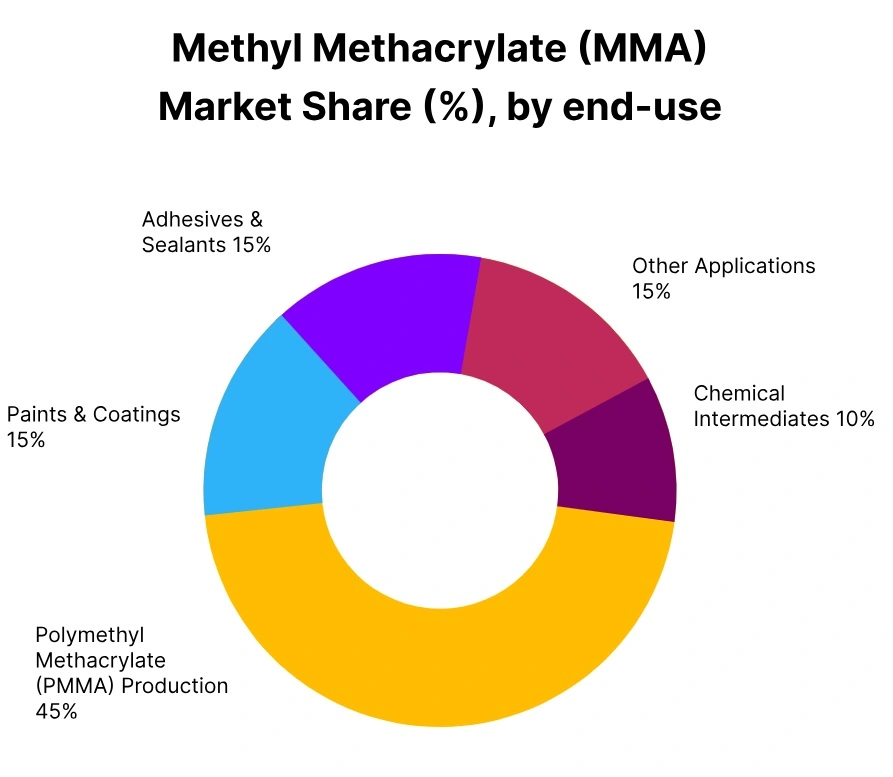
methyl methacrylate market share end use

Historically, several events have caused significant fluctuations in Methyl Methacrylate (mma) prices

  • Global Logistics and Shipping Crisis (2021-Present): The pandemic-related surge in e-commerce and disruptions in global shipping routes, combined with port closures and container shortages, led to a logistics crisis. The transportation of raw materials and finished Methyl Methacrylate (MMA) products became challenging. This caused delays and increased costs for manufacturers and end-users, further straining production.
  • Russia-Ukraine Conflict (2022-Present): The conflict disrupted energy supplies, especially natural gas and oil, which are crucial for the petrochemical industry. Europe, a major consumer of Russian energy, faced significant supply issues. The conflict impacted the availability and cost of energy and raw materials like styrene, which is derived from petrochemical processes. This led to increased production costs and supply disruptions in European Methyl Methacrylate (MMA) markets.
  • COVID-19 Pandemic (2020-2022): The pandemic caused widespread disruptions to global supply chains. Manufacturing plants were shut down, labour shortages occurred, and transportation logistics were severely impacted. The Methyl Methacrylate (MMA) industry experienced production halts due to factory closures and reduced demand from key sectors like automotive and construction. However, demand for packaging, especially for food and medical supplies, increased, causing volatility in supply and demand.
  • Winter Storm Uri (February 2021, U.S.): This severe winter storm affected large parts of the U.S., particularly Texas, which is a major hub for petrochemical production. The storm led to widespread power outages, causing petrochemical plants and refineries to shut down. This disrupted the production of key feedstocks for Methyl Methacrylate (MMA), such as styrene monomer, leading to shortages and price hikes in the Methyl Methacrylate (MMA) market.

Why Price Watch™?

Price Watch™ is your trusted resource for tracking global methyl methacrylate (mma) price trends. Our platform delivers real-time data and expert analysis, offering deep insights into the key factors driving price fluctuations in the methyl methacrylate (mma) market. By monitoring critical events such as geopolitical tensions, supply chain disruptions, and economic shifts, Price Watch™ keeps you fully informed of market dynamics.

In addition, Price Watch™ provides detailed forecasts and updates on production capacities, enabling you to anticipate market changes and make well-informed decisions. With Price Watch™, you gain a competitive edge in understanding all the elements that influence methyl methacrylate (mma) prices worldwide. Stay ahead of the curve with Price Watch’s™ reliable, accurate, and timely methyl methacrylate (mma) market data.

Track Price Watch's™ methyl methacrylate (mma) price assessment on a weekly basis since 2015 onwards, along with short-term forecasts, and get access to the detailed report in a downloadable format.

Methyl Methacrylate (mma) Market Price Trend published by Price Watch™ reflect prevailing spot market conditions, derived from independent research, verified trade inputs, and proprietary market intelligence as of the publication date. Prices are published on the specified Incoterm and represent indicative base market levels, exclusive of applicable taxes, VAT, duties, tariffs, and other statutory charges. Actual transaction values may vary depending on volume, credit terms, contractual structure, and other negotiated conditions. Market prices are inherently subject to volatility, liquidity dynamics, regulatory changes, and evolving trade activity. The information provided is for reference and benchmarking purposes only and does not constitute an offer, recommendation, or guarantee of transactional outcomes. Users should exercise independent commercial judgment and assess their specific contractual, regulatory, tax, and application requirements before making business decisions. Price Watch™ assumes no liability for decisions taken based on this information.

The commodity prices of Methyl Methacrylate (MMA) are influenced by several factors, including:

Raw Material Costs: MMA is primarily derived from feedstocks like propylene, methanol, and acetone. Fluctuations in the prices of these raw materials, often tied to global oil and gas prices, directly impact MMA prices.

Supply and Demand: The balance between MMA supply and demand plays a crucial role in price fluctuations. Increased demand in industries like automotive, construction, and electronics can drive prices up, while oversupply can lead to price drops.

Energy Prices: MMA production is energy-intensive, particularly in the synthesis of its feedstocks (propylene and methanol). Increases in energy prices (e.g., natural gas and electricity) can raise production costs, pushing MMA prices higher.

Production Capacity and Plant Utilization: The availability and efficiency of MMA production facilities, as well as any disruptions such as plant maintenance or closures, can affect supply and, consequently, prices.

Global Economic Conditions: Economic factors, including inflation rates, trade policies, and overall economic growth or recession, influence industrial demand for MMA and the costs associated with its production.

Environmental and Regulatory Factors: Stricter environmental regulations and sustainability initiatives may increase the cost of production or lead to the development of alternative production methods, influencing MMA prices.

Geopolitical Events: Political instability, natural disasters, or changes in trade policies in key production regions (e.g., Asia, North America) can disrupt supply chains and impact MMA prices.

Currency Exchange Rates: MMA is a globally traded commodity, and fluctuations in exchange rates can influence prices, particularly when raw materials or MMA itself is traded across borders.

Technological Advancements: Innovations in production processes, such as more efficient or lower-cost methods of synthesizing MMA, can lead to price reductions by lowering overall production costs.

Market Speculation: Market sentiment, including future price expectations and speculative trading, can also contribute to short-term fluctuations in MMA prices.

These factors interact to create dynamic pricing for MMA, often influenced by both global trends and regional market conditions.

Feedstock prices play a critical role in determining the commodity price of MMA. When the prices of propylene, methanol, and acetone increase due to supply-demand imbalances, raw material shortages, geopolitical tensions, or energy price hikes, the cost of producing MMA also rises. This increase in production costs typically leads to higher MMA prices, as producers pass on the additional costs to consumers. Conversely, a decrease in feedstock prices can lead to lower MMA prices, benefiting downstream industries that rely on MMA for their products.

The relationship between commodity prices and inflation for MMA is multifaceted. Rising feedstock prices (such as for propylene, methanol, and acetone) lead to higher production costs for MMA, which can then contribute to price increases for products containing MMA, fueling inflation. On the other hand, inflationary pressures such as higher energy prices, labor costs, and interest rates can also drive MMA prices upward, contributing to cost-push inflation. Additionally, global economic conditions, supply chain disruptions, and currency fluctuations all play roles in determining the price trajectory of MMA and its impact on inflation across industries.

MMA (Methyl Methacrylate) is a key chemical monomer used to produce acrylic plastics such as PMMA (Polymethyl Methacrylate), coatings, adhesives, and resins. It is widely used in automotive, construction, and electronics industries. Its price impacts production costs across these sectors. Price-Watch™ tracks MMA prices to help businesses stay informed about market movements and cost trends.

MMA prices fluctuate based on region, purity, and market conditions, influenced by feedstock costs (such as acetone and hydrogen cyanide), freight rates, and demand from downstream industries. Prices are typically quoted per metric ton and vary with supply-demand balance. Price-Watch™ provides up-to-date price assessments across key global markets.

MMA prices are influenced by feedstock costs, demand from construction, automotive, and electronics sectors, and production levels. Global supply-demand dynamics, raw material price fluctuations, and industrial activity play key roles. Recent trends show price volatility depending on feedstock availability and downstream demand recovery.

Major consumers of MMA include the construction industry, automotive manufacturers, and electronics sector. The construction sector accounts for the largest share, particularly for acrylic sheets, paints, and coatings, followed by automotive and electronics applications. Price-Watch™ tracks consumption trends across these sectors.

MMA is produced in chemical plants through processes such as the acetone cyanohydrin (ACH) route or newer methods like the C4 or ethylene-based processes. It is then used as a building block for acrylic products and resins.

Major exporters of MMA include countries such as China, Japan, South Korea, and the United States. Export volumes vary depending on production capacity, feedstock availability, domestic demand, and pricing competitiveness in the global market. Price-Watch™ monitors global trade flows and supply availability.

Overall supply is generally balanced; however, temporary tightness may arise due to plant shutdowns, feedstock constraints, logistics disruptions, or strong demand from key downstream industries. Price-Watch™ closely tracks supply-demand balances to highlight potential shortages or oversupply situations.

MMA is available in different purity levels and specifications, depending on application requirements. Prices vary based on purity, production process, performance characteristics, and end-use applications such as coatings, adhesives, or acrylic sheets. Price-Watch™ provides grade-wise price assessments for better market clarity.

When demand rises sharply, often driven by increased construction activity or demand for acrylic products, prices tend to increase, lead times may extend, and buyers may face limited spot availability. Price-Watch™ captures these shifts in real time.

Key feedstocks such as acetone, hydrogen cyanide, and isobutylene directly influence MMA production costs. Any increase in their prices raises manufacturing costs, which producers may pass on to buyers. Price-Watch™ analyses feedstock-MMA price correlations to explain cost movements.

Regional prices vary due to local production capacity, feedstock availability, energy costs, freight rates, import duties, and domestic demand levels. Price-Watch™ tracks regional differentials to highlight pricing gaps across markets.

The MMA price outlook depends on trends in key feedstocks, demand from construction and automotive sectors, capacity expansions, and overall global economic conditions. Price-Watch™ publishes regular forecasts projecting price direction over the next 12 months.

Yes. Reliable forecasts help buyers plan procurement, manage inventory, negotiate contracts, and control production costs. Price-Watch™ forecasts support smarter purchasing and budgeting decisions.

Events such as trade policy changes, plant outages, shipping disruptions, and energy price volatility can affect feedstock availability, alter production rates, and disrupt global trade flows, leading to fluctuations in MMA prices. Price-Watch™ provides timely updates on such market-moving events.

Price-Watch™ gathers data from producers, converters, traders, and buyers to publish transparent MMA price assessments, market reports, and forecasts, helping stakeholders stay ahead of market trends.