Mild Steel (ms) Beam Price Trend and Forecast

UNSPC code: 30101704
|
Weekly Update
|
Historical Data Since 2015
|
Forecast for 2026
  • Commodity Pricing

mild steel (ms) beam Price Trends by Country

inIndia

Global mild steel (ms) beam Spot Market Prices, Trend Analysis and Forecast

𝐏𝐫𝐢𝐜𝐞 𝐖𝐚𝐭𝐜𝐡™ provides price assessments for Mild Steel (MS) Beam across top trading regions:


Asia Pacific

  • MS Beam, EX Delhi-NCR, India
  • MS Beam, EX Mumbai, India


Note:
In assessments structured as CIF [Importing Port] (Exporting Country), the country mentioned in brackets indicates the primary origin of supply (exporting country), while the named port refers to the destination port in the importing country. Other Incoterms (FOB, FD, EXW, etc.) should be interpreted in accordance with standard international trade definitions.

MS Beam Price Trend Q4 2025

India: MS Beam, Domestically traded prices, Ex Delhi-NCR, India; Grade – Primary (400NB)

The MS Beam price trend in India during Q4 of 2025 has been subjected to mild bearish forces resulting from the over-supply of products and the lack of demand being shown by buyers as they enter early 2026. The price of MS Beams in Q4 of 2025 saw a decline of 3.48% over the preceding quarter which indicates modest softening conditions in the long steel domestic market. The demand for these products from the construction and infrastructure sectors along with small-scale fabrication saw a decrease towards year-end and so buyers have been taking a more cautious approach to procurement in anticipation of further drops in price. Adequate supply from both integrated steel mills and secondary producers provided an overall comfort level of availability in the market which put downward pressure on pricing, even though production levels remained steady. The variation in raw material prices (scrap material & iron ore) provided limited support for pricing, while the stability of logistics provided a consistent flow of goods through the regional marketplace. The price of MS Beams fell further in December 2025 when distributors have focused on clearing their inventory in preparation for year-end, and because there has been very little purchasing from contractors and fabricators as spot market transactions occurred at a limited volume.

Mild Steel (MS) Beam Price Trend Analysis: Q4 2025

In the third quarter of 2025, the price of mild steel beams has seen a decline around the world due to lowered demand in the construction and automotive industries, with further pressure regarding oversupply as predictable increases in Chinese exports.

There have been minor price differences in each region, yet sentiment remained bearish overall with downward pressure from trade tariffs, increased inventories, and weak industrial activity. Major producers have reduced capacity to protect margins.

India: Mild Steel (MS) Beam Domestically traded prices Ex-Delhi-NCR, India, Grade- Primary (400NB).

According to Price-Watch, In Q3 2025, the mild steel (MS) beam price trend in India has witnessed a 2.17% decline compared to Q2 2025, primarily due to seasonal moderation in demand during the monsoon period and slight easing in raw material costs. Despite this decline, underlying demand from infrastructure and real estate sectors has remained supportive, with India’s overall steel demand projected to grow steadily throughout the year.

The decrease primarily reflects a short-term correction rather than a structural weakness, as government safeguards on imports and stable domestic production have continued to provide a price floor. Market participants have closely monitored input cost movements and policy changes, maintaining cautious optimism heading into Q4.

A 0.23% increase in mild steel (MS) beam prices in India during September 2025 has been attributed to a slight rise in raw material costs and steady demand from construction and infrastructure sectors. Additionally, global supply chain fluctuations and marginal increases in transportation expenses have contributed to this modest price adjustment.

According to the PriceWatch, the price of Mild Steel (MS) Beams in India went up by $680.16 per metric ton (about 3.76%), Ex Mumbai in the second quarter of 2025. This rise is mainly because construction and infrastructure projects are demanding more steel, while the costs to produce steel like raw materials and transportation have also increased.

Additionally, government policies limiting steel imports and limited local supply have kept prices high. As a result, businesses buying steel will face higher costs, and unless production increases or imports rise significantly, prices are likely to stay high in the coming months. 

For Q1 2025, MS (Mild Steel) Beam India experienced a notable price increase of $650.13 per metric ton, Ex Mumbai reflecting a 0.49% rise compared to the previous quarter. This moderate price uptick indicates a steady demand environment and possibly higher input costs or supply constraints influencing the market.

Despite the seemingly small percentage increase, the absolute value suggests that manufacturers and suppliers are adjusting prices to maintain margins amidst fluctuating raw material costs and inflationary pressures. Overall, the market for MS Beam in India appears resilient, with incremental price growth signalling cautious optimism among industry stakeholders. 

Mild Steel (MS) Beam Price Trend Analysis: Q4 2024

In Q4 2024, MS Beam prices in India experienced a modest decline, dropping by $646.94 per metric ton, Ex-Mumbai which corresponds to a 1.08% decrease. This slight price correction reflects a combination of factors such as stabilized demand in the construction and manufacturing sectors, along with moderated raw material costs.

While the reduction is not steep, it indicates cautious market sentiment possibly influenced by global steel supply fluctuations and regional economic conditions. Overall, the MS Beam market shows signs of balancing after prior volatility, suggesting a period of consolidation for producers and buyers alike. 

In Q3 2024, MS Beam India experienced a notable price decline, with prices dropping by $654.03 per metric ton, Ex-Mumbai representing a 6.51% decrease compared to the previous quarter. This downward movement may reflect several factors, including easing demand pressures, increased supply availability, or broader market adjustments in raw material costs and global steel trends.

The price correction could provide relief for downstream industries relying on MS Beam, potentially stimulating consumption. However, for producers and suppliers, this decrease might signal tighter margins and the need for strategic cost management to maintain profitability in a competitive environment. Overall, the Q3 pricing trend suggests a cautious market sentiment amid fluctuating economic conditions impacting the steel sector in India. 


For Q2 2024, MS Beam India experienced a price increase of $699.56 per metric ton, Ex-Mumbai reflecting a 1.87% rise compared to the previous quarter. This moderate price uptick indicates a steady demand in the market, likely influenced by rising raw material costs and sustained infrastructure activities across the country.

Despite global economic uncertainties, the incremental price adjustment suggests manufacturers are cautiously balancing cost pressures while maintaining competitiveness. Overall, the increase points to a resilient steel sector in India, supported by ongoing industrial growth and infrastructure development. 

In Q1 2024, MS Beam prices in India experienced a notable decline, dropping by $686.75 per metric ton, Ex- Mumbai which translates to a 4.76% decrease compared to the previous quarter. This downward trend reflects a combination of factors such as softened demand in the construction and manufacturing sectors, increased supply from domestic producers, and possibly easing raw material costs like iron ore and scrap metal.

The price correction may also be influenced by cautious market sentiment amid broader economic uncertainties, leading buyers to negotiate better rates. Overall, the price dip in MS Beam suggests a temporary market adjustment, offering potential buying opportunities for end-users while signalling competitive pressure on producers to optimize costs.

Technical Specifications of Mild Steel (ms) Beam Price Trends

Product Description

MS Beam (Mild Steel Beam) is a robust and essential structural steel product, typically available in I beam or H beam shapes. Designed to support heavy loads, MS Beams are widely used in construction, infrastructure, and engineering projects. They provide excellent strength, rigidity, and stability for structures such as buildings, bridges, platforms, and industrial frameworks.

With superior load bearing capacity, good weldability, and resistance to deformation under stress, MS Beams are ideal for both vertical and horizontal structural support. Their reliability and performance make them a fundamental component in residential, commercial, and industrial construction.

Identifiers and Classification:

  • HS Code – 721610


Mild Steel Beam Grades Specific Price Assessment:

  • Primary (400NB)


Mild Steel Beam Global Trade and Shipment Terms

  • Quotation Terms (Product & Country Specific): 18-20 MT
  • Packaging Type (Product & Country Specific): Container


Incoterms Referenced in Mild Steel Beam Price Reporting

Shipping Term  Location  Definition 
EX Delhi-NCR   India  Domestically Traded MS Beam price in India 
EX Mumbai  India  Domestically Traded MS Beam price in India 

*Quotation Terms refers to the quantity range specified for the Mild Steel Beam being quoted or offered in a commercial transaction.

**Packaging Type refers to standard packaging size commonly used for Mild Steel Beam packing, ease of handling, transportation, and storage in industrial and commercial applications.

Key Mild Steel Beam Manufacturers

Manufacturer 
Tata Steel Limited 
JSW Steel 
SAIL 
JSPL 
Shyam Steel 

Mild Steel (ms) Beam Industrial Applications

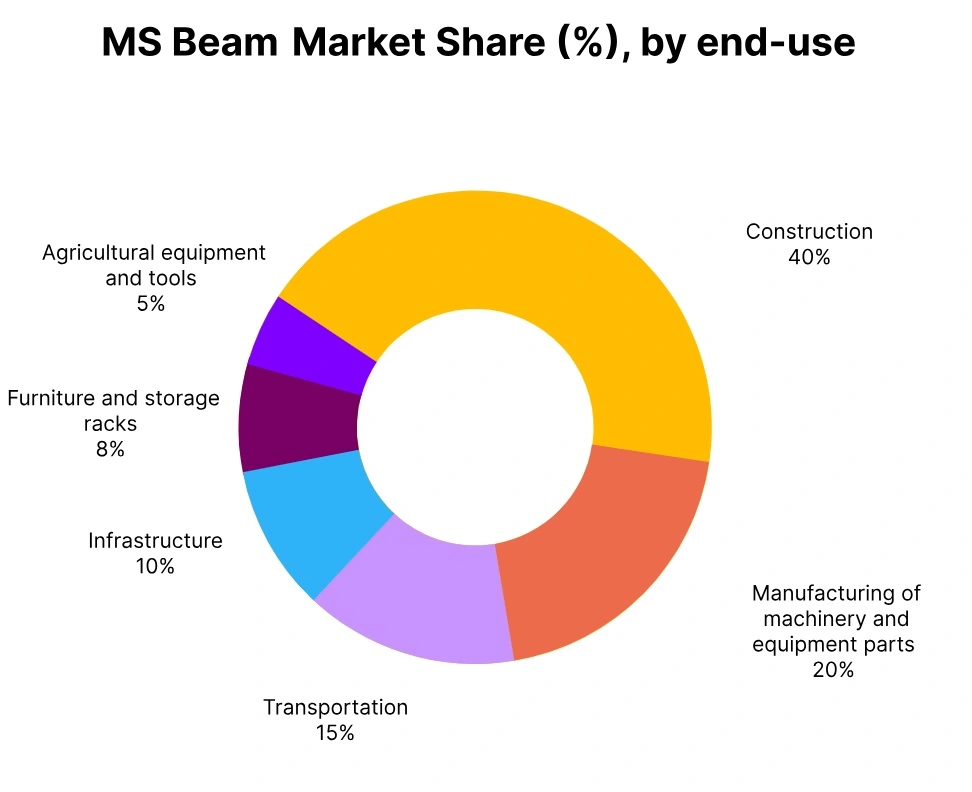
MS beam market share end use

Historically, several events have caused significant fluctuations in Mild Steel (ms) Beam prices

  • Chinese Production Policies (2007–2008): Concentration of smelters and tighter export controls in China reduced output, creating global shortages and driving prices sharply higher.
  • COVID 19 Pandemic (2020): Lockdowns and operational disruptions at Chinese smelters caused supply shocks, leading to multiyear spot price highs worldwide.
  • Global Supply and Demand Acceleration (2023–2024): Rising feedstock costs, seasonal smelter maintenance, and stronger industrial demand in India and the USA drove Q2–Q3 price gains of approximately 18–28%.
  • China Export Controls (2025): Restrictions and environmental quotas reduced exports by 40–50%, causing extreme global price jumps and regional market corrections.

These events underscore the MS Beam market’s sensitivity to supply disruptions, industrial demand shifts, and geopolitical or policy interventions, highlighting the importance of monitoring both global supply and domestic consumption patterns.

Why Price Watch™?

Price Watch™ is your trusted resource for tracking global mild steel (ms) beam price trends. Our platform delivers real-time data and expert analysis, offering deep insights into the key factors driving price fluctuations in the mild steel (ms) beam market. By monitoring critical events such as geopolitical tensions, supply chain disruptions, and economic shifts, Price Watch™ keeps you fully informed of market dynamics.

In addition, Price Watch™ provides detailed forecasts and updates on production capacities, enabling you to anticipate market changes and make well-informed decisions. With Price Watch™, you gain a competitive edge in understanding all the elements that influence mild steel (ms) beam prices worldwide. Stay ahead of the curve with Price Watch’s™ reliable, accurate, and timely mild steel (ms) beam market data.

Track Price Watch's™ mild steel (ms) beam price assessment on a weekly basis since 2015 onwards, along with short-term forecasts, and get access to the detailed report in a downloadable format.

Mild Steel (ms) Beam Market Price Trend published by 𝐏𝐫𝐢𝐜𝐞 𝐖𝐚𝐭𝐜𝐡™ reflect prevailing spot market conditions, derived from independent research, verified trade inputs, and proprietary market intelligence as of the publication date. Prices are published on the specified Incoterm and represent indicative base market levels, exclusive of applicable taxes, VAT, duties, tariffs, and other statutory charges. Actual transaction values may vary depending on volume, credit terms, contractual structure, and other negotiated conditions. Market prices are inherently subject to volatility, liquidity dynamics, regulatory changes, and evolving trade activity. The information provided is for reference and benchmarking purposes only and does not constitute an offer, recommendation, or guarantee of transactional outcomes. Users should exercise independent commercial judgment and assess their specific contractual, regulatory, tax, and application requirements before making business decisions. 𝐏𝐫𝐢𝐜𝐞 𝐖𝐚𝐭𝐜𝐡™ assumes no liability for decisions taken based on this information.

Raw Material Costs- MS beams are primarily produced from mild steel or carbon steel. Fluctuations in the prices of steel billets, iron ore, or scrap metal directly impact the cost of manufacturing MS beams.

Supply and Demand- High demand from sectors such as construction, infrastructure development, heavy engineering, and real estate drives prices upward. Conversely, oversupply or a downturn in construction activity can reduce prices.

Manufacturing Costs- Expenses related to labor, energy (electricity and fuel), maintenance of rolling mills, and technological upgrades contribute to the overall cost of production and influence beam pricing.

Global Trade Policies & Tariffs- Import/export duties, anti-dumping measures, and trade agreements affect the cost of steel products, thereby influencing the local and global pricing of MS beams.

Market Competition- The presence of multiple suppliers and manufacturers can lead to competitive pricing. Dominant players may influence market prices depending on their production capacity and pricing strategies.

Exchange Rates- Variations in foreign exchange rates affect the cost of imported raw materials and influence the competitiveness of exported beams, impacting pricing in both domestic and international markets.

Transportation and Logistics Costs- Beams are large and heavy, making shipping and freight a significant cost component. Increases in fuel prices or transportation disruptions can affect the final delivered cost of MS beams.

Government Regulations and Environmental Policies- Environmental norms, emission control mandates, taxation policies, and regulatory compliances (like BIS certification in India) increase production complexity and costs, thereby influencing prices.

Infrastructure and Real Estate Trends- Since MS beams are heavily used in structural applications, macroeconomic indicators, government infrastructure budgets, and real estate activity strongly affect demand and pricing.

The availability and cost of raw materials such as high-carbon steel and alloy coatings directly affect MS Beam production costs and pricing.

MS Beam prices generally rise with inflation, as increased costs of raw materials (like iron ore and coal), energy, and transportation drive up production expenses. Nonetheless, steady demand from construction, real estate, and industrial sectors often helps maintain relatively stable pricing patterns, even during periods of economic volatility.

Mild Steel Beam is a widely used structural steel product valued for its high load-bearing capacity, durability, and structural stability in construction, infrastructure, and industrial applications. Typically manufactured through hot rolling, it features cross-sectional profiles such as I-beams or H-beams designed to efficiently support heavy loads and distribute stress across structural frameworks. Mild steel beams are extensively used in the construction of buildings, bridges, warehouses, industrial sheds, and large infrastructure projects where strong support and rigidity are required. Their excellent weldability, machinability, and formability make them suitable for a variety of fabrication and engineering applications, including machinery structures, support columns, platforms, and structural reinforcements. As a key segment of the steel long products market, demand for mild steel beams is closely linked to construction activity, infrastructure development, and industrial expansion. 𝐏𝐫𝐢𝐜𝐞 𝐖𝐚𝐭𝐜𝐡™ tracks mild steel beam price trends to help businesses and industry stakeholders stay informed about supply dynamics, demand patterns, raw material cost movements, and broader market developments influencing the global steel sector.

MS Beam prices vary by region and market conditions. Prices are typically quoted per metric ton or per pound and fluctuate based on global supply, import/export flows, industrial demand, and currency exchange rates. 𝐏𝐫𝐢𝐜𝐞 𝐖𝐚𝐭𝐜𝐡™ provides real time price assessments across different global markets to help buyers and sellers make informed decisions.

Prices fluctuate due to changes in Chinese production, environmental regulations, seasonal smelter maintenance, feedstock availability, and demand from pharmaceuticals, electronics, and alloys. Exchange rates, logistics costs, and global economic conditions also influence trends.

Major consumers include pharmaceuticals, electronics, metallurgy, chemical & pigment industries, and research/specialty materials. 𝐏𝐫𝐢𝐜𝐞 𝐖𝐚𝐭𝐜𝐡™ analyses demand patterns across all these industries.

Mild Steel Beam is primarily produced through steel rolling processes, usually from billets or blooms made of low carbon steel in steel plants. High-quality Mild Steel Beams are manufactured using processes such as hot rolling, controlled cooling, and finishing operations. In this process, heated steel billets or blooms are passed through rolling mills where they are shaped into I-shaped or H-shaped cross sections with parallel flanges and a central web. The final products are standardized beams with uniform dimensions and strength, making them suitable for structural frameworks, building construction, bridges, industrial sheds, support structures, and various heavy engineering applications.

India is the world’s largest exporter. Export volumes vary with domestic policies, environmental regulations, and international demand. 𝐏𝐫𝐢𝐜𝐞 𝐖𝐚𝐭𝐜𝐡™ tracks production levels, export flows and trade patterns to help businesses understand global supply chains and identify sourcing opportunities.

Supply generally meets demand, but disruptions may occur due to smelter shutdowns, environmental restrictions, or spikes in industrial consumption. 𝐏𝐫𝐢𝐜𝐞 𝐖𝐚𝐭𝐜𝐡™ monitors these supply demand imbalances to alert the market about potential shortages or surpluses.

MS Beam is graded by purity: industrial grade (Primary (400NB)), and ultra-pure specialty forms. Higher purity grades cost more due to extra refining. 𝐏𝐫𝐢𝐜𝐞 𝐖𝐚𝐭𝐜𝐡™ provides separate price assessments for each grade to ensure market transparency.

When demand rises, for example: from pharmaceutical production or electronics manufacturing prices typically climb. Suppliers may prioritize certain customers, and lead times can extend. 𝐏𝐫𝐢𝐜𝐞 𝐖𝐚𝐭𝐜𝐡™ captures these market dynamics in real time.

Refining MS Beam is energy intensive. Rising electricity, fuel, or chemical costs often get passed on to buyers. This is why prices in regions with cheaper electricity tend to be lower, a correlation that 𝐏𝐫𝐢𝐜𝐞 𝐖𝐚𝐭𝐜𝐡™ analyses in its price assessments & market reports.

Regional variations arise from import dependency, shipping costs, currency fluctuations, and local demand. 𝐏𝐫𝐢𝐜𝐞 𝐖𝐚𝐭𝐜𝐡™ tracks prices across all major regions to highlight these differences.

Forecasts depend on production capacity, Chinese export policies, industrial demand, and macroeconomic factors. 𝐏𝐫𝐢𝐜𝐞 𝐖𝐚𝐭𝐜𝐡™ regularly publishes detailed forecasts that project price movements for the next 12 months based on comprehensive analysis of supply additions, demand growth in key industries, seasonal patterns, and macroeconomic indicators. Our forecasts help businesses anticipate market conditions and plan accordingly.

Yes. Accurate forecasts allow businesses to optimize purchasing, negotiate contracts, and manage inventories. If 𝐏𝐫𝐢𝐜𝐞 𝐖𝐚𝐭𝐜𝐡™ forecasts predict a price increase in three months, you might choose to stock up now or lock in long term contracts at current rates, potentially saving thousands of dollars.

Events such as Chinese export restrictions, smelter shutdowns, environmental regulations, or economic shocks can cause supply shortages and price volatility. 𝐏𝐫𝐢𝐜𝐞 𝐖𝐚𝐭𝐜𝐡™ provides timely alerts when such events affect the market.

𝐏𝐫𝐢𝐜𝐞 𝐖𝐚𝐭𝐜𝐡™ collects data from manufacturers, distributors, and buyers worldwide to publish regular price assessments, market reports, and forecasts. Our transparent methodology and comprehensive coverage make us a trusted source for understanding fair pricing and market trends in the MS Beam industry.