Pentaerythritol (pent) Price Trend and Forecast

Weekly Update
|
Historical Data Since 2015
|
Forecast for 2026
  • Commodity Pricing

pentaerythritol (pent) Price Trends by Country

cnChina
twTaiwan
seSweden
ruRussia
deGermany
itItaly
esSpain
usUnited States
inIndia
brBrazil
krSouth Korea

Global pentaerythritol (pent) Spot Market Prices, Trend Analysis and Forecast

𝐏𝐫𝐢𝐜𝐞 𝐖𝐚𝐭𝐜𝐡™ provides price assessments for Pentaerythritol across top trading regions:


Asia-Pacific

  • Pentaerythritol (PENT) Technical Grade (98%) (Mono) FOB Kaohsiung, Taiwan
  • Pentaerythritol (PENT) Technical Grade (98%) (Mono) FOB Qingdao, China
  • Pentaerythritol (PENT) Technical Grade (98%) (Mono) CIF Busan (China), South Korea
  • Pentaerythritol (PENT) Technical Grade (98%) (Mono) CIF Nhava Sheva (Russia), India
  • Pentaerythritol (PENT) Technical Grade (98%) (Mono) CIF Nhava Sheva (Sweden), India
  • Pentaerythritol (PENT) Technical Grade (98%) (Mono) CIF Nhava Sheva (Taiwan), India
  • Pentaerythritol (PENT) Technical Grade (98%) (Mono) Ex-Ankleshwar, India


North America

  • Pentaerythritol (PENT) Technical Grade (98%) (Mono) CIF Houston (Taiwan), USA


Europe

  • Pentaerythritol (PENT) Technical Grade (98%) (Mono) FD Barcelona, Spain
  • Pentaerythritol (PENT) Technical Grade (98%) (Mono) FD Genoa, Italy
  • Pentaerythritol (PENT) Technical Grade (98%) (Mono) FD Germany, Germany
  • Pentaerythritol (PENT) Technical Grade (98%) (Mono) FOB Helsingborg, Sweden
  • Pentaerythritol (PENT) Technical Grade (98%) (Mono) FOB Saint Petersburg, Russia


South America

  • Pentaerythritol (PENT) Technical Grade (98%) (Mono) CIF Santos (China), Brazil
  • Pentaerythritol (PENT) Technical Grade (98%) (Mono) CIF Santos (Sweden), Brazil


Note:
In assessments structured as CIF [Importing Port] (Exporting Country), the country mentioned in brackets indicates the primary origin of supply (exporting country), while the named port refers to the destination port in the importing country. Other Incoterms (FOB, FD, EXW, etc.) should be interpreted in accordance with standard international trade definitions.

Pentaerythritol Price Trend Q4 2025

In Q4 2025, the global Pentaerythritol market showed mixed performance across regions with price movements ranging from approximately -5% to +2%. Western markets, including the United States and several European countries such as Germany, Italy, Spain, and Sweden, experienced mild price declines, reflecting subdued demand from coatings, resins, and lubricant additive sectors amid comfortable supply availability and cautious purchasing activity. Asia-Pacific markets displayed divergent trends, with China and South Korea recording modest gains supported by steady downstream offtake, while Taiwan and India saw marginal softness due to competitive imports and measured procurement. Latin American markets, notably Brazil, also reported slight downward pressure amid balanced inventories and muted buying interest. Despite varying regional dynamics, the market remained broadly balanced, underpinned by stable formaldehyde availability and conservative inventory management. In general, market conditions stayed steady, supported by manageable supply chain fundamentals, consistent industrial activity, and stable freight costs. Regional supply-demand balances and uneven downstream consumption trends continued to guide pricing during the quarter.

Taiwan: Pentaerythritol (PENT) Export prices FOB Kaohsiung, Taiwan, Grade-Technical grade (98%) (Mono)

In Q4 2025, Pentaerythritol prices FOB Kaohsiung, Taiwan ranged USD 1400–1500 per metric ton and showed a downward price trend. The 3.57% decline stemmed from steady production levels, cautious regional demand from coatings and resin sectors, and balanced export availability. The defined range reflected orderly cargo placement despite selective buying. Pentaerythritol prices softened as suppliers adjusted volumes amid moderate downstream pull. The Asian Pentaerythritol market remained stable, with movements clearly tracked on the Pentaerythritol price chart and echoed by a softer Pentaerythritol price index. The prevailing Pentaerythritol price trend highlighted supply comfort outweighing demand recovery. In December 2025, prices increased by 2.70%, influenced by short-term restocking and limited spot availability.

Sweden: Pentaerythritol (PENT) Export prices FOB Helsingborg, Sweden, Grade-Technical grade (98%) (Mono)

In Q4 2025, Pentaerythritol prices FOB Helsingborg, Sweden ranged USD 1600–1700 per metric ton and showed a mild downward price trend. The 1.67% decrease reflected steady European demand, consistent production, and balanced export shipments. The tight range highlighted disciplined supply management. Pentaerythritol prices eased slightly as buyers maintained cautious procurement. The regional Pentaerythritol market stayed orderly, with changes visible on the Pentaerythritol price chart and reinforced by a marginally softer Pentaerythritol price index. The quarter’s Pentaerythritol price trend emphasized stability amid moderate demand. In December 2025, prices increased by 3.51%, supported by short-covering and seasonal restocking.

Russia: Pentaerythritol (PENT) Export prices FOB Saint Petersburg, Russia, Grade-Technical grade (98%) (Mono)

In Q4 2025, Pentaerythritol prices FOB Saint Petersburg, Russia ranged USD 1300–1500 per metric ton and showed a downward price trend. The 2.46% decline stemmed from steady export availability and cautious international buying. The broader range reflected uneven spot interest. Pentaerythritol prices softened as exporters focused on volume placement. The Eastern European Pentaerythritol market leaned supply-heavy, with movements tracked on the Pentaerythritol price chart and mirrored by a weaker Pentaerythritol price index. The prevailing Pentaerythritol price trend highlighted inventory-led selling. In December 2025, prices increased by 0.99%, influenced by selective replenishment.

China: Pentaerythritol (PENT) Export prices FOB Qingdao, China, Grade-Technical grade (98%) (Mono)

In Q4 2025, Pentaerythritol prices FOB Qingdao, China ranged USD 1400–1600 per metric ton and showed a mild upward price trend. The 1.66% rise reflected controlled production, steady export inquiries, and moderate resin-sector demand. The wider range indicated selective buying amid sufficient supply. Pentaerythritol prices edged higher as suppliers balanced contracts with spot volumes. The Chinese Pentaerythritol market showed stable fundamentals, tracked on the Pentaerythritol price chart and supported by a firmer Pentaerythritol price index. The quarter’s Pentaerythritol price trend emphasized supply discipline. In December 2025, prices decreased by 0.33%, influenced by inventory normalization.

Spain: Pentaerythritol (PENT) Domestically Traded prices FD Barcelona, Spain, Grade-Technical grade (98%) (Mono)

In Q4 2025, Pentaerythritol prices FD Barcelona, Spain ranged USD 1700–1800 per metric ton and showed a mild downward price trend. The 1.60% decline reflected moderate coatings demand and steady European supply. Pentaerythritol prices eased as distributors optimized inventories. The Spanish Pentaerythritol market remained balanced, with shifts visible on the Pentaerythritol price chart and echoed by a softer Pentaerythritol price index. The prevailing Pentaerythritol price trend highlighted demand-side caution. In December 2025, prices increased by 3.36%, supported by seasonal restocking.

Italy: Pentaerythritol (PENT) Domestically Traded prices FD Genoa, Italy, Grade-Technical grade (98%) (Mono)

In Q4 2025, Pentaerythritol prices FD Genoa, Italy ranged USD 1700–1800 per metric ton and showed a mild downward price trend. The 1.55% decline stemmed from steady supply and cautious downstream demand. Pentaerythritol prices softened as buyers limited spot exposure. The Italian Pentaerythritol market followed wider European cues, reflected on the Pentaerythritol price chart and aligned with a weaker Pentaerythritol price index. The quarter’s Pentaerythritol price trend emphasized stability with mild downside pressure. In December 2025, prices increased by 3.34%, influenced by short-term replenishment.

Germany: Pentaerythritol (PENT) Domestically Traded prices FD Germany, Germany, Grade-Technical grade (98%) (Mono)

In Q4 2025, Pentaerythritol prices FD Germany ranged USD 1600–1800 per metric ton and showed a mild downward price trend. The 1.63% decrease reflected balanced availability and moderate industrial demand. Pentaerythritol prices eased as distributors managed inventories conservatively. The German Pentaerythritol market stayed orderly, with movements tracked on the Pentaerythritol price chart and echoed by a softer Pentaerythritol price index. The prevailing Pentaerythritol price trend highlighted cautious procurement. In December 2025, prices increased by 3.42%, supported by year-end restocking.

USA: Pentaerythritol (PENT) Imported prices CIF Houston from Taiwan, USA, Grade-Technical grade (98%) (Mono)

In Q4 2025, Pentaerythritol prices CIF Houston from Taiwan ranged USD 1500–1700 per metric ton and showed a downward price trend. The 5.02% decline stemmed from steady import arrivals, reduced freight costs, and moderate coatings demand. Pentaerythritol prices softened as buyers optimized inventories. The US Pentaerythritol market leaned supply-comfortable, reflected on the Pentaerythritol price chart and supported by a weaker Pentaerythritol price index. The quarter’s Pentaerythritol price trend underscored inventory-led softness. In December 2025, prices increased by 1.18%, influenced by selective restocking.

South Korea: Pentaerythritol (PENT) Imported prices CIF Busan from China, South Korea, Grade-Technical grade (98%) (Mono)

In Q4 2025, Pentaerythritol prices CIF Busan from China ranged USD 1500–1600 per metric ton and showed a mild upward price trend. The 1.57% rise reflected steady demand and stable freight conditions. Pentaerythritol prices edged higher amid balanced imports. The Korean Pentaerythritol market remained orderly, tracked on the Pentaerythritol price chart and reinforced by a firmer Pentaerythritol price index. The prevailing Pentaerythritol price trend highlighted controlled supply. In December 2025, prices decreased by 0.32%, influenced by inventory normalization.

Brazil: Pentaerythritol (PENT) Imported prices CIF Santos from China, Brazil, Grade-Technical grade (98%) (Mono)

In Q4 2025, Pentaerythritol prices CIF Santos from China ranged USD 1600–1700 per metric ton and showed a downward price trend. The 2.73% decline stemmed from reduced freight and cautious demand. Pentaerythritol prices softened as importers managed inventories. The Brazilian Pentaerythritol market stayed balanced, visible on the Pentaerythritol price chart and echoed by a softer Pentaerythritol price index. The quarter’s Pentaerythritol price trend emphasized demand restraint. In December 2025, prices decreased by 2.14%, influenced by year-end destocking.

India: Pentaerythritol (PENT) Domestically Traded prices Ex-Ankleshwar, India, Grade-Technical grade (98%) (Mono)

In Q4 2025, Pentaerythritol prices Ex-Ankleshwar, India ranged USD 1700–1900 per metric ton and showed a mild downward price trend. The 0.75% decline reflected steady domestic supply and moderate resin-sector demand. Pentaerythritol prices eased as processors adopted cautious procurement. The Indian Pentaerythritol market remained balanced, tracked on the Pentaerythritol price chart and supported by a slightly weaker Pentaerythritol price index. The prevailing Pentaerythritol price trend highlighted stability with mild softness. In December 2025, prices increased by 1.22%, supported by short-term restocking.

Pentaerythritol (PENT) Price Trend Analysis: Q4 2025

In Q3 2025, the global Pentaerythritol (PENT) market showed uneven performance across regions. Western markets such as Sweden, Germany, and Spain showed moderate pentaerythritol (PENT) price trend declines due to weak demand from paint, coatings, and industrial adhesive sectors amid soft industrial output and ample supply.

European regions were comparatively stable with slight downward pressure, as consistent production and stable feedstock costs failed to offset cautious procurement. Nevertheless, Asia-Pacific markets experienced notable weakness with prices falling significantly in China and Taiwan on account of oversupply, competitive pricing, and subdued export demand, despite reliable production.

In general, the market remained reasonably balanced underpinned by stable industrial activity, stable feedstock supply, and moderate freight conditions. Regional supply chain fundamentals and disparate downstream consumption trends continued to drive pricing during the quarter.

Taiwan: Pentaerythritol (PENT) Export Price from Taiwan, Technical Grade (98%) (Mono) FOB Kaohsiung.

In Q3 2025, Pentaerythritol (PENT) price trend from Taiwan declined moderately, reflecting weaker demand from downstream alkyd resin and surface coating sectors in key export markets. FOB Kaohsiung prices ranged between USD 1,400–1,600 per metric ton, reflecting a quarterly decrease of 3.71%. Production remained stable, with no major disruptions at manufacturing facilities.

However, competitive pricing from Chinese and Russian suppliers added pressure on regional buyers. Feedstock acetaldehyde and formaldehyde costs showed limited volatility. Market sentiment remained cautious, with limited restocking activity observed across Asia and Europe.

Sweden: Pentaerythritol (PENT) Export Price from Sweden, Technical Grade (98%) (Mono) FOB Helsingborg.

In Q3 2025, Pentaerythritol (PENT) price trends from Sweden showed slight softness, despite consistent demand from European specialty chemical and resin producers. FOB Helsingborg prices ranged between USD 1,600–1,800 per metric ton, reflecting a quarterly decline of 2.04%.

Swedish producers maintained high product purity and reliable supply, supporting long-term contracts. However, weak industrial output in downstream paint and adhesive sectors limited pricing strength. Feedstock costs remained stable due to integrated production.

Russia: Pentaerythritol (PENT) Export Price from Russia, Technical Grade (98%) (Mono) FOB Saint Petersburg.

In Q3 2025, Pentaerythritol (PENT) price trend from Russia declined moderately, reflecting increased competition from Asian suppliers and logistical constraints in European markets. FOB Saint Petersburg prices ranged between USD 1,400–1,500 per metric ton, reflecting a quarterly decrease of 3.04%. Russian producers maintained steady output, supported by low domestic feedstock costs.

However, limited access to Western European markets and payment restrictions continued to affect offtake. Alternative export routes to the Middle East and Asia remained active. The market remained competitive, with pricing under pressure from oversupply.

China: Pentaerythritol (PENT) Export Price from China, Technical Grade (98%) (Mono) FOB Qingdao.

In Q3 2025, Pentaerythritol (PENT) price trend from China declined significantly, reflecting oversupply conditions and weak global demand. FOB Qingdao prices ranged between USD 1,400–1,600 per metric ton, marking a quarterly drop of 5.98%.

Chinese producers operated at high rates, but export interest remained subdued due to inventory buildup and competitive pricing from other regions. Feedstock acetaldehyde and formaldehyde costs softened, reducing production expenses. Despite lower prices, buyers remained selective, prioritizing quality and reliability.

Spain: Pentaerythritol (PENT) Domestically Traded Price in Spain, Technical Grade (98%) (Mono) FD Barcelona.

In Q3 2025, Pentaerythritol (PENT) price trend in Spain trended lower, reflecting weak demand from construction, paint, and industrial coatings sectors. FD Barcelona prices ranged between USD 1,700–1,900 per metric ton, reflecting a quarterly decrease of 2.04%.

Spanish converters maintained cautious procurement, aligning with soft industrial activity. Supply from domestic and neighbouring producers remained ample, preventing any price recovery. Feedstock and energy costs showed limited impact.

Italy: Pentaerythritol (PENT) Domestically Traded Price in Italy, Technical Grade (98%) (Mono) FD Genoa.

In Q3 2025, Pentaerythritol (PENT) price trend in Italy showed slight softness, reflecting subdued demand from alkyd resin and surface coating manufacturers. FD Genoa prices ranged between USD 1,700–1,900 per metric ton, reflecting a quarterly decline of 1.52%.

Italian buyers maintained selective procurement, prioritizing high-purity material for specialty applications. Supply from domestic and imported sources remained stable, with no major disruptions. Feedstock costs remained rangebound, offering little directional momentum.

Germany: Pentaerythritol (PENT) Domestically Traded Price in Germany, Technical Grade (98%) (Mono) FD Germany.

In Q3 2025, Pentaerythritol (PENT) price trend in Germany declined moderately, reflecting weak consumption from automotive, industrial coatings, and adhesive sectors. FD Germany prices ranged between USD 1,600–1,800 per metric ton, reflecting a quarterly decrease of 2.07%. Downstream converters operated at reduced rates amid soft industrial output. Supply from integrated European producers remained consistent, ensuring ample availability. Feedstock and logistics costs showed limited volatility.

USA: Pentaerythritol (PENT) Import Price in USA from Taiwan, Technical Grade (98%) (Mono) CIF Houston (Taiwan).

During Q3 2025, freight costs to Houston declined moderately, supported by improved vessel availability and reduced trans-Pacific congestion, providing mild cost relief to importers. Pentaerythritol (PENT) prices in the U.S. showed notable weakness, with CIF Houston prices ranging between USD 1,600–1,800 per metric ton, reflecting a quarterly decrease of 3.63%.

Despite lower logistics expenses, demand from alkyd resin and coatings sectors remained subdued. Taiwanese suppliers maintained reliable shipments but faced competition from domestic and European producers. U.S. buyers remained selective, aligning procurement with soft manufacturing activity.

South Korea: Pentaerythritol (PENT) Import Price in South Korea from China, Technical Grade (98%) (Mono) CIF Busan (China).

During Q3 2025, freight costs to Busan increased slightly, reflecting sustained demand for chemical imports and stable shipping schedules, adding marginal pressure to Overall prices. Pentaerythritol (PENT) price trend in South Korea declined significantly, with CIF Busan prices ranging between USD 1,400–1,600 per metric ton, reflecting a quarterly drop of 5.82%. Despite higher freight expenses, weak downstream demand limited price resilience.

Chinese suppliers offered aggressive pricing, increasing competitive pressure on local producers. Korean converters maintained cautious procurement, aligning with soft industrial output. The market remains oversupplied, with limited recovery expected.

Brazil: Pentaerythritol (PENT) Import Price in Brazil from China, Technical Grade (98%) (Mono) CIF Santos (China).

During Q3 2025, freight costs to Santos rose sharply, driven by strong demand for trans-Atlantic chemical shipments and logistical bottlenecks, significantly increasing Overall expenses. Pentaerythritol (PENT) price trend in Brazil showed marginal softness, with CIF Santos prices ranging between USD 1,600–1,800 per metric ton, reflecting a mild quarterly decline.

Despite elevated freight costs, Chinese suppliers maintained competitive pricing to secure market share. Demand from local paint, resin, and adhesive sectors remained stable, supporting steady offtake. Brazilian buyers continued long-term contracts, balancing cost and reliability.

India: Pentaerythritol (PENT) Domestically Traded Price in India, Technical Grade (98%) (Mono) Ex-Ankleshwar.

According to Price-Watch, in Q3 2025, Pentaerythritol (PENT) price trend in India showed slight firmness, supported by steady domestic demand from alkyd resin, paint, and varnish manufacturers. Ex-Ankleshwar prices ranged between USD 1,820–1,840 per metric ton, reflecting a marginal quarterly increase.

Local production remained stable, with no major disruptions at manufacturing units. Indian buyers preferred domestically produced PENT due to consistent quality and shorter lead times. Feedstock costs showed limited volatility, supporting stable pricing.

According to the PriceWatch, In Q2 2025, Pentaerythritol prices averaged USD 1580 per metric ton on FOB Qingdao basis. This reflected a quarterly increase of +3.49%, supported by improved overseas demand and tighter regional supply. The Pentaerythritol price trend in China moved upward as key buyers in Europe and Southeast Asia resumed bulk purchases. Export volumes increased slightly as producers received stronger inquiries for technical-grade shipments. Domestic producers in China limited output during maintenance shutdowns in early May, helping tighten supply.

Feedstock formaldehyde and acetaldehyde prices held steady, offering marginal cost support. Despite stable freight rates, shipment timelines were extended due to port congestion in Northern China. According to the Pentaerythritol price chart, Q2 showed steady appreciation in prices, with gains most prominent in May. The global Pentaerythritol market remained moderately active with a firming tone across key export hubs. 

According to the PriceWatch, In Q2 2025, Pentaerythritol prices in India averaged USD 1853.70 per metric ton on Ex-Ankleshwar basis. This marked a mild decrease of -0.16% compared to the previous quarter. The Indian Pentaerythritol market remained largely balanced as domestic offtake from alkyd resin, paint, and synthetic lubricant industries stayed consistent. Traders reported steady warehouse dispatches, with minimal inventory overhang.

However, limited buying appetite during early April and regional stock adjustments capped upward momentum. The Pentaerythritol price trend stayed flat with only minor day-to-day variations across major western Indian markets. Input cost pressure was minimal, with upstream chemicals maintaining a neutral price direction.

According to the Pentaerythritol price chart, prices hovered within a narrow range, highlighting market stability. Overall, the Indian Pentaerythritol market closed Q2 with a steady tone and limited price volatility. 

In Q1 2025, Pentaerythritol FOB Qingdao prices rose to USD 1,527/MT, marking a notable +3.67% increase from the previous quarter. The upward trend was supported by improved regional demand as downstream industries resumed higher production activity after the Lunar New Year period. Inventory replenishment ahead of the spring manufacturing season and stable logistics from the Qingdao port added to the positive momentum, with supply chains well-aligned to meet the uptick in orders. 

In Q1 2025, prices climbed to 1834.71/MT, reflecting a strong quarterly gain of +9.49%. The rise was attributed to robust restocking activity and increased consumption in paints, varnishes, and explosives manufacturing ahead of the peak application season. Distributors reported firm buying interest supported by healthy demand fundamentals. Meanwhile, constrained supply in certain parts of the region due to maintenance shutdowns contributed to the bullish price sentiment. 

Pentaerythritol (PENT) Price Trend Analysis: Q4 2024

Q4 2024 saw Pentaerythritol FOB Qingdao prices ease to USD 1,473/MT, reflecting a slight -0.94% dip compared to Q3. Market sentiment was somewhat subdued as year-end destocking and reduced purchasing activity weighed on prices. However, the decline was limited by ongoing steady demand from the coatings and resin sectors, as well as exporters maintaining moderate stock levels to fulfill existing contracts before the year’s close. 

During Q4 2024, Pentaerythritol prices moved moderately higher to USD 1718.55/MT, marking a quarterly increase of +2.62%. While demand from the coatings and alkyd resin segments remained consistent, the uptick was more reflective of higher input costs and cautious stocking ahead of the year-end. Market participants took a slightly bullish stance amid forecasts of tighter supply in early 2025. However, the availability of locally produced material kept any sharp price spikes in check. 

During Q3 2024, Pentaerythritol FOB Qingdao prices reached USD 1,487/MT, recording a robust +6.75% increase from Q2. The market benefited from heightened seasonal demand ahead of the autumn construction and manufacturing ramp-up, especially in the coatings and adhesives industries. Logistics remained efficient at Qingdao, while feedstock availability and stable production runs helped sustain price momentum amid tightening regional supplies. 

In Q3 2024, prices saw a substantial rise, reaching USD 1688.37/MT, a notable increase of +14.79% from Q2 levels. This sharp movement was primarily driven by tightening domestic supply amid scheduled plant turnarounds and lower import volumes. Downstream demand remained strong, particularly from sectors such as synthetic lubricants and adhesives. Buyers, anticipating further hikes, advanced their purchases, contributing to upward pricing momentum across the western Indian market. 

In Q2 2024, Pentaerythritol FOB Qingdao prices climbed to USD 1,393/MT, posting a +4.97% gain over the previous quarter. The rise was driven by stronger international demand for specialty chemicals and improved export activity from China. The market also saw increased procurement from downstream sectors preparing for mid-year product launches, while port congestion and shipping delays were well-managed, ensuring smooth outward flows. 

In Q2 2024, the market registered a moderate price increase as values moved up to USD 1477.15 /MT, a gain of +4.65% over the previous quarter. Seasonal demand improvement from construction coatings and explosive-grade chemical manufacturers provided consistent support. Some disruptions in feedstock availability, coupled with port congestion, led to temporary delays in inbound logistics, contributing to the bullish tone in spot markets. 

Q1 2024 started with Pentaerythritol FOB Qingdao prices at USD 1,327/MT, a -2.43% decrease from the prior quarter. The slight softening was attributed to the typical post-holiday lull and cautious buying behavior as buyers awaited clearer signals on raw material costs and downstream demand. However, prices remained relatively stable due to consistent export activity and balanced inventories, highlighting the region’s resilience amid seasonal market fluctuations. 

In Q1 2024, prices edged slightly lower to USD 1418.30 /MT, recording a minor decrease of -0.72% from Q4 2023. The dip reflected weak post-festive season demand and sluggish offtake from key downstream sectors. Buyers adopted a wait-and-watch approach amid market uncertainty, leading to muted trading. Adequate stock levels and smooth plant operations in the Ankleshwar industrial belt kept the supply side well-balanced, resulting in limited price movements. 

Technical Specifications of Pentaerythritol (pent) Price Trends

Product Description

Pentaerythritol is a clear, water-insoluble liquid with a distinctive sweet, pungent odour, and is highly flammable. It is primarily used as an industrial solvent and chemical intermediate. Pentaerythritol serves as a key feedstock in the production of Benzene, Pentaerythritol diisocyanate (TDI), and other petrochemical derivatives. It is commonly derived from the catalytic reforming of petroleum or as a byproduct of coke oven processes. Pentaerythritol plays a critical role in industries such as paints and coatings, adhesives, pharmaceuticals, and chemical manufacturing.

Identifiers and Classification:

  • CAS No – 115-77-5
  • HS Code – 290545
  • Molecular Formula – C₅H₁₂O₄
  • Molecular Weight[g/mol] – 136.15 g/mol


Pentaerythritol Synonyms:

  • 2,2-Bis(hydroxymethyl)propane-1,
  • 3-diol, 1,3,5-Tris(hydroxymethyl)-2,4,
  • 6-trioxocyclohexane


Pentaerythritol Grades Specific Price Assessment:

  • Technical Grade (98%) (Mono)


Pentaerythritol Global Trade and Shipment Terms

  • Quotation Terms (Product & Country Specific): 25-30 MT
  • Packaging Type (Product & Country Specific): Flexible Intermediate Bulk Container (FIBC), 25 Kg Bag


Incoterms Referenced in Pentaerythritol Price Reporting

Shipping Term  Location  Definition 
FOB Kaohsiung  Kaohsiung, Taiwan  Pentaerythritol export price from Taiwan 
FOB Helsingborg  Helsingborg, Sweden  Pentaerythritol export price from Sweden 
FOB Saint Petersburg  Saint Petersburg, Russia  Pentaerythritol export price from Russia 
FOB Qingdao  Qingdao, China  Pentaerythritol export price from China 
CIF Houston (Taiwan)  Houston, USA  Pentaerythritol import price in USA from Taiwan 
CIF Busan (China)  Busan, South Korea  Pentaerythritol import price in South Korea from China 
CIF Santos (China)  Santos, Brazil  Pentaerythritol import price in Brazil from China 
CIF Santos (Sweden)  Santos, Brazil  Pentaerythritol import price in Brazil from Sweden 
CIF Nhava Sheva (Russia)  Nhava Sheva, India  Pentaerythritol import price in India from Russia 
CIF Nhava Sheva (Sweden)  Nhava Sheva, India  Pentaerythritol import price in India from Sweden 
CIF Nhava Sheva (Taiwan)  Nhava Sheva, India  Pentaerythritol import price in India from Taiwan 
FD Barcelona  Barcelona, Spain  Domestically traded Pentaerythritol price in Spain 
FD Genoa  Genoa, Italy  Domestically traded Pentaerythritol price in Italy 
FD Germany  Germany  Domestically traded Pentaerythritol price in Germany 
Ex-Ankleshwar  Ankleshwar, India  Domestically traded Pentaerythritol price in India 

*Quotation Terms refers to the quantity range specified for the Pentaerythritol being quoted or offered in a commercial transaction.

**Packaging Type refers to standard packaging size commonly used for Pentaerythritol packing, ease of handling, transportation, and storage in industrial and commercial applications.

Key Pentaerythritol Manufacturers

Manufacturer 
Celanese Corporation 
Perstorp Holding AB 
Ercros S.A. 
Merck KGaA 
Metafrax 
Hubei Yihua Group Co., Ltd. 
Samyang Chemical Corporation 
Asian Paints  
Kanoria Chemicals

Pentaerythritol (pent) Industrial Applications

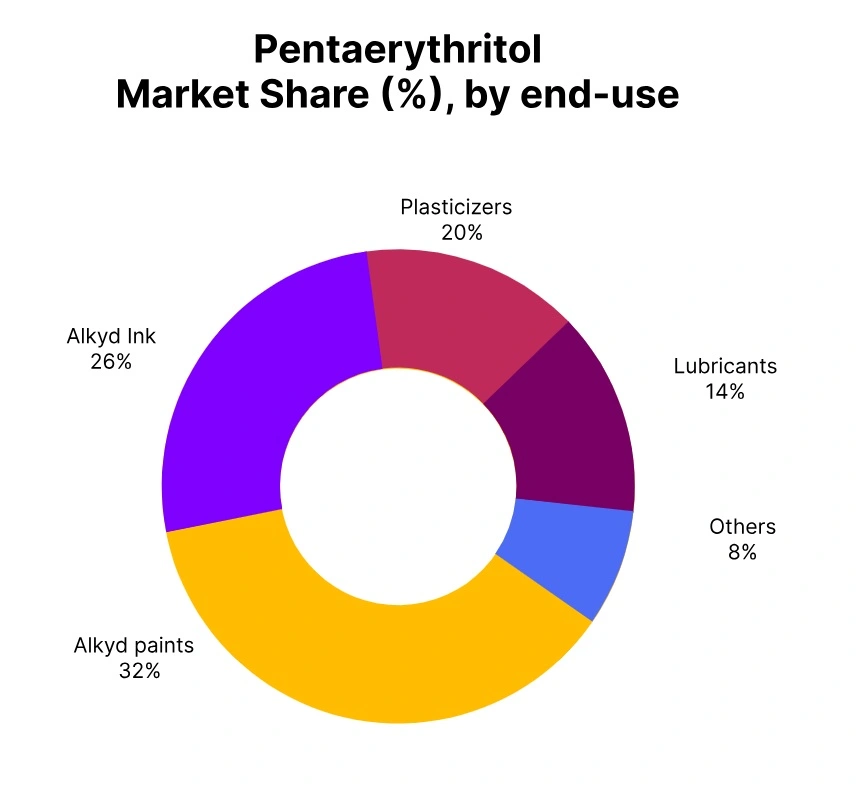
pentaerythritol market share end use

Historically, several events have caused significant fluctuations in Pentaerythritol (pent) prices

U.S.–China Trade Tariff Dispute on Chemical Intermediates (April 2025): 

In April 2025, the United States and China imposed steep reciprocal tariffs—up to 100%—on a range of chemical intermediates, including polyols, alcohols, and resins, many of which are related to or dependent on pentaerythritol. The tariffs disrupted supply chains for coatings and lubricant industries, especially in North America and East Asia. U.S. importers faced elevated costs and increased lead times, while Chinese exporters saw a buildup in unsold inventory. The trade friction introduced uncertainty and price volatility across global pentaerythritol markets. 

Red Sea Shipping Disruptions Due to Houthi Attacks (Late 2023 – Early 2024): 

Starting in late 2023, escalating attacks by Houthi rebels on commercial vessels in the Red Sea severely disrupted shipping routes between Asia and Europe. As a result, shipments of pentaerythritol and related chemicals from China and India were rerouted via longer and more expensive paths around the Cape of Good Hope. Extended transit times and elevated freight costs led to supply bottlenecks in Europe, driving up regional pentaerythritol prices through early 2024. 

Russia–Ukraine War and Sanctions Impact (February 2022 onward): 

The outbreak of war between Russia and Ukraine in early 2022 led to international sanctions on Russian chemical exports, along with widespread disruption in natural gas and formaldehyde supply chains—key inputs for pentaerythritol production. Eastern European production faced energy shortages and logistical hurdles. The resulting supply tightness in Europe, along with elevated energy prices, triggered a spike in pentaerythritol pricing globally, especially impacting coatings, alkyd resins, and explosives markets. 

Raw Material Volatility – Methanol and Formaldehyde Price Spikes (2021): 

In the first half of 2021, prices of upstream materials such as methanol and formaldehyde rose sharply due to global tightness in natural gas supply and recovery in industrial demand. Since these inputs are critical in pentaerythritol synthesis, manufacturers faced cost pressures, which were passed downstream. This triggered a chain reaction in pentaerythritol pricing, affecting resin and lubricant industries. 

COVID-19 Pandemic Supply Chain Disruptions (2020–2021): 

The global pandemic caused extensive interruptions in supply chains, port operations, and manufacturing output. Pentaerythritol production in Asia, particularly China and India, faced labor shortages and export restrictions. Simultaneously, demand for alkyd resins in paints and coatings rebounded rapidly in late 2020, especially in home renovation sectors. This supply-demand mismatch caused price surges across Europe and North America. 

China Environmental Crackdown on Chemical Industries (2017–2018): 

During 2017 and 2018, China enforced strict environmental regulations, resulting in the shutdown or curtailment of numerous chemical plants in key provinces such as Shandong and Jiangsu. As China is a major producer and exporter of Pentaerythritol, supply disruptions from these closures led to significant shortages in global markets. European and North American buyers, heavily reliant on Chinese imports, faced higher procurement costs, pushing global pentaerythritol prices upward. 

These events highlight the sensitivity of the Pentaerythritol market to geopolitical tensions, weather disruptions, and shifts in supply-demand dynamics, underscoring the importance of monitoring global trends. 

Why Price Watch™?

Price Watch™ is your trusted resource for tracking global pentaerythritol (pent) price trends. Our platform delivers real-time data and expert analysis, offering deep insights into the key factors driving price fluctuations in the pentaerythritol (pent) market. By monitoring critical events such as geopolitical tensions, supply chain disruptions, and economic shifts, Price Watch™ keeps you fully informed of market dynamics.

In addition, Price Watch™ provides detailed forecasts and updates on production capacities, enabling you to anticipate market changes and make well-informed decisions. With Price Watch™, you gain a competitive edge in understanding all the elements that influence pentaerythritol (pent) prices worldwide. Stay ahead of the curve with Price Watch’s™ reliable, accurate, and timely pentaerythritol (pent) market data.

Track Price Watch's™ pentaerythritol (pent) price assessment on a weekly basis since 2015 onwards, along with short-term forecasts, and get access to the detailed report in a downloadable format.

Pentaerythritol (pent) Market Price Trend published by 𝐏𝐫𝐢𝐜𝐞 𝐖𝐚𝐭𝐜𝐡™ reflect prevailing spot market conditions, derived from independent research, verified trade inputs, and proprietary market intelligence as of the publication date. Prices are published on the specified Incoterm and represent indicative base market levels, exclusive of applicable taxes, VAT, duties, tariffs, and other statutory charges. Actual transaction values may vary depending on volume, credit terms, contractual structure, and other negotiated conditions. Market prices are inherently subject to volatility, liquidity dynamics, regulatory changes, and evolving trade activity. The information provided is for reference and benchmarking purposes only and does not constitute an offer, recommendation, or guarantee of transactional outcomes. Users should exercise independent commercial judgment and assess their specific contractual, regulatory, tax, and application requirements before making business decisions. 𝐏𝐫𝐢𝐜𝐞 𝐖𝐚𝐭𝐜𝐡™ assumes no liability for decisions taken based on this information.

The price of Pentaerythritol is influenced by several key factors, including the cost of feedstocks like formaldehyde and acetaldehyde, which are used in its production. Supply-demand dynamics, plant operating rates, and unplanned maintenance or shutdowns also play a significant role in pricing trends. Geopolitical tensions, energy costs, and environmental regulations can impact production costs and, consequently, pricing. Additionally, the demand from end-use industries such as paints and coatings, automotive, plastics, and explosives influences market prices. Changes in raw material costs or shifts in production capacity in major producing regions, such as China and Europe, also affect the global price structure.

Shifts in global supply and demand directly influence Pentaerythritol prices. An increase in demand from sectors like automotive coatings, plasticizers, and alkyd resin manufacturing can push prices higher, particularly if there is limited supply due to plant outages or raw material shortages. On the other hand, oversupply resulting from capacity expansions or weakened demand in key industries can lead to price declines. Market players must monitor fluctuations in raw material costs, the operating status of production facilities, and consumption patterns across major sectors to anticipate price movements and make informed sourcing decisions.

Pentaerythritol pricing can vary significantly across regions due to factors such as the availability of feedstocks, transportation logistics, and regional demand from key industries like paints, coatings, and plasticizers. For instance, Asia may experience higher price volatility due to changing demand in the automotive and construction sectors, while North America’s prices may be more stable owing to steady supply and local production capabilities. Regional environmental regulations and production capacities also impact pricing. Procurement teams should closely monitor regional pricing trends, assess supply chain risks, and consider diversifying their sources of supply to mitigate risks associated with price volatility or disruptions.

Pentaerythritol (PENT) is a white crystalline organic compound with four hydroxyl groups, widely used as a key building block in the production of alkyd resins, synthetic lubricants, explosives, plasticizers, rosin esters, and various specialty chemicals. Its price directly impacts the cost of paints and coatings, printing inks, synthetic lubricants, PETN explosives, flame retardants, and numerous industrial products, making pentaerythritol pricing a critical factor for coating manufacturers, lubricant producers, and chemical companies worldwide. 𝐏𝐫𝐢𝐜𝐞 𝐖𝐚𝐭𝐜𝐡™ tracks these prices to help businesses and consumers understand and stay updated with the market trends.

Pentaerythritol prices vary by region and grade. Prices are typically quoted per metric ton or per kilogram, and change based on supply, demand, feedstock costs, and production capacity. 𝐏𝐫𝐢𝐜𝐞 𝐖𝐚𝐭𝐜𝐡™ provides real-time price assessments across different global markets to help buyers and sellers make informed decisions.

Pentaerythritol prices fluctuate due to changes in feedstock costs (primarily formaldehyde and acetaldehyde), energy price movements, production capacity utilization, and demand from alkyd resin, rosin ester, synthetic lubricant, and explosive manufacturers. Manufacturing process efficiency (aldol condensation technology), raw material availability (formaldehyde supply from methanol), quality and purity specifications, supply chain disruptions, seasonal variations in coating and construction industries, environmental regulations affecting production, competition from alternative polyols, trade policies affecting chemical intermediates, and broader economic conditions further shape price trends, with recent outlooks reflecting volatility driven by formaldehyde pricing, coating industry demand cycles, construction activity levels, and methanol market dynamics.

The biggest buyers of Pentaerythritol are alkyd resin manufacturers producing decorative and industrial paints and coatings, representing the largest end-use application. Additional significant demand comes from rosin ester producers (for adhesives, inks, and coatings), synthetic lubricant manufacturers (producing pentaerythritol esters for aviation and automotive applications), explosives producers making PETN (pentaerythritol tetranitrate), flame retardant manufacturers, plasticizer producers, radiation-curing monomer and oligomer manufacturers, and specialty chemical companies. 𝐏𝐫𝐢𝐜𝐞 𝐖𝐚𝐭𝐜𝐡™ analyses demand patterns across all these industries.

Pentaerythritol is manufactured through the aldol condensation reaction of formaldehyde and acetaldehyde in the presence of an alkaline catalyst (typically calcium hydroxide or sodium hydroxide), followed by purification, filtration, and crystallization processes. The reaction produces pentaerythritol along with by-products including dipentaerythritol and tripentaerythritol. It is produced in specialized chemical plants by organic chemical manufacturers and intermediate producers with aldehyde chemistry capabilities.

Pentaerythritol trade is driven by production capacity, formaldehyde integration, and regional coating industry presence. China is the world’s largest producer and exporter of Pentaerythritol, with substantial production capacity serving global markets. European countries including Sweden, Germany, and other EU nations, along with producers in South Korea, the United States, and select other Asian countries also participate in regional and global trade. Export volumes fluctuate based on alkyd resin and coating industry demand, rosin ester production requirements, formaldehyde and acetaldehyde feedstock availability and costs, environmental compliance requirements, construction and automotive sector activity, and trade dynamics in chemical intermediates and coating raw materials. 𝐏𝐫𝐢𝐜𝐞 𝐖𝐚𝐭𝐜𝐡™ tracks production levels, export flows and trade patterns to help businesses understand global supply chains and identify sourcing opportunities.

Supply generally matches demand, but regional shortages can occur due to plant shutdowns, formaldehyde supply constraints, maintenance turnarounds, transportation problems, or sudden spikes in coating and resin production. Environmental regulations affecting formaldehyde or acetaldehyde production can create tight market conditions. Seasonal peaks in construction and coating activity can temporarily strain supply. 𝐏𝐫𝐢𝐜𝐞 𝐖𝐚𝐭𝐜𝐡™ monitors these supply-demand imbalances to alert the market about potential shortages or surpluses.

Pentaerythritol prices vary by grade based on purity levels, particle size, moisture content, and application requirements. Technical-grade PENT (98% purity) is the most widely traded specification, suitable for alkyd resins, rosin esters, general coating applications, and industrial uses, offering good performance and cost-effectiveness for most commercial applications. Higher-purity grades (98.5-99%+ purity) with tighter specifications on dipentaerythritol content, ash, moisture, hydroxyl value, and color command premium prices for specialty synthetic lubricants, high-performance coatings, pharmaceutical intermediates, or processes requiring superior quality and consistency. Lower-purity commercial grades (95-97%) may be available at discounted prices for less demanding industrial applications. Mono-pentaerythritol (lower dipentaerythritol content) versus standard grades also affects pricing based on specific application requirements. Particle size distribution and physical form (powder, granular, flakes) can influence pricing for handling and processing considerations. 𝐏𝐫𝐢𝐜𝐞 𝐖𝐚𝐭𝐜𝐡™ provides separate price assessments for technical-grade (98%) and other grades to ensure market transparency.

When Pentaerythritol demand rises quickly, often due to increased coating production during construction booms, strong automotive or furniture manufacturing activity, or rosin ester requirements, prices typically increase. Suppliers may prioritize long-term contract customers with established relationships, while spot buyers face tighter availability, longer lead times, or premium pricing to secure supplies. Production flexibility is limited by formaldehyde availability, reaction capacity, and crystallization/purification capabilities. 𝐏𝐫𝐢𝐜𝐞 𝐖𝐚𝐭𝐜𝐡™ captures these market dynamics in real-time.

Energy is a significant cost component in Pentaerythritol production, particularly for formaldehyde production (from methanol), reaction heating, crystallization processes, and drying operations. When natural gas, electricity, or steam costs rise, producers typically pass these costs on to buyers, making PENT more expensive. Feedstock costs (formaldehyde derived from methanol, and acetaldehyde) are also influenced by energy and natural gas prices. This is why prices in regions with cheaper energy, integrated formaldehyde production, and efficient manufacturing facilities tend to be lower, a correlation that 𝐏𝐫𝐢𝐜𝐞 𝐖𝐚𝐭𝐜𝐡™ analyses in its price assessments & market reports.

Pentaerythritol prices vary by region based on local production capacity, formaldehyde and acetaldehyde feedstock availability and costs, methanol pricing (formaldehyde precursor), energy prices, regulatory compliance requirements, environmental standards, transportation and logistics expenses, coating and resin industry concentration, construction sector activity, import/export dynamics, and packaging requirements. Regions with integrated formaldehyde production and established coating industries often have competitive pricing, while areas dependent on imports or facing environmental constraints may see higher prices. 𝐏𝐫𝐢𝐜𝐞 𝐖𝐚𝐭𝐜𝐡™ tracks prices across all major regions to highlight these differences.

The Pentaerythritol market outlook depends on factors such as formaldehyde and methanol feedstock price trends, acetaldehyde availability and costs, energy prices, alkyd resin and coating industry demand, construction sector activity and growth, rosin ester production requirements, automotive and furniture manufacturing trends, synthetic lubricant market developments, capacity additions or closures, environmental regulations affecting production, seasonal demand patterns in coating applications, trade policies affecting chemical intermediates, and macroeconomic indicators affecting construction, manufacturing, and industrial production. 𝐏𝐫𝐢𝐜𝐞 𝐖𝐚𝐭𝐜𝐡™ regularly publishes detailed forecasts that project price movements for the next 12 months based on comprehensive analysis of supply additions, demand growth in key industries, seasonal patterns, and macroeconomic indicators. Our forecasts help businesses anticipate market conditions and plan accordingly.

Absolutely. Accurate forecasting allows you to time your purchases better, negotiate contracts more effectively, and budget more accurately. If 𝐏𝐫𝐢𝐜𝐞 𝐖𝐚𝐭𝐜𝐡™ forecasts predict a price increase in three months, you might choose to stock up now or lock in long-term contracts at current rates, potentially saving thousands of dollars.

Events like natural disasters, plant accidents, formaldehyde or methanol supply disruptions, environmental regulatory enforcement actions, maintenance shutdowns, construction boom or bust cycles, trade disputes, transportation disruptions, or economic downturns affecting coating and construction sectors can cause supply shortages and price spikes. Environmental regulations forcing formaldehyde production curtailments, methanol supply constraints, coating industry demand surges during construction booms, pandemic-related construction activity fluctuations, force majeure declarations at production facilities, and sudden raw material cost increases, for instance, have created significant market volatility. 𝐏𝐫𝐢𝐜𝐞 𝐖𝐚𝐭𝐜𝐡™ provides timely alerts when such events affect the market.

𝐏𝐫𝐢𝐜𝐞 𝐖𝐚𝐭𝐜𝐡™ collects data from manufacturers, distributors, and buyers worldwide to publish regular price assessments, market reports, and forecasts. Our transparent methodology and comprehensive coverage make us a trusted source for understanding fair pricing and market trends in the Pentaerythritol industry, with specific focus on technical-grade (98%) material and other commercial specifications.