Selenium Price Trend and Forecast

UNSPC code: 12141910
|
Weekly Update
|
Historical Data Since 2015
|
Forecast for 2026
  • Commodity Pricing

selenium Price Trends by Country

usUnited States
nlNetherlands

Global selenium Spot Market Prices, Trend Analysis and Forecast

𝐏𝐫𝐢𝐜𝐞 𝐖𝐚𝐭𝐜𝐡™ provides price assessments for Selenium across top trading regions:

North America

  • Selenium Purity: 99.9%min Del Alabama, USA


Europe

  • Selenium Purity: 99.5%min FD Rotterdam, Netherlands


Note:
In assessments structured as CIF [Importing Port] (Exporting Country), the country mentioned in brackets indicates the primary origin of supply (exporting country), while the named port refers to the destination port in the importing country. Other Incoterms (FOB, FD, EXW, etc.) should be interpreted in accordance with standard international trade definitions.

Selenium Price Trend Q4 2025

In Q4 2025, the global Selenium market continued a modest downward trend, with prices declining slightly across key regions. The dip was largely driven by subdued demand from the electronics, photovoltaic, and chemical industries, as manufacturers maintained cautious purchasing strategies amid ongoing economic uncertainties. On the supply side, stable production from major exporting regions ensured sufficient availability, preventing sharper declines. Meanwhile, careful inventory management by downstream users contributed to restrained market activity and limited immediate price recovery. Overall, the market remained relatively stable, with low volatility, reflecting a continuation of the mild correction phase observed in the previous quarter.

USA: Selenium Domestic traded prices Del Alabama, USA; Purity: 99.5%min.

According to Price-Watch™ , In Q4 2025, Selenium prices trend in the USA declined by 0.22% compared to Q3, reflecting cautious buying from electronics, glass, and chemical manufacturers amid ample inventories and stable feedstock costs. Downstream procurement slowed as preholiday restocking concluded, while domestic production and competitive import availability-maintained supply balance, creating mild downward pressure on prices. In December 2025, prices remained flat at 0.00%, as moderate consumption was matched by steady supply and limited yearend trading, resulting in a neutral market sentiment. Overall, the quarter exhibited a slightly bearish to neutral tone, with expectations of gradual price movements in Q1 2026 depending on downstream demand and industrial activity.

Netherlands: Selenium Domestic traded prices FD Rotterdam, Netherlands; Purity: 99.5%min.

In Q4 2025, selenium prices trend in the Netherlands declined slightly by 0.71% compared to Q3, reflecting a continuation of the mild softening trend seen earlier in the year. Demand from the electronics, glass, and chemical industries remained moderate, while steady domestic supply and imports met consumption needs. Weak end-user demand, subdued year-end industrial activity, and competitive supplier pricing contributed to the downward pressure. In December 2025, prices remained flat as year-end trading slowed and buyers held back on restocking. Overall, the market sentiment was neutral to slightly bearish, with balanced supply-demand conditions and expectations of gradual stabilization entering Q1 2026.

Selenium Price Trend Analysis: Q4 2025

In the third quarter of 2025, the global market for selenium is down a bit, with overall prices falling around 0.12% over the previous quarter. The small decline in price has largely been due to a softening demand from the electronics, photovoltaic, and chemical industries, which represent the main end-use sectors of selenium.

In key producing regions such as Australia and South Africa, steady supply levels kept the market from sharper declines, while cautious procurement by downstream users limited immediate price recovery. Supply-side stability, coupled with moderate inventory levels, contributed to localized fluctuations in trade. Overall, the market remained relatively stable with limited volatility, reflecting a minor correction phase after previous price adjustments.

USA: Selenium Domestically traded prices Del Alabama, USA, Purity: 99.5%min.

According to Price-Watch, in Q3 2025, selenium price trend in the U.S. market have decreased a little by 0.21% compared to the previous quarter as demand from the electronics, glass, and chemical manufacturing sectors softened modestly. Downstream buyers have curtailed purchases when inventories were adequate and raw material costs were stable, exerting mild downward pressure on prices.

While domestic supply remains sufficient, ample imports from major producers have increased competition, contributing to the slight decline. Overall, the market has displayed a mildly bearish sentiment, with producers managing output and inventories cautiously to maintain balance.

In September 2025, selenium prices in the U.S. have remained unchanged, showing 0% movement, as stable demand has been matched by adequate domestic supply and consistent import flows, keeping market sentiment neutral.

Netherlands: Selenium Domestically traded prices FD Rotterdam, Netherlands, Purity: 99.5%min.

According to Price-Watch, In Q3 2025, the selenium price trend in the Netherlands decreased slightly by 0.04% from the prior quarter, reflecting an overall stable market. The electronics, glass, and chemical industries experienced stable demand, and supply from domestic producers and imports satisfied consumption levels.

Minor movement in procurement and competition amongst suppliers resulted in very slight downward pressure. Overall, market sentiment has been neutral to slightly bearish with pricing not dramatically moving in either direction, and the market experienced a balance of supply and demand for the entire quarter.

Selenium price in the Netherlands decreased by 1% in September 2025, driven primarily by softer demand from the electronics, glass, and chemical manufacturing sectors with slower industrial activity. Domestic production continued to supply steady amounts of selenium, supplemented by consistent imports ahead of production demand for Q4, also contributing to downward pressure on prices.

According to the PriceWatch, In Q2 2025, Selenium is expected to experience a notable price increase of $30,230 per metric ton, Del Alabama representing a 0.10% rise. This moderate percentage growth, despite the seemingly large absolute price hike, suggests that the baseline price is already high, reflecting strong demand or constrained supply in the selenium market.

Such an increase could be driven by factors including rising production costs, supply chain disruptions, or increased industrial usage, particularly in electronics and glass manufacturing. Buyers and stakeholders should prepare for tighter margins and potentially adjust procurement strategies to accommodate the higher costs while monitoring market dynamics for further fluctuations. 

In Q1 2025, Selenium experienced a notable price decline, dropping by $30,200 per metric ton, Del Alabama which represents a 4.23% decrease from the previous period. This downward trend may reflect a combination of factors such as reduced industrial demand, shifts in supply dynamics, or broader market influences affecting commodity metals.

The significant price correction suggests increased market volatility or potential oversupply concerns. Stakeholders should closely monitor underlying drivers like production levels, technological advancements in usage, and global economic conditions to better understand Selenium’s future pricing trajectory. 

Selenium Price Trend Analysis: Q4 2024

In Q4 2024, Selenium experienced a notable price increase of 31,533 per metric ton, Del Alabama representing a substantial 7.99% rise compared to previous periods. This upward trend likely reflects tightening supply dynamics or increased demand within key industrial sectors such as electronics, glass manufacturing, and metallurgy, where Selenium plays a critical role.

The price surge may also be influenced by broader market factors including raw material shortages, geopolitical tensions, or shifts in production costs. For stakeholders, this increase signals potential cost pressures but also opportunities for producers to capitalize on stronger market pricing. Monitoring ongoing supply chain developments and end-use demand will be essential to anticipate future price movements for Selenium. 

In Q3 2024, Selenium experienced a significant price surge, rising by $29,200 per metric ton, Del Alabama which represents a substantial increase of 22.35% compared to the previous quarter. This sharp uptick reflects growing demand in key industries such as electronics, glass manufacturing, and agriculture, coupled with tightening supply constraints due to limited mining output and geopolitical factors impacting major producing regions.

The price jump underscores Selenium’s increasing strategic importance as a critical raw material in advanced technologies, driving market participants to adjust their procurement and inventory strategies in anticipation of continued volatility. 


In Q2 2024, Selenium experienced a significant price increase of 23,867 per metric ton, Del Alabama marking a 7.51% rise compared to the previous quarter. This upward trend reflects tightening supply conditions and growing demand in key industrial applications, particularly in electronics and steel manufacturing where Selenium is a critical component.

The price surge signals potential supply chain constraints or increased production costs, which may influence manufacturers to adjust procurement strategies. As Selenium’s market tightens, buyers and investors should anticipate continued volatility, while suppliers might benefit from improved margins in the near term. 

In the first quarter of 2024, Selenium experienced a notable price increase of $22,200 per metric ton, Del Alabama representing a 1.52% rise compared to the previous period. This upward shift suggests a strengthening demand or tightening supply dynamics in the market. Despite the relatively moderate percentage increase, the substantial absolute price change indicates that Selenium’s market value remains highly sensitive to shifts in industry demand, production costs, or geopolitical factors affecting its supply chain. Such trends highlight the importance for stakeholders to closely monitor market conditions, as even small percentage changes can translate into significant cost implications for industries reliant on Selenium. 


Technical Specifications of Selenium Price Trends

Product Description

Selenium is a non-metallic, trace element (Se) known for its versatile chemical and physical properties, making it indispensable across various industrial and health related applications. As a semiconductor with photoconductive characteristics, selenium is widely used in electronic components such as photocopiers, solar cells, and rectifiers. Its ability to convert light into electricity underpins its role in renewable energy technologies. Selenium compounds are also valuable in the glass industry to decolorize or impart red hues, and in the production of pigments and catalysts.

Additionally, selenium is essential in small amounts for human health, playing a key role as an antioxidant and in thyroid function. Its antimicrobial and antifungal properties make it a component in animal feed and agricultural supplements. As demand grows for advanced electronics and sustainable technologies, selenium continues to be a critical element in innovation and environmental health.

Identifiers and Classification:

  • CAS No – 7782-49-2
  • HS Code – 280490


Selenium Grades Specific Price Assessment:

  • Selenium Purity: 99.9%min. Price Trend
  • Selenium Purity: 99.5%min. Price Trend


Selenium Global Trade and Shipment Terms

  • Quotation Terms (Product & Country Specific): 500-1000 Kg
  • Packaging Type (Product & Country Specific): Steel drum


Incoterms Referenced in Selenium Price Reporting

Shipping Term  Location  Definition 
FD Rottterdam  Rottterdam, Netherlands  Selenium Export price from Netherlands 
Del Alabama  Alabama, USA  Domestically Traded Selenium price in USA 

*Quotation Terms refers to the quantity range specified for the Selenium being quoted or offered in a commercial transaction.

**Packaging Type refers to standard packaging size commonly used for Selenium packing, ease of handling, transportation, and storage in industrial and commercial applications.

Key Selenium Manufacturers

Manufacturer 
Aurubis 
Buchem B.V. 
American Elements 
Novotech Nutraceuticals 

Selenium Industrial Applications

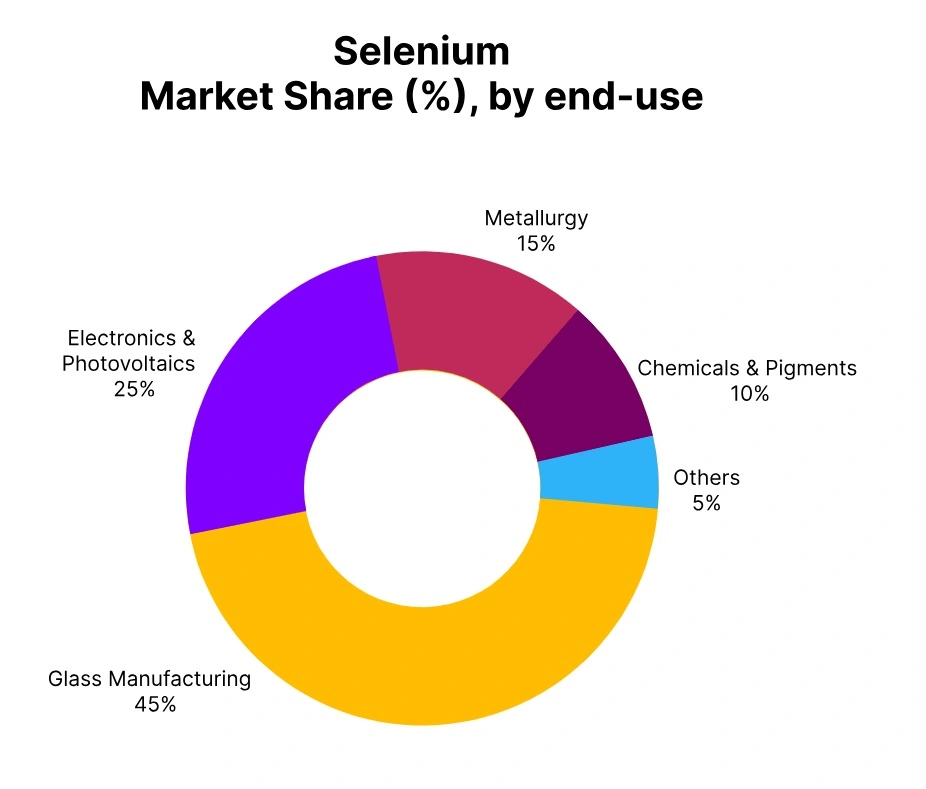
selenium market share end use

Historically, several events have caused significant fluctuations in Selenium prices

  • Market Stabilization & Diversification Efforts (2023–2024): By 2023, increased selenium production from expanded copper refining capacity, coupled with improved recycling infrastructure and stable demand outlooks, led to more balanced market conditions. Policies in major consumer regions aimed at securing diverse supply chains and promoting sustainable sourcing further helped stabilize prices and reduce volatility heading into 2024. 
  • Increased Recycling & Alternative Technologies (2022–2023): Rising selenium prices incentivized enhanced recycling efforts from industrial waste streams and prompted research into selenium substitutes in certain applications. Additionally, some slowdown in solar panel installations amid shifting subsidies and supply chain issues tempered demand growth, leading to a gradual softening of selenium prices. 
  • Rebound in Mining & Market Speculation (2021–2022): As mining activities resumed post-pandemic and refiners boosted selenium recovery, supply began to catch up. However, ongoing investment uncertainty and market speculation around supply risks, exacerbated by geopolitical tensions and raw material nationalism kept selenium prices volatile and elevated during this time. 

Why Price Watch™?

Price Watch™ is your trusted resource for tracking global selenium price trends. Our platform delivers real-time data and expert analysis, offering deep insights into the key factors driving price fluctuations in the selenium market. By monitoring critical events such as geopolitical tensions, supply chain disruptions, and economic shifts, Price Watch™ keeps you fully informed of market dynamics.

In addition, Price Watch™ provides detailed forecasts and updates on production capacities, enabling you to anticipate market changes and make well-informed decisions. With Price Watch™, you gain a competitive edge in understanding all the elements that influence selenium prices worldwide. Stay ahead of the curve with Price Watch’s™ reliable, accurate, and timely selenium market data.

Track Price Watch's™ selenium price assessment on a weekly basis since 2015 onwards, along with short-term forecasts, and get access to the detailed report in a downloadable format.

Selenium Market Price Trend published by 𝐏𝐫𝐢𝐜𝐞 𝐖𝐚𝐭𝐜𝐡™ reflect prevailing spot market conditions, derived from independent research, verified trade inputs, and proprietary market intelligence as of the publication date. Prices are published on the specified Incoterm and represent indicative base market levels, exclusive of applicable taxes, VAT, duties, tariffs, and other statutory charges. Actual transaction values may vary depending on volume, credit terms, contractual structure, and other negotiated conditions. Market prices are inherently subject to volatility, liquidity dynamics, regulatory changes, and evolving trade activity. The information provided is for reference and benchmarking purposes only and does not constitute an offer, recommendation, or guarantee of transactional outcomes. Users should exercise independent commercial judgment and assess their specific contractual, regulatory, tax, and application requirements before making business decisions. 𝐏𝐫𝐢𝐜𝐞 𝐖𝐚𝐭𝐜𝐡™ assumes no liability for decisions taken based on this information.

• Raw Material Availability: Selenium is not mined directly but is primarily obtained as a byproduct of copper refining, particularly from anode slimes during electrolytic copper production. Therefore, selenium supply is closely tied to copper mining activity. Fluctuations in copper production levels or ore grades directly impact selenium availability and prices.

• Supply and Demand Dynamics: Selenium demand comes from diverse industries including glass manufacturing (as a decolourizer), metallurgy, agriculture (as a feed additive), electronics, and solar power (e.g., cadmium telluride thin-film solar panels). Emerging technologies or shifts in demand especially in the photovoltaic sector or animal nutrition can strongly influence prices. If demand outpaces byproduct recovery, prices tend to rise.

• Production and Processing Costs: Although selenium is a byproduct, its recovery and purification involve additional processing steps such as leaching, filtration, and precipitation. The costs of these processes, along with energy and labour inputs, influence the economics of selenium production. If copper prices drop and refining slows, selenium supply contracts, which may push prices up.

• Environmental and Regulatory Factors: Selenium is a trace element with both essential and toxic properties. Stringent environmental regulations on selenium emissions, disposal, and contamination especially in the U.S., EU, and China can limit its production or raise compliance costs, affecting supply levels and prices.

• Global Trade Policies and Tariffs: Selenium production is concentrated in a few countries, notably Chile, Japan, Canada, and Germany. Any export restrictions, tariffs, or changes in trade relationships involving major producers and consumers (e.g., China or the U.S.) can disrupt flows and lead to pricing volatility.

• Geopolitical Risks and Regional Stability: Since selenium is a byproduct of copper refining, political instability in major copper-producing regions (such as Chile or Peru) can affect both base metal production and selenium availability. Nationalization efforts or strikes at refineries can disrupt the supply chain and influence prices.

• Technological Advancements: Innovations in refining and recovery methods can improve selenium yield from anode slimes or other sources. On the demand side, breakthroughs in solar technologies (like thin-film solar panels) or reduced selenium use due to material substitution (e.g., tellurium or rare earths) can shift demand patterns, influencing prices.

• Exchange Rates: As selenium is traded globally, fluctuations in the currencies of major producers (e.g., Chilean Peso, Japanese Yen, Canadian Dollar) against the U.S. Dollar can affect export pricing and international competitiveness, impacting global selenium prices.

• Market Competition and Substitutes: Competition among selenium producers and the availability of substitutes (like sulphur, tellurium, or synthetic decolourizers in glass) can influence pricing strategies. Additionally, recycling of selenium from industrial waste or electronics can affect the balance of supply and demand.

The availability and cost of raw materials such as high-carbon steel and alloy coatings directly affect Selenium production costs and pricing.

Selenium prices can be influenced by inflation, particularly through increased costs of energy, labor, and transportation involved in its extraction and refinement. However, selenium’s pricing is also strongly shaped by industrial demand, especially from the glass, electronics, and metallurgical sectors as well as its status as a byproduct of copper refining. As such, while inflation can contribute to upward pressure on selenium prices, market-specific dynamics and supply chain factors often play a more dominant role.

PriceWatch offers a range of tools and services to track commodity prices effectively:

Real-Time Data: Access market intelligence and data on global Selenium supply chains.

Expert Analysis: Insights on market trends and potential risks.

Risk Assessment: Tools to evaluate supply chain vulnerabilities.

Benchmarking: Compare Selenium prices and sourcing practices.

Supplier Intelligence: Information on supplier reliability and financial health.

Selenium is a non-metallic element with properties between metals and nonmetals, appearing as a gray to red powder. It is primarily used in glassmaking, photovoltaics (solar cells), electronics, pigments, and as a nutritional supplement. Its price matters because it affects industries such as renewable energy, electronics manufacturing, chemical production, and agriculture. 𝐏𝐫𝐢𝐜𝐞 𝐖𝐚𝐭𝐜𝐡™ tracks selenium prices to help businesses and consumers stay updated with market trends.

Selenium prices vary depending on form (metal, powder, pellets, or chemicals), purity, and market conditions. Prices are typically quoted per kilogram and fluctuate due to supply availability, industrial demand, and geopolitical factors. 𝐏𝐫𝐢𝐜𝐞 𝐖𝐚𝐭𝐜𝐡™ provides real-time price assessments across different markets to assist buyers and sellers.

Prices fluctuate due to raw material availability (selenium is mainly recovered as a byproduct of copper refining), refining capacity, energy costs, and demand from solar, electronics, and chemical sectors. Trade policies, export controls, and macroeconomic conditions also significantly influence trends.

Major consumers include glass manufacturers, solar cell producers, electronics companies, chemical manufacturers, and the agricultural sector (for supplements). 𝐏𝐫𝐢𝐜𝐞 𝐖𝐚𝐭𝐜𝐡™ analyses demand patterns across all these industries.

Selenium is primarily obtained as a byproduct of copper refining and sometimes from lead or nickel refining. It is refined into metallic selenium, selenium dioxide, or high-purity forms for electronic, glass, and chemical applications.

Leading exporters include China, Japan, Belgium, and the United States. Export volumes are influenced by domestic regulations, strategic material policies, and global demand. 𝐏𝐫𝐢𝐜𝐞 𝐖𝐚𝐭𝐜𝐡™ tracks production levels, export flows, and trade patterns to help businesses navigate global supply chains.

Supply generally meets demand, but disruptions may occur due to limited primary production, export restrictions, or increased demand from high-tech industries and solar power expansion. 𝐏𝐫𝐢𝐜𝐞 𝐖𝐚𝐭𝐜𝐡™ monitors these supply-demand imbalances to highlight potential shortages or surpluses.

Grades include metallic selenium, selenium powder, selenium dioxide, and high-purity forms for electronics or solar applications. Prices vary based on purity, application requirements, and production complexity. 𝐏𝐫𝐢𝐜𝐞 𝐖𝐚𝐭𝐜𝐡™ provides separate assessments for each grade to ensure market transparency.

When demand rises, for example from solar panel production or electronics manufacturing, prices typically increase. Suppliers may prioritize strategic industries, and lead times can extend. 𝐏𝐫𝐢𝐜𝐞 𝐖𝐚𝐭𝐜𝐡™ captures these market dynamics in real time.

Selenium refining and purification require energy-intensive processes. Rising electricity and fuel costs can impact overall production costs. Regions with lower energy costs often have competitive pricing, a correlation that 𝐏𝐫𝐢𝐜𝐞 𝐖𝐚𝐭𝐜𝐡™ analyses in price reports.

Variations arise from local demand, export controls, shipping costs, currency fluctuations, and government policies. 𝐏𝐫𝐢𝐜𝐞 𝐖𝐚𝐭𝐜𝐡™ tracks prices across major regions to highlight these differences.

Forecasts consider copper production trends (since selenium is a byproduct), refining capacity, demand growth in solar and electronics, and geopolitical developments. 𝐏𝐫𝐢𝐜𝐞 𝐖𝐚𝐭𝐜𝐡™ regularly publishes projections for the next 12 months based on supply additions, demand growth, seasonal trends, and market indicators. These forecasts help businesses plan procurement and production strategies.

Yes. Accurate forecasts allow businesses to optimize purchasing strategies, negotiate contracts, and manage inventories effectively. If 𝐏𝐫𝐢𝐜𝐞 𝐖𝐚𝐭𝐜𝐡™ predicts a price rise, companies may stock up or secure long-term contracts, potentially reducing procurement costs.

Events such as export restrictions, trade tensions, supply chain disruptions, or geopolitical conflicts can significantly affect availability and pricing. 𝐏𝐫𝐢𝐜𝐞 𝐖𝐚𝐭𝐜𝐡™ provides timely alerts on such market impacts.

𝐏𝐫𝐢𝐜𝐞 𝐖𝐚𝐭𝐜𝐡™ collects data from producers, distributors, and end-users worldwide to publish regular price assessments, market reports, and forecasts. Its transparent methodology makes it a trusted source for understanding fair pricing and market trends in the Selenium market.