Silicone Rubber Price Trend and Forecast

UNSPC code: 12352315
|
Weekly Update
|
Historical Data Since 2015
|
Forecast for 2026

silicone rubber Price Trends by Country

deGermany
cnChina
inIndia
vnVietnam

Global silicone rubber Spot Market Prices, Trend Analysis and Forecast

Price Watch™provides real-time price assessments and price forecasts for Silicone Rubber across top trading regions:

Silicone Rubber Regional Coverage Silicone Rubber Grade and Country Coverage Silicone Rubber Pricing Data Coverage Explanation
Asia Silicone Rubber Pricing Analysis Silicone Rubber Liquid Silicone Rubber (Tensile Strength: 8) FOB at Shanghai Port, China Weekly price update on Silicone Rubber real-time export prices from Shanghai Port, China to global markets.
Silicone Rubber Liquid Silicone Rubber (Tensile Strength: 8) CIF Prices at Nhava Sheva Port, India importing from China Weekly price update on Silicone Rubber real-time import prices at Nhava Sheva Port, India from China.
Silicone Rubber Liquid Silicone Rubber (Tensile Strength: 8) CIF Prices at Haiphong Port, Vietnam importing from China Weekly price update on Silicone Rubber real-time import prices at Haiphong Port, Vietnam from China.
Europe Silicone Rubber Pricing Analysis Silicone Rubber Liquid Silicone Rubber (Tensile Strength: 10.9) FOB at Hamburg Port, Germany Weekly price update on Silicone Rubber real-time export prices from Hamburg Port, Germany to global markets.

Note: In assessments structured as CIF [Importing Port] (Exporting Country), the country mentioned in brackets indicates the primary origin of supply (exporting country), while the named port refers to the destination port in the importing country. Other Incoterms (FOB, FD, EXW, etc.) should be interpreted in accordance with standard international trade definitions.

Liquid Silicone Rubber (LSR) Price Trend Q1 2026

Liquid silicone rubber price has increased over the first quarter of 2026. Prices have been growing consistently, increasing approximately 9% in several key regions worldwide, which has been driven by high levels of demand from both automotive and electronics industries and overall increased feedstock costs along with tighter supply conditions around the world. Demand from global markets for elastomers that provide high-performance, heat resistance, flexibility, and durability is also increasing.

Overall, while consumption through APAC, North America, or Europe remains stable or increasing, this demand is acting to support continued price momentum of LSR, along with other increased costs throughout the globe due to geopolitical tension and the current conflict that exists between Iran and Israel and the effect that their actions are having on the shipping routes through the Strait of Hormuz, which are also driving up the overall price of fuel and freight charges.

Germany: Liquid Silicone Rubber prices FOB Hamburg, Germany; Grade – Tensile Strength 10.9

During Q1 2026, Liquid Silicone Rubber prices in Germany have increased by 2.8%, supported by stable demand from automotive, healthcare, and electrical sectors, where high-performance elastomers continue to see consistent consumption.

Market conditions remained relatively balanced, with producers maintaining controlled operating rates to avoid excess supply. Feedstock silicon metal prices experienced moderate increases due to higher energy costs and tighter supply conditions in Europe, while methyl chloride trends also contributed to rising production costs.

This has been reflected in Liquid Silicone Rubber prices in Germany and the overall Liquid Silicone Rubber price trend in Germany, indicating a firm market environment. Similarly, in the last month of the quarter, in March 2026, Liquid Silicone Rubber prices in Germany have increased by 2.3%, supported by steady demand and stable supply conditions.

China: Liquid Silicone Rubber prices FOB Shanghai, China; Grade – Tensile Strength 8

During Q1 2026, Liquid Silicone Rubber prices in China have increased significantly by 9.1%, driven by strong recovery in domestic demand across electronics, automotive, and consumer goods sectors. Post-Lunar New Year restocking activities boosted procurement, while improved manufacturing output supported higher consumption levels.

Feedstock silicon metal prices surged due to power supply constraints and production controls in key regions, while methyl chloride costs also moved upward, creating strong cost-push pressure. Additionally, export demand improved, further tightening supply availability.

This has been reflected in Liquid Silicone Rubber prices in China and the broader Liquid Silicone Rubber price trend in China, indicating bullish market sentiment.

Similarly, in the last month of the quarter, in March 2026, Liquid Silicone Rubber prices in China have increased sharply by 10.3%, driven by strong restocking demand and higher feedstock costs.

India: Liquid Silicone Rubber import prices CIF Nhava Sheva (China), India; Grade – Tensile Strength 8

During Q1 2026, Liquid Silicone Rubber prices in India have increased by 11.7%, primarily due to rising import prices from China and strong demand recovery in domestic downstream sectors such as automotive, medical devices, and electrical applications.

Import dependency made the Indian market highly responsive to global price movements, especially amid tightening supply conditions in China. Additionally, consistent freight movement and steady shipment arrivals supported supply flow, but higher import offers drove prices upward. Feedstock trends remained firm, further contributing to cost support.

This has been reflected in Liquid Silicone Rubber prices in India and the prevailing Liquid Silicone Rubber price trend in India, indicating strong bullish momentum. Similarly, in the last month of the quarter, in March 2026, Liquid Silicone Rubber prices in India have surged by 12.5%, driven by aggressive restocking and elevated import parity prices.

Vietnam: Liquid Silicone Rubber import prices CIF Haiphong (China), Vietnam; Grade – Tensile Strength 8

Vietnam’s Liquid Silicone Rubber prices grew by 9.0% in Q1 2026 compared to Q4 2025 due to increased demand from consumer goods and industrial applications within the electronics manufacturing space. Vietnam relies heavily on imports, so the increase in prices of exports from China, along with tightened supply from higher domestic consumption and feedstock costs, directly impacted Vietnam’s prices for LSR.

Overall, average international freight rates have remained stable, meaning sellers continue to receive their goods consistently but higher seller offers from suppliers have pushed overall pricing levels up. Following previous inventory draw downs, increased procurement activity from buyers has also contributed significantly to the bullish nature of the market.

According to Price-Watch™, in March of 2026, LSR prices in Vietnam have continued to trend higher as evidenced by their increase of 10.3% against previous month levels. Therefore, liquid silicone rubber pricing trends in Vietnam have demonstrated stronger fundamentals.

Silicone Rubber Price Trend Analysis: Q4 2025

The global Liquid Silicone Rubber (LSR) price trend in Q4 2025 recorded a moderate increase of around 2% across major regions, supported by steady demand and stable supply conditions.

In the APAC region, countries such as China and India witnessed consistent demand from automotive, electronics, and healthcare sectors, driving gradual price growth due to the rising need for high-performance elastomers with excellent heat resistance, flexibility, and durability.

North America also experienced a firm market trend with slight price increases backed by balanced feedstock availability and stable downstream consumption, while Europe observed a relatively stable yet slightly upward pricing environment amid cautious procurement and mild cost pressures.

Overall, the global LSR market remained resilient, with feedstock cost fluctuations and supply chain dynamics continuing to influence pricing trends during the quarter.

Germany: Liquid Silicone Rubber prices FOB Hamburg, Germany; Grade – Tensile Strength 10.9

During Q4 2025, Liquid Silicone Rubber prices in Germany have increased by 2.1%, primarily supported by firm demand from key downstream industries such as automotive, healthcare, and electrical components. Despite broader economic slowdown concerns in Europe, steady consumption of high-performance elastomers in medical and specialty applications helped maintain market stability.

Feedstock silicon metal and methyl chloride costs showed slight upward movement during the quarter due to energy cost fluctuations and controlled production levels in Europe, providing cost support to LSR pricing. Additionally, limited supply availability due to periodic plant maintenance activities supported the price increase.

This has been reflected in Liquid Silicone Rubber prices in Germany and the overall Liquid Silicone Rubber price trend in Germany, indicating a firm market. Similarly, in the last month of the quarter, In December 2025, Liquid Silicone Rubber prices in Germany have increased by 1.1%, supported by stable demand and tight supply conditions.

China: Liquid Silicone Rubber prices FOB Shanghai, China; Grade – Tensile Strength 8

During Q4 2025, Liquid Silicone Rubber prices in China have increased by 1.9%, driven by stable domestic demand from electronics, automotive, and consumer goods sectors. The Chinese market remained balanced, with producers maintaining steady operating rates while managing supply in response to earlier oversupply conditions.

Feedstock silicon metal prices experienced mild fluctuations due to power cost variations and environmental production controls, while methyl chloride costs remained stable, providing moderate cost support. Export demand also showed slight improvement during the quarter, contributing to price firmness.

This has been reflected in Liquid Silicone Rubber prices in China and the broader Liquid Silicone Rubber price trend in China, indicating stable-to-firm market fundamentals. Similarly, in the last month of the quarter, in December 2025, Liquid Silicone Rubber prices in China have increased by 1.1%, supported by steady buying interest and balanced supply.

India: Liquid Silicone Rubber import prices CIF Nhava Sheva (China), India; Grade – Tensile Strength 8

During Q4 2025, Liquid Silicone Rubber prices in India have increased by 4.0%, primarily due to higher import prices from China and improving domestic demand from automotive, electrical, and medical device sectors. Buyers increased procurement activity during the quarter following earlier inventory drawdowns, while import dependency made the Indian market sensitive to global price movements.

Freight rates remained stable, but consistent shipment arrivals ensured steady supply flow. Feedstock trends in exporting countries provided cost support, further pushing prices upward. This has been reflected in Liquid Silicone Rubber prices in India and the prevailing Liquid Silicone Rubber price trend in India, indicating strengthening market sentiment.

Similarly, in the last month of the quarter, in December 2025, Liquid Silicone Rubber prices in India have increased by 2.4%, driven by firm import offers and active restocking demand.

Vietnam: Liquid Silicone Rubber import prices CIF Haiphong (China), Vietnam; Grade – Tensile Strength 8

During Q4 2025, Liquid Silicone Rubber prices in Vietnam have increased by 2.2%, supported by steady demand from electronics, consumer goods, and industrial manufacturing sectors. The market remained reliant on imports from China, and stable supply flows ensured adequate availability throughout the quarter.

However, rising export prices from Chinese suppliers and firm feedstock silicon metal costs provided upward pressure on import prices. Buyers maintained regular procurement cycles, particularly for export-oriented manufacturing activities.

This has been reflected in Liquid Silicone Rubber prices in Vietnam and the broader Liquid Silicone Rubber price trend in Vietnam, indicating a firm market environment. Similarly, in the last month of the quarter, in December 2025, Liquid Silicone Rubber prices in Vietnam have increased by 1.1%, supported by stable demand and consistent import pricing trends.

The global Liquid Silicone Rubber (LSR) price trend in Q3 2025 experienced moderate growth, with a 1–2% change across key regions. In the APAC region, countries such as Germany, China, and India saw steady demand from various industrial sectors, resulting in gradual price increases.

This growth Showed largely driven by the need for high-performance elastomers with excellent heat resistance, flexibility, and durability. North America also witnessed a stable price trend, with slight increases supported by consistent demand and balanced raw material availability.

In Europe, the market faced some pressure, but overall consumption remained steady, leading to a muted quarterly change. Globally, the liquid silicone rubber market remains resilient, with supply chain dynamics and feedstock costs continuing to influence pricing trends across these regions.

Germany: Liquid Silicone Rubber (LSR) Export prices FOB Hamburg, Germany, Grade- (Tensile Strength: 10.9).

In Q3 2025, Liquid Silicone Rubber prices in Germany showed a positive price trend, with an overall 1.0% increase FOB Hamburg. The liquid silicone rubber price trend in Germany Showed supported by steady demand from key industrial sectors, where liquid silicone rubber is valued for its flexibility, heat resistance, and durability. Balanced supply conditions and consistent downstream consumption contributed to the quarterly increase.

In September 2025, liquid silicone rubber prices increased by 0.6%, reflecting ongoing procurement activity and limited inventory levels among distributors. The Liquid Silicone Rubber (LSR) price trend in Germany is expected to remain stable to slightly firm heading into the next quarter.

China: Liquid Silicone Rubber (LSR) Export prices FOB Shanghai, China, Grade- (Tensile Strength: 8).

According to Price-Watch™, in Q3 2025, Liquid Silicone Rubber prices in China declined by 2.7% FOB Shanghai. The liquid silicone rubber price trend in China softened during the quarter due to moderate demand from key industrial sectors, including automotive, electronics, and general manufacturing, coupled with sufficient domestic and imported supply.

Stable feedstock availability and cautious procurement from downstream manufacturers further contributed to the gradual price decline observed over the quarter. In September 2025, Liquid Silicone Rubber (LSR) prices increased by 1.6% compared to the previous month, as buyers resumed procurement and downstream consumption showed signs of improvement, particularly in sectors requiring high-performance elastomers.

The combination of these factors suggests that the Liquid Silicone Rubber (LSR) price trend in China may remain cautiously stable to slightly firm in the near term. Despite the quarterly decline, the market continues to be influenced by overall supply-demand dynamics, raw material costs, and inventory levels, which are expected to play a key role in shaping price movements in the upcoming months.

India: Liquid Silicone Rubber (LSR) import price CIF Nhava Sheva (China), India, Grade- (Tensile Strength: 8).

In Q3 2025, Liquid Silicone Rubber import prices in India decreased by 0.4% CIF Nhava Sheva (China). The liquid silicone rubber price trend in India softened slightly during the quarter due to moderate demand from industrial sectors and adequate import availability from China. Stable feedstock costs and cautious purchasing activity among downstream manufacturers contributed to the minor decline observed in Q3.

In September 2025, Liquid silicone rubber prices increased by 2.7% compared to the previous month, reflecting renewed procurement activity, limited distributor inventories, and improved consumption from end-users. Overall, the Liquid Silicone Rubber (LSR) price trend in India is expected to remain moderately firm in the near term, influenced by continued import inflows and balanced supply-demand conditions.

Vietnam: Liquid Silicone Rubber (LSR) import price CIF Haiphong (China), Vietnam, Grade- (Tensile Strength: 8).

In Q3 2025, Liquid silicone rubber (LSR) import prices in Vietnam decreased by 2.7% CIF Haiphong (China). The LSR price trend in Vietnam softened during the quarter due to moderate demand from industrial sectors and ample import availability from China. Stable feedstock costs and cautious purchasing activity among downstream manufacturers contributed to the decline in prices.

In September 2025, Liquid Silicone Rubber (LSR) prices increased by 1.6% compared to the previous month, reflecting renewed procurement activity, limited distributor inventories, and improving consumption from end-users. Overall, the Liquid Silicone Rubber (LSR) price trend in Vietnam is expected to remain cautiously stable to slightly firm in the near term, influenced by balanced supply-demand conditions and ongoing industrial demand.

According to the PriceWatch, the China Liquid Silicone Rubber (LSR) market experienced a 1.2% increase in prices during Q2 2025. The average price for the quarter was recorded at USD 4,982 per metric ton (FOB Shanghai). This marginal price uptick was primarily supported by a slight improvement in downstream demand from sectors such as medical devices, electronics, and automotive components, where LSR is widely used for precision Molding applications.

Market sentiment also firmed because of stable production operations and moderate export activity. Although buyers continued to maintain cautious procurement strategies, improved order flow from both domestic and overseas clients contributed to gradual price strengthening.

Inventory levels across major suppliers remained under control, helping to keep the supply-demand balance intact. With no major disruptions reported in logistics or port operations, the market maintained smooth supply flows. The LSR market in China is currently showing mild bullish momentum, and this trend is expected to continue in the near term, supported by stable production, moderate demand growth, and firm market sentiment. 

According to the PriceWatch, the India Liquid Silicone Rubber (LSR) market (CIF Nava Sheva, China origin) recorded a 1% increase in prices during Q2 2025. The average price for the quarter stood at USD 5,047 per metric ton, reflecting continued firmness in the market despite the moderate pace of growth. The price stability was supported by steady demand from medical device, electrical insulation, and consumer product segments, where LSR is preferred for its biocompatibility and durability.

While import volumes remained consistent, global supply remained slightly constrained due to ongoing compliance-driven production costs and strict environmental regulations in China, which limited excessive output. Indian buyers continued to place forward orders cautiously, focusing on secure supply chains over aggressive spot procurement.

Logistics and port operations remained stable, ensuring timely delivery of imported material. The Indian LSR market maintained a balanced tone during the quarter, and this steady-to-firm pricing trend is expected to persist in the near term, as buyers prioritize reliability and regulatory-compliant sourcing amidst a stable demand outlook. 

In Q1 2025, Liquid Silicone Rubber prices settled at USD 4,923/MT FOB Shanghai, maintaining stability with no significant change from Q4 2024. The market showed signs of balance between supply and demand. While feedstock costs remained elevated, output from key Chinese suppliers normalized. Buyers adopted a cautious stance with adequate inventory levels, leading to flat pricing. 

In Q1 2025, the Indian Liquid Silicone Rubber market entered Q1 2025 with steady momentum, as prices averaged USD 5,010/MT CIF Nava Sheva importing from China, marking a 2% rise over Q4. While demand stabilized post-holiday season, price firmness continued, supported by ongoing global supply tightness and increased regulatory compliance costs abroad. Forward bookings by cautious buyers helped uphold pricing levels at the fiscal year’s start. 

Silicone Rubber Price Trend Analysis: Q4 2024

In Q4 2024, Liquid Silicone Rubber prices peaked at USD 4,940/MT FOB Shanghai, a 5% increase quarter-over-quarter. Strong order flows ahead of the year-end, combined with delays in Chinese shipments due to regulatory inspections, helped maintain upward pressure. Buyers accelerated procurement to avoid potential price hikes in the new year, contributing to a bullish close to 2024. 

Liquid Silicone Rubber prices continued rising in Q4 2024, reaching USD 5,078/MT CIF Nava Sheva importing from China, showing a 6% increase from the prior quarter. Despite year-end inventory corrections, industrial demand held firm. Ongoing international logistics issues and constrained output in exporting countries sustained upward pricing pressure. Forward buying ahead of expected Q1 2025 hikes added to the firm market tone. 

In Q3 2024The upward momentum continued in Q3 2024 Liquid Silicone Rubber prices surged to USD 4,688/MT FOB Shanghai, a 12% jump from Q2 2024. This sharp rise was largely fuelled by tight global supply, particularly in East Asia, and surging logistics costs. Key sectors such as automotive, healthcare, and consumer electronics drove aggressive buying, amplifying market pressure. 

In Q3 2024, the Liquid Silicone Rubber market witnessed a significant rise in India, with prices averaging USD 4,788/MT CIF Nava Sheva importing from China, up by 13% from Q2. The increase was largely due to seasonal restocking and strong demand from the automotive and cable sectors. Tight availability from East Asia and volatile freight rates contributed to higher landed costs, while limited inventories triggered aggressive purchasing activity among buyers. 

In Q2 2024, Prices rose to USD 4,184/MT FOB Shanghai for Liquid Silicone Rubber, showing a 9% increase over the previous quarter. This upswing was driven by stronger international demand, particularly from Asia and Europe.

Feedstock volatility, coupled with a mild shortage of high-purity silicon inputs, led suppliers to adopt firmer pricing. Restocking activities and seasonal demand further supported the upward trend. 

During Q2 2024, Liquid Silicone Rubber prices climbed to USD 4,262/MT CIF Nava Sheva importing from China, marking a 9% increase over Q1. The price surge was fuelled by tightening global supply and costlier silicon-based feedstocks. Heightened demand for industrial and medical-grade applications, alongside port congestion and extended lead times, added urgency to procurement, reinforcing bullish sentiment in the Indian market. 

In Q1 2024, Liquid Silicone Rubber prices averaged USD 3,858/MT FOB Shanghai, reflecting a cautious start to the year. The market was largely stable, with demand from downstream sectors like automotive and electronics holding steady. Producers maintained price levels amid manageable feedstock costs and steady export demand, though supply chain efficiency remained under close watch. 

In Q1 2024, the Indian Liquid Silicone Rubber market recorded modest growth, with prices averaging USD 3,919/MT CIF Nava Sheva importing from China, reflecting a 2% increase from the previous quarter. The rise was driven by renewed demand from the automotive and electronics sectors, along with restocking by manufacturers anticipating stronger consumption. While supply remained largely consistent, optimism in end-use industries helped maintain pricing strength during the quarter. 

Technical Specifications of Silicone Rubber Price Trends

Product Description

Liquid Silicone Rubber (LSR) is a high-purity, two-component platinum-cured elastomer known for its outstanding flexibility, resilience, and stability. It exhibits excellent resistance to heat, cold, and aging, maintaining its mechanical properties across a wide temperature range. LSR offers superior chemical resistance, low compression set, and excellent electrical insulation properties. It provides consistent performance under extreme conditions and retains its elasticity and strength over time. Due to its precise Molding capability and uniform quality, Liquid Silicone Rubber ensures long-term reliability and durability in demanding environments.

Identifiers and Classification:

  • CAS No – 63394-02-5
  • HS Code – 39100090
  • Molecular Formula – [R₂SiO]n (where R represents organic groups)
  • Molecular Weight[g/mol] – 20,000 to 80,000


Liquid Silicone Rubber Synonyms:

  • LSR
  • Polysiloxane
  • Flowable Silicone Elastomer
  • High-consistency Liquid Silicone


Liquid Silicone Rubber (LSR) Grades Specific Price Assessment:

  • Liquid Silicone Rubber (Tensile Strength: 10.9) Price Trend
  • Liquid Silicone Rubber (Tensile Strength: 8) Price Trend


Liquid Silicone Rubber (LSR) Global Trade and Shipment Terms

  • Quotation Terms (Product & Country Specific): 500-1000 Kg, 1-2 MT
  • Packaging Type (Product & Country Specific): 200 Kg Drum


Incoterms Referenced in LSR Price Reporting

Shipping Term  Location  Definition 
FOB Hamburg  Hamburg, Germany  LSR Export price from Germany 
FOB Shanghai  Shanghai, China  LSR Export price from China 
CIF Nhava Sheva (China)  Nhava Sheva, India  LSR import price in India from China 
CIF Haiphong (China)  Haiphong, Vietnam  LSR import price in Vietnam from China 

*Quotation Terms refers to the quantity range specified for the LSR being quoted or offered in a commercial transaction.

**Packaging Type refers to standard packaging size commonly used for LSR packing, ease of handling, transportation, and storage in industrial and commercial applications.

Key Liquid Silicone Rubber (LSR) Manufacturers and their brands

Brand Name  Manufacturer 
ELASTOSIL®  Wacker Chemie AG 
NA  Midgold Co LTD. 

Silicone Rubber Industrial Applications

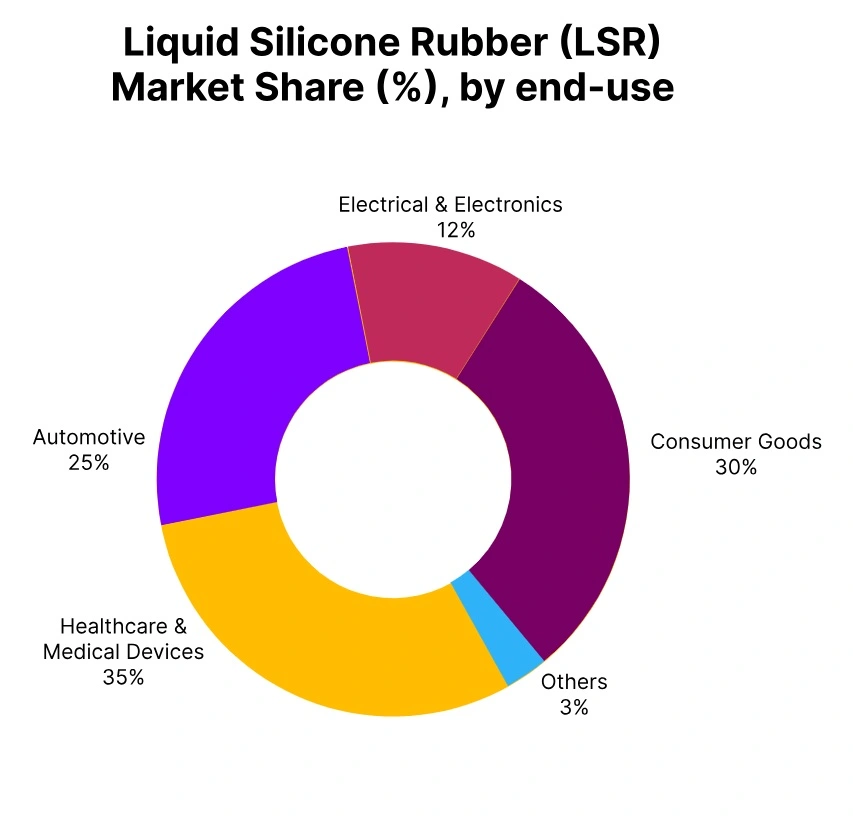
silicone rubber market share end use

Historically, several events have caused significant fluctuations in Silicone Rubber prices

  • Global Logistics and Shipping Crisis (2021-Present): The global logistics and shipping crisis has severely impacted the Silicone Rubber market, leading to supply chain disruptions and increased costs. Delays in the transport of key raw materials, such as butadiene and styrene, have reduced production rates and caused plant shutdowns. Rising freight costs from container shortages and higher fuel prices have also made Silicone Rubber more expensive for industries like automotive and construction. Supply chain volatility has caused stock shortages, complicating manufacturers’ ability to meet demand. Regions like Europe, reliant on imports, have been more affected, while Asia has seen relatively better stability. 
  • Global Energy Crisis (2021-2023): The 2021-2023 energy crisis significantly impacted Silicone Rubber production, leading to supply constraints and price increases. Rising energy costs, driven by disruptions in natural gas supplies, higher oil prices, and supply chain issues, escalated operating expenses for Silicone Rubber producers, particularly in Asia and Europe. This led to reduced production rates and even plant shutdowns, tightening global supply and pushing prices higher. Transportation costs also surged, further exacerbating the situation. The crisis prompted Silicone Rubber producers to explore energy-efficient technologies and diversify energy sources to reduce future risks, while price volatility and supply instability affected downstream industries like automotive and construction. 
  • COVID-19 Pandemic (2020-2022): The COVID-19 pandemic caused widespread production halts as lockdowns forced manufacturing plants to close, delaying new vehicle releases and disrupting parts supply. Global supply chains, dependent on just-in-time manufacturing, faced severe disruptions, with critical component shortages like semiconductors leading to delays and cost increases. Consumer demand also plummeted due to economic uncertainty and lockdowns, further impacted by car dealership closures. A shift towards private vehicles and electric vehicles (EVs) emerged, driven by health concerns and online sales trends. Though the industry began to recover by late 2020, semiconductor shortages slowed the recovery, with Asia-Pacific rebounding faster than other regions. 

Why Price Watch™?

Price Watch™ is your trusted resource for tracking global silicone rubber price trends. Our platform delivers real-time data and expert analysis, offering deep insights into the key factors driving price fluctuations in the silicone rubber market. By monitoring critical events such as geopolitical tensions, supply chain disruptions, and economic shifts, Price Watch™ keeps you fully informed of market dynamics.

In addition, Price Watch™ provides detailed forecasts and updates on production capacities, enabling you to anticipate market changes and make well-informed decisions. With Price Watch™, you gain a competitive edge in understanding all the elements that influence silicone rubber prices worldwide. Stay ahead of the curve with Price Watch’s™ reliable, accurate, and timely silicone rubber market data.

Track Price Watch's™ silicone rubber price assessment on a weekly basis since 2015 onwards, along with short-term forecasts, and get access to the detailed report in a downloadable format.

Silicone Rubber Market Price Trend published by Price Watch™ reflect prevailing spot market conditions, derived from independent research, verified trade inputs, and proprietary market intelligence as of the publication date. Prices are published on the specified Incoterm and represent indicative base market levels, exclusive of applicable taxes, VAT, duties, tariffs, and other statutory charges. Actual transaction values may vary depending on volume, credit terms, contractual structure, and other negotiated conditions. Market prices are inherently subject to volatility, liquidity dynamics, regulatory changes, and evolving trade activity. The information provided is for reference and benchmarking purposes only and does not constitute an offer, recommendation, or guarantee of transactional outcomes. Users should exercise independent commercial judgment and assess their specific contractual, regulatory, tax, and application requirements before making business decisions. Price Watch™ assumes no liability for decisions taken based on this information.

The pricing of Silicone Rubber is primarily influenced by several factors, including the cost of key raw materials like silicon metal and methyl chloride, fluctuations in crude oil prices, and production costs. Supply-demand dynamics, transportation and logistics expenses, and external market conditions such as geopolitical tensions or economic downturns also play a role. Seasonal demand variations in industries like automotive, electronics, and construction can further impact pricing trends.

Silicone Rubber pricing is heavily affected by the fluctuations in the cost of raw materials, particularly silicon metal. When raw material prices increase due to supply constraints or higher production costs, manufacturers pass these costs onto the buyers, leading to higher Silicone Rubber prices. Conversely, when raw material prices drop, procurement heads may see reductions in silicone rubber costs, depending on market conditions.

As of the latest market trends, Silicone Rubber prices have seen volatility due to supply chain disruptions and fluctuating raw material costs. Procurement heads can optimize buying strategies by closely monitoring price forecasts, securing long-term contracts during periods of lower prices, and considering alternative suppliers to mitigate risks. Staying informed on freight costs, market demand, and geopolitical factors can also help in timing purchases effectively.

LSR (Liquid Silicone Rubber) is a high-performance elastomer used in medical devices, automotive components, electronics, and consumer goods. Its price directly affects manufacturing costs in precision and high-spec industries. Price-Watch™ tracks LSR prices to help businesses stay informed about market movements and cost trends.

LSR prices vary based on grade, region, and application, influenced by raw material costs (siloxanes), energy prices, and demand from medical and automotive sectors. Prices are typically quoted per metric ton and differ based on specifications and purity levels. Price-Watch™ provides up-to-date price assessments across key global markets.

LSR prices are influenced by silicone feedstock costs, demand from medical devices, automotive electrification, and electronics manufacturing. Global supply conditions, energy costs, and specialty chemical availability also play key roles. Recent trends show firm pricing due to steady demand from high-growth applications.

Major consumers of LSR include the medical device industry, automotive sector, electronics manufacturers, and baby care product producers. Medical and healthcare applications account for a significant share due to strict quality and biocompatibility requirements. Price-Watch™ tracks consumption trends across these sectors.

LSR is produced from silicone-based raw materials derived from silica (sand) through a chemical process that produces siloxane intermediates, which are then formulated into liquid rubber systems for Molding and processing.

Major exporters of LSR include countries such as Germany, the United States, China, and Japan, supported by strong specialty chemical manufacturing bases. Export volumes depend on production capacity, technological capability, and demand from global high-end industries. Price-Watch™ monitors global trade flows and supply availability.

Supply is generally stable, but tightness can occur due to feedstock constraints, capacity limitations in specialty silicone plants, or sudden demand increases from medical and electronics sectors. Price-Watch™ closely tracks supply-demand balances to highlight potential shortages or oversupply situations.

LSR is available in medical grade, food grade, industrial grade, and optical/electronic grades. Prices differ based on purity, certification requirements, viscosity, curing properties, and performance specifications. Price-Watch™ provides grade-wise price assessments for better market clarity.

When demand rises sharply, especially from medical or electronics sectors, prices may increase, lead times extend, and allocation may tighten due to limited specialty production capacity. Price-Watch™ captures these market shifts in real time.

LSR pricing is strongly linked to silicone intermediates and energy costs. Any rise in siloxane feedstock prices or energy inputs increases production costs, which are often passed on to buyers. Price-Watch™ analyses feedstock-LSR price correlations to explain cost movements.

Regional differences arise due to production concentration, logistics costs, import duties, regulatory standards (especially medical certification), and local demand from high-tech industries. Price-Watch™ tracks global pricing variations across regions.

LSR price outlook depends on silicone feedstock trends, growth in medical and EV industries, capacity expansions, and global economic conditions. Price-Watch™ publishes regular forecasts projecting price direction over the next 3 months.

Yes. Forecasts help manufacturers plan procurement, manage long-term contracts, optimize production costs, and reduce supply risk in critical industries like healthcare and electronics. Price-Watch™ supports smarter purchasing decisions.

Events such as energy price volatility, semiconductor demand cycles, trade restrictions, or disruptions in silicone feedstock supply can impact production and pricing of LSR globally. Price-Watch™ provides timely updates on such market-moving factors.

Price-Watch™ collects data from producers, converters, and buyers to publish transparent LSR price assessments, market reports, and forecasts, helping stakeholders stay ahead of market trends.