Silver Price Trend and Forecast

UNSPC code: 54101501
|
Weekly Update
|
Historical Data Since 2015
|
Forecast for 2026
  • Commodity Pricing

silver Price Trends by Country

usUnited States

Global silver Spot Market Prices, Trend Analysis and Forecast

Price Watch™provides real-time price assessments and price forecasts for Silver across top trading regions:

Silver Global Coverage Silver Grade and Country Coverage Silver Pricing Data Coverage Explanation
Global Silver Pricing Analysis Silver Purity: 99.9% Spot Price Weekly Closing Globally Weekly price update on Silver real-time prices across global markets.

Silver Price Trend Q1 2026

According to Price-Watch™, in Q1 2026, silver’s prices increased by about 50% from the previous quarter. This has been one of the largest quarterly increases for silver in recent times; this rise has been influenced heavily due to several macro/economic and geopolitical issues coming together along with many factors in the manufacturing sector.

Central banks increased their purchases of precious metals across the world as a hedge against future inflation, creating a huge increase in the institutional demand for silver. A rapid decline in value of the US dollar relative to other major currencies made silver much less expensive for many international buyers and thus there was a sharp increase in worldwide demand.

At the same time, a global green energy transition has reached an important turning point; record amounts of new solar panels and electric vehicles are being manufactured which has driven industrial consumption of silver to record levels.

Supply and manufacturing issues have also made the price of silver rise; both Peru and Mexico, some of the world’s largest silver-producing countries, have had difficulties producing silver as a result of mining problems, which created further tightening of the quantities of silver available.

After several major economies announced unexpected government spending, many people have been speculative inflation would return and therefore many investors became very bullish on silver.

Global (XAG/USD)

XAGUSD recorded a historic price increase of 50% in Q1 2026 compared to Q4 2025, reflecting an extraordinary alignment of bullish drivers across both the investment and industrial landscape. The quarter opened with silver already at elevated levels from Q4 2025, and momentum accelerated as the Federal Reserve signaled a potential pause in its tightening cycle, reducing the opportunity cost of holding non-yielding assets like silver.

Heightened geopolitical instability across Eastern Europe and the Middle East intensified safe-haven demand, drawing significant capital into precious metals. On the industrial front, surging demand from the photovoltaics sector driven by aggressive government-backed renewable energy rollout programs in China, the European Union, and the United States created structural tightening in silver supply chains. The price was declined in March 2026 by 3.37%, as the market remained deeply unsettled following January’s historic crash.

JP Morgan allegedly closed a massive silver short position at the exact intraday bottom, while CME’s COMEX division simultaneously hiked margin requirements on silver futures, forcing leveraged traders to dump contracts into a falling market.

This engineered flush of the paper silver market compounded by a stronger dollar and fading speculative momentum extended selling pressure well into March, as retail investors remained cautious and institutional repositioning continued to suppress paper prices despite firm underlying physical demand.

Silver Price Trend Analysis: Q4 2025

In Q4 2025, silver prices increased by approximately 40% compared to Q3 2025, representing a substantial and sustained upward movement driven by a multi-dimensional set of market forces.

This sharp quarterly appreciation was underpinned by intensifying global industrial demand, particularly from the solar energy and semiconductor manufacturing sectors, which continue to consume silver at record levels.

Inflationary pressures persisted across major economies despite monetary tightening efforts, reinforcing silver’s dual appeal as both a hedge asset and a strategic industrial input.

The U.S. dollar weakened notably in Q4 as market participants began pricing in a potential pivot in Federal Reserve policy, making dollar-denominated commodities like silver more attractive to foreign investors.

Additionally, central banks in emerging markets accelerated their accumulation of precious metals as an alternative reserve asset, amplifying demand-side momentum.

Supply remained constrained, as output from leading silver-producing nations failed to keep pace with rising demand, creating structural deficits that supported elevated price levels throughout the quarter.

Global (XAG/USD)

XAGUSD the price trend in Q4 2025 increased of 40% in Q4 2025 compared to Q3 2025, driven by a confluence of macro-financial and sector-specific catalysts.

The quarter commenced with silver building on the momentum established in Q3, as growing expectations of a Federal Reserve policy shift reduced real yields and elevated the attractiveness of non-yielding precious metals.

Industrial demand from the green energy sector reached record levels, with photovoltaic installations globally driving unprecedented silver consumption in solar cell manufacturing.

December 2025 was the standout month of the quarter, delivering an 11% price increase the steepest monthly gain driven by a year-end surge in investor demand as fund managers repositioned portfolios toward commodities.

Retail investor participation also spiked, fueled by growing mainstream narratives around silver’s critical role in the energy transition.

According to Price-Watch™ , Silver experienced approximately a 20% increase in price in Q3 of 2025, primarily due to robust industrial demand and investment demand in light of uncertainty surrounding the economic outlook.

Industrial silver demand significantly increased as a result of growth in renewable energy, particularly manufacturing solar panels and batteries for electric vehicles. The investment segment, comprised of silver ETFs and coins, saw significant inflows, with investors seeking a hedge against inflation and currency devaluation.

Ongoing inflationary pressures and a weaker dollar also made silver attractive as a value store. Furthermore, increasing geopolitical tensions has resulted in further risk aversion, adding to the demand for precious metals. The combination of these factors all contributed to the upside price momentum experienced in the third quarter.

Global (XAG/USD)

XAG/USD price movements in the third quarter of 2025, an increase in silver prices of 20% has been observed compared to the second quarter of 2025.

The price increase of silver has been spurred by a strong recovery in industrial demand from the electronics and renewable energy sector, in addition to stronger demand from investments. Inflationary pressures and a softer U.S. dollar also served to make silver an attractive option.

In September 2025, XAG USD rose more sharply by 11% (higher than the average), as safe-haven buying swelled in reaction to growing geopolitical tensions and weaker broader economic readings globally. These factors enhanced silver’s dual role as both an industrial metal and as a precious metal investment, leading to the strong upward momentum of the price in Q3.

According to Price-Watch™, the price of silver (XAG/USD) rose significantly in the second quarter of 2025, climbing by $33.10 per ounce an increase of 14.59% with prices peaking at $37.32. This sharp uptrend was primarily driven by a combination of macroeconomic and industrial factors.

Persistent inflationary pressures and growing expectations of prolonged interest rate cuts by major central banks, particularly the U.S. Federal Reserve, boosted investor demand for silver as a hedge against currency devaluation.

Additionally, industrial demand surged due to continued expansion in green energy technologies, especially solar panel manufacturing, which relies heavily on silver. Supply-side constraints also played a role, as disruptions in major silver producing regions, including parts of Latin America, created concerns over reduced output. 

The upward trend in silver continued in Q1 2025, with prices increasing by 2.66% to reach $32.45 per ounce (Spot price weekly closing). Ongoing global economic instability, geopolitical risks, and steady industrial demand contributed to the positive momentum.

Institutional and retail investors alike maintained their interest in silver, seeking diversification and inflation protection. Despite periodic corrections due to market volatility and shifting yields, silver remained resilient and continued to benefit from its hybrid role in investment and industry. 

Silver Price Trend Analysis: Q4 2024

Silver prices advanced 5.20% in Q4 2024, closing the year at $31.61 per ounce (Spot price weekly closing). Renewed investor interest and seasonal demand especially from markets like India played a significant role in supporting prices. Continued concerns over geopolitical instability and fluctuating economic data sustained silver’s safe-haven appeal.

Industrial consumption remained strong, particularly in solar and electronics applications, offsetting the impact of profit-booking and monetary policy uncertainty. 

Despite facing headwinds from a strengthening dollar and rising bond yields, silver prices edged up 2.53% in Q3 2024 to $30.05 per ounce (Spot price weekly closing). The momentum slowed compared to the previous quarter due to improving macroeconomic indicators and a shift toward higher-risk assets.

However, sustained demand from emerging markets and industrial users helped maintain positive price action. The market also saw support from investors viewing silver as a lower-cost alternative to gold in times of uncertainty. 

Silver experienced a significant rally in Q2 2024, to $29.30 per ounce (Spot price weekly closing). The surge was driven by robust industrial demand, particularly from the renewable energy and electronics sectors. Growing investor confidence, central bank buying, and a weakening US dollar added further upward momentum.

As economic uncertainty persisted, silver’s appeal as a hedge against inflation and market volatility gained traction. Profit-taking led to brief pullbacks, but overall sentiment remained strongly bullish. 

In Q1 2024, silver prices saw a modest increase of 0.30%, rising from $23.70 to $23.77 per ounce (Spot price weekly closing). The metal’s movement lagged behind gold, reflecting investor hesitation amid mixed economic signals and relatively subdued industrial demand.

While inflationary concerns and global uncertainties supported precious metal sentiment, silver’s dual role as both an investment and industrial commodity kept its gains limited. Fluctuating interest rates and a stronger US dollar also contributed to the restrained performance. 

Technical Specifications of Silver Price Trends

Product Description:

Silver (XAG/USD) is a globally traded precious metal recognized for its dual role as both an investment asset and an essential industrial material. Traded on major commodity exchanges, silver is valued for its conductivity, reflectivity, and antimicrobial properties, making it crucial across multiple sectors. It also serves as a hedge against inflation, currency depreciation, and market volatility.

Identifiers and Classification:

CAS No: 7440-22-4

HS Code: 710691

Silver Grades Specific Price Assessment:

  • Purity 99.9%

Silver Global Trade and Shipment Term

*Quotation Terms (Product & Country Specific): 1-5 oz

**Packaging Type (Product & Country Specific): Vacuum-sealed plastic

Incoterms Reference in Silver Reporting

Shipping Term  Location  Definition 
Weekly Spot Price   Global  Silver Spot Price (XAG/USD) 

*Quotation Terms refers to the quantity range specified for the Silver being quoted or offered in a commercial transaction.

**Packaging Type refers to standard packaging size commonly used for silver packing, ease of handling, transportation, and storage in industrial and commercial applications.

Key Silver Manufacturers

Manufacturer 
Fresnillo PLC 
Pan American Silver 
Hecla Mining 
Polymetal International 

Silver Industrial Applications

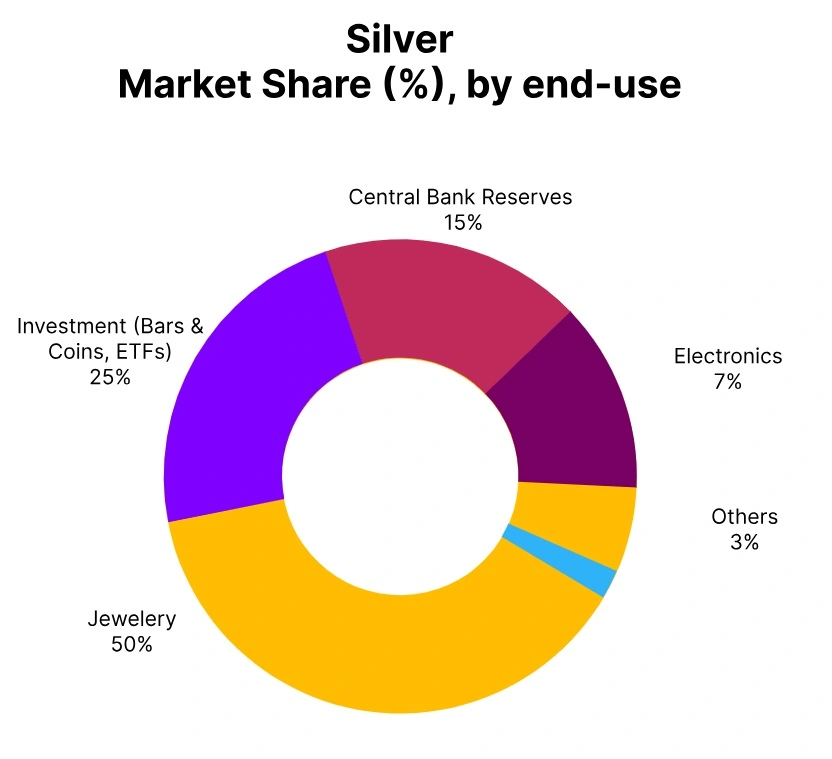
silver market share end use

Historically, several events have caused significant fluctuations in Silver prices

  • Russia-Ukraine Conflict (2022): Geopolitical instability boosted silver’s investment appeal. At the same time, concerns over supply chain disruptions in industrial sectors added to price pressures, reinforcing silver’s hybrid nature as both a monetary and industrial asset. 
  • COVID-19 Pandemic (2020-2021): Silver experienced significant price volatility. Initial declines were followed by a sharp rally driven by safe-haven demand, a weakening US dollar, and booming industrial use in electronics and renewable energy—especially solar. 
  • Global Financial Crisis (2008-2009): While initially impacted by the broader market sell-off, silver prices rebounded sharply as safe-haven demand surged and expectations for industrial recovery grew, reflecting silver’s dual role as both an investment and industrial metal.

Why Price Watch™?

Price Watch™ is your trusted resource for tracking global silver price trends. Our platform delivers real-time data and expert analysis, offering deep insights into the key factors driving price fluctuations in the silver market. By monitoring critical events such as geopolitical tensions, supply chain disruptions, and economic shifts, Price Watch™ keeps you fully informed of market dynamics.

In addition, Price Watch™ provides detailed forecasts and updates on production capacities, enabling you to anticipate market changes and make well-informed decisions. With Price Watch™, you gain a competitive edge in understanding all the elements that influence silver prices worldwide. Stay ahead of the curve with Price Watch’s™ reliable, accurate, and timely silver market data.

Track Price Watch's™ silver price assessment on a weekly basis since 2015 onwards, along with short-term forecasts, and get access to the detailed report in a downloadable format.

Silver Market Price Trend published by Price Watch™ reflect prevailing spot market conditions, derived from independent research, verified trade inputs, and proprietary market intelligence as of the publication date. Prices are published on the specified Incoterm and represent indicative base market levels, exclusive of applicable taxes, VAT, duties, tariffs, and other statutory charges. Actual transaction values may vary depending on volume, credit terms, contractual structure, and other negotiated conditions. Market prices are inherently subject to volatility, liquidity dynamics, regulatory changes, and evolving trade activity. The information provided is for reference and benchmarking purposes only and does not constitute an offer, recommendation, or guarantee of transactional outcomes. Users should exercise independent commercial judgment and assess their specific contractual, regulatory, tax, and application requirements before making business decisions. Price Watch™ assumes no liability for decisions taken based on this information.

Macroeconomic Trends: Inflation, interest rates, and global economic growth affect silver prices due to its dual role as both an investment and industrial metal.

Industrial Demand: Silver’s use in solar panels, electronics, and medical devices makes manufacturing trends a key price driver.

Geopolitical Risks: Global instability, supply chain disruptions, and trade tensions often boost safe-haven demand for silver.

To diversify portfolios, hedge against inflation and currency depreciation, and capitalize on long-term industrial growth.

Price-Watch™ delivers real-time pricing, expert commentary, and weekly updates, helping you stay on top of market trends and make informed decisions.

Silver is a precious metal valued for rarity, conductivity, and versatility. Used in jewelry, electronics, solar panels, investment products, and industrial applications, silver prices impact manufacturing costs, investment portfolios, and global trade. Price-Watch™ monitors these prices to inform businesses, investors, and consumers.

Silver prices fluctuate constantly due to industrial demand, investment flows, currency exchange rates, and global economic conditions. Prices are quoted per troy ounce, gram, or kilogram. Price-Watch™ provides real-time assessments across major markets.

Silver prices respond to macroeconomic factors such as inflation, interest rates, industrial demand, currency movements (especially the USD), and investor sentiment. Safe-haven demand often boosts silver during economic uncertainty. Supply factors, including mining output and recycling, also influence trends.

Key silver consumers include electronics, photovoltaics (solar panels), jewelry, photography (historically), medical devices, and investment markets (bars, coins, ETFs). Central banks occasionally hold silver as part of reserves. Price-Watch™ tracks consumption across sectors for insight.

Silver is primarily mined as a byproduct of gold, copper, lead, and zinc mining. Recycling from jewelry, electronics, and industrial scrap is also significant. Major producers include Mexico, Peru, China, Russia, and Australia.

Mexico, Peru, and China are leading exporters due to large mining outputs and refining infrastructure. Switzerland is also a major hub for refining and trade. Export levels fluctuate based on mining, trade policies, and global demand.

Global silver supply is typically sufficient, combining mined silver and recycling. Supply constraints can arise from declining ore grades, mining disruptions, regulatory changes, or surges in industrial and investment demand.

Silver purity is measured in fineness (e.g., 999 for investment-grade, 925 for sterling). Prices vary by purity, form (coins, bars, jewelry), fabrication costs, and brand premiums. Price-Watch™ tracks these differences for transparency.

Price spikes occur during industrial booms, economic uncertainty, or festive seasons with high jewelry demand. Investors often move funds to silver as a hedge, increasing market volatility. Price-Watch™ captures these dynamics in real time.

Silver does not generate interest, so rising rates can reduce investor demand relative to yield-bearing assets. Conversely, low rates enhance silver’s attractiveness as a store of value. Price-Watch™ analyzes these trends alongside historical data.

Regional prices vary due to taxes, import duties, transportation, local demand, and seasonal effects (festivals, industrial cycles). Price-Watch™ monitors regional markets to highlight such differences.

Forecasts depend on industrial demand, macroeconomic trends, central bank policies, inflation expectations, and geopolitical developments. Price-Watch™ provides 12-month projections based on data-driven modeling and seasonal patterns.

Yes. Jewelry manufacturers, industrial users, and investors can plan procurement, hedge risks, and manage inventory efficiently based on accurate forecasts.

Financial crises, geopolitical conflicts, supply chain disruptions, and central bank policies can significantly influence silver markets, often increasing its safe-haven appeal and price volatility.

Price-Watch™ compiles pricing data from traders, refiners, exchanges, and industrial users worldwide. Its methodology and global coverage make it a trusted source for transparent silver pricing and market trends.