Sodium Aluminosilicate (4a Zeolite) Price Trend and Forecast

UNSPC code: 12352308
|
Weekly Update
|
Historical Data Since 2015
|
Forecast for 2026
  • Commodity Pricing

sodium aluminosilicate (4a zeolite) Price Trends by Country

cnChina
mxMexico
vnVietnam

Global sodium aluminosilicate (4a zeolite) Spot Market Prices, Trend Analysis and Forecast

Price-Watch™ provides price assessments for Sodium Aluminosilicate (4A Zeolite) across top trading regions:

Asia-Pacific

  • Sodium Aluminosilicate Grade-4A Zeolite Powder FOB Shanghai, China
  • Sodium Aluminosilicate Grade-4A Zeolite Powder CIF Haiphong (China), Vietnam


North America

  • Sodium Aluminosilicate Grade-4A Zeolite Powder CIF Manzanillo, Mexico (China)


Note:
In assessments structured as CIF [Importing Port] (Exporting Country), the country mentioned in brackets indicates the primary origin of supply (exporting country), while the named port refers to the destination port in the importing country. Other Incoterms (FOB, FD, EXW, etc.) should be interpreted in accordance with standard international trade definitions.

Sodium Aluminosilicate (4A Zeolite) Price Trend Q1 2026

During the quarter of 2026, the price trend for Sodium Aluminosilicate has been upward on a quarterly average basis but has been stable at the beginning of the quarter, owing to well-balanced availability of the feedstock, as well as moderate demand in the downstream market. But in March, the price shot up abruptly owing to global logistical problems and disruptions in supply of raw material, resulting in sharp price rise of 6% to 14%. This shows that the price trend of Sodium Aluminosilicate is sensitive to supply problems, transport issues, and changes in demand in the downstream industry.

China: Sodium Aluminosilicate Export prices FOB Shanghai, China; Grade-4A Zeolite Powder

During the first quarter of 2026, the Sodium Aluminosilicate price trend in China increased by 3.50%. This can be attributed to the tightened supplies and continued rise in downstream demands from detergent, catalysts, and specialty glass markets. On the other hand, in March, the Sodium Aluminosilicate price in China increased dramatically by 6.00%. This is due to the disruption of the global supply chains leading to issues like limited availability of raw materials and higher shipping expenses amidst the conflict between the US-Iran. In March 2026, Sodium Aluminosilicate in China indicates how sensitive the market is to upstream supply shortages, shipping issues, and changing downstream consumption patterns.

Mexico: Sodium Aluminosilicate import prices CIF Manzanillo, Mexico; Grade-4A Zeolite Powder

According to Price-Watch™ , in Q1 2026, Sodium Aluminosilicate price trend in Mexico rose by 1.00% on a quarterly average, supported by gradually improving downstream demand and steady supply conditions. Early-quarter stability reflected balanced feedstock availability and measured procurement by buyers. However, in March, the Sodium Aluminosilicate price in Mexico surged sharply by 14.00%, driven primarily by disruptions in global supply chains and logistical bottlenecks, including constrained raw material shipments and higher freight costs.

The sharp March increase prompted aggressive restocking and amplified short-term volatility. In March 2026, Sodium Aluminosilicate price in Mexico underscored the market’s sensitivity to global supply shocks, transportation constraints, and shifts in downstream demand, emphasizing the importance of monitoring feedstock flows, inventory levels, and procurement patterns.

Vietnam: Sodium Aluminosilicate Import prices CIF Haiphong, Vietnam; Grade-4A Zeolite Powder

In Q1 2026, Sodium Aluminosilicate price trend in Vietnam rose by 4.00% on a quarterly average, driven by tightening supply conditions and steady growth in downstream demand from detergents, catalysts, and specialty glass applications. Early-quarter stability reflected balanced feedstock availability and cautious procurement by buyers. However, in March 2026, Sodium Aluminosilicate price in Vietnam surged by 6.00%, largely driven by global supply chain disruptions, logistical bottlenecks, and constrained raw material shipments.

The sharp increase prompted accelerated restocking and contributed to heightened short-term volatility. Overall, the Sodium Aluminosilicate price in Vietnam in March highlighted the market’s sensitivity to supply constraints, transportation challenges, and downstream demand fluctuations, emphasizing the importance of closely monitoring feedstock flows, inventory levels, and procurement strategies.

Sodium Aluminosilicate (4A Zeolite) Price Trend Analysis: Q4 2025

For Q4 2025, the price trend for Sodium Aluminosilicate indicated moderate rises in prices of about 1-2%, backed by stable end-user demand from industries like detergent manufacturing, catalyst production, and specialty glass manufacturing, combined with controlled sourcing of raw materials and proper procurement. However, in December, the rise in prices is somewhat stabilized at 1.0-1.5%, due to some year-end corrections and selectivity in restocking. Overall, the price trend for Sodium Aluminosilicate in December showed how procurement has been managed promptly by the procurers.

China: Sodium Aluminosilicate Export prices FOB Shanghai, China; Grade-4A Zeolite Powder

In quarter four of 2025, the Sodium Aluminosilicate price trend in China showed an increase of 2.00%, with the continued demand from the detergent, catalysts, and glass industry as well as a consistent level of supply and raw materials contributing towards the growth. The December figure for the Sodium Aluminosilicate price in China showed a smaller increase of 1.00%, implying some form of stabilization towards the end of the year, with restocking and purchasing being undertaken cautiously. In December 2025, Sodium Aluminosilicate price in China revealed that the price trend has been maintained through controlled purchases and stable levels of supply.

Mexico: Sodium Aluminosilicate import prices CIF Manzanillo, Mexico; Grade-4A Zeolite Powder

According to Price-Watch™ , in Q4 2025, Sodium Aluminosilicate price trend in Mexico declined by -0.50% on a quarterly average, reflecting subdued demand from downstream industries such as detergents, glass, and catalysts, coupled with cautious procurement amid relatively balanced supply. Early-quarter activity is restrained as buyers managed inventories conservatively, limiting upward price momentum. The Sodium Aluminosilicate price in Mexico recorded a slightly sharper decline of -1.00% in December, indicating continued softening toward year-end, driven by inventory adjustments and limited restocking. In December 2025, Sodium Aluminosilicate price in Mexico highlighted how careful buying and manageable supply helped contain further price erosion, even as market sentiment remained weak.

Vietnam: Sodium Aluminosilicate Import prices CIF Haiphong, Vietnam; Grade-4A Zeolite Powder

In Q4 2025, Sodium Aluminosilicate price trend in Vietnam increased by 1.50% on a quarterly average, reflecting steady downstream demand from sectors such as detergents, glass, and catalysts, along with balanced feedstock availability and moderate procurement activity. The Sodium Aluminosilicate price in Vietnam rose by 1.00% in December, indicating mild stabilization toward the end of the quarter, supported by controlled inventory adjustments and selective restocking. In December 2025, Sodium Aluminosilicate price in Vietnam underscored that consistent demand and measured buying helped maintain upward momentum while preventing excessive volatility.

In Q3 2025, the Sodium Aluminosilicate (4A Zeolite) price trend demonstrated a pronounced increase worldwide, attributed to escalating prices for raw materials, energy costs, and firm demand from the detergent and cleaning sectors. The Sodium Aluminosilicate price in key production and export regions, such as China, exhibited a steady increase through the quarter, with the pace of the price increase accelerating in September.

This was primarily due to increased alumina and sodium silicate costs, as well as reduced supply for market purchases, impacted by increased environmental regulations in China limiting production capacity. Buyers in markets globally experienced higher procurement costs and, in some cases, locked in volumes at higher prices in anticipation of further price increases. Consequently, 4A Zeolite prices remained stable with continued upward pressure around the world, and expectations remained for continued firm prices heading into Q4 if feedstock costs and energy prices are sustained.

China: Sodium Aluminosilicate Export prices FOB Shanghai, China, Grade-4A Zeolite Powder.

According to Price-Watch, in the third quarter of 2025, the Sodium Aluminosilicate (4A Zeolite) price trend in China showed some price pressure up about 4% on an FOB Shanghai, China basis. Mild upward price pressure was attributed to fluctuating input costs in addition to steady export demand. Sodium Aluminosilicate (4A Zeolite) price remained stable over the quarter, particularly with firmer costs for sodium silicate, alumina, and slight upward pressure in energy and labor costs among producers.

Exporters, in particular, indicated improving inquiries from overseas despite a largely balanced domestic supply, especially from Southeast Asia and the Middle East, which continued to support firmer offer levels of Sodium Aluminosilicate (4A Zeolite) in September 2025.

Overall, the Sodium Aluminosilicate (4A Zeolite) price trend in Q3 suggested modest price pressure with a steadily firmer price sentiment, observing closely on upstream cost pressures and environmental compliance factors which could change over time and impact production levels.

Mexico: Sodium Aluminosilicate import prices CIF Manzanillo, Mexico, Grade-4A Zeolite Powder

In Q3 2025, Sodium Aluminosilicate (4A Zeolite) price trend in Mexico recorded a decline of approximately 5%, primarily driven by a sharp reduction in international freight charges. The Sodium Aluminosilicate (4A Zeolite) price in Mexico moved lower despite relatively stable FOB values from key exporting regions like China, as logistics costs particularly container rates from Asia to Latin America fell significantly throughout the quarter. This drop in freight translated directly into lower landed costs for Mexican importers.

By September 2025, Sodium Aluminosilicate (4A Zeolite) price in market fully reflected this adjustment, with traders and buyers securing more competitive offers amid steady demand from the detergent and chemical manufacturing sectors. While the core material costs remained unchanged, the overall Sodium Aluminosilicate (4A Zeolite) price was influenced heavily by external logistics dynamics, leading to temporary relief in import pricing. Barring any reversal in freight trends, the market is expected to remain soft in the near term.

Vietnam: Sodium Aluminosilicate Import prices CIF Haiphong, Vietnam, Grade-4A Zeolite Powder

According to Price-Watch, In Q3 2025, the Sodium Aluminosilicate (4A Zeolite) price trend in Vietnam recorded a 4% increase, supported by rising production costs and consistent demand from the domestic detergent and chemical sectors. The Sodium Aluminosilicate (4A Zeolite) price in Vietnam moved upward steadily throughout the quarter, with the trend becoming more evident in September, as suppliers from key origins, particularly China, adjusted offer levels in response to higher raw material and energy costs.

While freight rates remained relatively stable, the increase was mainly attributed to firm export pricing and limited availability in the spot market. By the end of the quarter, Vietnamese importers were paying noticeably higher prices, reflecting tight supply conditions and supplier pricing discipline. By the end in September 2025, Sodium Aluminosilicate (4A Zeolite price in Vietnam remained on a mildly bullish trajectory, with expectations of continued firmness if upstream pressures persist into Q4.

According to PriceWatch, In Q2 2025, the average price of Sodium Aluminosilicate (Zeolite 4A) reached USD 466 per ton (FOB Shanghai, China), reflecting a 1.3% increase from the previous quarter’s average of USD 460 per ton in Q1 2025. This slight but notable price rise followed a 3.2% quarter-on-quarter decline from Q4 2024 to Q1 2025, indicating a gradual market recovery and renewed price stability.

The uptick can be attributed to a combination of factors, including marginally rising raw material and energy costs, improved downstream demand particularly from the detergent, water treatment, and industrial cleaning sectors and a more favourable export climate.

While the increase was not dramatic, it points to strengthening market fundamentals and sustained confidence across the supply chain. Production levels remained consistent, and suppliers maintained a steady pace of deliveries, with no major logistical bottlenecks reported.

The Chinese market, especially around Shanghai, continued to benefit from competitive manufacturing conditions, positioning Zeolite 4A producers well in both domestic and international markets. Overall, Q2 2025 demonstrated signs of resilience and moderate optimism, with pricing movements reflecting underlying market health rather than volatility. 

In Q1 2025, the average price of Sodium Aluminosilicate (Zeolite 4A) was recorded at USD 460 per ton (FOB Shanghai, China), representing a 3.2% decrease compared to Q4 2024, when the average price stood at USD 475 per ton. The slight decline indicates a softening in market conditions, potentially due to reduced demand from detergent manufacturers or improved raw material availability. Despite the dip, overall market stability was maintained, with no significant disruptions reported in supply or production throughout the quarter. 

Sodium Aluminosilicate (4A Zeolite) Price Trend Analysis: Q4 2024

In Q4 2024, the average price of Sodium Aluminosilicate (Zeolite 4A) remained stable at approximately USD 475 per ton (FOB Shanghai, China). This reflects a slight increase from the Q3 levels, suggesting continued firm demand from end-use sectors such as detergents and industrial applications.

The market showed resilience with balanced supply conditions and steady production output. The marginal quarter-on-quarter price growth also hints at stable input costs and logistics, contributing to a relatively calm pricing environment in the final quarter of the year. 

In Q3 2024, the average price of Sodium Aluminosilicate (Zeolite 4A) stood at approximately USD 470 per ton (FOB Shanghai, China), reflecting a modest increase compared to the Q1 average of USD 450 per ton. This 4.4% quarter-on-quarter rise indicates a slight upward shift in market dynamics, likely influenced by factors such as increased raw material costs, rising logistics expenses, or improved demand from downstream industries, particularly in detergents and construction materials. Despite the uptick, the market remained relatively stable, with no significant disruptions in supply or trade activity reported during the quarter. 

In Q2 2024, the average price of Sodium Aluminosilicate (Zeolite 4A) remained stable at around USD 449 per ton (FOB Shanghai, China), showing minimal change from the Q1 average of USD 450 per ton. This slight dip of USD 1 per ton indicates a broadly balanced market with steady supply and demand dynamics.

The price stability suggests that production costs, raw material availability, and export volumes continued to be consistent. The detergent and chemical processing industries, key consumers of Zeolite 4A, maintained regular procurement patterns, contributing to the overall market equilibrium during the quarter. 

In Q1 2024, the average price of Sodium Aluminosilicate (Zeolite 4A) stood at approximately USD 450 per ton (FOB Shanghai, China). This pricing level reflects relative market stability during the period, influenced by steady demand from the detergent and water treatment sectors, as well as consistent raw material availability.

Despite global fluctuations in chemical markets, the Zeolite 4A segment remained largely balanced in China, with limited price volatility. Export activity out of Shanghai was moderate, supported by favorable production costs and competitive positioning in the international market. 

Technical Specifications of Sodium Aluminosilicate (4a Zeolite) Price Trends

Product Description

Sodium Aluminosilicate (Zeolite 4A) is a synthetic crystalline aluminosilicate with a well-defined porous structure, widely used as a molecular sieve and ion exchange material. Classified as a Type 4A zeolite, it has a uniform pore size of approximately 4 angstroms, which allows it to selectively adsorb water and other small polar molecules while excluding larger compounds. It is commonly used in detergents as a water softener, replacing phosphates by capturing calcium and magnesium ions during washing.

Zeolite 4A is also utilized in drying applications, gas separation, catalysis, and as a reinforcing filler in plastics and coatings. Manufactured from natural raw materials like alumina, silica, and sodium hydroxide, it is environmentally friendly, non-toxic, and highly effective in a wide range of industrial and household applications.

Identifiers and Classification:

  • CAS No – 1318-02-1
  • HS Code – 28421000
  • Molecular Formula – Na12[(AlO2)12(SiO2)12]•xH2O
  • Molecular Weight[g/mol] – 720.76 g/mol


Sodium Aluminosilicate (4A Zeolite) Synonyms:

  • Sodium Zeolite A
  • NaA Zeolite


Sodium Aluminosilicate (4A Zeolite) Grades Specific Price Assessment:

  • 4A Zeolite Powder


Sodium Aluminosilicate (4A Zeolite) Global Trade and Shipment Terms

  • Quotation Terms (Product & Country Specific): 15-20 MT
  • Packaging Type (Product & Country Specific): 25 Kg Bag


Incoterms Referenced in Sodium Aluminosilicate (4A Zeolite) Price Reporting

Shipping Term  Location  Definition 
FOB Shanghai  Shanghai, China  Sodium Aluminosilicate Export price from China 
CIF Manzanillo (China)  Manzanillo, Mexico  Sodium Aluminosilicate import price in Mexico from China 
CIF Haiphong (China)  Haiphong, Vietnam  Sodium Aluminosilicate import price in Vietnam from China 

*Quotation Terms refers to the quantity range specified for the Sodium Aluminosilicate (4A Zeolite) being quoted or offered in a commercial transaction.

**Packaging Type refers to standard packaging size commonly used for Sodium Aluminosilicate (4A Zeolite) packing, ease of handling, transportation, and storage in industrial and commercial applications.

Key Sodium Aluminosilicate (4A Zeolite) Manufacturers

Manufacturer 
Huiying Chemical Industry (Xiamen) Co. 
Shanghai Jiuzhou Chemicals Co., Ltd 
BASF SE 
SOLINC INDUSTRIAL CO. LIMITED. 

Sodium Aluminosilicate (4a Zeolite) Industrial Applications

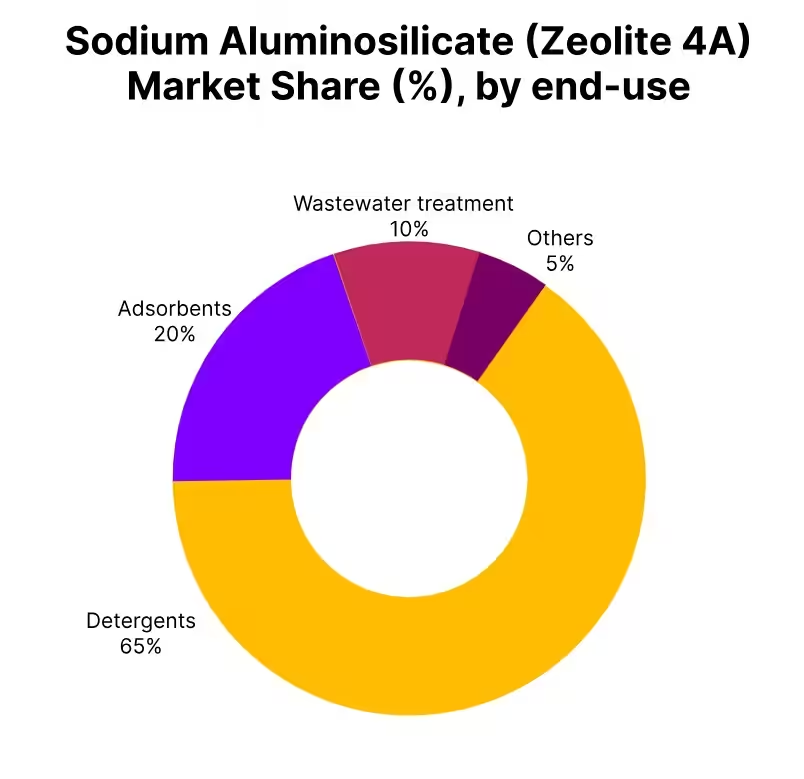
sodium aluminosilicate market share end use

Historically, several events have caused significant fluctuations in Sodium Aluminosilicate (4a Zeolite) prices

  • Russia-Ukraine Conflict (2022-Present): Disruptions in European crude oil production led to increased costs and global price volatility. 
  • Israel-Hamas Conflict (2023): The recent escalation in the Israel-Hamas conflict has introduced additional uncertainty in Middle Eastern supply chains, potentially impacting global crude oil prices and, consequently, the pricing of Sodium Aluminosilicate (4A Zeolite) disruptions in this region can affect supply routes and increase volatility in markets worldwide. 
  • COVID-19 Pandemic (2020): The Sodium Aluminosilicate (4A Zeolite) market faced significant disruptions in production and logistics due to widespread lockdowns. These challenges led to a notable increase in prices as demand surged for cleaning and personal care products, highlighting the industry’s rapid adaptation to evolving consumer priorities cantered on hygiene and sanitation. 
  • Geopolitical Tensions (2018-2019): U.S.-China trade wars caused price instability due to disrupted supply chains. During particularly concerning trade tariffs on chemicals, had a profound impact on the Sodium Aluminosilicate (4A Zeolite) market. These tariffs disrupted established supply chains and led to significant alterations in pricing structures, resulting in price fluctuations. This volatility highlighted the challenges faced by manufacturers as they navigated the complexities of a shifting global trade environment. 


These events underscore the Sodium Aluminosilicate (4A Zeolite) market’s vulnerability to global disruptions and highlight the need for continuous monitoring of supply-demand dynamics.
 

Why Price Watch™?

Price Watch™ is your trusted resource for tracking global sodium aluminosilicate (4a zeolite) price trends. Our platform delivers real-time data and expert analysis, offering deep insights into the key factors driving price fluctuations in the sodium aluminosilicate (4a zeolite) market. By monitoring critical events such as geopolitical tensions, supply chain disruptions, and economic shifts, Price Watch™ keeps you fully informed of market dynamics.

In addition, Price Watch™ provides detailed forecasts and updates on production capacities, enabling you to anticipate market changes and make well-informed decisions. With Price Watch™, you gain a competitive edge in understanding all the elements that influence sodium aluminosilicate (4a zeolite) prices worldwide. Stay ahead of the curve with Price Watch’s™ reliable, accurate, and timely sodium aluminosilicate (4a zeolite) market data.

Track Price Watch's™ sodium aluminosilicate (4a zeolite) price assessment on a weekly basis since 2015 onwards, along with short-term forecasts, and get access to the detailed report in a downloadable format.

Sodium Aluminosilicate (4a Zeolite) Market Price Trend published by Price Watch™ reflect prevailing spot market conditions, derived from independent research, verified trade inputs, and proprietary market intelligence as of the publication date. Prices are published on the specified Incoterm and represent indicative base market levels, exclusive of applicable taxes, VAT, duties, tariffs, and other statutory charges. Actual transaction values may vary depending on volume, credit terms, contractual structure, and other negotiated conditions. Market prices are inherently subject to volatility, liquidity dynamics, regulatory changes, and evolving trade activity. The information provided is for reference and benchmarking purposes only and does not constitute an offer, recommendation, or guarantee of transactional outcomes. Users should exercise independent commercial judgment and assess their specific contractual, regulatory, tax, and application requirements before making business decisions. Price Watch™ assumes no liability for decisions taken based on this information.

The pricing of Sodium Aluminosilicate (4A Zeolite) is influenced by several interconnected factors. Fluctuations in raw material costs, particularly for phosphate rock and phosphoric acid, directly affect production expenses. Additionally, supply and demand dynamics contribute to price volatility; heightened demand in sectors like water treatment, detergents, and food processing can drive prices up. The operational capacity of manufacturing facilities is also critical, as shutdowns or reduced output may lead to supply constraints. Market competition and the presence of alternative supplier’s further impact pricing strategies. Transportation and logistics play a significant role, with changes in freight costs affecting final prices, especially in import-dependent regions. Broader economic conditions, including inflation, currency fluctuations, and geopolitical stability, can influence pricing as well. Moreover, compliance with environmental regulations can alter production costs, while seasonal demand fluctuates, particularly in agriculture and water treatment, add another layer of complexity to the pricing landscape.

The price of Sodium Aluminosilicate (4A Zeolite) is influenced by several key factors, including raw material costs (such as phosphoric acid and sodium carbonate), production capacity, supply chain dynamics, and global demand trends. Additionally, regulatory changes affecting phosphate use in detergents and food products can impact pricing. Understanding these factors will help procurement heads make informed purchasing decisions.

To effectively forecast pricing trends for Sodium Aluminosilicate (4A Zeolite), procurement heads should monitor market reports, track fluctuations in raw material costs, and analyze demand patterns across key industries such as detergents, food processing, and water treatment. Additionally, staying informed about geopolitical events and regulatory changes can provide insights into potential price movements, allowing for better budgeting and procurement strategies.

Sodium Aluminosilicate, commonly called 4A Zeolite, is a crystalline microporous material made from alumina, silica, and sodium oxide, widely used as a molecular sieve, adsorbent, and catalyst support in detergents, industrial drying, gas separation, and chemical processing due to its uniform pore structure and high-water absorption capacity. Its price is significant because fluctuations directly impact production costs for detergents, cleaning agents, and industrial applications, while regional supply constraints and energy-intensive production make pricing sensitive to raw material costs, energy expenses, and global demand.

The current price of 4A Zeolite varies by region, grade, and particle size, typically quoted per metric ton, and is influenced by raw material costs, energy prices, production capacity, and global demand. Countries with strong chemical industries like China and India often offer more competitive pricing, while import-dependent regions face higher costs due to logistics and duties. Price-Watch™ provides real-time benchmarks for manufacturers and buyers to make informed decisions.

The 4A Zeolite market is steadily growing, driven by increasing demand from detergents, industrial drying, chemical processing, and petrochemical sectors, particularly in emerging economies. Prices are influenced by raw material availability, energy costs, production capacity, seasonal demand fluctuations, and environmental regulations, with supply-demand imbalances causing short-term price volatility, while long-term growth is supported by urbanization and industrial expansion.

The largest consumers of 4A Zeolite are the detergent and cleaning product manufacturers, followed by industrial drying, gas adsorption, chemical processing, petrochemical, and agricultural sectors, where it is used as a water-softening agent, molecular sieve, catalyst support, and nutrient carrier, making it a critical raw material across industries relying on ion-exchange, adsorption, or molecular sieving properties.

4A Zeolite is synthesized from silica and alumina through a hydrothermal crystallization process in the presence of sodium hydroxide, producing uniform crystalline structures with high water-absorption capacity; major production hubs include China, India, Europe, and the United States, where advanced chemical manufacturing infrastructure allows large-scale industrial production.

China is the largest global exporter of 4A Zeolite due to its extensive production capacity, followed by India, the United States, and select European countries, with export volumes affected by domestic demand, production levels, and regional trade policies, while Price-Watch™ tracks these flows to help buyers identify competitive sourcing options.

Global production of 4A Zeolite generally meets demand, but short-term shortages can occur due to production disruptions, energy constraints, or sudden spikes in detergent and industrial drying requirements, as supply is concentrated among a limited number of manufacturers, making careful monitoring of supply-demand dynamics essential.

4A Zeolite is available in detergent-grade, industrial-grade, and catalyst-grade forms, with price differences driven by purity, particle size, water absorption capacity, crystallinity, and quality control requirements, as higher-grade or specialty applications demand additional processing and stricter specifications.

A sudden increase in 4A Zeolite demand, often due to higher detergent production or industrial drying needs, can lead to short-term supply tightness and price rises because production expansion is limited by time-intensive crystallization and drying processes, causing higher spot prices and prioritization of long-term or large-volume buyers.

Energy costs significantly impact 4A Zeolite production, as high-temperature crystallization and drying processes consume substantial electricity, fuel, or natural gas, with rising energy prices increasing production, transportation, and storage expenses, while regions with stable low-cost energy can produce more competitively.

Regional price variations are driven by raw material availability, local production capacity, import dependency, transportation costs, environmental regulations, and currency fluctuations, with regions having abundant production enjoying lower prices and import-reliant regions facing higher costs due to freight, duties, and handling fees.

Future 4A Zeolite prices will be influenced by raw material costs, energy expenses, production expansions, and global demand from detergents, industrial drying, and chemical industries, with increasing consumption supporting moderate price growth, while capacity expansions or energy cost reductions could stabilize or reduce prices over the next 12 months.

Yes, accurate forecasts allow businesses to plan procurement, optimize inventory, negotiate contracts, and manage costs effectively, enabling companies to secure supply before price increases, avoid unexpected expense spikes, and improve operational efficiency in detergents, industrial drying, and chemical applications.

Global events such as raw material shortages, energy price spikes, production shutdowns, geopolitical tensions, natural disasters, and regulatory changes can disrupt 4A Zeolite supply and push prices upward, while monitoring by Price-Watch™ helps businesses anticipate market volatility and adjust sourcing strategies accordingly.

Price-Watch™ provides accurate and up-to-date 4A Zeolite price information, gathering data from manufacturers, distributors, and buyers worldwide, offering price assessments, market reports, and forecasts that help businesses understand regional trends, supply-demand dynamics, and make strategic procurement decisions.