

Sulphur Price Trend and Forecast

Weekly Update
|
Historical Data Since 2015
|
Forecast for 2026

sulphur Price Trends by Country

qaQatar
aeUnited Arab Emirates
saSaudi Arabia
caCanada
usUnited States
cnChina
brBrazil
inIndia

Global sulphur Spot Market Prices, Trend Analysis and Forecast

Price-Watch’s most active coverage of Sulphur price assessment:

  • Granular FOB Ras Laffan, Qatar
  • Granular FOB Jebel Ali, UAE
  • Granular FOB Dammam, Saudi Arabia
  • Granular FOB vancouver, Canada
  • Granular FOB West Coast, USA
  • Granular CFR Port of Santos (USA), Brazil
  • Granular CFR Qingdao (UAE), China
  • Granular CFR Paradip (Qatar), India
  • Granular CFR Paradip (UAE), India
  • Granular CFR Paradip (Saudi Arabia), India
  • Molten Ex-West India, India
  • Lump Ex-West India, India
  • Molten Ex-East India, India
  • Lump Ex-East India, India
  • Lump Ex-North India, India
  • Pellet Ex-North India, India
  • Lump Ex-South India, India
  • Pellet Ex-South India, India

Sulphur Price Trend Q3 2025

In Q3 2025, the global Sulphur market exhibited a generally soft to stable trend, influenced by balanced supply and cautious downstream demand from fertilizer and industrial sectors. Middle Eastern exporters saw modest price easing amid steady production and ample availability, while buyers in Asia and East Africa limited purchases due to sufficient inventories.

North American markets reflected restrained domestic and export demand, with North America maintaining stable supply flows. South America and East Asia recorded slight declines as importers sourced selectively amid high domestic stock levels.

In South Asia, Sulphur prices across granular, molten, lump, and pellet grades edged lower, shaped by careful procurement and abundant global supply. Overall, the market remained well-balanced, with measured trading activity and limited price volatility throughout the quarter.

Qatar

Sulphur Granular Exported price in Qatar, Grade: Granular.

In Q3 2025, Granular Sulphur export prices from Qatar have softened amid easing demand from fertilizer and chemical sectors. Sulphur price in Qatar has reflected this softening trend, with FOB Ras Laffan prices ranging between USD 250–310 per metric ton, marking a quarterly decline of –2.71%.

In September 2025, Sulphur prices in Qatar have risen by 13.21%, compared to the previous month. Exporters have noted ample supply availability and stable production rates, while buyers in South Asia and Southeast Asia have adopted cautious procurement in response to ample global inventories.

Freight and logistics conditions have remained favorable, supporting regular shipment schedules. Overall, market sentiment has been subdued with modest downward price adjustments reflecting balanced supply–demand dynamics. Sulphur price trend in Qatar indicates a softening trajectory.

United Arab Emirates

Sulphur Granular Exported price in the UAE, Grade: Granular.

In Q3 2025, Granular Sulphur export prices from the UAE have dipped slightly as downstream fertilizer and industrial users have managed inventories conservatively. Sulphur price in the UAE has reflected these dynamics, with FOB Jebel Ali values trading between USD 250–320 per metric ton, down by –2.54% quarter on quarter.

In September 2025, Sulphur prices in the UAE have risen by 13.16%, compared to the previous month. Steady production at local refining facilities has ensured consistent export availability, while moderate buying interest from East African and South Asian markets has limited price upside.

Market participants have observed measured procurement strategies amid stable freight conditions and ample global supply. Sulphur price trend in the UAE has been modestly downward.

Saudi Arabia

Sulphur Granular Exported price in Saudi Arabia, Grade: Granular.

In Q3 2025, Saudi Granular Sulphur FOB Dammam prices have eased by –3.17% to a range of USD 250–320 per metric ton. Sulphur price in Saudi Arabia has softened as downstream fertilizer producers in India and Southeast Asia curtailed purchases amid sufficient onshore inventories and competitive import offers. In September 2025, Sulphur prices in Saudi Arabia have risen by 14.02%, compared to the previous month.

Steady output at major refineries has maintained export volumes, and favorable shipping conditions has supported cargo movements. Overall, market sentiment has been cautious as buyers have monitored global supply levels and delayed restocking decisions. Sulphur price trend in Saudi Arabia has shown a mild decline.

Canada

Sulphur Granular Exported price in Canada, Grade: Granular.

In Q3 2025, Granular Sulphur FOB Vancouver prices have fallen by –2.00% to USD 250–300 per metric ton, pressured by tepid demand from Western Hemisphere fertilizer and industrial sectors. Sulphur price in Canada has been modestly lower as exporters have reported steady availability from gas processing plants, but buyers have exercised restraint amid abundant global inventories.

In September 2025, Sulphur prices in Canada have risen by 11.11%, compared to the previous month. Freight costs have remained stable, allowing uninterrupted shipments to Latin American and Asian destinations. Market activity has been subdued, reflecting balanced supply–demand conditions and cautious procurement approaches. Sulphur price trend in Canada has been slightly downward.

United States

Sulphur Granular Exported price in the USA, Grade: Granular.

In Q3 2025, Granular Sulphur FOB West Coast prices have dipped by –1.06% to a range of USD 250–300 per metric ton. Sulphur price in the USA has been stable, as demand from domestic fertilizer manufacturers has been moderate, while export inquiries from Latin America and Asia have remained steady but selective. In September 2025, Sulphur prices in the USA have risen by 10.81%, compared to the previous month.

Production from Gulf Coast and Rockies sources has ensured ample volumes. Buyers have managed stocks conservatively amid stable freight dynamics. Overall, price movements have been modest, reflecting well-balanced supply and demand. Sulphur price trend in the USA has shown slight softness.

Brazil

Sulphur Granular Imported price in Brazil from the USA, Grade: Granular.

In Q3 2025, Brazil’s Granular Sulphur CFR Santos prices from the USA have moved slightly lower by –0.43%, trading at USD 260–330 per metric ton. Sulphur price in Brazil has reflected these developments, as downstream fertilizer and chemical segments have maintained balanced consumption, drawing on both domestic output and imports.

In September 2025, Sulphur prices in Brazil have risen by 13.00%, compared to the previous month. Stable freight rates have supported regular arrivals. Buyers have adopted a selective purchasing stance, mindful of adequate domestic and international inventories. Market sentiment has been neutral, with minimal price volatility across the quarter. Sulphur price trend in Brazil has been nearly flat.

China

Sulphur Granular Imported price in China from the UAE, Grade: Granular.

In Q3 2025, China’s Granular Sulphur CFR Qingdao prices from the UAE have declined by –2.85% to USD 270–340 per metric ton. Sulphur price in China has softened as demand from fertilizer blending and industrial users has remained cautious amid high domestic stock levels.

In September 2025, Sulphur prices in China have risen by 13.38%, compared to the previous month. Importers have leveraged competitive offers and favorable shipping terms to secure volumes. Market activity has been restrained, with minor price concessions reflecting ample supply and measured downstream procurement strategies. Sulphur price trend in China has shown a downward movement.

India

Sulphur Granular Imported and Domestically Traded price in India, Grades: Granular, Molten, Lump, Pellet.

According to Price-Watch, in Q3 2025, India’s Sulphur market has exhibited mixed trends across grades and origins. Sulphur price in India has been mixed across regions and grades, with Granular Sulphur CFR Paradip prices edging lower by –0.19% to –1.13% (USD 270–340 per metric ton) for cargoes from Qatar, UAE, and Saudi Arabia, as downstream fertilizer makers have managed working stocks amid ample global supply. In September 2025, Sulphur prices in India have risen by 11.86%, compared to the previous month.

Domestic Ex-West India Molten and Lump prices have eased by –1.99% (USD 330–350), while Ex-East India grades have dropped sharply –7.10% (USD 280–340). Ex-North and Ex-South India Lump and Pellet prices have fallen by –6.61% (USD 310–360) and –2.31% to –2.41% (USD 290–320), respectively, as regional buyers have tempered procurement. Overall, balanced supply and cautious end-user buying have kept price adjustments modest to moderate. Sulphur price trend in India has varied by origin and grade.
Sulphur Price Trend Analysis: Q2 2025

Sulphur experienced mixed sentiment through Q2 2025. April and May saw a consistent upward trend across key exporting hubs like Saudi Arabia, the UAE, Qatar, Canada, and the U.S. West Coast. This was primarily driven by increased demand from phosphate fertilizer manufacturers in South Asia and North Africa, where planting activities ramped up during the quarter. Additionally, steady inquiries from China added support to FOB prices.

However, the market softened in June as downstream buying slowed due to filled inventories and delays in shipments. Weather-related logistical constraints and lower-than-expected seasonal demand in India and Brazil further reduced spot interest. As procurement paused and availability improved, exporters across all regions were prompted to lower offers, reversing the earlier uptrend. According to PriceWatch, Sulphur prices assessed at USD 255 per Metric ton FOB Dammam. 

Sulphur prices in India trended upward during April and May 2025, with imports from Qatar, the UAE, and Saudi Arabia all witnessing price increases. This bullish movement was largely attributed to heightened demand from phosphate-based fertilizer producers ahead of the Kharif cropping season. Indian buyers showed stronger procurement interest in anticipation of favorable monsoon forecasts, pushing CFR values upward.

Additionally, some upstream supply tightness and delayed shipments supported sentiment during the first two months of Q2. However, the trend reversed in June as buying slowed after pre-season stocking was completed. With inventories sufficiently built and fewer fresh inquiries from downstream industries, suppliers had to lower offers to maintain trade momentum.

Improved vessel availability and reduced port congestion further pressured prices. By quarter-end, the market softened across all origins, with the CFR Paradip price for Qatari-origin Sulphur settling lower. According to PriceWatch, Sulphur prices were assessed at USD 297/MT CFR Paradip (Qatar).

In Q1 2025, Sulphur granular prices showed a consistent upward movement across key global regions, including Qatar, the UAE, Saudi Arabia, Canada, the United States, Brazil, China, and India. In Qatar, prices at FOB Ras Laffan climbed from USD 167 per metric ton in January to USD  220 in February 2025, eventually reaching USD 239 by March 2025. The cost hike was mainly driven by strong demand from fertilizer makers and a variety of industrial users.

Similar price jumps were seen in the UAE and Saudi Arabia. In North America, prices shot up due to limited supply and rising energy costs. At the same time, import prices in India and China remained firm as purchasers were aggressively replenishing their inventories. As of the end of March, the price of Sulphur granular at FOB Ras Laffan hit USD 239 per metric ton.  

In the first quarter of 2025, Sulphur granular prices saw a strong and steady upswing in major global supply corridors to Paradip, India. Take the UAE, for instance Sulphur prices rose from approximately USD 191 per metric ton in January to USD 267 per metric ton by March.

The recent surge in the Sulphur granular market was driven by a significant rise in demand from the fertilizer and chemical sectors, particularly in countries like India, China, and Brazil. Tight supply conditions and the rising cost of upstream Sulphur added to the market pressure, further strengthening the positive outlook.

Similar trends were observed in other regions, such as Qatar and Saudi Arabia, where prices by the end of March were also fluctuating around USD 284 per metric ton. Strong purchasing activity in the region, coupled with limited export availability from Middle Eastern suppliers, resulted in a decidedly optimistic close to Q1 2025 for Sulphur granular.

Sulphur Price Trend Analysis: Q4 2024

In the fourth quarter of 2024, the price of Sulphur granular prices observed strong volatility in major markets around the globe. Canada, for instance, Sulphur prices there shot up from USD 110 per metric ton in October to USD 155 per metric ton by December 2024.

This upward trend was fuelled by a growing appetite for Sulphur in the fertilizer and chemical industries, particularly in North America, China, India, Brazil, and the Middle East. Several other regions, including Qatar, the UAE, Saudi Arabia, the USA, Brazil, and China, also saw prices head north during these months.

The consistent price hike in Canada was further propped up by some supply hiccups and the increasing price of raw materials. By the time December rolled around, the price tag for Sulphur granules in Vancouver had reached USD 155 per metric ton. 

In the fourth quarter of 2024, Sulphur granular prices experienced a notable surge in key markets, including India. Take Paradip, India, with shipments from Qatar as an example: prices jumped from around USD 147 per metric ton in October to USD 188 per metric ton by December.

This sharp rise was fueled by increasing demand in the fertilizer and chemical industries in India, China, Brazil, and the Middle East. Parallel to Qatar, prices for Sulphur granules being shipped from UAE and Saudi Arabia to Paradip also shot up during these months, indicating a wider regional scenario.

Supply dwindling, mounting raw material expenditure, and logistic constraints were all factors contributing to the price increments. The price for Sulphur granules at Paradip, having attained its zenith for the year, was enough to reinforce the strong fundamentals of the market by December. 

During the period from July to September 2024, there was a consistent rise in the price of Sulphur granules across major global markets. In the UAE, specifically at the FOB Jebel Ali port, Sulphur prices climbed from USD  85 per metric ton in July to reach USD 123 per metric ton by September.

The surge upwards came about thanks to strong demand from the fertilizer and chemical industries in places like India, China, Brazil, the US, and a bunch of Middle Eastern countries. We saw a really big jump in August, caused by supply chains getting squeezed and the prices of raw materials going up and up.

Similar upward trends were observed in other crucial regions including Qatar, Saudi Arabia, Canada, and the USA. As of the end of September, the price of Sulphur granules at FOB Jebel Ali, UAE, was evaluated at USD  123 per metric ton. 

Sulphur granular prices on a CFR Paradip basis shot up in Q3 2024. Short supply from the Middle East and steady buying from Indian fertiliser makers pushed prices to USD 107.83/MT in July. Strong buying before the Rabi season drove up demand causing prices to jump to USD 139.52/MT in August. Limited supply from Gulf nations and a shortage of available vessels also helped drive up prices.

This upward trend continued, with prices climbing to USD 147.47/MT in September. The big jump in price during the quarter was due to several factors: fertilizer makers restocking their supplies high demand for phosphate fertilizers, and pricier global shipping. As Q3 ended, prices reached their peak for the year hinting at a stable supply. 

During the second quarter of 2024, we saw some ups and downs in Sulphur granular prices across the globe. In April, the prices at FOB Dammam, Saudi Arabia, were sitting at USD  89 per metric ton, thanks to a steady demand from the fertilizer and chemical sectors in countries like India, China, Brazil, and the USA.

This price hike was also driven by some supply issues and refinery activities in the Middle East. However, come May, prices took a dip to USD  84 per metric ton as market demand started to wane and global supply improved.

By June, they eased even further to USD 80 per metric ton. While feedstock availability remained stable, the uncertainty in the market did have an effect on export volumes. By the end of June, Sulphur granular prices were back to USD  80 per metric ton at FOB Dammam, Saudi Arabia. 

For Sulphur Granular, prices depict a declining trend in Q2 2024 on a CFR Paradip basis. In the month of April, it was USD  106/MT being pressured mildly by fresh procurement activities in India regarding fertilizers and steady shipments from the UAE. However, by May the prices have fallen to USD  102/MT, highlighting a lessening of demand pressures and improving availability of cargoes from Middle East suppliers.

This softening was still to be seen in June as the market moved down to USD  96/MT as the country’s stocks were higher, offtake lower than DAP and the export supply system was running without significant disruption. pricesCurvesByEndofQ2 – The Sulfur Granular prices by the end of Q2 reached at USD  96/MT CFR Paradip, UAE A consistent bearish correction by the end of the same quarter. 

During Q1 2024, Sulphur grain prices rose continuously worldwide. Starting from USD  67/MT FOB Ras Laffan, Qatar in January, prices increased in February, reaching USD  77/MT due to increasing demand from fertilizer, chemical and metal industries in the whole of India, China, Brazil and the United States. Limited supply and stable refinery operations in the Middle East tightened the availability by supporting the price hike.

By March, prices climbed up to USD 84/MT as downstream consumption in major markets strengthened. Feedstock remained stable from natural gas, but export volumes were limited, further auxiliary prices. Up to March-end, prices were USD 84/MT FOB Ras Laffan, Qatar. 

In the first quarter of 2024, Sulphur Granular prices on a CFR Paradip (Qatar) basis saw a consistent rise. Starting at USD  90 per metric ton in January, the prices were fueled by moderate demand from the Indian fertilizer and chemical sectors. Prices had reached USD  95 per metric ton by February as demand surged, with phosphate fertilizer producers that were running on low inventories accounting for the strongest demand.

Prices rose to USD 103 per metric ton in March, supported by strong downstream demand, limited availability of material from Middle Eastern sources and a steady feedstock environment. Qatar Sulphur Granular prices remained unchanged throughout March at USD  103 per metric ton CFR Paradip. 

Technical Specifications of Sulphur Price Trends

Product Description

Sulphur is a versatile elemental mineral recognized for its bright yellow color, distinct odor, and stable chemical nature. It occurs naturally or is recovered from industrial processes and is available in various physical forms such as powder, flakes, and granules. Characterized by high purity, consistency, and excellent reactivity under controlled conditions, sulphur serves as a fundamental material in numerous chemical transformations. Its abundance, stability, and cost-effectiveness enhance its value as a sustainable and essential element in industrial and environmental applications.

Identifiers and Classification:

  • CAS No: 7704-34-9
  • HS Code: 25030010
  • Molecular Formula: S₈ (most common allotrope)
  • Molecular Weight[g/mol]: Approximately 256.48 g/mol (for S₈)


Sulphur Synonyms:

  • Sulfur (American English)
  • Brimstone
  • Elemental Sulfur
  • Sulphur Powder
  • Sulphur Flakes
  • Sulfur Granules
  • Native Sulfur


Sulphur Grades Specific Price Assessment:

  • Granular
  • Molten
  • Lump
  • Pellet


Sulphur Global Trade and Shipment Terms

  • Quotation Terms (Product & Country Specific): For Export :- >1000 MT , For Domestic :- 40 MT
  • Packaging Type (Product & Country Specific): Bulk Carrier, Tanker, Loose Packaging


Incoterms Referenced in Sulphur Price Reporting

Shipping Term  Location  Definition 
FOB Ras Laffan  Ras Laffan, Qatar  Sulphur export price from Qatar 
FOB Jebel Ali  Jebel Ali, United Arab Emirates  Sulphur export price from UAE 
FOB Dammam  Dammam, Saudi Arabia  Sulphur export price from Saudi Arabia 
FOB Vancouver  Vancouver, Canada  Sulphur export price from Canada 
FOB US West Coast  US West Coast, USA  Sulphur export price from USA 
CFR Port of Santos (USA)  Port of Santos, Brazil  Sulphur import price in Brazil from USA 
CFR Qingdao (UAE)  Qingdao, China  Sulphur import price in China from UAE 
CFR Paradip (Qatar)  Paradip, India  Sulphur import price in India from Qatar 
CFR Paradip (UAE)  Paradip, India  Sulphur import price in India from UAE 
CFR Paradip (Saudi Arabia)  Paradip, India  Sulphur import price in India from Saudi Arabia 
Ex-West India  West India  Domestically traded Sulphur price in West India 
Ex-East India  East India  Domestically traded Sulphur price in East India 
Ex-North India  North India  Domestically traded Sulphur price in North India 
Ex-South India  South India  Domestically traded Sulphur price in South India 

Quotation Terms refers to the quantity range specified for the Sulphur being quoted or offered in a commercial transaction.

Packaging Type refers to standard packaging size commonly used for Sulphur packing, ease of handling, transportation, and storage in industrial and commercial applications.

Key Sulphur Manufacturers

Manufacturer 
Saudi Aramco 
National Company for Sulphur Products 
Sohar Sulphur Fertilizers LLC (SSF) 
QatarEnergy 
IRASULPH 
Gazprom 
Tengizchevroil (TCO) 
China Petroleum & Chemical Corporation (Sinopec) 
Suncor Energy 
Chemtrade Logistics Inc. 
Trammo, Inc. 
IOCL 
BPCL 
HPCL 
MRPL 

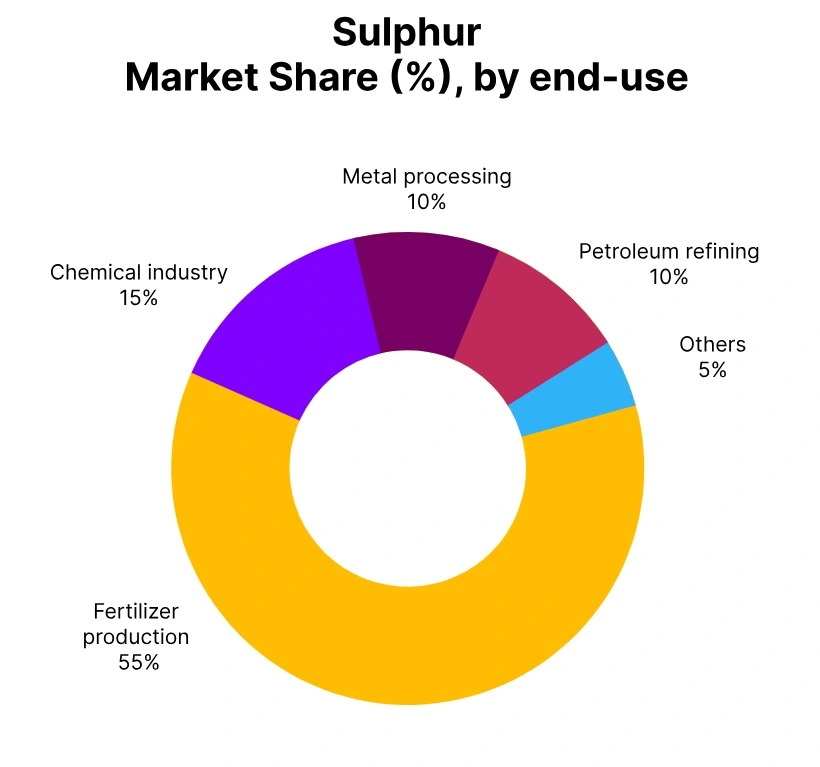
Sulphur Industrial Applications

sulphur market share end use

Historically, several events have caused significant fluctuations in Sulphur prices

India’s Policy Shift Toward Virgin Sulphur (Late 2024–2025): 

In a move to improve quality control and reduce dependency on recycled or industrial by-product Sulphur, India introduced a new regulation in late 2024 mandating a higher proportion of virgin Sulphur usage in key industries like fertilizers and chemicals. This sudden shift reduced the usable supply in the domestic market and forced both producers and traders to pivot toward costlier virgin material. By early 2025, Sulphur prices in major Indian ports began rising steadily, with compliance-linked penalties further tightening the market. The policy marked a turning point in India’s Sulphur procurement strategy and had a noticeable impact on regional trade dynamics. 

Environmental Reforms in China (2022–2023): 

China’s aggressive enforcement of environmental regulations during 2022 and 2023 resulted in the closure of several Sulphur-consuming and processing units that did not meet the new standards. Since China is both a major importer and consumer of Sulphur, these reforms disrupted domestic operations and led to a rise in regional demand for imported material. As a result, Sulphur prices climbed in nearby markets such as India, South Korea, and Southeast Asia due to reduced availability and tighter trade balances. 

India’s Policy Shift Toward Virgin Sulphur (Late 2024–2025): 

In a move to improve quality control and reduce dependency on recycled or industrial by-product Sulphur, India introduced a new regulation in late 2024 mandating a higher proportion of virgin Sulphur usage in key industries like fertilizers and chemicals. This sudden shift reduced the usable supply in the domestic market and forced both producers and traders to pivot toward costlier virgin material. By early 2025, Sulphur prices in major Indian ports began rising steadily, with compliance-linked penalties further tightening the market. The policy marked a turning point in India’s Sulphur procurement strategy and had a noticeable impact on regional trade dynamics. 


Why PriceWatch?

PriceWatch is your trusted resource for tracking global sulphur price trends. Our platform delivers real-time data and expert analysis, offering deep insights into the key factors driving price fluctuations in the sulphur market. By monitoring critical events such as geopolitical tensions, supply chain disruptions, and economic shifts, PriceWatch keeps you fully informed of market dynamics.

In addition, PriceWatch provides detailed forecasts and updates on production capacities, enabling you to anticipate market changes and make well-informed decisions. With PriceWatch, you gain a competitive edge in understanding all the elements that influence sulphur prices worldwide. Stay ahead of the curve with PriceWatch’s reliable, accurate, and timely sulphur market data.

Track PriceWatch's sulphur price assessment on a weekly basis since 2015 onwards, along with short-term forecasts, and get access to the detailed report in a downloadable format.

Data Collection and Sources​

  • Real-Time Market Data: PriceWatch aggregates real-time pricing data from a diverse range of sources, including global commodity exchanges, industry reports, and proprietary databases. This ensures that our assessments reflect the most current market conditions. 
  • On-the-Ground Intelligence: Our team gathers insights directly from key market participants, including producers, suppliers, traders, and end-users, across major Sulphur production hubs. This ground-level intelligence is crucial for understanding localized market dynamics. 
  • Supply Chain Monitoring: We track the entire Sulphur supply chain, from raw material availability to production and distribution channels. This includes monitoring feedstock prices, production capacities, and transportation logistics.

Event Tracking and Impact Analysis​

  • Geopolitical Tensions: PriceWatch continuously monitors global geopolitical developments, such as conflicts or trade disputes, which can significantly impact Sulphur prices. Our analysis includes potential disruptions to supply chains and their immediate and long-term effects on pricing. 
  • Natural Disasters and Climate Events: We assess the impact of natural disasters, such as hurricanes or winter storms, on Sulphur production facilities, particularly in vulnerable regions like the APAC coasts. These events are factored into our price forecasts and supply outlooks. 
  • Economic Shifts: PriceWatch evaluates macroeconomic trends, including global economic growth, inflation rates, and sector-specific demand (e.g., fertilizer, chemical synthesis, to predict shifts in Sulphur demand and corresponding price movements. 

Production Capacity and Supply Analysis

  • Current Production Monitoring: We maintain a comprehensive database of global Sulphur production facilities, tracking their operational status, maintenance schedules, and output levels. This allows us to assess current supply availability accurately. 
  • Future Capacity Projections: Our research includes detailed forecasts of upcoming Sulphur production capacities, factoring in new plant constructions, expansions, and technological advance Sulphur. This helps in predicting future supply trends and potential price stabilization. 

Demand Forecasting

  • Sectoral Demand Analysis: PriceWatch provides an in-depth analysis of demand trends across key sectors, including Sulphuric acid production, fertilizer, chemical synthesis, and other end-uses. We track year-on-year demand growth and project future consumption patterns based on economic indicators and industry developments. 
  • Global Demand Dynamics: Our methodology considers regional demand variations and how they influence global Sulphur pricing. This includes understanding the impact of shifts in manufacturing bases, trade policies, and environmental regulations. 

Pricing Model Development

  • Dynamic Pricing Models: PriceWatch utilizes advanced econometric models to forecast Sulphur prices, incorporating real-time data, historical trends, and projected market conditions. Our models are continuously refined to enhance accuracy and predictive power. 
  • Scenario Analysis: We conduct scenario-based assessments to evaluate potential future market conditions. This includes best-case, worst-case, and most-likely scenarios, helping our clients prepare for a range of market outcomes. 

Reporting and Client Support

  • Comprehensive Reports: Our clients receive detailed reports that include current price assessments, future price forecasts, and in-depth analysis of market drivers. These reports are designed to be actionable, providing clear insights and recommendations. 
  • Ongoing Support: PriceWatch offers continuous updates and personalized support to our clients, ensuring they have the most up-to-date information to make informed decisions. Our experts are available to discuss specific market developments and provide tailored advice. 

This research methodology ensures that PriceWatch delivers the most accurate, timely, and actionable Sulphur pricing assessments, helping our clients stay ahead of market trends and make informed business decisions. 

Sulphur Market Price Trend provided by PriceWatch is a base price and excludes VAT/Taxes, discounts, or offers. The information herein is accurate to the best of our knowledge as of the date indicated and is provided solely for the convenience of our customers as a reference for sulphur. PriceWatch disclaims any warranties or representations regarding the accuracy of results derived from this information. It is the sole responsibility of the user to assess the suitability of the product for their specific application. This document does not constitute an endorsement to use the product in violation of any applicable patent rights.

Granular Sulphur prices are influenced by raw material costs, primarily linked to oil and gas refining activities, where Sulphur is recovered as a by-product. Global demand from fertilizer, chemical, and metal processing industries plays a critical role, along with freight costs, regional supply availability, refinery shutdowns, and environmental policies. Currency fluctuations and international trade dynamics can also impact pricing.

Begin by tracking regional and global Sulphur market trends to understand price movements. Commit to bulk orders or long-term procurement agreements to secure discounted rates. Establish diversified sourcing from multiple regions to avoid overdependence on a single supplier. Strong vendor relationships, consistent order volumes, and timely payments can help unlock favorable terms. Transparent communication about logistics or quality requirements can also support negotiation.

Risks include market price volatility, disruptions due to refinery shutdowns or transport delays, and changes in environmental or trade regulations. To mitigate, maintain supplier diversity, consider fixed-price contracts, and keep an emergency buffer stock. Vet suppliers for product quality, safety compliance, and timely delivery. Monitoring policy developments and geopolitical conditions can also help avoid unexpected procurement issues.