Terbium Price Trend and Forecast

UNSPC code: 12352301
|
Weekly Update
|
Historical Data Since 2015
|
Forecast for 2026
  • Commodity Pricing

terbium Price Trends by Country

cnChina
inIndia
nlNetherlands
usUnited States

Global terbium Spot Market Prices, Trend Analysis and Forecast

𝐏𝐫𝐢𝐜𝐞 𝐖𝐚𝐭𝐜𝐡™ provides price assessments for Terbium across top trading regions:


Asia Pacific

  • Terbium 99%min FOB Shanghai, China
  • Terbium 99%min CIF Nhava Sheva, China


North America

  • Terbium 99%min CIF Houston, China


Europe

  • Terbium 99%min CIF Rotterdam, China


Note:
 In assessments structured as CIF [Importing Port] (Exporting Country), the country mentioned in brackets indicates the primary origin of supply (exporting country), while the named port refers to the destination port in the importing country. Other Incoterms (FOB, FD, EXW, etc.) should be interpreted in accordance with standard international trade definitions.

Terbium 99%min Price Trend Q4 2025

In Q4 2025, the global Terbium market showed a broadly positive trend, driven by strong demand across key sectors such as high performance magnets, electric vehicle motors, and advanced electronics. Prices strengthened in most regions, supported by disciplined supply management and sustained consumption, while import dependent markets faced moderate upward pressure due to tight shipment schedules and strategic inventory positioning. Regions with domestic rare earth production experienced steady but progressive price gains, and downstream buyers maintained proactive procurement strategies to secure supply. Overall, the Terbium market in Q4 2025 reflected solid fundamentals and gradual price appreciation, setting a constructive tone for early 2026.

China: Terbium 99%min Export prices FOB Shanghai, China; Grade – Purity:99%min

In Q4 2025, Terbium prices in China increased by 5.24% compared to Q3 2025, reflecting a noticeable upward trend amid cautiously optimistic market sentiment. Demand from permanent magnet, electronics, and advanced alloy sectors remained robust, while upstream production from rare earth separation plants stayed steady, allowing supply to meet market requirements without significant disruption. Producers maintained controlled output strategies, balancing availability with stable pricing, and in December 2025, prices were further supported by selective spot purchases and year end restocking from manufacturers, despite limited stimulation from subdued global export markets. Overall, the Terbium market in China demonstrated strong fundamentals and resilience, achieving a solid quarterly gain as it transitioned into early 2026.

Netherlands: Terbium 99%min Import prices in Netherlands from China CIF Rotterdam, Netherlands; Grade – Purity:99%min

In Q4 2025, Terbium prices in the Netherlands rose by 6.78% compared to Q3 2025, reflecting a strong upward trend across Europe. Market sentiment remained cautiously optimistic as steady demand from permanent magnet, specialty alloy, and high tech electronics manufacturers persisted. Downstream procurement increased toward year end as buyers secured material amid expectations of tighter spot availability, while continued dependence on Chinese imports influenced regional pricing. Upstream production remained stable, but limited shipment volumes, longer lead times, and disciplined inventory strategies supported firmer offers. Exchange rate stability within the Eurozone and logistical considerations provided moderate support to import linked costs. In December 2025, prices surged further due to restocking activity and precautionary purchases ahead of year end factory shutdowns, with restricted arrivals and extended delivery schedules strengthening supplier leverage. Overall, the Terbium market in the Netherlands demonstrated robust fundamentals and resilient demand momentum entering early 2026.

USA: Terbium 99%min Import prices in USA from China CIF Houston, North America; Grade- Purity:99%min

In Q4 2025, U.S. Terbium prices rose by 6.91% compared to Q3 2025, continuing a firm upward trend driven by strong demand from the permanent magnet, high performance alloy, and specialty electronics sectors. Procurement activity increased toward year end due to strategic restocking and precautionary purchases, while the market remained heavily reliant on imports, particularly from China, which influenced domestic pricing. Although global upstream production was relatively stable, constrained shipment volumes and freight considerations contributed to the price rise. Domestic traders managed inventories carefully, maintaining supply while supporting price discipline, and industrial consumption remained steady, preventing extreme volatility. Prices climbed further in December 2025 as accelerated restocking and extended delivery timelines reinforced supplier leverage in the spot market, while export demand stayed limited and pricing was largely determined by domestic consumption. Overall, the U.S. Terbium market showed solid supply demand fundamentals and entered early 2026 with resilient pricing momentum.

India: Terbium 99%min Import prices in India from China CIF Nhava Sheva, India; Grade – Purity:99%min

In Q4 2025, Terbium prices in India increased by 6.74% compared to Q3 2025, reflecting a firm market trend driven by strong demand from high performance magnet manufacturers, specialized alloys, and advanced technology sectors. Buyers were proactive, securing operational stocks and making precautionary purchases amid anticipated supply tightness, as India remained largely dependent on imports from China. Global upstream production was steady but limited immediate shipment availability and firm international offers contributed to upward pressure, while domestic traders managed inventory to maintain supply without overstocking. End user consumption in renewable energy, electronics, and industrial magnet segments remained robust, and currency stability against the US Dollar moderated extreme import related volatility. Prices rose further in December 2025 due to year end demand acceleration and strategic restocking, though ample material availability prevented sharp spikes, leaving the Terbium market entering 2026 with resilient fundamentals and sustained pricing momentum.

Terbium Price Trend Analysis: Q4 2025

In the third quarter of 2025, prices for terbium have exhibited a favorable increase in the global market owing to a reduction in supply, particularly from China given tightened export controls, and stable magnet and electronics demand. High purity terbium oxide prices have stabilized, maintaining strength after a 26% increase in the first half of 2025.

Market conditions remain positive with additional bullish support for the market, driven by stock replenishment and strategic purchasing from manufacturers, combined with little supply planned outside China.

USA: Terbium Import prices CIF Houston (China), USA, Grade- Purity: 99%.

According to PriceWatch, In Q3 2025, terbium prices in the U.S. market have risen by 8.46% compared to Q2, extending the strong global uptrend fuelled by tightening supply and surging demand from the clean energy, EV, and defence sectors. This growth has reflected persistent supply constraints shaped by China’s dominant position in rare earth processing and the increasing strategic importance of terbium in advanced technologies.

Consequently, U.S. manufacturers have faced higher input costs, while investors and policymakers have intensified efforts to secure diversified, stable supply chains and advance domestic critical mineral initiatives.

The 3.84% price increase in September 2025 has stemmed from heightened demand for high-efficiency magnets and displays, compounded by export restrictions from major producers like China that have further tightened global availability.

Netherlands: Terbium Import prices CIF Rotterdam (China), Netherlands, Grade- Purity: 99%.

In Q3 2025, terbium prices in the Netherlands have risen by 7.97% compared to Q2, extending the global upward trend driven by tightening supply chains and surging demand from high-tech sectors such as electronics and renewable energy. Environmental regulations and logistical challenges have constrained production, while strategic stockpiling has reinforced price growth.

This sustained rise has underscored terbium’s indispensable role in advanced technologies, with the market maintaining strong momentum heading into Q4 2025. The 3.78% price increase recorded in September 2025 has likely reflected heightened demand and supply limitations, signaling continued pressure within the rare earth value chain.

China: Terbium Export prices FOB Shanghai, China, Grade Purity: 99%.

In the third quarter of 2025, the terbium price trend in China displayed an increase of 5.57% from the second quarter. This price rise in terbium has largely been driven by a tight supply picture, firm downstream demand from the magnet and electronics sectors, and continued regulatory restrictions on rare earths.

Average terbium oxide prices increased, as manufacturers provided limited spot availability, and continued to restock cautiously in line with growing demand. The combination of government export controls and production curtailments continued to add supply pressure to a tight initial supply picture.

Additionally, speculative buying by manufacturers and traders facilitated the upward price momentum. However, future price stability remains sensitive to policy shifts, affordability concerns, and global substitution efforts. The 2.87 % price rise in terbium in China in September 2025 reflected tighter supply conditions (e.g. reduced spot availability or constrained mine output) coupled with resurgent demand from magnet and electronics sectors pushing buyers to restock.

India: Terbium Import prices CIF Nhava Sheva (China), India, Grade- Purity: 99%.

In Q3 2025, terbium prices in the Indian market have increased by 6.98% compared to Q2, driven by tightening global supply, rising demand from the EV and clean energy sectors, and strategic stockpiling amid continued import dependence. Although global spot transactions have shown short-term softness, India’s efforts to secure terbium imports and bolster domestic magnet manufacturing have sustained the upward price movement.

The 3.76% rise in September 2025 has reflected strong global demand for rare earth elements in green energy and electronics, alongside supply chain constraints and limited export volumes from major producing countries that have further restricted availability.

According to the PriceWatch, In Q2 2025, the price of terbium in China surged by approximately $1,165,854 per metric ton, FOB Shanghai marking a 10.68% increase, driven by a combination of tight supply, strong industrial demand, and geopolitical factors. Supply disruptions particularly reduced imports from Myanmar and reinforced Chinese export controls on heavy rare earths significantly tightened market availability.

At the same time, aggressive procurement by downstream sectors such as EV and high performance magnet manufacturers pushed demand higher. Geopolitical tensions further fuelled speculative buying, adding a risk premium to pricing. This sharp price movement highlights terbium’s strategic importance in advanced technologies and reflects growing market polarization within the rare earth sector. 

According to the PriceWatch, In Q2 2025, the price of terbium in India surged by $1,238,369 per metric ton, CIF Nhava Sheva (China) marking an 8.50% quarter over quarter increase driven by tightening global supply and strong industrial demand. This price spike reflects growing constraints in key producing regions like China and Myanmar, coupled with limited recycling infrastructure, which has failed to keep pace with rising demand from sectors such as electric vehicles, wind turbines, and advanced electronics.

For India, this underscores the urgency of diversifying supply chains, investing in strategic reserves, and fostering domestic rare earth processing capabilities to mitigate price volatility and ensure a stable supply for high tech manufacturing. 

In Q1 2025, terbium prices experienced a sharp increase of $1,053,333 per metric ton, FOB Shanghai marking a 6.40% rise from the previous quarter. This surge reflects intensifying demand for terbium in high-tech applications, particularly in green energy technologies such as solid-state lighting and permanent magnets used in wind turbines and electric vehicles.

Tightened supply chains limited global production concentrated mainly in China, and strategic stockpiling by key industries further contributed to the upward pressure on prices. This significant price movement underscores the growing strategic importance of terbium in the global shift toward sustainable energy and advanced electronics. 

In Q1 2025, the Indian terbium market experienced a significant upswing, marked by a price increase of $1,140,397 per metric ton, CIF Nhava Sheva (China) translating to an 8.21% rise. This surge reflects robust demand from key sectors such as electronics, renewable energy, and defense, where terbium’s role in high-performance magnets and phosphors remains critical.

Supply-side constraints, including limited global production and export restrictions from major suppliers like China, further exacerbated the price escalation. The sharp price movement underscores India’s growing strategic focus on rare earth self-reliance and the pressing need for investment in domestic extraction and refining capabilities. 

Terbium Price Trend Analysis: Q4 2024

In Q4 2024, terbium experienced a significant price surge, increasing by $990,001 per metric ton, FOB Shanghai a rise of 5.69%. This sharp uptick reflects heightened demand driven by its critical role in green technologies, especially in high-efficiency lighting and permanent magnets used in electric vehicles and wind turbines.

Additionally, constrained global supply due to tightened export controls and environmental regulations in major producing countries, particularly China, exacerbated the price movement. Market sentiment remains bullish as industries prioritize secure access to rare earth elements, positioning terbium as a strategic material amid growing geopolitical and technological pressures. 

In the fourth quarter of 2024, India’s terbium market experienced a notable price increase of $1,053,909 per metric ton, CIF Nhava Sheva (China) reflecting a 1.03% rise. This uptick was influenced by a combination of factors, including China’s strategic export controls and a resurgence in demand from the magnet manufacturing sector.

China’s export restrictions, aimed at bolstering domestic supply and asserting geopolitical leverage, have tightened global availability, contributing to upward pressure on prices . Simultaneously, a rebound in downstream demand, particularly from industries reliant on rare earth elements for advanced technologies, has further supported price increases .

While the market remains sensitive to supply chain disruptions and geopolitical developments, the observed price trend indicates a period of relative stability and cautious optimism for stakeholders in India’s terbium sector. 

In Q3 2024, the price of terbium experienced a sharp decline, dropping by $936,667 per metric ton, FOB Shanghai representing a significant 10.79% decrease. This notable price correction likely reflects a combination of factors, including reduced demand from the electronics and green energy sectors, ongoing inventory adjustments, and increased supply from key producers, particularly in China.

Market sentiment may have also been influenced by broader macroeconomic uncertainties and weakening rare earth metal markets. The scale of the drop suggests heightened volatility and potential oversupply concerns, prompting stakeholders to reassess procurement strategies and future pricing forecasts. 

In Q3 2024, India’s terbium request endured a notable downturn, with prices dwindling by roughly $1,043,163 per metric ton, CIF Nhava Sheva (China) reflecting a 5.84% decline. The downturn was driven by factors similar as reduced demand from the attraction sector, surfeit from increased significances of rare earth ores, and geopolitical insecurity affecting product in Myanmar, a significant source of heavy rare earth rudiments. Despite these challenges, judges anticipate a implicit answer in terbium prices, supported by its critical part in green technologies and the limited pliantness of its force. 

In Q2 2024, terbium experienced a significant price surge, increasing by $1,050,000 per metric ton, FOB Shanghai marking a 6.24% rise. This substantial price hike can be attributed to heightened demand in the clean energy and electronics sectors, particularly for terbium’s use in green phosphors for LED displays and permanent magnets in wind turbines and electric vehicles.

Additionally, tightening export controls and limited production from key suppliers such as China further strained global supply, amplifying upward pressure on prices. Investors and manufacturers are now closely monitoring supply chain dynamics and geopolitical developments, as terbium continues to be a critical rare earth element in the global transition to sustainable technologies. 

In the second quarter of 2024, India experienced a significant surge in terbium prices, with an increase of $1,107,836 per metric ton, CIF Nhava Sheva (China) representing a 7.10% rise. This upward trend aligns with global market dynamics, where terbium prices had been declining in early 2024 due to factors like increased production and decreased demand.

However, by mid-2024, the market began to stabilize, influenced by factors such as reduced mining quotas, a shift from off-season to peak season, and increased demand from downstream industries. Additionally, geopolitical tensions, particularly in regions like Myanmar, have disrupted supply chains, contributing to price volatility.

This price increase underscores the critical role of terbium in high-tech applications and the complex interplay of market and geopolitical factors affecting its pricing in India. 

In Q1 2024, terbium experienced a significant market correction, with its price plummeting by $988,333 per metric ton, FOB Shanghai marking a steep decline of 28.38%. This sharp drop can be attributed to a combination of factors, including reduced demand from key sectors such as green technology and electronics, increased inventory levels in China, and easing geopolitical tensions that had previously driven speculative buying.

The price correction reflects a recalibration of supply-demand dynamics, as manufacturers adjusted procurement strategies in response to softer-than-expected economic growth and improvements in recycling technologies that reduced reliance on primary terbium sources. 

In Q1 2024, India’s terbium market experienced a significant downturn, with prices dropping by $1,034,441 per metric ton, CIF Nhava Sheva (China) reflecting a 24.45% decrease. This sharp decline mirrors global trends, notably in China, where terbium prices fell to a three-year low due to increased ore availability and reduced demand from the magnet industry. The absence of restocking activities by major rare earth companies and weak downstream demand further pressured prices.

Additionally, geopolitical factors, such as China’s export controls and Myanmar’s suspension of mining licenses, disrupted supply chains, exacerbating the price decline. These global dynamics likely influenced India’s market, highlighting the interconnectedness of the rare earth sector. 

Technical Specifications of Terbium Price Trends

Product Description

Terbium is a rare earth metal known for its unique optical and magnetic properties, making it indispensable in various advanced technologies. Primarily sourced from monazite and bastnasite ores, terbium is commonly used in the production of high-performance phosphors for energy efficient lighting, such as in compact fluorescent lamps (CFLs) and LEDs. Additionally, terbium is a critical element in the development of magnetic refrigeration systems, where its magnetic properties help improve cooling efficiency.

Terbium is also used in alloys to enhance the performance of electronic devices, particularly in the aerospace and defence industries. Its ability to absorb and emit specific wavelengths of light, alongside its magnetic characteristics, positions terbium as a key material in the advancement of green technology and high-tech innovations.

Identifiers and Classification:

  • CAS No – 7440-27-9
  • HS Code – 280530


Terbium Grades Specific Price Assessment:

  • Purity: 99%


Terbium Global Trade and Shipment Terms

  • Quotation Terms (Product & Country Specific): 500-800 Kgs
  • Packaging Type (Product & Country Specific): Steel drum


Incoterms Referenced in Terbium Price Reporting

Shipping Term  Location  Definition 
FOB Shanghai  Shanghai, China  Terbium Metal Export price from China 
CIF Houston (China)  Houston, USA  Terbium import price in USA from China 
CIF Rotterdam (China)  Rotterdam, Netherlands  Terbium import price in Netherlands from China 
CIF Nhava Sheva (China)  Nhava Sheva, India  Terbium import price in India from China 

*Quotation Terms refers to the quantity range specified for the Terbium being quoted or offered in a commercial transaction.

**Packaging Type refers to standard packaging size commonly used for Terbium packing, ease of handling, transportation, and storage in industrial and commercial applications.

Key Terbium Manufacturers

Manufacturer 
Lynas Rare Earths Ltd. 
China Northern Rare Earth Group High-Tech 
Ganzhou Qiandong Rare Earth Group 
Beijing Zhong Ke San Huan High-Tech 

Terbium Industrial Applications

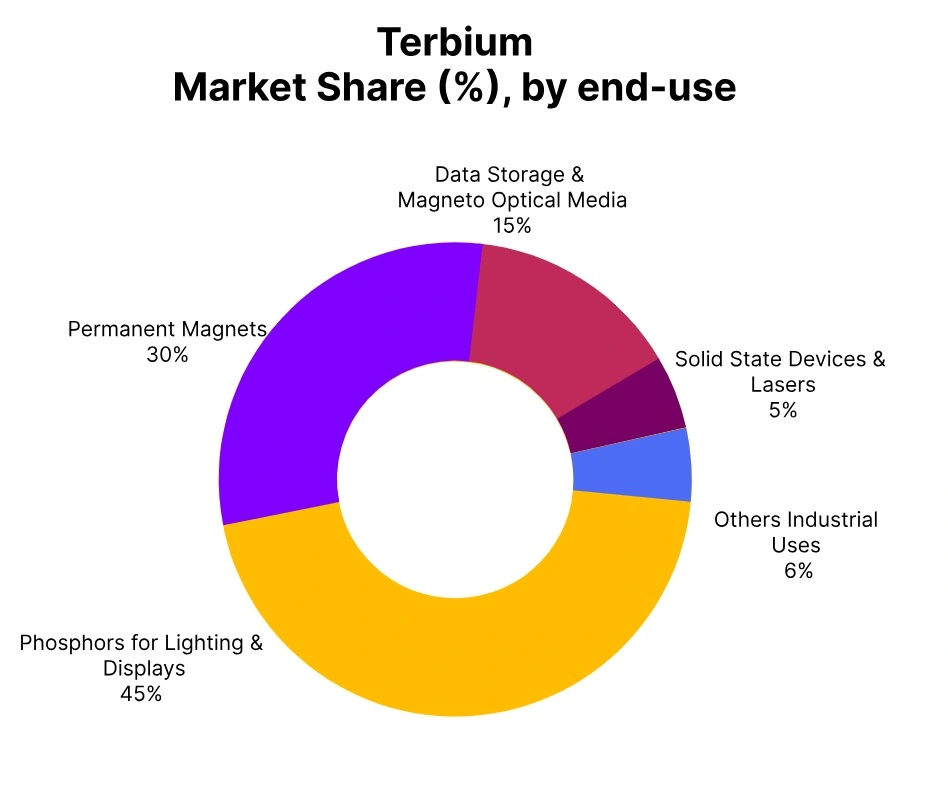
Terbium market share end use

Historically, several events have caused significant fluctuations in Terbium prices

  • Chinese Production Policies (2007–2008): Concentration of smelters and tighter export controls in China reduced output, creating global shortages and driving prices sharply higher.
  • COVID 19 Pandemic (2020): Lockdowns and operational disruptions at Chinese smelters caused supply shocks, leading to multiyear spot price highs worldwide.
  • Global Supply and Demand Acceleration (2023–2024): Rising feedstock costs, seasonal smelter maintenance, and stronger industrial demand in India and the USA drove Q2–Q3 price gains of approximately 18–28%.
  • China Export Controls (2025): Restrictions and environmental quotas reduced exports by 40–50%, causing extreme global price jumps and regional market corrections.

These events underscore the terbium market’s sensitivity to supply disruptions, industrial demand shifts, and geopolitical or policy interventions, highlighting the importance of monitoring both global supply and domestic consumption patterns.

Why Price Watch™?

Price Watch™ is your trusted resource for tracking global terbium price trends. Our platform delivers real-time data and expert analysis, offering deep insights into the key factors driving price fluctuations in the terbium market. By monitoring critical events such as geopolitical tensions, supply chain disruptions, and economic shifts, Price Watch™ keeps you fully informed of market dynamics.

In addition, Price Watch™ provides detailed forecasts and updates on production capacities, enabling you to anticipate market changes and make well-informed decisions. With Price Watch™, you gain a competitive edge in understanding all the elements that influence terbium prices worldwide. Stay ahead of the curve with Price Watch’s™ reliable, accurate, and timely terbium market data.

Track Price Watch's™ terbium price assessment on a weekly basis since 2015 onwards, along with short-term forecasts, and get access to the detailed report in a downloadable format.

Terbium Market Price Trend published by 𝐏𝐫𝐢𝐜𝐞 𝐖𝐚𝐭𝐜𝐡™ reflect prevailing spot market conditions, derived from independent research, verified trade inputs, and proprietary market intelligence as of the publication date. Prices are published on the specified Incoterm and represent indicative base market levels, exclusive of applicable taxes, VAT, duties, tariffs, and other statutory charges. Actual transaction values may vary depending on volume, credit terms, contractual structure, and other negotiated conditions. Market prices are inherently subject to volatility, liquidity dynamics, regulatory changes, and evolving trade activity. The information provided is for reference and benchmarking purposes only and does not constitute an offer, recommendation, or guarantee of transactional outcomes. Users should exercise independent commercial judgment and assess their specific contractual, regulatory, tax, and application requirements before making business decisions. 𝐏𝐫𝐢𝐜𝐞 𝐖𝐚𝐭𝐜𝐡™ assumes no liability for decisions taken based on this information.

The pricing of Terbium is influenced by several factors, including:

i. Supply & Availability
• Primary Production: Terbium is primarily extracted from monazite and bastnasite ores, often found alongside other rare earth elements. The availability of terbium is influenced by mining and refining operations, particularly in regions such as China, which controls a significant portion of the production.
• Global Reserves: China is the dominant producer, but there are also reserves in countries like Australia, the United States, and Brazil. Changes in mining policies, production quotas, or export restrictions in these countries can have a notable effect on global supply and pricing.

ii. Demand from Key Industries
• Phosphors & Fluorescent Lighting: Terbium is critical for the production of phosphors used in energy-efficient lighting, such as compact fluorescent lamps (CFLs) and LEDs. As global demand for energy-efficient lighting increases, so does the demand for terbium.
• Electronic Devices: Terbium is used in specialized electronics, such as in the production of the green phosphor in television screens, monitors, and other display technologies. As the demand for high-resolution displays rises, so does the demand for terbium.
• Magnets & Alloys: Terbium is also used in the production of high-performance magnets and alloys, particularly in applications requiring high-temperature stability, such as in jet engines and other advanced engineering sectors.

iii. Purity & Quality
• High-Purity Grades: Terbium is available in different purities (e.g., 3N, 4N). Higher purity terbium, which requires more advanced refining techniques, typically commands a premium price due to its application in high-precision electronics, lighting, and other advanced technology sectors.

iv. Geopolitical Factors
• Export Controls & Quotas: China’s dominance in the terbium market allows it to influence prices through export quotas, tariffs, or other restrictions. As with other rare earth elements, these actions can cause global supply uncertainties and price fluctuations.
• Strategic Stockpiling: Countries or corporations may stockpile terbium for national security or industrial strategy reasons, leading to potential distortions in market supply and pricing.

v. Market Speculation & Investment Trends
• Commodities Markets: Speculation in critical raw materials, including terbium, often tied to technological advancements or green technologies, can drive price fluctuations. Investor behavior in commodities markets can result in price spikes or drops.
• Short-Term Volatility: As with many rare earths, terbium prices can experience short-term volatility due to shifting demand, technological innovations, or supply chain disruptions.

vi. Alternative Materials & Substitutes
• Substitution Research: Ongoing research into alternative materials and new technologies seeks to reduce or replace terbium in various applications. For example, advancements in LED technologies or phosphor substitutes could reduce terbium usage, affecting demand and price stability.
• Innovation in Alloys and Magnet Design: Innovations in alloy compositions or magnet designs that reduce terbium dependency or use it more efficiently could impact overall demand.

vii. Processing & Refinement Costs
• Complex Separation: Terbium is often found in complex ores and requires significant processing and separation, which can be costly. Rising energy costs and labor expenses associated with this process can push up the price of refined terbium.
• Environmental Regulations: Environmental restrictions, especially in China, may limit production capacities or increase operational costs. These costs are often passed on to consumers, influencing market prices.

viii. Currency Exchange Rates
• Global Trading Impact: Like many other commodities, terbium is often priced in U.S. dollars. Fluctuations in exchange rates between the U.S. dollar and other currencies (like the Chinese yuan or the euro) can impact the cost for countries importing or exporting terbium, thereby influencing its global price dynamics.

Rising feedstock prices increase the cost of producing terbium, leading to higher market prices and potential supply constraints.

Inflation can raise terbium prices by increasing the costs of mining, refining, and energy, which are essential for its production. Additionally, inflation may drive up demand for high-tech applications such as green technologies (e.g., energy-efficient lighting, renewable energy systems), electronics, and advanced materials, further putting upward pressure on prices.

Terbium is a high purity heavy rare earth element critical for advanced technologies due to its unique magnetic and luminescent properties. It is widely used in high intensity lighting, LED and fluorescent phosphors, lasers, magneto strictive alloys like terfenol D, and optical fibre amplifiers, making it essential for industries such as telecommunications, automotive electronics, renewable energy, aerospace, and defence systems. Terbium enhances the performance of devices requiring precise magnetic control, high efficiency light emission, and vibration sensing. Its market is influenced by supply concentration in limited mining regions, growing demand from high technology sectors, recycling and substitution trends, and geopolitical and strategic material considerations. 𝐏𝐫𝐢𝐜𝐞 𝐖𝐚𝐭𝐜𝐡™ tracks terbium metal and oxide trends to help businesses monitor supply, demand, technological adoption, and global market movements, reflecting its key role in next generation energy, mobility, and electronic solutions.

Terbium prices vary by region and market conditions. Prices are typically quoted per metric ton or per pound and fluctuate based on global supply, import/export flows, industrial demand, and currency exchange rates. 𝐏𝐫𝐢𝐜𝐞 𝐖𝐚𝐭𝐜𝐡™ provides real time price assessments across different global markets to help buyers and sellers make informed decisions.

Prices fluctuate due to changes in Chinese production, environmental regulations, seasonal smelter maintenance, feedstock availability, and demand from pharmaceuticals, electronics, and alloys. Exchange rates, logistics costs, and global economic conditions also influence trends.

Major consumers include pharmaceuticals, electronics, metallurgy, chemical & pigment industries, and research/specialty materials. 𝐏𝐫𝐢𝐜𝐞 𝐖𝐚𝐭𝐜𝐡™ analyses demand patterns across all these industries.

Terbium is primarily obtained as a by product of rare earth mineral processing, especially from ores like xenotime and monazite that contain multiple rare earth elements. High purity terbium metal is produced through refining techniques such as solvent extraction, ion exchange separation, and electrolytic reduction of terbium compounds, typically terbium oxide (Tb₄O₇) or terbium chloride (TbCl₃). These processes allow the recovery of terbium in ingot or powder form, which is suitable for use in high performance magnets, phosphors, and other advanced technological applications.

China is the world’s largest exporter. Export volumes vary with domestic policies, environmental regulations, and international demand. 𝐏𝐫𝐢𝐜𝐞 𝐖𝐚𝐭𝐜𝐡™ tracks production levels, export flows and trade patterns to help businesses understand global supply chains and identify sourcing opportunities.

Supply generally meets demand, but disruptions may occur due to smelter shutdowns, environmental restrictions, or spikes in industrial consumption. 𝐏𝐫𝐢𝐜𝐞 𝐖𝐚𝐭𝐜𝐡™ monitors these supply demand imbalances to alert the market about potential shortages or surpluses.

Terbium is graded by purity: industrial grade (~99%), high purity 99.99%, and ultra-pure specialty forms. Higher purity grades cost more due to extra refining. 𝐏𝐫𝐢𝐜𝐞 𝐖𝐚𝐭𝐜𝐡™ provides separate price assessments for each grade to ensure market transparency.

When demand rises, for example: from pharmaceutical production or electronics manufacturing prices typically climb. Suppliers may prioritize certain customers, and lead times can extend. 𝐏𝐫𝐢𝐜𝐞 𝐖𝐚𝐭𝐜𝐡™ captures these market dynamics in real time.

Refining terbium is energy intensive. Rising electricity, fuel, or chemical costs often get passed on to buyers. This is why prices in regions with cheaper electricity tend to be lower, a correlation that 𝐏𝐫𝐢𝐜𝐞 𝐖𝐚𝐭𝐜𝐡™ analyses in its price assessments & market reports.

Regional variations arise from import dependency, shipping costs, currency fluctuations, and local demand. 𝐏𝐫𝐢𝐜𝐞 𝐖𝐚𝐭𝐜𝐡™ tracks prices across all major regions to highlight these differences.

Forecasts depend on production capacity, Chinese export policies, industrial demand, and macroeconomic factors. 𝐏𝐫𝐢𝐜𝐞 𝐖𝐚𝐭𝐜𝐡™ regularly publishes detailed forecasts that project price movements for the next 12 months based on comprehensive analysis of supply additions, demand growth in key industries, seasonal patterns, and macroeconomic indicators. Our forecasts help businesses anticipate market conditions and plan accordingly.

Yes. Accurate forecasts allow businesses to optimize purchasing, negotiate contracts, and manage inventories. If 𝐏𝐫𝐢𝐜𝐞 𝐖𝐚𝐭𝐜𝐡™ forecasts predict a price increase in three months, you might choose to stock up now or lock in long term contracts at current rates, potentially saving thousands of dollars.

Events such as Chinese export restrictions, smelter shutdowns, environmental regulations, or economic shocks can cause supply shortages and price volatility. 𝐏𝐫𝐢𝐜𝐞 𝐖𝐚𝐭𝐜𝐡™ provides timely alerts when such events affect the market.

𝐏𝐫𝐢𝐜𝐞 𝐖𝐚𝐭𝐜𝐡™ collects data from manufacturers, distributors, and buyers worldwide to publish regular price assessments, market reports, and forecasts. Our transparent methodology and comprehensive coverage make us a trusted source for understanding fair pricing and market trends in the Terbium 99%min industry.