Toluene Diisocyanate (tdi) Price Trend and Forecast

UNSPC code: 12162002
|
Weekly Update
|
Historical Data Since 2015
|
Forecast for 2026

toluene diisocyanate (tdi) Price Trends by Country

cnChina
saSaudi Arabia
usUnited States
deGermany
itItaly
inIndia
krSouth Korea
trTurkey

Global toluene diisocyanate (tdi) Spot Market Prices, Trend Analysis and Forecast

Price-Watch™ provides real-time price assessments and price forecasts for Toluene Diisocyanate (TDI) across top trading regions:

Toluene Diisocyanate (TDI) Regional Coverage Toluene Diisocyanate (TDI) Grade and Country Coverage Toluene Diisocyanate (TDI) Pricing Data Coverage Explanation
Asia Toluene Diisocyanate (TDI) Pricing Analysis Toluene Diisocyanate Industrial Grade (>99.5% purity) FOB Prices at Shanghai Port, China Weekly Price Update on TDI Real-Time Export Prices from Shanghai Port, China to Global Markets
Toluene Diisocyanate Industrial Grade (>99.5% purity) FOB Prices at Busan Port, South Korea Weekly Price Update on TDI Real-Time Export Prices from Busan Port, South Korea to Global Markets
Toluene Diisocyanate Industrial Grade (>99.5% purity) FOB Prices at Al Jubail Port, Saudi Arabia Weekly Price Update on TDI Real-Time Export Prices from Al Jubail Port, Saudi Arabia to Global Markets
Toluene Diisocyanate Industrial Grade (>99.5% purity) CIF Prices at JNPT Port, India, Importing from China Weekly Price Update on TDI Real-Time Import Prices at JNPT Port, India from China
Toluene Diisocyanate Industrial Grade (>99.5% purity) Ex-Mumbai Domestic Prices, India Weekly Price Update on TDI Real-Time Domestic Prices in Mumbai, India
North America Toluene Diisocyanate (TDI) Pricing Analysis Toluene Diisocyanate Industrial Grade (>99.5% purity) FOB Prices at Texas, USA Weekly Price Update on TDI Real-Time Export Prices from Texas, USA to Global Markets
Toluene Diisocyanate Industrial Grade (>99.5% purity) CIF Prices at Mersin Port, Turkey, Importing from Busan, South Korea Weekly Price Update on TDI Real-Time Import Prices at Mersin Port, Turkey from South Korea
Europe Toluene Diisocyanate (TDI) Pricing Analysis Toluene Diisocyanate Industrial Grade (>99.5% purity) FOB Prices at Hamburg Port, Germany Weekly Price Update on TDI Real-Time Export Prices from Hamburg Port, Germany to Global Markets
Europe Domestic & Import Analysis Toluene Diisocyanate Industrial Grade (>99.5% purity) FD Prices at Trieste, Italy Weekly Price Update on TDI Real-Time Domestic Prices in Trieste, Italy
Toluene Diisocyanate Industrial Grade (>99.5% purity) CIF Prices at Mersin Port, Turkey, Importing from Busan, South Korea Weekly Price Update on TDI Real-Time Import Prices at Mersin Port, Turkey from South Korea

Note: In assessments structured as CIF [Importing Port] (Exporting Country), the country mentioned in brackets indicates the primary origin of supply (exporting country), while the named port refers to the destination port in the importing country. Other Incoterms (FOB, FD, EXW, etc.) should be interpreted in accordance with standard international trade definitions.

Toluene Diisocyanate Price Trend Q1 2026

The average global toluene diisocyanate price trend have seen substantial increases in the first quarter of 2026. The main reasons that have contributed to such price hikes include disruptions in the supply chains and rising prices of the input raw materials, resulting in higher manufacturing costs in all major areas.

Issues in the strait of Hormuz and the growing political tension between Iran and Israel have has an impact on shipping logistics. Moreover, shortages in product availability in several countries have arisen due to issues in logistics. However, despite careful procurement and constant negotiations about the prices, the limited supply has contributed to the price rise trend.

It can be stated that the toluene diisocyanate price trend has demonstrated a solid price increase in response to a robust market condition in which the supply pressures have been dominant over demand uncertainties.

China: Toluene Diisocyanate Export prices FOB Shanghai, China, Grade- Industrial Grade (>_99.5% purity)

The TDI price in China has experienced an increase on a steady rate during Q1 2026, attributed to high feedstock costs and supply chain disruptions which have resulted in high production costs. However, despite these issues, the price trend has maintained a narrow range, which is indicative of stability and firmness in the market.

There is firm toluene diisocyanate price trend in China because the market has experienced a balanced state in terms of supply and demand. Even though there has been caution in downstream demand, there have been constraints from the supply side which have resulted in firm prices in the market.

In China, Toluene diisocyanate price in March 2026 has experienced a rise of 21% due to geopolitical tensions and constrained supply. The geopolitical tensions witnessed between Iran and Israel have also caused trade route disruptions and problems in relation to the Strait of Hormuz, which has an effect on the trade.

USA: Toluene Diisocyanate Export prices FOB Texas, USA, Grade- Industrial Grade (>_99.5% purity)

Toluene diisocyanate prices in the USA in Q1 2026 are trading down, owing to an adequate local supply level and modest downstream demand from polyurethane applications. The current pricing is also being driven by the ongoing negotiations process and abundant inventories, as well as low feedstock expenses that mitigate production concerns. This range reflects a relatively balanced but weak market.

The toluene diisocyanate price trend in the USA suggests a satisfactory supply position, with weak demand exerting downward pressure. In the USA, toluene diisocyanate prices in March 2026 rose 7% from the preceding month, amid geopolitical uncertainties and tight supply, which limited access and pushed up prices despite weak demand.

South Korea: Toluene Diisocyanate Export prices FOB Busan, South Korea, Grade- Industrial Grade (>_99.5% purity)

For Q1 2026, there is an increase in the TDI price in South Korea, despite the limited supply levels in the market as well as due to the higher cost of feedstocks which have led to higher overall cost of production. The disruptions in the logistics processes as well as geopolitical risks along trade routes have impacted the exports of TDI to some extent.

However, toluene diisocyanate price trend in South Korea has seen stability in a narrow trading range. There have been stable market conditions in terms of supply with continued constraints at the supply end leading to increased prices despite cautious demand at the consumption end.

In South Korea, toluene diisocyanate price trend in March 2026 shows an increase of 16% as compared to the previous month, with geopolitical uncertainties and constrained supply being the drivers for the same.

Saudi Arabia: Toluene Diisocyanate Export prices FOB Al Jubail, Saudi Arabia, Grade- Industrial Grade (>_99.5% purity)

In Q1 2026, TDI prices in Saudi Arabia have risen due to a lack of supply and increasing production costs associated with rising feedstock prices in the region. With logistics and other issues affecting exports from the country and geopolitical issues continuing to play an important role in shipping, the market environment continues to be one of risk and caution.

Despite such market conditions, prices remain relatively stable in the market, signalling that supply and demand for toluene diisocyanate price trend in Saudi Arabia is still balanced. The supply conditions of the market have been favourable, contributing to the rising prices due to limited supply despite relatively steady downstream demand.

In Saudi Arabia, toluene diisocyanate prices in March 2026 have seen a rise of 30% as compared to last month, owing to a geopolitical issue in addition to tight supply conditions.

Germany: Toluene Diisocyanate Export prices FOB Hamburg, Germany, Grade- Industrial Grade (>_99.5% purity)

In Q1 2026, TDI prices in Germany edged lower as supply remained sufficient and buying activity from downstream polyurethane sectors stayed cautious, keeping overall demand weak. Competitive pricing and softer feedstock costs further reduced cost support, adding pressure on the market.

Even so, prices moved within a narrow range, suggesting a stable but slightly soft market environment. The toluene diisocyanate price trend in Germany reflected balanced supply conditions, where muted demand continued to weigh on prices despite steady operations.

In Germany, toluene diisocyanate prices in March 2026 increased by 3% compared to the previous month, supported by the Iran–Israel war and tightening supply conditions. Reduced availability and ongoing disruptions helped lift prices, even as demand remained relatively cautious.

Italy: Toluene Diisocyanate Export prices FD Trieste, Italy, Grade- Industrial Grade (>_99.5% purity)

In Q1 2026, toluene diisocyanate price trend in Italy moved lower as supply remained ample and downstream polyurethane buyers continued to purchase cautiously, keeping demand on the softer side. Ongoing price negotiations and relatively weaker feedstock costs reduced cost support further, adding pressure on the market.

Despite this, prices stayed within a narrow range, pointing to a stable but slightly weak market environment. The toluene diisocyanate price trend in Italy reflected balanced supply conditions, where muted demand continued to pull prices down even as market operations remained steady.

In Italy, TDI prices in March 2026 increased by 3% compared to the previous month, driven by the Iran–Israel war and tightening supply conditions. Limited availability and supply disruptions supported the upward movement, even though demand remained relatively cautious.

Turkey: Toluene Diisocyanate Export prices CIF Mersin_Busan, Turkey, Grade- Industrial Grade (>_99.5% purity)

In Q1 2026, TDI prices in Turkey moved higher mainly due to increased import costs from South Korea, as rising feedstock prices and ongoing supply chain disruptions pushed overall costs upward. Logistics challenges and freight volatility, influenced by geopolitical tensions around the Strait of Hormuz, further limited shipment flows and tightened availability.

Even with these pressures, prices stayed within a narrow range, indicating a firm yet stable market. The TDI price trend in Turkey reflected balanced supply conditions, where supply-side constraints continued to support the upward movement despite cautious but steady downstream demand.

In Turkey, TDI prices in March 2026 increased by 28% compared to the previous month, driven by geopolitical uncertainties and tightening supply conditions. Limited availability and ongoing disruptions kept the market firm, even as buying interest remained measured.

India: Toluene Diisocyanate Export prices CIF JNPT_China, India, Grade- Industrial Grade (>_99.5% purity)

In Q1 2026, TDI prices in India moved upward as import costs from China increased, mainly due to higher feedstock prices and continued supply chain disruptions. Logistics issues and freight volatility, influenced by geopolitical tensions around the Strait of Hormuz, affected shipment schedules and overall availability.

Despite these challenges, prices stayed within a narrow range, pointing to a stable yet firm market. The toluene diisocyanate price trend in India reflected balanced supply conditions, where supply-side pressures kept prices supported even as downstream demand remained cautious but steady.

In India, TDI prices in March 2026 increased by 27% compared to the previous month, driven by the Iran-Israel war and tightening supply conditions. Reduced availability and ongoing disruptions kept the market firm, even though buying activity stayed relatively cautious.

India: Toluene Diisocyanate Export prices Ex-Mumbai India, Grade- Industrial Grade (>_99.5% purity)

According to Price-Watch™, in Q1 2026, TDI prices in India moved higher as rising feedstock costs and ongoing supply chain disruptions pushed up domestic production expenses. Logistics challenges and freight volatility, linked to geopolitical tensions and issues around the Strait of Hormuz, affected raw material availability and trade flows.

Even with these factors, prices remained within a narrow range, indicating a stable yet firm market. The toluene diisocyanate price trend in India reflected balanced supply conditions, where supply-side pressures continued to support higher costs despite cautious but steady downstream demand.

In India, TDI prices in March 2026 increased by 37% compared to the previous month, driven by sharp supply tightness in exporting countries following disruptions around the Strait of Hormuz. Limited availability and restricted flows kept the market strongly supported despite cautious buying activity.

Toluene Diisocyanate (TDI) Price Trend Analysis: Q4 2025

The global market’s average toluene diisocyanate price in Q4 2025 shown a mixed trend by region. This was due to different market situations, where prices were rising in Europe and falling in Asia and America. Overall stability was preserved by stable production rates, balanced supply and demand, and regulated inventory levels in important markets. The polyurethane industry’s adequate supply and moderate demand contributed to the decreasing trend in Asia and the USA, while tighter supply conditions and stronger regional demand caused the European market to rise. Regional pricing fluctuations were also influenced by minor adjustments to feedstock and energy costs. Extreme volatility were avoided by trade flow patterns and conservative procurement practices across markets, leading to a steady and regionally diverse pricing trend shaping the overall market direction.

China: Toluene Diisocyanate Export prices FOB Shanghai, China, Grade- Industrial Grade (>_99.5% purity)

In Q4 2025, TDI prices in China showed a softer tone as production remained steady and inventories were sufficient, while demand from the polyurethane sector stayed relatively mild. Small fluctuations in energy and feedstock toluene costs also contributed to the weaker pricing environment. Despite this, prices moved within a narrow range, reflecting a market that was stable and under control. The TDI price trend in China indicated balanced supply-demand conditions, where ample availability continued to weigh on prices even with steady operations. In December 2025, TDI prices in China increased by 8% compared to the previous month, supported by cautious buying activity and rising production and energy costs, which helped push prices upward.

USA: Toluene Diisocyanate Export prices FOB Texas, USA, Grade- Industrial Grade (>_99.5% purity)

In Q4 2025, TDI prices in USA showed a downward trend as buyers from the polyurethane sector continued to purchase cautiously, even though demand conditions saw some improvement and domestic supply remained sufficient. Changes in feedstock costs and ongoing geopolitical uncertainty also weighed on pricing sentiment, while supply chain inefficiencies and occasional logistical delays affected overall market activity. Prices stayed within a narrow range, indicating a controlled but slightly declining market. The TDI price trend in USA reflected balanced supply conditions, with muted demand continuing to put pressure on prices despite stable operating rates. In December 2025, TDI prices in USA slightly declined by 2% compared to the previous month, as steady demand from the foam industry and ongoing price negotiations among buyers kept the market under mild pressure.

South Korea: Toluene Diisocyanate Export prices FOB Busan, South Korea, Grade- Industrial Grade (>_99.5% purity)

In Q4 2025, TDI prices in South Korea moved on a softer note as demand from the downstream polyurethane sector remained weak and buying interest stayed limited. Variations in feedstock costs along with occasional supply chain disruptions further reduced cost support and weighed on overall market sentiment. Even so, prices remained within a narrow range, reflecting a stable but slightly pressured market. The TDI price trend in South Korea indicated ample supply conditions, with weak demand continuing to keep prices under pressure despite steady production levels. In December 2025, TDI prices in South Korea increased by 7% compared to the previous month, supported by higher production and energy costs along with tightening supply conditions, which pushed prices upward despite cautious demand.

Saudi Arabia: Toluene Diisocyanate Export prices FOB Al Jubail, Saudi Arabia, Grade- Industrial Grade (>_99.5% purity)

In Q4 2025, TDI prices in Saudi Arabia trended lower as buyers from the downstream polyurethane sector remained cautious and overall product availability stayed comfortable. Fluctuations in feedstock costs reduced cost support further, while logistical challenges and continued geopolitical uncertainty affected trading activity. Even with these factors, prices moved within a narrow range, indicating a market that was balanced but slightly under pressure. The TDI price trend in Saudi Arabia reflected sufficient supply conditions, where weaker demand continued to weigh on prices despite steady operations. In December 2025, TDI prices in Saudi Arabia slightly declined by 0.5% compared to the previous month, as the Iran–Israel war and related supply tightness created uncertainty and kept the market under mild pressure.

Germany: Toluene Diisocyanate Export prices FOB Hamburg, Germany, Grade- Industrial Grade (>_99.5% purity)

In Q4 2025, TDI prices in Germany moved higher as supply remained tight due to intermittent production issues and regional supply chain disruptions. Rising feedstock costs added further pressure on production expenses, while logistical challenges and geopolitical uncertainties continued to affect trade flows and material availability. Despite these factors, prices stayed within a narrow range, reflecting a stable yet firm market. The TDI price trend in Germany indicated balanced supply-demand conditions, where supply-side constraints kept prices supported alongside steady downstream demand. In December 2025, TDI prices in Germany declined by 3% compared to the previous month, as supply disruptions and tightening availability affected overall market balance and weighed on pricing.

Italy: Toluene Diisocyanate Export prices FD Trieste, Italy, Grade- Industrial Grade (>_99.5% purity)

In Q4 2025, TDI prices in Italy moved higher as demand from downstream polyurethane sectors remained firm while product availability stayed limited. Rising feedstock costs added pressure on production, and occasional logistical issues along with geopolitical uncertainties continued to affect supply flows. Even with these challenges, prices stayed within a narrow range, reflecting a stable yet firm market. The TDI price trend in Italy showed balanced supply-demand conditions, where supply-side constraints continued to support higher prices alongside steady downstream demand. In December 2025, TDI prices in Italy declined by 3% compared to the previous month, as supply disruptions and tightening availability affected market balance and led to a softer pricing trend.

Turkey: Toluene Diisocyanate Export prices CIF Mersin_Busan, Turkey, Grade- Industrial Grade (>_99.5% purity)

In Q4 2025, TDI prices in Turkey moved lower as downstream polyurethane producers continued to buy cautiously, while import availability from South Korea remained sufficient. Changes in feedstock costs reduced cost support, and ongoing logistical challenges along with freight uncertainties disrupted trade flows and weighed on procurement sentiment. Despite these factors, prices stayed within a narrow range, indicating a stable but slightly pressured market. The TDI price trend in Turkey reflected balanced supply conditions, where muted demand continued to keep prices under pressure despite steady market activity. In December 2025, TDI prices in Turkey declined by 8% compared to the previous month, as ongoing logistical issues and supply disruptions contributed to weaker market sentiment and downward price movement.

India: Toluene Diisocyanate Export prices CIF JNPT_China, India, Grade- Industrial Grade (>_99.5% purity)

In Q4 2025, TDI prices in India moved on a weaker note as import availability from China remained ample and downstream polyurethane buyers continued to purchase cautiously. Softer feedstock costs and ongoing negotiations among buyers further reduced price support, while minor logistical issues and fluctuating freight rates affected trade flows. Even so, prices stayed within a narrow range, reflecting a stable but slightly pressured market. The TDI price trend in India showed balanced supply conditions, where subdued demand continued to weigh on prices despite steady market activity. In December 2025, TDI prices in India increased by 9% compared to the previous month, supported by supply tightness and ongoing geopolitical uncertainties, which tightened availability and pushed prices upward.

India: Toluene Diisocyanate Export prices Ex-Mumbai, India, Grade- Industrial Grade (>_99.5% purity)

In Q4 2025, TDI Ex prices in India moved lower as domestic supply remained ample and downstream polyurethane buyers continued to adopt a cautious purchasing approach, keeping demand subdued. Competitive pricing and relatively softer feedstock costs reduced production cost support, while uneven demand trends and minor logistical disruptions weighed on overall market sentiment. Even with these factors, prices stayed within a narrow range, pointing to a stable but slightly weak market. The TDI price trend in India reflected balanced supply conditions, where muted demand continued to keep prices under pressure despite steady operations. In December 2025, TDI prices in India increased due to cautious buying activity and rising production and energy costs in exporting regions, which tightened supply and supported a firmer pricing trend.

The global Toluene Diisocyanate (TDI) market saw a prominent upward trend in the third quarter of 2025, with prices rising approximately 10-15%. Sustained demand from downstream flexible polyurethane foam converters for Toluene Diisocyanate further boosted price increases across the regions and specifically in furniture, automotive and bedding sectors.

A combination of tight supply in key Toluene Diisocyanate producing regions and increased costs of feedstock (toluene and amines) fueled higher prices. The supply and production capacities for TDI have been steady, although inventory management by TDI converters and cautious stocking by major end-users deepened existing market tightness.

Next quarter, demand from downstream flexible polyurethane foam converters continues to be a key factor in sustaining the Toluene Diisocyanate (TDI) price increase and further expanding the market.

USA: Toluene Diisocyanate Export prices FOB Texas, USA, Grade- Industrial Grade (99.5% min purity), T80/20).

According to PriceWatch, in Q3 2025, the Toluene Diisocyanate (TDI) price trend in the USA showed a firm upward movement, with TDI prices in September 2025 ranging between USD 2300–2500/MT in the US.

The TDI market trend during the quarter has largely been influenced by tight supply conditions in key producing regions and rising feedstock costs for toluene and amines.

Strong demand from downstream flexible polyurethane foam producers in the furniture, automotive, and bedding sectors supported the price rally. Despite steady production levels of Toluene Diisocyanate, cautious inventory management and strategic stockpiling by major end-users contributed to upward pressure.

South Korea: Toluene Diisocyanate Export prices FOB Busan, South Korea, Grade- Industrial Grade (99.5% min purity), T80/20).

In Q3 2025, Toluene Diisocyanate (TDI) price trend in South Korea recorded an upward trend, with TDI prices in September 2025 ranging between USD 1800–2000/MT in South Korea. The market movement during the quarter was influenced by steady feedstock costs for toluene and amines, coupled with firm demand from downstream flexible polyurethane foam producers serving the furniture, automotive, and bedding sectors.

Limited supply availability from key producing regions and strategic inventory management by buyers further reinforced price gains. As a result, the Toluene Diisocyanate price in South Korea strengthened, with the Toluene Diisocyanate price trend in South Korea reflecting positive market sentiment.

Saudi Arabia:Toluene Diisocyanate Export prices FOB Al Jubail, Saudi Arabia, Grade- Industrial Grade (99.5% min purity), T80/20).

In the third quarter of 2025, Toluene Diisocyanate (TDI) price trend in Saudi Arabia demonstrated a significant upward trajectory, Toluene Diisocyanate (TDI) prices in September 2025 reaching between USD 1800–2000/MT.

The quarter’s market dynamics derived from ongoing strong feedstock costs for toluene and amines, and healthy demand from downstream flexible polyurethane foam producers in the furniture, automotive, and bedding sectors.

Limited supply from producing regions and preemptive stock builds by buyers were technical features that also provided upward pressure. The result was a considerable strengthening of Toluene Diisocyanate price in Saudi Arabia, which showed the tight market fundamentals reflected in the Toluene Diisocyanate price trend in Saudi Arabia.

Germany: Toluene Diisocyanate Export prices FOB Hamburg, Germany, Grade- Industrial Grade (99.5% min purity), T80/20).

In Q3 2025, the Toluene Diisocyanate (TDI) price trend in Germany recorded a firm upward trend, with TDI prices in September 2025 ranging between USD 2400–2600/MT. The market movement during the quarter was influenced by rising feedstock costs for toluene and amines, coupled with strong demand from downstream flexible polyurethane foam producers across the furniture, automotive, and bedding sectors.

Tight supply from major producing regions and strategic inventory management by buyers reinforced the price gains. Consequently, the Toluene Diisocyanate price in Germany strengthened, with the Toluene Diisocyanate (TDI) price trend in Germany reflecting solid market fundamentals

Italy: Toluene Diisocyanate Domestically traded prices FD Trieste, Italy, Grade- Industrial Grade (99.5% min purity), T80/20).

According to PriceWatch, In Q3 2025, the Toluene Diisocyanate (TDI) price trend in Italy showed a strong upward movement, with Toluene Diisocyanate (TDI) FD prices in September 2025 ranging between USD 2400–2600/MT. The market trend during the quarter was influenced by firm feedstock costs for toluene and amines, alongside robust demand from downstream flexible polyurethane foam producers in the furniture, automotive, and bedding sectors.

Limited supply availability from key producing regions and strategic stockpiling by buyers added further upward pressure. As a result, the Toluene Diisocyanate price in Italy strengthened, with the Toluene Diisocyanate price trend in Italy reflecting tight market fundamentals.

China: Toluene Diisocyanate Export prices FOB Shanghai, China, Grade- Industrial Grade (99.5% min purity), T80/20).

According to PriceWatch, during the third quarter of 2025, Toluene Diisocyanate (TDI) price trend in China experienced a steady increase. In September 2025, Toluene Diisocyanate prices in China have reported within a range of USD 1750–2000/MT.

Market conditions in Q3 2025 indicated higher prices primarily due to increasing feedstock prices for toluene and amines, further supported by growing demand from end-users of flexible polyurethane foam in the furniture, automotive, and bedding sectors.

Additional upward price pressure noted due to tight supply from the main producing areas, combined with a cautious inventory approach by purchasing personnel.

India: Toluene Diisocyanate Import prices CIF JNPT, India, Grade- Industrial Grade (99.5% min purity), T80/20).

According to Price-Watch AI, in Q3 2025, Toluene Diisocyanate (TDI) price trend in India experienced a consistent upward trajectory, with Toluene Diisocyanate (TDI) prices in September 2025 falling between USD 1800–2100/MT.

The development of the market during the quarter was led by rising FOB prices from key exporting regions where tight supply and surging feedstock costs for toluene and amines were in place to buoy prices.

Furthermore, solid demand from downstream flexible polyurethane foam manufacturers in furniture, automotive, and bedding sectors supported a firm market sentiment. Prices for domestic TDI in India increased approximately 5–10% in Q3, aided by increasing industrial activity and customers remaining cautious in their inventory information.

Turkey: Toluene Diisocyanate Import prices CIF Mersin, Turkey, Grade- Industrial Grade (99.5% min purity), T80/20).

In the third quarter of 2025, Toluene Diisocyanate (TDI) price trend in Turkey, from South Korea, showed a consistent upward trend, with Toluene Diisocyanate (TDI) prices in September 2025 hovering between USD 1900-2200/MT in Turkey. The market trend for the quarter has primarily been influenced by increasing FOB price from South Korea, bolstered by stable feedstock prices for toluene and amines and limited regional availability.

Additional price momentum has been provided by strong demand from downstream flexible polyurethane foam producers, including those in the furniture, automotive, and bedding sectors in Turkey. Finally, while production has been stable, cautious buying and planned inventories of Turkish end-users put upward pressure on Toluene Diisocyanate (TDI) prices.

According to PriceWatch, In Q2 2025, Toluene Diisocyanate price trend in the Chinese domestic market fell sharply by 11.92%, settling at USD 1670 per metric ton. This significant price drop was largely driven by persistently weak demand from downstream segments such as flexible foam, adhesives, and synthetic leather, where end-user consumption remained sluggish despite seasonal expectations.

Additionally, increased domestic availability and pressure to offload stock led producers to adopt aggressive pricing strategies to stay competitive. Feedstock toluene prices remained relatively steady but offered little support to offset declining margins. Export demand was also soft, especially from key regional markets in South and Southeast Asia, further dampening market sentiment. Inventory levels remained high due to slower off-take, amplifying the downward pressure.

Overall, the Chinese TDI market in Q2 reflected a bearish tone shaped by oversupply, reduced downstream activity, and weak global demand, all contributing to the continued price erosion. 

According to PriceWatch, In Q2 2025, Toluene Diisocyanate price trend in the Indian market experienced a steep decline, with CIF prices for Chinese-origin material dropping by 13.11% to USD 1730 per metric ton and Ex prices falling by 12.41% to USD 2005 per metric ton. The sharp reduction was primarily influenced by soft international pricing and oversupplied conditions in the global market, especially from China.

Indian importers responded to falling offers by reducing procurement volumes, anticipating further drops and relying on existing inventories. Demand from domestic industries such as mattresses, furniture, footwear, and coatings remained underwhelming, which further limited restocking activity. Distributors and traders in the local market adjusted Ex-Depot pricing in line with falling import costs to remain competitive.

Additionally, logistical costs remained stable, allowing the full effect of lower global prices to pass through to the domestic market. Overall, Q2 was marked by a pessimistic market mood, led by a combination of weak demand, global supply pressure, and aggressive price corrections. 

The Toluene Diisocyanate (TDI) market in China saw a notable rebound in Q1 2025, with prices rising by 9.41% to USD 1896/MT. This upward movement was primarily fueled by renewed demand after the Lunar New Year holidays, particularly from the flexible foam and coating sectors. A surge in downstream consumption, coupled with reduced inventory levels due to production cuts in the prior quarter, supported the price increase.

Additionally, a modest uptick in raw material prices and logistical constraints in northern China temporarily disrupted supply chains, creating localized shortages. As a result, market participants grew more confident, and procurement activity intensified, lifting the overall market sentiment. 

The Indian Toluene Diisocyanate market showed mixed pricing behavior in Q1 2025. India CIF prices increased by 9.70%, climbing to USD 1991/MT, whereas India Ex prices decreased by 2.30%, settling at USD 2289/MT.

The surge in CIF prices was driven by a post-holiday demand uptick in China, tightening export availability and raising offer levels for Indian buyers. In contrast, domestic Ex prices corrected as local suppliers adjusted to the high inventory levels carried over from Q4 2024 and faced muted buying during the fiscal year-end.

Additionally, some end-users postponed large-scale procurement in anticipation of potential price cuts or duty changes in the upcoming budget. The divergence between CIF and Ex prices reflected global supply-side tightening juxtaposed with domestic demand-side restraint.

Toluene Diisocyanate (TDI) Price Trend Analysis: Q4 2024

In Q4 2024, TDI (Toluene Diisocyanate) prices in China showed signs of stabilization, with only a marginal decline of 0.46%, settling at USD 1733/MT. The limited price movement indicated that the market might have reached a near-term floor after consecutive quarters of decline. Some planned maintenance activities at major TDI plants slightly tightened supply, which helped curb further price drops.

While demand remained subdued due to seasonal slowdowns in construction and furniture manufacturing, the reduced pace of price erosion suggested that sellers were resisting further discounts amid tighter margins. Sentiment was cautious but slightly more balanced compared to the previous quarters. 

TDI (Toluene Diisocyanate) prices in India moderated in Q4 2024. India CIF prices registered a minor decline of 0.55%, reaching USD 1815/MT, while India Ex prices dropped more significantly by 7.72%, settling at USD 2343/MT. The domestic price correction was influenced by improved domestic production and import availability, which eased supply-side constraints observed in the previous quarter.

Demand also softened due to the typical year-end industrial slowdown, especially in sectors like home furnishing and construction. On the import side, the limited decline in CIF values suggested some stabilization in global TDI markets, particularly from China, where prices had approached a floor following multiple quarters of declines. This convergence hinted at a potential rebalancing of market fundamentals moving into the new year. 

In Q3 2024, Toluene Diisocyanate (TDI) prices witnessed the sharpest quarterly decline of 11.80%, falling to USD 1741/MT. This significant dip was influenced by a combination of high inventories, aggressive price competition among local suppliers, and weak demand from both domestic and international buyers.

The summer season typically sees lower construction and manufacturing activity due to high temperatures, further slowing down the demand for TDI. Additionally, Chinese exporters faced difficulties in securing orders due to competitive pricing from Southeast Asian and Middle Eastern suppliers. These market dynamics, coupled with stable-to-soft raw material costs, intensified the bearish momentum in the Chinese TDI market. 

In Q3 2024, a divergence emerged between import and domestic prices. India CIF prices saw a sharp drop of 11.75%, reaching USD 1825/MT, while India Ex prices surprisingly rose by 6.32% to USD 2539/MT. The fall in CIF values reflected aggressive price undercutting by Chinese exporters amid surplus stocks and sluggish international demand.

However, within India, a combination of tight domestic availability due to limited plant operations and a rebound in demand from the automotive and consumer goods sectors helped push Ex prices upward.

Buyers in India turned to local sources to avoid long import lead times, creating upward momentum in domestic pricing. This contrast signaled a short-term decoupling between import and domestic price trends driven by localized supply-demand dynamics. 

During Q2 2024, the downward trend in TDI (Toluene Diisocyanate) prices continued, with a further decline of 8.27%, bringing prices down to USD 1974/MT. The drop was primarily driven by oversupply in the domestic market, as key producers continued operations at high capacity despite tepid demand recovery. Feedstock toluene and nitric acid prices remained soft, reducing production costs and enabling sellers to offer lower prices.

Moreover, the Chinese real estate and automotive sectors, major end-users of polyurethane foams, showed limited growth, restraining overall TDI consumption. Market sentiment remained cautious, with buyers adopting a wait-and-watch approach in anticipation of further price corrections. 

In Q2 2024, Toluene Diisocyanate (TDI) prices in India continued to trend lower. India CIF prices dropped further by 6.72% to USD 2068/MT, while India Ex prices experienced a modest decline of 0.75%, settling at USD 2388/MT. The CIF market was pressured by persistently weak Chinese prices and competitive offers from global suppliers trying to offload excess inventory.

The appreciation of the Indian Rupee during this quarter also made imports relatively cheaper. Meanwhile, the domestic market saw subdued price movement as downstream industries, particularly in construction and furniture, entered a seasonally slower demand phase. However, logistical efficiency and steady local demand helped keep Ex prices relatively stable in comparison to import values. 

In the first quarter of 2024, Toluene Diisocyanate (TDI) prices in the Chinese market dropped by 7.96%, settling at USD 2152/MT. This decline followed the elevated prices seen in Q4 2023 and was largely attributed to sluggish demand from downstream polyurethane and foam sectors, which typically experience a slow recovery post the Lunar New Year holidays.

Additionally, the restart of several domestic production units, previously shut for maintenance, led to increased supply, further dampening prices. Weak export inquiries also contributed, as global demand remained uncertain amid economic concerns and currency fluctuations. The imbalance between supply and demand created a bearish tone in the market during this quarter. 

TDI prices in the Indian market registered a downward correction in Q1 2024. India CIF prices declined by 6.97%, settling at USD 2217/MT, while India Ex prices dropped by 2.31%, reaching USD 2406/MT. The downward pressure on prices was driven by weak demand recovery post the year-end slowdown and a lack of strong procurement activity from downstream sectors such as foam and adhesives.

Additionally, improved inventory positions among Indian importers and better shipping availability from China contributed to the decline in CIF values. On the domestic front, the limited dip in Ex prices indicated a degree of pricing resilience supported by ongoing consumption from key users, though market sentiment remained cautious. 

Technical Specifications of Toluene Diisocyanate (tdi) Price Trends

Product Description:

Toluene diisocyanate (TDI), derived from petroleum-based toluene, is a key chemical intermediate for polyurethane foam production. It exists as two isomers: 2,4-TDI and 2,6-TDI, which can be used individually or as a mixture. TDI plays a crucial role in creating flexible and rigid polyurethane foams, which are found in products like cushions, insulation panels, and mattresses. It is also essential in producing high-performance coatings and sealants that offer durability and resistance in a variety of applications.

Identifiers and Classification:

  • CAS No – 26471-62-5
  • HS Code – 29291020
  • Molecular Formula – C9H6N2O2
  • Molecular Weight[g/mol] – 174.2


Toluene Diisocyanate Synonyms:

  • Dimethylbenzene Diisocyanate
  • Toluene diisocyanate (TDI)
  • Toluene-2,4-diisocyanate
  • Toluene-2,6-diisocyanate
  • 2,4-tolylene diisocyanate
  • 2,6-tolylene diisocyanate


Toluene Diisocyanate Grades Specific Price Assessment:

  • Industrial Grade (99.5% min purity), T80/20)


Toluene Diisocyanate Global Trade and Shipment Terms

  • Quotation Terms (Product & Country Specific): 25-28 MT(Global), 10-15 MT(India)
  • Packaging Type (Product & Country Specific):250 kg Drums


Incoterms Referenced in Toluene Diisocyanate Price Reporting

Shipping Term  Location  Definition 
FOB Texas  Texas, USA  TDI Export price from USA 
FOB Busan  Busan, South Korea  TDI Export price from South Korea 
FOB Al Jubail  Al Jubail, Saudi Arabia  TDI Export price from Saudi Arabia 
FOB Hamburg  Hamburg, Germany  TDI Export price from Germany 
FD Trieste  Trieste, Italy  TDI Domestically traded price in Italy 
FOB Shanghai  Shanghai, China  TDI Export price from China 
CIF JNPT_China  Mumbai, India  TDI import price in India from China 
Ex-Mumbai  Mumbai, India  Domestically Traded TDI price in Mumbai 
CIF Mersin_South Korea  Mersin, Turkey  TDI import price in Turkey from South Korea 

*Quotation Terms refers to the quantity range specified for the TDI being quoted or offered in a commercial transaction.

**Packaging Type refers to standard packaging size commonly used for TDI packing, ease of handling, transportation, and storage in industrial and commercial applications.

Key Toluene Diisocyanate Manufacturers and their brands

Brand  Company 
Lupranat  BASF 
Desmodur TDI  Covestro AG 
WANTDI  Wanhua Chemical Group Co., Ltd. 
Voranate  Dow Inc. 
Tolonate  Mitsui Chemicals, Inc 
Flying Lion  Cangzhou Dahua Group Co., Ltd. 

Toluene Diisocyanate (tdi) Industrial Applications

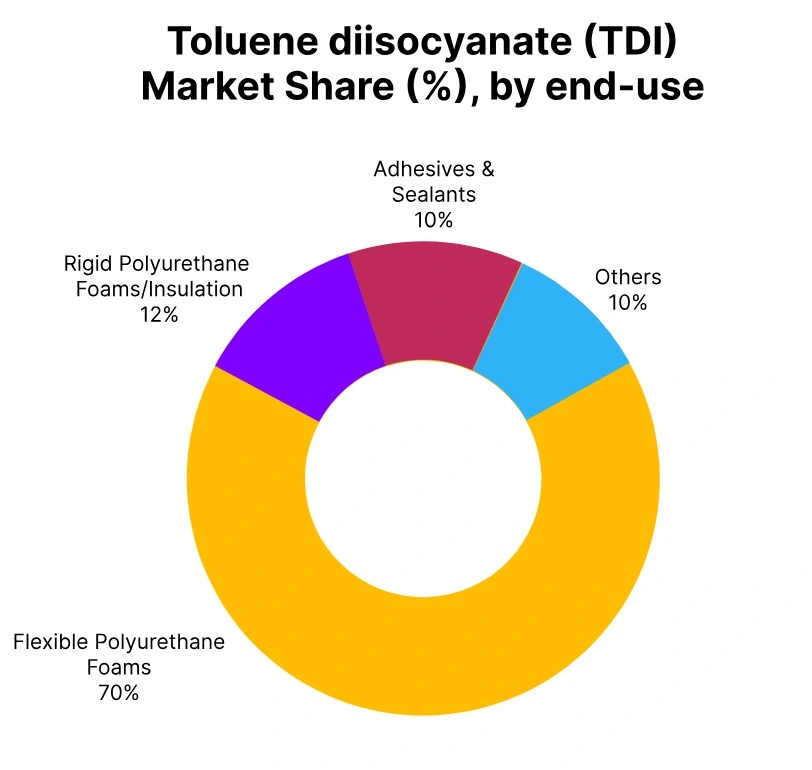
Toluene diisocyanate market share end use

Historically, several events have caused significant fluctuations in Toluene Diisocyanate (tdi) prices

  • 2022 (Energy Crisis and Supply Disruptions): The Russia-Ukraine conflict resulted in a global energy crisis, particularly affecting natural gas prices in Europe, a critical input for TDI production. Energy shortages and rising production costs led to significant price spikes in the second half of the year. At the same time, production disruptions and rising freight costs added to the volatility. 
  • 2019-2021 (Trade Tensions, Pandemic, and Supply Chain Disruptions): The U.S.-China trade war affected global chemical supply chains, contributing to fluctuating prices. In Asia, particularly in China, prices remained volatile due to uncertainty around tariffs and trade policies. The COVID-19 pandemic led to a sharp decrease in demand for TDI, especially in the automotive and construction sectors, driving prices lower. However, as countries recovered and industries began ramping up production later in the year, prices saw an uptick due to supply chain disruptions and plant shutdowns. Despite ongoing supply chain challenges, demand from recovering sectors like automotive, construction, and appliances drove prices up. Several manufacturers struggled with logistics issues, and a global shortage of raw materials like benzene caused further price increases. 
  • 2015-2018 (Supply Tightness and Plant Disruptions): From 2015 to 2018, supply shortages due to plant maintenance in China and Europe, as well as production issues at BASF’s German facility, tightened global supplies. TDI prices surged to record highs due to shutdowns at key plants, including Covestro’s facility in Germany, and stricter environmental regulations in China, which affected local production. 


These events underscore the TDI market’s vulnerability to global disruptions and highlight the need for continuous monitoring of supply-demand dynamics.

Why Price Watch™?

Price Watch™ is your trusted resource for tracking global toluene diisocyanate (tdi) price trends. Our platform delivers real-time data and expert analysis, offering deep insights into the key factors driving price fluctuations in the toluene diisocyanate (tdi) market. By monitoring critical events such as geopolitical tensions, supply chain disruptions, and economic shifts, Price Watch™ keeps you fully informed of market dynamics.

In addition, Price Watch™ provides detailed forecasts and updates on production capacities, enabling you to anticipate market changes and make well-informed decisions. With Price Watch™, you gain a competitive edge in understanding all the elements that influence toluene diisocyanate (tdi) prices worldwide. Stay ahead of the curve with Price Watch’s™ reliable, accurate, and timely toluene diisocyanate (tdi) market data.

Track Price Watch's™ toluene diisocyanate (tdi) price assessment on a weekly basis since 2015 onwards, along with short-term forecasts, and get access to the detailed report in a downloadable format.

Toluene Diisocyanate (tdi) Market Price Trend published by Price Watch™ reflect prevailing spot market conditions, derived from independent research, verified trade inputs, and proprietary market intelligence as of the publication date. Prices are published on the specified Incoterm and represent indicative base market levels, exclusive of applicable taxes, VAT, duties, tariffs, and other statutory charges. Actual transaction values may vary depending on volume, credit terms, contractual structure, and other negotiated conditions. Market prices are inherently subject to volatility, liquidity dynamics, regulatory changes, and evolving trade activity. The information provided is for reference and benchmarking purposes only and does not constitute an offer, recommendation, or guarantee of transactional outcomes. Users should exercise independent commercial judgment and assess their specific contractual, regulatory, tax, and application requirements before making business decisions. Price Watch™ assumes no liability for decisions taken based on this information.

Toluene diisocyanate (TDI) prices are influenced by several key factors, including raw material costs, production capacity, demand from end-user industries, and geopolitical events. Fluctuations in the prices of feedstocks such as toluene and phosgene significantly affect TDI pricing. Additionally, supply disruptions due to maintenance shutdowns or regulatory changes can tighten supply, leading to price increases. Economic conditions, such as growth in the automotive, furniture, and construction sectors, also play a crucial role in shaping demand and influencing TDI prices globally.

Environmental regulations significantly influence Toluene Diisocyanate (TDI) pricing and procurement strategies by imposing additional costs on manufacturers for compliance and sustainability practices. Stricter regulations may lead to increased production costs, which can be passed on to customers in the form of higher TDI prices. Procurement heads should consider sourcing from suppliers with a strong compliance record and sustainable practices, as they may offer competitive pricing and mitigate risks associated with regulatory penalties and market access.

International trade policies, including tariffs, trade agreements, and import/export restrictions, play a crucial role in Toluene Diisocyanate (TDI) pricing fluctuations. For instance, tariffs on raw materials or finished products can lead to increased costs for manufacturers, which may be reflected in TDI prices. Additionally, trade agreements can facilitate smoother supply chains and potentially lower costs. Procurement heads should stay informed about trade policy changes in key producing countries to adjust their sourcing strategies and manage pricing effectively.

Toluene Diisocyanate is a colorless to pale yellow aromatic compound widely used as a key building block in industrial chemistry for producing polyurethane foams, coatings, adhesives, sealants, and elastomers. Its price directly impacts the cost of downstream products ranging from flexible and rigid polyurethane foams used in furniture and automotive applications to coatings, insulation materials, and various industrial intermediates, making Toluene Diisocyanate pricing a critical factor for manufacturers across multiple industries worldwide. Price-Watch™ tracks these prices to help businesses and consumers understand and stay updated with market trends.

Toluene Diisocyanate prices vary by region. Prices are typically quoted per metric ton and change based on supply, demand, feedstock costs, and energy prices. Price-Watch™ provides real-time price assessments across different global markets to help buyers and sellers make informed decisions.

Toluene Diisocyanate prices fluctuate due to changes in feedstock costs (primarily toluene and nitric acid), along with movements in crude oil and energy prices, production capacity utilization, and demand from key consuming industries such as polyurethane foams, coatings, adhesives, and sealants. Supply-demand dynamics are strongly influenced by operating rates and the availability of intermediates like toluene and dinitrotoluene, which play a crucial role in the production chain. Global capacity additions and plant shutdowns, transportation and logistics costs, seasonal demand patterns in construction, furniture, and automotive sectors, trade flows and import/export dynamics, and broader economic conditions further shape price trends, with recent outlooks reflecting volatility driven by feedstock availability, regional supply constraints, and demand cycles in the polyurethane industry.

The biggest buyers of Toluene Diisocyanate are polyurethane manufacturers, particularly those producing flexible foams for furniture, bedding, and automotive seating, followed by producers of rigid foams used in insulation applications. Additional demand comes from coatings, adhesives, sealants, and elastomer manufacturers serving construction, automotive, and industrial sectors, along with specialty chemical producers utilizing TDI-based intermediates in various applications. Price-Watch™ analyses demand patterns across all these industries.

Toluene Diisocyanate is manufactured primarily through the nitration and phosgenation process, where toluene is first nitrated to form dinitrotoluene (DNT), which is then hydrogenated to produce toluene diamine (TDA). This intermediate is further reacted with phosgene to produce Toluene Diisocyanate (TDI). It is produced in large integrated petrochemical complexes by major chemical companies worldwide, with production closely linked to the availability of toluene and other upstream intermediates.

Toluene Diisocyanate trade is driven by production capacity, regional demand balances, and petrochemical integration. Major exporters include countries such as the United States, China, and several European nations including Belgium and the Netherlands, which act as key production centers and trading hubs. Asian producers in South Korea, Japan, and China also play significant roles in regional and global trade, while Middle Eastern exports have grown with capacity expansions. Export volumes fluctuate based on domestic polyurethane demand, production economics, availability of feedstocks like toluene, operating rates, shipping and logistics costs, and regional plant turnarounds or capacity additions. Price-Watch™ tracks production levels, export flows and trade patterns to help businesses understand global supply chains and identify sourcing opportunities.

Supply generally aligns with demand, but regional shortages can occur due to plant shutdowns, feedstock constraints, transportation issues, or sudden spikes in industrial activity. Maintenance turnarounds at major TDI production facilities can temporarily tighten market availability. Disruptions in the supply of key intermediates such as toluene, dinitrotoluene (DNT), or toluene diamine (TDA), along with operating rate adjustments, can also create pricing pressures in the TDI market. Price-Watch™ monitors these supply-demand imbalances to alert the market about potential shortages or surpluses.

Toluene Diisocyanate prices vary by grade and type based on isomer composition, purity, and application requirements. Common grades such as TDI 80/20 and TDI 65/35 are used in different polyurethane applications, with variations in performance and pricing. Pricing can also differ based on quality specifications, supplier standards, and contract terms. Additionally, TDI is typically handled and transported in liquid form, and logistics, storage conditions, and safety requirements can influence overall pricing structures. Price-Watch™ provides separate price assessments for each grade to ensure market transparency.

When Toluene Diisocyanate demand rises quickly, often due to increased production in polyurethane foams, coatings, adhesives, and sealants sectors, prices typically increase. Suppliers may prioritize long-term contract customers, while spot buyers face tighter availability, longer lead times, or premium pricing to secure supplies. Production flexibility is limited by plant operating rates, availability of key intermediates such as toluene, DNT, and TDA, and overall feedstock balance. Price-Watch™ captures these market dynamics in real-time.

Energy is a major cost component in Toluene Diisocyanate production. When natural gas, electricity, or steam costs rise, producers typically pass these costs on to buyers, making TDI more expensive. Feedstock costs, particularly toluene, are also closely linked to crude oil and overall petrochemical market movements, further influencing pricing trends. This is why prices in regions with cheaper energy and integrated petrochemical feedstocks tend to be lower, a correlation that Price-Watch™ analyses in its price assessments & market reports.

Toluene Diisocyanate prices vary by region based on local production capacity, feedstock availability and costs, energy prices, transportation and logistics expenses, import/export dynamics, and regional polyurethane demand strength. Areas with limited domestic production or higher logistics costs typically see higher prices, while regions with integrated petrochemical complexes and favorable feedstock economics often benefit from relatively lower prices. Price-Watch™ tracks prices across all major regions to highlight these differences.

The Toluene Diisocyanate market outlook depends on factors such as toluene feedstock price trends, crude oil and energy costs, operating rates and availability of key intermediates like DNT and TDA, capacity additions and plant turnarounds, and demand growth in key consuming industries (especially polyurethane foams, coatings, adhesives, and sealants). Construction, furniture, and automotive sector activity, along with trade flows, regional supply-demand balances, and broader macroeconomic conditions, also play a crucial role in shaping market dynamics. Price-Watch™ regularly publishes detailed forecasts that project price movements for the next 12 months based on comprehensive analysis of supply additions, demand growth in key industries, seasonal patterns, and macroeconomic indicators. Our forecasts help businesses anticipate market conditions and plan accordingly.

Absolutely. Accurate forecasting allows you to time your purchases better, negotiate contracts more effectively, and budget more accurately. If Price-Watch™ forecasts predict a price increase in three months, you might choose to stock up now or lock in long-term contracts at current rates, potentially saving thousands of dollars.

Events such as natural disasters, trade disputes, factory accidents, feedstock supply disruptions, or economic downturns can disrupt production or shipping routes, causing supply shortages and price volatility in the TDI market. Hurricanes affecting U.S. Gulf Coast chemical plants, force majeure declarations at major TDI facilities, disruptions in toluene or intermediate supplies (such as DNT and TDA), and geopolitical tensions impacting trade flows have all contributed to market instability. Additionally, pandemic-related demand shifts and logistical bottlenecks have further intensified price fluctuations across regions. Price-Watch™ provides timely alerts when such events affect the market.

Price-Watch™ collects data from manufacturers, distributors, and buyers worldwide to publish regular price assessments, market reports, and forecasts. Our transparent methodology and comprehensive coverage make us a trusted source for understanding fair pricing and market trends in the Toluene Diisocyanate industry.