Unsaturated Polyester Resin (upr) Price Trend and Forecast

UNSPC code: 13111003
|
Weekly Update
|
Historical Data Since 2015
|
Forecast for 2026

unsaturated polyester resin (upr) Price Trends by Country

cnChina
inIndia
twTaiwan
usUnited States
idIndonesia
vnVietnam

Global unsaturated polyester resin (upr) Spot Market Prices, Trend Analysis and Forecast

Price-Watch™ provides real-time price assessments and price forecasts for Unsaturated Polyester Resin across top trading regions:

Unsaturated Polyester Resin Regional Coverage Unsaturated Polyester Resin Grade and Country Coverage Unsaturated Polyester Resin Pricing Data Coverage Explanation
Asia Unsaturated Polyester Resin Pricing Analysis Unsaturated Polyester Resin Fiber Reinforced BMC (Flexural Strength: 90-120) FOB prices at Shanghai port, China Weekly Price Update on Unsaturated Polyester Resin Real-Time Export Prices from Shanghai port, China to Global Markets
Unsaturated Polyester Resin Bulk/Sheet Moulding Compound (Viscosity: 1000-2000) FOB prices at Kaohsiung port, Taiwan Weekly Price Update on Unsaturated Polyester Resin Real-Time Export Prices from Kaohsiung port, Taiwan to Global Markets
Unsaturated Polyester Resin Fiber Reinforced BMC (Flexural Strength: 90-120) CIF Prices at Jakarta port, Indonesia Importing from China Weekly Price Update on Unsaturated Polyester Resin Real-Time Import Prices at Jakarta port, Indonesia from China
Unsaturated Polyester Resin Fiber Reinforced BMC (Flexural Strength: 90-120) CIF Prices at Haiphong port, Vietnam Importing from China Weekly Price Update on Unsaturated Polyester Resin Real-Time Import Prices at Haiphong port, Vietnam from China
Unsaturated Polyester Resin General Purpose Orthopthallic Resin (Viscosity: 350-450) Ex-Delhi Domestic Prices, India Real-Time Weekly Price Update of Unsaturated Polyester Resin Domestic Prices in Delhi, India
North America Unsaturated Polyester Resin Pricing Analysis Unsaturated Polyester Resin Fiber Reinforced BMC (Flexural Strength: 90-120) CIF Prices at Houston port, USA Importing from China Weekly Price Update on Unsaturated Polyester Resin Real-Time Import Prices at Houston port, USA from China

Note: In assessments structured as CIF [Importing Port] (Exporting Country), the country mentioned in brackets indicates the primary origin of supply (exporting country), while the named port refers to the destination port in the importing country. Other Incoterms (FOB, FD, EXW, etc.) should be interpreted in accordance with standard international trade definitions.

Unsaturated Polyester Resin (UPR) Price Trend Q1 2026

Regarding price trends in the global market for UPR, the prices of the commodity have been on the rise in Q1 2026, rising about 1-6%. In APAC, countries such as China, Taiwan, Indonesia, and Vietnam have experienced an improvement in demand from fiberglass-reinforced plastic, construction and marine applications leading to price gains. This price increase has been driven by procurement improvements as well as slow but sure revival of downstream activities.

Meanwhile, production levels have remained stable, ensuring a steady supply of UPR. North America has experienced a firm trend, characterized by price rises driven by steady demand from construction and composite industries coupled with stable supply.

Similarly, in Europe, price trends for UPR have been on an upward trajectory due to improvements in industrial demand as well as stable market sentiments. Towards the end of Q1 2026, disruptions in the Middle East, including those between Iran and Israel, have created logistics issues, contributing to price increases globally.

India: UPR Domestically traded prices Ex-Delhi; Grade- General Purpose Orthopthallic Resin (Viscocity:350-450)

During Q1 2026, UPR prices in India have risen by about 6.2% in the context of robust recovery due to growing raw material prices and decreasing imports despite moderate demand growth. UPR price trend in India has shown that there has been an increase due to high prices of styrene monomer and maleic anhydride. The current market is characterized by selective purchases as consumers purchase only what they need considering increasing price trends.

Imports of styrene monomer from the Middle East have been rising, while domestic stocks of it have been tight due to disruption of shipments via the Strait of Hormuz, limiting crude and naphtha shipments.

In March 2026, UPR prices in India have seen a sharp increase of about 26.8% relative to the previous month due to the force majeure of SABIC in relation to styrene, shortage of maleic anhydride, and depreciation of the Indian rupee.

China: UPR Export prices FOB Shanghai; Grade- Fiber Reinforced BMC (Flexural Strength:90-120)

UPR prices in China in Q1 2026 have risen by roughly 2.2%. UPR price trend in China have trended upward, due to tight supplies of styrene monomer and maleic anhydride. The market has seen prudent buying, whereby purchases have been made on a need-based basis due to steady demand. There has been gradual supply tightness because of production adjustments due to feedstock tightness.

In March 2026, UPR prices in China have risen by approximately 10% when compared to February prices. This has been because of notable supply disruptions upstream. The crude runs by Sinopec and throughput at Zhejiang Petroleum & Chemical have declined, leading to a decline in feedstock levels. The delays in styrene shipments from South Korea owing to YNCC force majeure and tight supplies from SABIC have caused input costs to rise further.

Taiwan: UPR Export prices FOB Kaohsiung; Grade- Bulk/Sheet Moulding Compound (Viscocity:1000-2000)

In Q1 2026, UPR prices in Taiwan have increased by approximately 2.5%, reflecting a gradual recovery supported by tightening feedstock availability and rising input costs. UPR price trend in Taiwan has been upward, influenced by constrained supply of styrene monomer and maleic anhydride. The market has been witnessing cautious procurement activity, with buyers have been aligning purchases with immediate requirements amid moderate demand conditions. Supply conditions have been tightening gradually as import dependency has been increasing.

In March 2026, UPR prices in Taiwan have increased sharply by around 11.3% compared to February, driven by force majeure declared by Formosa Petrochemical and disruptions in naphtha shipments linked to Middle East tensions. These disruptions have limited availability of styrene and related inputs, while delays in shipments through the Strait of Hormuz and Suez Canal have further tightened supply, supporting higher production costs and price increases.

USA: UPR Import prices CIF Houston (China); Grade- Fiber Reinforced BMC (Flexural Strength:90-120)

In Q1 2026, UPR prices in the USA (CIF Houston from China) have increased by approximately 1.9%, reflecting a modest upward trend supported by rising global feedstock costs despite stable domestic demand. UPR price trend in the USA has been slightly upward, influenced by higher input costs and steady import supply.

The market has been witnessing balanced availability, while buyers have been maintaining controlled procurement aligned with demand conditions. Costs of styrene monomer and related inputs have been gradually increasing, providing support to pricing.

In March 2026, UPR prices in the USA have increased by around 9.7% compared to February, driven by global supply disruptions linked to Middle East tensions. Constraints in crude and naphtha flows and higher freight costs have increased input costs, while tighter global availability of styrene has reinforced the upward pricing trend toward the end of the quarter.

Vietnam: UPR Import prices CIF Haiphong (China); Grade- Fiber Reinforced BMC (Flexural Strength:90-120)

In Q1 2026, UPR prices in Vietnam (CIF Haiphong from China) have increased by approximately 2.2%, reflecting moderate upward movement supported by rising import costs and tightening regional supply. UPR price trend in Vietnam has been upward, influenced by higher costs of styrene monomer and maleic anhydride imported from China and the Middle East.

The market has been witnessing cautious procurement activity, with buyers have been maintaining need-based purchasing amid stable downstream demand. Import availability has been tightening gradually, which has been supporting price increases.

In March 2026, UPR prices in Vietnam have increased by around 9.9% compared to February, driven by Middle East disruptions that have constrained crude and feedstock flows, while higher freight costs and delays in shipments have reduced availability, reinforcing the upward pricing trend.

Indonesia: UPR Import prices CIF Jakarta (China); Grade- Fiber Reinforced BMC (Flexural Strength:90-120)

According to Price-Watch™, in Q1 2026, UPR prices in Indonesia (CIF Jakarta from China), have increased by approximately 2.0%, reflecting a gradual recovery supported by rising import costs and tightening feedstock availability. UPR price trend in Indonesia has been upward, influenced by higher costs of styrene monomer and maleic anhydride across the supply chain.

The market has been witnessing controlled procurement activity, with buyers have been aligning purchases with immediate requirements amid moderate demand conditions. Import supply has been relatively stable initially but has been tightening toward the end of the quarter.

In March 2026, UPR prices in Indonesia have increased by around 9.9% compared to February, driven by Middle East geopolitical disruptions, which have constrained crude and feedstock flows and increased freight costs. These factors have reduced availability and raise production costs, supporting a firmer pricing trend.

Unsaturated Polyester Resin (UPR) Price Trend Analysis: Q4 2025

The price movement for Unsaturated Polyester Resin (UPR) around the world in Q4 2025 has been experiencing a slightly declining trend, with prices reducing between 0.5% and 3%. In the APAC market, nations including China, Taiwan, Indonesia, and Vietnam have low demand from fiberglass reinforced plastics, constructions, and marine markets.

This trend has been causing a price reduction due to low purchasing and project activities in the downstream sector. North America has been having a slight reduction trend because of the limited downstream demand and adequate imports of UPR into the market. The UPR price in Europe has slight pressure in Q4 2025 because of low demand from the construction and industries.

India: UPR Domestically traded prices Ex-Delhi; Grade- General Purpose Orthopthallic Resin (Viscocity:350-450)

For the fourth quarter of 2025, there is a decline in UPR prices in India to the tune of about 0.8%, following the slightly softer trajectory seen in the prior quarter, as demand from construction and fiberglass-reinforced plastics industries remains soft. There has been a marginal decline in the UPR price trend in India owing to conservative purchasing practices and consistent production rates within the country.

The current state of supply in the industry has been well balanced with enough supply from local producers and purchases made according to need. Input costs for styrene and unsaturated polyester intermediates have no volatility and thus provided less help in pricing UPRs. Prices are further dampened by inventory levels that remain sufficient now. In India, UPR price in December 2025 have fallen by an estimated 0.7% relative to November due to muted trade activity and demand.

China: UPR Export prices FOB Shanghai; Grade- Fiber Reinforced BMC (Flexural Strength:90-120)

By Q4 2025, UPR prices in China has been observed to fall by about 2.2%, indicating that the prices of UPR continue to face pressure due to low demand within the composites, construction, and fiberglass-reinforced plastics segments. The UPR price trend in China has been declining, with factors like conservative buying behavior and normal production being responsible for influencing the same.

The market environment has been characterized by ample availability of supply, with buyers having been restraining themselves from purchasing large volumes of supplies. The costs of inputs such as styrene have experienced minor volatility and offered little help to the market.

In December 2025, UPR price in China export operations have been steady, but the level of export activities has not been sufficiently high to counterbalance the weakness prevailing within the domestic demand environment.

Taiwan: UPR Export prices FOB Kaohsiung; Grade- Bulk/Sheet Moulding Compound (Viscocity:1000-2000)

In Q4 2025, UPR prices in Taiwan have declined by approximately 1.7%, continuing the downward trend as demand from fiberglass-reinforced plastics and construction sectors has remained subdued. UPR price trend in Taiwan has been downward, influenced by cautious procurement and stable production output.

The market has been witnessing balanced supply conditions, while buyers have been maintaining controlled purchasing strategies. Costs of key inputs such as styrene have been fluctuating slightly, offering limited support to pricing. Export demand has been moderate, which has been contributing to overall price softness.

In December 2025, UPR prices in Taiwan have been decreasing by around 0.3% compared to November, driven by slower downstream activity and reduced trading volumes, while the overall market has remained soft and stable.

USA: UPR Import prices CIF Houston (China); Grade- Fiber Reinforced BMC (Flexural Strength:90-120)

In Q4 2025, UPR prices in USA (CIF Houston from China) have declined by approximately 3.0%, reflecting weak demand from construction, automotive, and fiberglass-reinforced plastics sectors. UPR price trend in the USA has been downward, influenced by sufficient import supply and cautious procurement activity.

The market has been witnessing steady inflows from Asia, particularly China, ensuring adequate availability, while buyers have been limiting purchases amid moderate demand conditions. Costs of key inputs such as styrene have been fluctuating moderately, offering limited support to pricing.

Inventory levels have been remaining comfortable, which has been further pressuring the market. In December 2025, UPR prices in the USA have been decreasing by around 3.0% compared to November, driven by year-end slowdown in demand and reduced trading activity, while overall market conditions have remained weak.

Vietnam: UPR Import prices CIF Haiphong (China); Grade- Fiber Reinforced BMC (Flexural Strength:90-120)

In Q4 2025, UPR prices in Vietnam (CIF Haiphong from China) have declined by approximately 2.1%, reflecting subdued demand from construction, marine, and fiberglass-reinforced plastics sectors. UPR price trend in Vietnam has been downward, influenced by stable import supply from China and cautious procurement activity.

The market has been witnessing sufficient availability, while buyers have been limiting purchases amid moderate consumption levels. Costs of key inputs such as styrene have been showing minor fluctuations, offering limited support to pricing. Import flows have been remaining steady, which has been maintaining balanced supply conditions.

In December 2025, UPR prices in Vietnam have been decreasing by around 0.8% compared to November, driven by slower trading activity and weak downstream demand, while overall market sentiment has remained soft.

Indonesia: UPR Import prices CIF Jakarta (China); Grade- Fiber Reinforced BMC (Flexural Strength:90-120)

In Q4 2025, UPR prices in Indonesia (CIF Jakarta from China) have declined by approximately 2.2%, continuing the downward trend as demand from construction, marine, and fiberglass sectors has remained weak. UPR price trend in Indonesia has been downward, influenced by cautious procurement and stable import supply from China.

The market has been witnessing adequate availability, while buyers have been maintaining limited purchasing activity. Costs of key inputs such as styrene have been fluctuating slightly, offering minimal support to pricing. Inventory levels have been remaining sufficient, contributing to the soft pricing environment.

In December 2025, UPR prices in Indonesia have been decreasing by around 0.8% compared to November, driven by reduced downstream activity and slower trading volumes, while overall market conditions have remained subdued.

The global Unsaturated Polyester Resin (UPR) price trend in Q3 2025 has been experiencing a moderate decline, registering a 2–3% decrease across key regions. In the APAC region, countries such as China, Taiwan, Indonesia, and Vietnam have been seeing weaker demand from fiberglass-reinforced plastics, construction, and marine sectors, putting downward pressure on prices. This decline has been driven by cautious procurement and selective downstream project activity.

North America has also been experiencing a soft price trend, with slight decreases due to restrained demand from construction and composite sectors, alongside stable import supply. In Europe, the price trend has been facing mild pressure as demand from industrial and construction sectors has been remaining subdued, contributing to a muted quarterly decline. Globally, UPR prices have been showing consistent downward movement, with feedstock stability and downstream activity continuing to influence price trends across these regions.

India: UPR Domestically traded prices Ex-Delhi, Grade General Purpose Orthopthallic Resin (Viscocity:350-450).

According to PriceWatch, in Q3 2025, Unsaturated polyester resin (UPR) prices in India, Ex-Delhi, have been following a downward market trend, declining by 0.7% during the quarter. The UPR price trend in India has been being influenced by moderate regional demand, which has been remaining subdued due to cautious procurement and stable production. Raw material costs for unsaturated polyesters and styrene have been showing minor fluctuations, contributing to measured pricing pressure.

Supply from local and regional manufacturers has been staying steady, while shipping logistics have been remaining mostly smooth, supporting limited market stability. In September 2025, UPR prices in India have been recording a marginal decline from August, reflecting consistent production activity and balanced supply. Overall, the Indian Unsaturated polyester resin market has been maintaining a stable but slightly downward price trend through Q3 2025.

China: Unsaturated polyester resin Export prices FOB Shanghai, Grade- Fiber Reinforced BMC (Flexural Strength:90-120).

According to PriceWatch, in Q3 2025, Unsaturated polyester resin export prices FOB Shanghai, China, have been following a downward price trend, declining by 1.9% to USD 1880–1890/MT. The UPR price trend in China has been being influenced by slower demand from composites, construction, and fiberglass-reinforced plastics sectors, where UPR has been serving as a primary resin. Feedstock values have been showing minor fluctuations, creating additional pricing pressure.

Production levels have been remaining steady, but selective procurement by buyers has been contributing to a subdued market. In September 2025, UPR prices in China have been recording a 0.9% decrease from the previous month, reflecting continued cautious demand. Overall, the Chinese UPR price trend in Q3 2025 has been remaining moderate, with further movements being influenced by downstream demand and feedstock availability.

Taiwan: UPR Export prices FOB Kaohsiung, Grade- Bulk/Sheet Moulding Compound (Viscocity:1000-2000).

In Q3 2025, UPR export prices in Taiwan have been following a downward trend, declining by 2.0% during the quarter. The UPR price trend has been being influenced by weaker demand in fiberglass-reinforced plastics and construction sectors, where UPR has been serving as a primary resin. Feedstock costs have been fluctuating slightly, creating additional pricing pressure.

Production levels have been remaining steady, while selective procurement by buyers has been contributing to the downward movement. In September 2025, UPR prices in Taiwan have been recording a 1.1% decline from August, reflecting cautious activity. Overall, the Taiwan UPR price trend has been staying downward through Q3 2025, with movements being influenced by sector demand and feedstock stability.

USA: UPR Import prices CIF Houston (China), Grade- Fiber Reinforced BMC (Flexural Strength:90-120).

According to PriceWatch, in Q3 2025, UPR import prices CIF Houston, USA, have been following a downward trend, declining by 3.4% during the quarter. The UPR price trend in the USA has been being influenced by weaker demand from fiberglass-reinforced plastics, construction, and automotive sectors, where UPR has been serving as a primary resin. Feedstock costs have been fluctuating moderately, creating additional pricing pressure.

Supply from China has been steady, but buyers have been reducing procurement, contributing to the downward movement. In September 2025, Unsaturated Polyester Resin (UPR) prices in the US recorded a 0.7% decline from August, reflecting continued cautious activity. Overall, the USA UPR market has been staying downward through Q3 2025, with movements being influenced by downstream project activity and inventory levels.

Vietnam: UPR Import prices CIF Haiphong (China), Grade- Fiber Reinforced BMC (Flexural Strength:90-120).

In Q3 2025, UPR import prices CIF Haiphong, Vietnam, have been following a downward trend, declining by 1.9% during the quarter. The UPR price trend in Vietnam has been being influenced by slower demand from fiberglass-reinforced plastics, construction, and boat manufacturing sectors, where UPR has been serving as a primary resin.

Feedstock costs have been showing minor fluctuations, creating additional pricing pressure. Supply from China has been remaining stable, while buyers have been maintaining cautious procurement, contributing to the downward movement.

In September 2025, UPR prices in Vietnam have been recording a 0.9% decline from August, reflecting limited downstream activity. Overall, the Vietnam UPR market has been staying downward through Q3 2025, with movements being influenced by sector activity and feedstock stability.

Indonesia: UPR Import prices CIF Jakarta (China), Grade- Fiber Reinforced BMC (Flexural Strength:90-120).

In Q3 2025, UPR import prices CIF Jakarta, Indonesia, have been following a downward trend, declining by 2.5% during the quarter. The price trend has been reflecting reduced demand from fiberglass-reinforced plastics, construction, and marine sectors, where UPR has been serving as a key material. Feedstock costs have been showing slight variation, creating additional pricing pressure.

Shipments from China have been remaining steady, but buyers have been limiting procurement, contributing to the downward movement. In September 2025, UPR prices in Indonesia have recorded a 0.9% drop from August, reflecting cautious activity in downstream projects. Overall, the Indonesia UPR market has been staying downward through Q3 2025, with movements being influenced by sector demand and feedstock stability.

According to PriceWatch, in the Chinese market, the prices of Unsaturated Polyester Resin (Bulk Moulding Compound Injection Moulding) experienced a decline of approximately 2.7% in the second quarter of 2025. The product was evaluated at USD 1929 per metric ton on an FOB Shanghai basis. This price reduction was attributed to low demand from overseas markets and weak consumption downstream.

The price trend exhibited a consistently negative trajectory throughout April, May, and June. Both the construction and marine sectors demonstrated minimal activity in resin procurement. The price chart illustrated a distinct downward slope with no indications of a rebound. Market participants reported elevated stock levels and limited spot buying activity. Operating rates remained stable, yet the movement of finished goods was sluggish. Offers were frequently revised downward to stimulate demand.

Feedstock costs decreased, providing no upward momentum. Traders refrained from making large purchases, citing uncertainties in the global economy. The market continued to exhibit bearish sentiment, and the overall pricing environment lacked any substantial support. 

According to PriceWatch, in the Indian market, the prices of Unsaturated Polyester Resin (UPR) General Purpose experienced a slight increase of about 0.20% in the second quarter of 2025. The product was evaluated at USD 1347 per metric ton on an Ex-Delhi basis. Throughout the quarter, prices remained largely stable due to a balance between supply and demand. The price trend indicated a minor upward movement, bolstered by steady procurement from domestic sectors. The price chart displayed a flat to slightly bullish trend during April and May.

Consumption from the construction and automotive sectors provided modest support. Inventory levels were well-managed at both distributor and converter levels. Buyers exhibited limited interest in bulk transactions, opting instead for consistent spot purchases. Stable raw material costs played a role in maintaining pricing consistency.

The market did not experience significant price reductions or discounts. The offtake of resin for fibre-reinforced applications contributed to price stability. Overall, the market remained neutral with a slight positive inclination. Prices are likely to remain firm if demand continues to gradually increase in the third quarter. 

In Q1 2025, Unsaturated Polster Resin (Bulk moulding Compound Injection moulding) prices showed early signs of recovery, inching up to 1982 USD/MT FOB Shanghai marking a 1.46% quarter-on-quarter increase. The rebound was modest but encouraging, supported by a marginal rise in Feedstock-Styrene Monomer and Maleic Anhydride prices and renewed procurement activity from composite manufacturers ahead of the spring construction season.

Additionally, the Chinese government’s focus on infrastructure and green energy investments helped lift market sentiment. However, producers remain cautious, as overall demand growth is still considered fragile and highly sensitive to fluctuations in raw material pricing and global trade conditions. 

In Q1 2025, UPR General Purpose prices moved marginally down, falling 1.33% from Q4 to 1344 USD/MT Ex-Delhi. Downstream demand was modest, despite stable and reasonably priced feedstock supplies, particularly maleic anhydride. A solid but muted UPR market resulted from market participants waiting for fiscal signs before committing to higher volumes. As industrial sentiment improves, a modest recovery is expected in Q2. 

Unsaturated Polyester Resin (UPR) Price Trend Analysis: Q4 2024

In Q4 2024, prices declined further to 1953 USD/MT FOB Shanghai a 2.18% drop from Q3. The UPR (Bulk moulding Compound Injection moulding) market continued to struggle with sluggish export demand, especially amid geopolitical tensions and delayed shipments impacting global resin movement. Meanwhile, feedstock trends remained muted Styrene Monomer prices saw minor fluctuations, while Maleic Anhydride availability was sufficient, limiting any major cost-push pressure. End-users also adopted a cautious buying approach, anticipating further price corrections considering steady inventory levels across the resin supply chain. 

In Q4 2024, UPR General Purpose prices corrected to 1362 USD/MT Ex-Delhi down 3.45% from Q3. The correction was due to reduced construction activity post-monsoon and year-end inventory adjustments. Additionally, Maleic Anhydride prices stabilized, relieving cost pressures on resin producers. Buyers adopted a cautious approach as holiday slowdowns impacted production schedules. 

In Q3 2024, the UPR (Bulk moulding Compound Injection moulding) market in China and Taiwan faced a slight downturn, with prices dropping to 1997 USD /MT FOB Shanghai reflecting a 1.33% decline from the previous quarter. This softening was primarily driven by weak demand from downstream sectors such as construction and marine applications, coupled with an oversupplied market. Feedstock prices, particularly Styrene Monomer and Maleic Anhydride, remained relatively stable but lacked bullish momentum, leading producers to reduce resin prices to stimulate buying interest. 

In Q3 2024, UPR General Purpose Prices increased even further, reaching 1410 USD/MT Ex-Delhi, representing a 5.44% gain—the largest increase of the year. Higher crude costs and tighter supply chains were the main causes of this global increase in the price of maleic anhydride. Prior to slowdowns brought on by the monsoon, the resin industry witnessed robust purchasing, driven mostly by the fiberglass and composites sectors. 

By Q2 2024, prices continued to drop in China as lower raw material costs reduced production expenses, and excess supply coupled with diminished demand from key industries like construction contributed to the trend. However, in the Taiwan market prices were stable during this period due to a balanced gap between the demand and supply. 

In Q2 2024, UPR General Purpose prices rebounded by 2.64% to 1338 USD/MT Ex-Delhi. The price increase was supported by a modest rise in Maleic Anhydride costs, coupled with seasonal demand improvement from infrastructure and automotive sectors. Manufacturers also saw improved order flow from OEMs, prompting slight restocking and production adjustments 

In Q1 2024, the Unsaturated Polyester Resin (UPR) (Bulk moulding Compound Injection moulding) market in China and Taiwan experienced a price decline due to oversupply amidst weak demand, particularly from the downstream construction sector and broader Asian markets. Additionally, reduced production costs provided limited support for UPR prices, as the cost of key feedstocks like Propylene Glycol and Maleic anhydride dropped. This combination of excess supply and lower feedstock prices exerted downward pressure on the UPR market throughout the quarter. 

In Q1 2024, the UPR General Purpose market in (Ex-Delhi) experienced a marginal decline, with prices at 1303 USD/MT, down 1.61% from the previous quarter. This softening was primarily due to stable feedstock prices, including Maleic Anhydride, and sluggish demand from downstream industries such as construction and marine composites. While the post-holiday season usually brings some recovery, market activity remained tepid. 

Technical Specifications of Unsaturated Polyester Resin (upr) Price Trends

Product Description

Unsaturated Polyester Resin (UPR) is a thermosetting polymer produced by the condensation of unsaturated polyesters with a reactive monomer, commonly styrene. UPR exhibits excellent mechanical strength, chemical resistance, and thermal stability. It offers high durability, dimensional stability, and resistance to corrosion. The polymer allows flexibility in formulation to achieve specific performance characteristics. UPR demonstrates reliable performance under varying conditions, and its properties can be tailored to optimize rigidity, toughness, and thermal behavior. The condensation process and cross-linking reactions contribute to its robust network structure, enhancing structural integrity and long-term stability.

Identifiers and Classification:

  • CAS No – 113669-95-7
  • HS Code – 39079120
  • Molecular Formula – [C6​H8​O4]n​
  • Molecular Weight[g/mol] – 500 to 5,000 g/mole


Unsaturated Polyester Resin Synonyms:

  • UPR
  • UP Resin
  • Unsaturated polyester


Unsaturated Polyester Resin (UPR) Grades Specific Price Assessment:

  • General Purpose Orthopthallic Resin (Viscocity:350-450) Grade Price Trend
  • Fiber Reinforced BMC (Flexural Strength:90-120) Grade Price Trend
  • Bulk/Sheet moulding Compound (Viscocity:1000-2000) Grade Price Trend


Unsaturated Polyester Resin (UPR) Global Trade and Shipment Terms

  • Quotation Terms (Product & Country Specific):25-28 MT, 5-10 MT, 15-20 MT
  • Packaging Type (Product & Country Specific):225Kg Barrel, 25Kg Carton


Incoterms Referenced in UPR Price Reporting

Shipping Term  Location  Definition 
FOB Kaohsiung  Kaohsiung, Taiwan  UPR Export price from Taiwan 
FOB Shanghai  Shanghai, China  UPR Export price from China 
CIF Haipong (China)  Shanghai, China  UPR import price in Vietnam from China 
CIF Houston (China)  Houston, USA  UPR import price in USA from China 
CIF Jakarta (China)  Jakarta, Indonesia  UPR import price in Indonesia from China 
Ex-Delhi  Delhi, India  Domestically Traded UPR price in Delhi 

*Quotation Terms refers to the quantity range specified for the UPR being quoted or offered in a commercial transaction.

**Packaging Type refers to standard packaging size commonly used for UPR packing, ease of handling, transportation, and storage in industrial and commercial applications.

Key Unsaturated Polyester Resin (UPR) Manufacturers and their brands

Brand Name  Manufacturer 
SinoPoly  Sino Polymer 
NA  NanYa Plastics Corporation 
ETERSET 2388  Eternal Materials Co., Ltd. 
NA  Union Composite 

Unsaturated Polyester Resin (upr) Industrial Applications

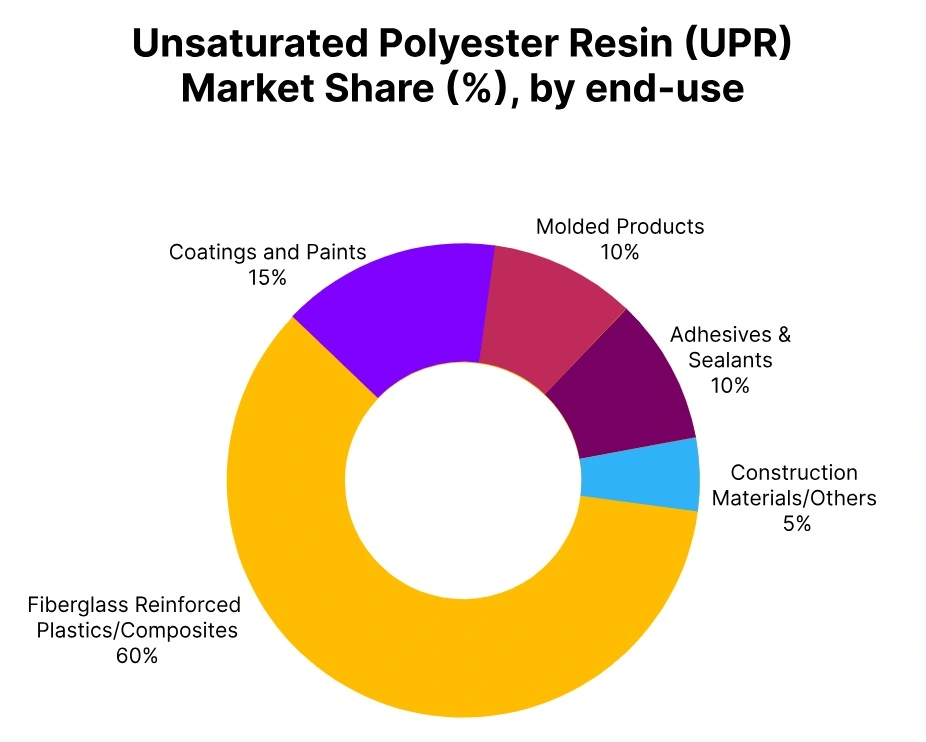
Unsaturated polyester resin market share end use

Historically, several events have caused significant fluctuations in Unsaturated Polyester Resin (upr) prices

  • Russia-Ukraine Conflict (2022-Present): The conflict disrupted energy supplies, especially natural gas and oil, which are crucial for the petrochemical industry. Europe, a major consumer of Russian energy, faced significant supply issues. The conflict impacted the availability and cost of energy and raw materials like Propylene glycol, Maleic anhydride which is derived from petrochemical processes.  
  • Global Logistics and Shipping Crisis (2021-Present): The rise in e-commerce driven by the pandemic, coupled with disruptions in global shipping routes, port closures, and container shortages, resulted in a logistics crisis. Transporting raw materials and finished Unsaturated Polyester Resin products became difficult, leading to delays and higher costs for manufacturers and end-users, which further strained production. 
  • COVID-19 Pandemic (2020-2022): The pandemic led to significant disruptions in global supply chains, with manufacturing plants shutting down, labour shortages arising, and transportation logistics suffering considerable setbacks. As a result, the Unsaturated Polyester Resin industry faced production stoppages due to factory closures and a decline in demand from major sectors such as automotive and construction. 

Why Price Watch™?

Price Watch™ is your trusted resource for tracking global unsaturated polyester resin (upr) price trends. Our platform delivers real-time data and expert analysis, offering deep insights into the key factors driving price fluctuations in the unsaturated polyester resin (upr) market. By monitoring critical events such as geopolitical tensions, supply chain disruptions, and economic shifts, Price Watch™ keeps you fully informed of market dynamics.

In addition, Price Watch™ provides detailed forecasts and updates on production capacities, enabling you to anticipate market changes and make well-informed decisions. With Price Watch™, you gain a competitive edge in understanding all the elements that influence unsaturated polyester resin (upr) prices worldwide. Stay ahead of the curve with Price Watch’s™ reliable, accurate, and timely unsaturated polyester resin (upr) market data.

Track Price Watch's™ unsaturated polyester resin (upr) price assessment on a weekly basis since 2015 onwards, along with short-term forecasts, and get access to the detailed report in a downloadable format.

Unsaturated Polyester Resin (upr) Market Price Trend published by Price Watch™ reflect prevailing spot market conditions, derived from independent research, verified trade inputs, and proprietary market intelligence as of the publication date. Prices are published on the specified Incoterm and represent indicative base market levels, exclusive of applicable taxes, VAT, duties, tariffs, and other statutory charges. Actual transaction values may vary depending on volume, credit terms, contractual structure, and other negotiated conditions. Market prices are inherently subject to volatility, liquidity dynamics, regulatory changes, and evolving trade activity. The information provided is for reference and benchmarking purposes only and does not constitute an offer, recommendation, or guarantee of transactional outcomes. Users should exercise independent commercial judgment and assess their specific contractual, regulatory, tax, and application requirements before making business decisions. Price Watch™ assumes no liability for decisions taken based on this information.

The prices of Unsaturated Polyester Resins (UPR) are influenced by various factors, including raw material costs, supply and demand dynamics, production capacity, and market competition. One of the most significant factors affecting UPR prices is the cost of key feedstocks, such as styrene and polyester resins. Additionally, global demand for UPRs in industries like automotive, construction, and marine also plays a role in shaping prices. If demand for UPR-based products increases due to growth in construction or automotive sectors, this can lead to price hikes. Conversely, economic slowdowns or a decrease in demand for certain applications could put downward pressure on UPR prices. Supply chain issues, such as disruptions in the delivery of raw materials or manufacturing delays, can also significantly impact UPR prices.

Feedstock prices have a direct and substantial effect on UPR prices. The primary feedstocks for UPR production are styrene and unsaturated polyesters, and any fluctuations in the prices of these materials can lead to changes in UPR prices. For example, if the price of styrene increases due to a rise in the cost of crude oil or disruptions in the supply of petrochemicals, the production cost of UPR will also rise, prompting manufacturers to increase UPR prices. Similarly, changes in the availability or cost of other raw materials such as resins, curing agents, and additives can also have an impact on UPR pricing. As raw materials account for a significant portion of production costs, any volatility in feedstock prices often results in corresponding changes in UPR prices.

Inflation has a notable influence on UPR prices due to its impact on overall production costs and market conditions. As inflation rises, the cost of raw materials, energy, and labor also tends to increase, directly affecting UPR manufacturers. With higher operating costs, manufacturers may pass on these increases to consumers, leading to higher UPR prices. Additionally, inflation can lead to an increase in the costs of transportation and logistics, which further contributes to price hikes. However, inflation can also influence demand for UPR-based products. In times of high inflation, consumers and industries might reduce spending, leading to a potential decrease in demand for certain products that rely on UPRs. In such cases, even though production costs may rise, the overall demand reduction might keep prices stable or cause them to decrease. Therefore, the relationship between UPR prices and inflation is shaped by a combination of cost-push and demand-side factors.

UPR (Unsaturated Polyester Resin) is a thermosetting polymer widely used in composites, reinforced plastics, coatings, and construction materials. It is typically combined with glass fibre to produce strong, lightweight structures. Its price is critical because it directly influences the cost of end-products in sectors such as construction, marine, automotive, and infrastructure. Price-Watch™ tracks UPR prices to help businesses stay informed about market movements and cost trends.

UPR prices vary depending on resin type (orthophthalic, isophthalic, DCPD-based), viscosity, and application requirements. Prices are usually quoted per metric ton and fluctuate based on feedstock costs, supply-demand balance, and regional market conditions. Price-Watch™ provides up-to-date price assessments across key global markets.

UPR prices are influenced by upstream raw materials such as styrene, maleic anhydride, and phthalic anhydride, along with production rates and demand from construction and composite industries. Market trends are also shaped by seasonal construction activity, export-import dynamics, and fluctuations in crude-derived feedstocks. Recent movements show variability depending on resin demand and feedstock volatility.

Major consumers include construction companies, fiberglass-reinforced plastic (FRP) manufacturers, automotive component producers, marine manufacturers, and infrastructure developers. Applications such as panels, pipes, tanks, sanitary ware, and boat hulls drive substantial demand. Price-Watch™ tracks consumption trends across these sectors.

UPR is produced at chemical manufacturing facilities through a polycondensation reaction involving unsaturated acids or anhydrides and glycols, followed by dilution in reactive monomers such as styrene. The resulting resin is supplied in liquid form for moulding and composite fabrication processes.

Asia, particularly China, is a major exporter of UPR, followed by countries in Europe and the Middle East. Export volumes depend on production capacity, domestic consumption, and cost competitiveness in global markets. Price-Watch™ monitors trade flows and supply availability.

Global UPR supply is generally adequate, however, temporary tightness may occur due to feedstock shortages, plant maintenance, or strong demand from construction and infrastructure projects. Price-Watch™ tracks supply-demand balances to highlight potential market constraints.

UPR is available in various grades such as Orthophthalic, isophthalic, vinyl ester-modified, and DCPD-based resins. Prices differ based on chemical composition, mechanical performance, corrosion resistance, and application-specific requirements. Higher-performance resins typically command premium pricing. Price-Watch™ provides grade-wise price insights.

A surge in demand often driven by construction activity or infrastructure projects can lead to higher resin prices, reduced availability, and longer lead times. Manufacturers may prioritize contract buyers, limiting spot market supply. Price-Watch™ captures these shifts in real time.

Styrene is a key raw material in UPR production, acting as a reactive diluent in the resin formulation. Any fluctuations in styrene prices directly impact UPR production costs, as it forms a significant portion of the resin composition. Increases in styrene prices typically lead to higher UPR prices, while stable or declining styrene costs can ease pricing pressure. Price-Watch™ analyses styrene–UPR price correlations to explain cost movements.

Regional price variations arise from differences in feedstock availability, manufacturing capacity, energy costs, environmental regulations, freight rates, and local demand. Import dependency and currency fluctuations can also impact pricing. Price-Watch™ tracks these regional dynamics.

UPR price outlook depends on trends in styrene and other upstream chemicals, construction sector demand, and global economic conditions. Capacity additions and supply chain stability also influence future pricing direction. Price-Watch™ publishes regular forecasts projecting price direction over the next 12 months.

Yes. Accurate forecasts enable businesses to optimize procurement strategies, manage raw material risks, and control production costs. This is particularly important for industries with large-scale composite and construction applications. Price-Watch™ supports informed decision-making through reliable forecasts.

Global factors such as crude oil volatility, supply chain disruptions, environmental regulations, and geopolitical tensions can affect feedstock availability and resin production. These changes can lead to fluctuations in UPR prices and supply conditions.

Price-Watch™ provides comprehensive UPR price data, market analysis, and forecasts based on inputs from producers, traders, and end-users, helping businesses stay ahead of market trends.