Vinyl Chloride Monomer (vcm) Price Trend and Forecast

UNSPC code: 12142100
|
Weekly Update
|
Historical Data Since 2015
|
Forecast for 2026

vinyl chloride monomer (vcm) Price Trends by Country

qaQatar
usUnited States
idIndonesia
deGermany
beBelgium
mxMexico
inIndia

Global vinyl chloride monomer (vcm) Spot Market Prices, Trend Analysis and Forecast

𝐏𝐫𝐢𝐜𝐞 𝐖𝐚𝐭𝐜𝐡™ provides price assessments for Vinyl Chloride Monomer (VCM) across top trading regions:

Asia-Pacific

  • VCM Industrial Grade(99.98%) FOB Mesaieed, Qatar
  • VCM Industrial Grade(99.98%) CIF JNPT (Qatar), India
  • VCM Industrial Grade(99.98%) FOB Tanjung Priok,Indonesia
  • North America
  • VCM Industrial Grade(99.98%) FOB Texas, USA
  • VCM Industrial Grade(99.98%) CIF Manzanillo_USA, Mexico


Europe

  • VCM Industrial Grade(99.98%) FOB Hamburg, Germany
  • VCM Industrial Grade(99.98%) FD Antwerp, Belgium


Note:
In assessments structured as CIF [Importing Port] (Exporting Country), the country mentioned in brackets indicates the primary origin of supply (exporting country), while the named port refers to the destination port in the importing country. Other Incoterms (FOB, FD, EXW, etc.) should be interpreted in accordance with standard international trade definitions.

Vinyl Chloride Monomer (VCM) Price Trend Q1 2026

In Q1-2026, global Vinyl Chloride Monomer (VCM) prices have shown mixed trends across major markets. Quarterly movements have reflected demand variations and supply conditions. In March, prices have surged sharply due to geopolitical tensions between Iran, Israel, and the USA, increasing energy and logistics costs.

Qatar: Vinyl Chloride Monomer (VCM) Export prices FOB Mesaieed, Qatar; Industrial Grade (99.98%)

For Q1 2026, the price of VCM in Qatar has fallen on account of poor global demand dynamics in the first half of the quarter. The VCM price trend in Qatar has been characterized by low export performance and adequate availability. Manufacturers have been under pressure from minimal PVC utilization in major consumer regions. The price of VCM in Qatar for Q1 2026 has witnessed a decline of 7.12% from the last quarter.

Feedstock prices have been constant, giving little price support. Stockpiles have grown due to reduced sales, whereas exports have weakened owing to conservative purchasing methods. However, in March 2026, the price of VCM in Qatar has gone up by 29.98% from the previous month. Price levels have climbed due to geopolitical unrest in the Middle East between Iran, Israel, and the USA affecting oil prices. The VCM price trend in Qatar has seen a rise due to growing crude prices resulting in higher manufacturing and freight charges.

India: Vinyl Chloride Monomer (VCM) Import prices CIF JNPT, India; Industrial Grade (99.98%)

Vinyl Chloride Monomer (VCM) prices in India saw a decrease in H1 of Q1 2026 as there has been softer demand from imports. The Vinyl Chloride Monomer (VCM) price trend in India has affected by the careful buying behaviour of downstream companies, and on the other hand, the demand in the construction and packaging sectors has been steady.

The strategy of importing firms regarding VCM has shifted due to ample availability in inventories. The global market conditions are favorable to importers during the quarter, and pressure remained high because of competitive prices. However, in India, Vinyl Chloride Monomer (VCM) price in March 2026 have risen by 27.61%. This price increase has been caused by the geopolitical issue of war between Iran, Israel, and USA that is causing a surge in crude oil prices, thus raising the price of import and production cost.

Indonesia: Vinyl Chloride Monomer (VCM) Export prices FOB Tanjung Priok, Indonesia; Industrial Grade (99.98%)

Vinyl Chloride Monomer (VCM) prices in Indonesia have gone up because of better export demand and volatile global supply dynamics in the first quarter of 2026. The Vinyl Chloride Monomer (VCM) price trend in Indonesia has been on the upswing because of higher regional demand; suppliers have enjoyed strong demand for their products. The price of Vinyl Chloride Monomer (VCM) in Indonesia in the first quarter of 2026 has increased by 2.83% when compared to the last quarter.

Supportive feedstock and favorable export operations have resulted in higher prices, while inventory positions have remained stable amid robust demand. In Indonesia, Vinyl Chloride Monomer (VCM) price in March 2026 has increased by 37.15% when compared to February 2026. This increase can be attributed to geopolitical tensions in the region related to the Iran-Israel-USA war, resulting in high energy costs, making production expensive.

Germany: Vinyl Chloride Monomer (VCM) Export prices FOB Hamburg, Germany; Industrial Grade (99.98%)

Vinyl Chloride Monomer (VCM) prices in Germany witnessed sharp gains in Q1 2026 due to relatively constant demand and changing global shipping dynamics. There have been relatively constant PVC demand levels in the region, which have been driving Vinyl Chloride Monomer (VCM) prices, while the supply side has been relatively balanced. There have been increases in Vinyl Chloride Monomer (VCM) price trend in Germany by 1.84% in Q1 2026, with feedstock and energy costs offering some mild support.

Trade flows are balanced in the European region, with relatively balanced inventories in the region. There have been increases in Germany, Vinyl Chloride Monomer (VCM) price in March 2026 by 8.87% compared to February 2026, with geopolitical risks such as the Iran-Israel-USA war, resulting in energy costs increasing.

Belgium: Vinyl Chloride Monomer (VCM) FD Antwerp, Belgium; Industrial Grade (99.98%)

According to Price-Watch™ , in Q1-2026, Vinyl Chloride Monomer (VCM) prices in Belgium have increased moderately due to steady demand. Vinyl Chloride Monomer (VCM) price trend in Belgium has reflected stable supply and improving consumption. European market conditions have supported gradual increases. Q1-2026, Vinyl Chloride Monomer (VCM) prices in Belgium have increased by 1.75% compared to the previous quarter. Production levels have remained consistent across facilities.

Demand from construction and automotive sectors has improved. Trade flows have remained uninterrupted. In Belgium, Vinyl Chloride Monomer (VCM) prices in March 2026 have increased by 8.43% compared to the previous month. Prices have increased due to geopolitical tensions between Iran, Israel, and the USA. Higher crude costs have elevated manufacturing expenses.

USA: Vinyl Chloride Monomer (VCM) Export prices FOB Texas, USA; Industrial Grade (99.98%)

In Q1-2026, Vinyl Chloride Monomer (VCM) prices in the USA have increased significantly due to stronger demand. Vinyl Chloride Monomer (VCM) price trend in the USA has been driven by improved export activity. Domestic consumption has shown recovery during the quarter. Q1-2026, Vinyl Chloride Monomer (VCM) prices in USA have increased by 17.46% compared to the previous quarter.

Export demand has strengthened across key regions. Inventory levels have declined due to better offtake. Producers have raised prices accordingly. In the US, Vinyl Chloride Monomer (VCM) prices in March 2026 have increased by 11.40% compared to the previous month. Prices have surged due to geopolitical tensions between Iran, Israel, and the USA. Rising oil prices have increased feedstock and transportation costs.

Mexico: Vinyl Chloride Monomer (VCM) Import prices CIF Manzanillo, Mexico; Industrial Grade (99.98%)

In Q1-2026, Vinyl Chloride Monomer (VCM) prices in Mexico have increased due to stronger import demand. Vinyl Chloride Monomer (VCM) price trend in Mexico has reflected improved downstream consumption. Importers have increased procurement amid better sentiment. Q1-2026, Vinyl Chloride Monomer (VCM) prices in Mexico have increased by 11.16% compared to the previous quarter.

Supply availability has remained steady from major exporters. Demand from construction and packaging sectors has improved. Inventory levels have been maintained efficiently. In Mexico, Vinyl Chloride Monomer (VCM) prices in March 2026 have increased by 10.15% compared to the previous month. Prices have increased due to geopolitical tensions between Iran, Israel, and the USA. Higher logistics and import costs have supported the rise.

Vinyl Chloride Monomer (VCM) Price Trend Analysis: Q4 2025

In Q4-2025, global Vinyl Chloride Monomer (VCM) prices have exhibited mixed trends across key regions. Declines have dominated in export-driven markets due to weak demand and oversupply. Meanwhile, some regions have seen slight stability or gains. Monthly movements in December have reflected cautious sentiment and year-end demand slowdown.

Qatar: Vinyl Chloride Monomer (VCM) Export prices FOB Mesaieed, Qatar; Industrial Grade (99.98%)

Vinyl Chloride Monomer (VCM) Prices in Qatar for Q4 2025 has registered a marginal fall on account of supply stability during the period under consideration. Vinyl Chloride Monomer (VCM) Prices Trend in Qatar for Q4 2025 showed that there has been steady production along with modest exports, whereas the cost of ethylene as a feedstock is stable, thus not allowing significant volatility in prices during Q4 2025. Vinyl Chloride Monomer (VCM) Prices Trend in Qatar for Q4 2025 indicates a drop of 1.14% over Q3 2025.

There has also been stable regional demand for vinyl chloride monomer from the Asian markets, which have not driven the price growth. The producers have kept steady operating rates to prevent stock accumulation, while exports have been steady. In Qatar, Vinyl Chloride Monomer (VCM) Prices in December 2025 indicates a small drop of 0.95% from the previous month. Vinyl Chloride Monomer (VCM) Prices Trend in Qatar for December 2025 reflects market caution on account of limited purchasing from the downstream players.

India: Vinyl Chloride Monomer (VCM) Import prices CIF JNPT, India; Industrial Grade (99.98%)

For Q4 2025, there has been an increase in Vinyl Chloride Monomer (VCM) price in India, owing to robust imports. Vinyl Chloride Monomer (VCM) price trend in India has been driven by steady consumption in the PVC sector. At the same time, import dependence has affected the pricing pattern due to erratic global supply. For Q4 2025, there has been an increase in the prices of Vinyl Chloride Monomer (VCM) in India by 1.13%. Domestic demand in the construction and packaging sectors has been stable.

The suppliers have revised their pricing policies considering the cost of transportation and purchasing, keeping stock positions well-balanced at key ports. For December 2025, there has been a fall in the prices of Vinyl Chloride Monomer (VCM) in India by 0.89% from the previous month. In India, Vinyl Chloride Monomer (VCM) price in December 2025 has been impacted by temporary demand weakness.

Indonesia: Vinyl Chloride Monomer (VCM) Export prices FOB Tanjung Priok, Indonesia; Industrial Grade (99.98%)

The Vinyl Chloride Monomer (VCM) prices in Indonesia have witnessed a downward shift in Q4 2025, owing to lower export orders. Vinyl Chloride Monomer (VCM) price trend in Indonesia has been characterized by falling demand from downstream consumers in regional markets, whereas manufacturers are under pressure from fierce price competition in the Asian region. Vinyl Chloride Monomer (VCM) prices in Indonesia have fallen by 3.70% during Q4 2025 relative to the previous quarter.

Sufficient supply levels have maintained, preventing any price recovery. There have been minor declines in export volumes in the presence of conservative purchasing trends, while rising feedstock prices have failed to exert any supportive effect on prices. In Indonesia, Vinyl Chloride Monomer (VCM) prices in December 2025 have fallen by 9.80% from their levels in the prior month. The price trend of the Vinyl Chloride Monomer (VCM) in Indonesia has been driven by negative market sentiment amid slow end-of-year procurement processes.

Germany: Vinyl Chloride Monomer (VCM) Export prices FOB Hamburg, Germany; Industrial Grade (99.98%)

Vinyl Chloride Monomer (VCM) prices in Germany during Q4 2025 has experienced slight increases with stable demand from industries. Supply factors have played an instrumental role in determining the Vinyl Chloride Monomer (VCM) price trend in Germany during Q4 2025 due to steady supply and production, coupled with stable downstream demand from Europe. In Germany, Vinyl Chloride Monomer (VCM) prices in December 2025 during Q4 2025 have registered a 0.41% increase when compared to previous quarter prices.

There have been slight increases in raw material costs, while trade in the European region has been smooth, and inventory has been enough. The price trend for Vinyl Chloride Monomer (VCM) in Germany during December 2025 has seen a drop of 4.62%. This has been brought about by the decline in downstream demand.

Belgium: Vinyl Chloride Monomer (VCM) FD Antwerp, Belgium; Industrial Grade (99.98%)

In Q4-2025, Vinyl Chloride Monomer (VCM) prices in Belgium have remained relatively stable with slight upward movement. Vinyl Chloride Monomer (VCM) price trend in Belgium has reflected steady regional demand and consistent supply flows. European market dynamics have supported minor price adjustments during the quarter.

Q4-2025, Vinyl Chloride Monomer (VCM) prices in Belgium have increased by 0.39% compared to the previous quarter. Production levels have remained stable across major facilities. Demand from construction and automotive sectors has provided moderate support. Trade flows within the region have remained uninterrupted. In Belgium, Vinyl Chloride Monomer (VCM) prices in December 2025 have decreased by 4.40% compared to the previous month. Year-end inventory adjustments have influenced the monthly decline.

USA: Vinyl Chloride Monomer (VCM) Export prices FOB Texas, USA; Industrial Grade (99.98%)

In Q4-2025, Vinyl Chloride Monomer (VCM) prices in the USA have declined significantly due to weak demand. Vinyl Chloride Monomer (VCM) price trend in the USA has been impacted by oversupply and reduced export activities. Domestic production has remained high, creating downward pricing pressure. Q4-2025, Vinyl Chloride Monomer (VCM) prices in USA have decreased by 12.45% compared to the previous quarter.

Export demand from Latin America and Asia has weakened during the period. Inventory levels have increased due to slower offtake. Producers have adjusted pricing to remain competitive globally. In the USA, Vinyl Chloride Monomer (VCM) prices in December 2025 have increased by 2.51% compared to the previous month. Short-term demand recovery has supported the slight monthly increase.

Mexico: Vinyl Chloride Monomer (VCM) Import prices CIF Manzanillo, Mexico; Industrial Grade (99.98%)

In Q4-2025, Vinyl Chloride Monomer (VCM) prices in Mexico have declined sharply due to reduced import demand. Vinyl Chloride Monomer (VCM) price trend in Mexico has reflected weak downstream consumption and ample supply. Importers have remained cautious in procurement strategies during the quarter. Q4-2025, Vinyl Chloride Monomer (VCM) prices in Mexico have decreased by 23.51% compared to the previous quarter.

Supply availability from the USA has remained strong, intensifying price pressure. Demand from construction and packaging sectors has softened. Inventory levels have remained sufficient across major ports. In Mexico, Vinyl Chloride Monomer (VCM) prices in December 2025 have increased by 2.20% compared to the previous month. Slight improvement in buying activity has supported the monthly price rise.

Vinyl Chloride Monomer (VCM) markets across major regions displayed mixed performance in Q3 2025. Stable product prices in Qatar and Indonesia reflected steady demand and balanced supply.

India registered a marginal dip amid competitive pressure and controlled inventory. Meanwhile, Germany, Belgium, the USA, and Mexico witnessed price declines influenced by weak PVC output and oversupply. Product price trends suggest a mildly bearish global sentiment continuing into Q4 2025.

Germany: VCM Export prices FOB Hamburg, Germany, Grade – Industrial Grade (99.98%).

In Q3 2025, Vinyl Chloride Monomer prices in Germany weakened following slower demand recovery and reduced polymer production activity. Vinyl Chloride Monomer (VCM) price trend in Germany reflected market oversupply and subdued feedstock utilization. Soft downstream demand from the PVC sector weighed on overall product prices.

According to PriceWatch, VCM prices in Germany dropped by 4.89% in Q3 2025. Product prices in Q3 struggled to gain momentum amid high storage levels and limited export movement. Lower ethylene costs intensified the decline across North European markets. In September 2025, VCM prices in Germany reflected downward adjustments consistent with overall bearish sentiment.

Belgium: Vinyl Chloride Monomer  Domestically traded prices FD Antwerp, Belgium, Grade – Industrial Grade (99.98%).

In Q3 2025, Vinyl Chloride Monomer market in Belgium experienced softening trends amid reduced activity in chemical and PVC manufacturing. Vinyl Chloride Monomer price trend in Belgium showed notable weakness influenced by lower production rates and mild downstream consumption. Decreased industrial output suppressed product prices through the quarter.

According to PriceWatch, VCM prices in Belgium fell by 4.84% in Q3 2025. Product prices in Q3 reflected contraction stemming from reduced domestic demand. European inventory buildup further pressured VCM price dynamics in the region. In September 2025, Vinyl Chloride Monomer prices in Belgium continued to record downward adjustments consistent with weak regional sentiment.

United States: VCM Export prices FOB Texas, USA, Grade – Industrial Grade (99.98%).

In Q3 2025, Vinyl Chloride Monomer prices in the United States decreased due to softer global demand and higher feedstock supply. Vinyl Chloride Monomer price trend in the USA reflected mild bearishness as domestic PVC output moderated. Increased ethylene production and reduced export inquiries pressured product prices. According to PriceWatch, Vinyl Chloride Monomer prices in the USA declined by 3.97% in Q3 2025.

Product prices in Q3 showed downward momentum reflecting weaker international trade sentiment. Energy feedstock cost correction further weighed on overall pricing structure. In September 2025, VCM prices in the USA remained below Q2 averages with muted buying interest.

Mexico: VCM Import prices CIF Manzanillo (USA), Mexico, Grade – Industrial Grade (99.98%).

In Q3 2025, Vinyl Chloride Monomer (VCM) imports into Mexico registered marginal decline amid subdued industrial activity. Vinyl Chloride Monomer (VCM) price trend in Mexico reflected moderate softness due to reduced supply from the United States and lower downstream efficiency.

Product prices faced mild pressure as PVC manufacturers adjusted inventory levels. According to PriceWatch, Vinyl Chloride Monomer prices in Mexico dropped by 3.72% in Q3 2025.

Product prices in Q3 remained constrained under stable feedstock availability and lower export inflows. Regional demand moderation contributed to cautious procurement behaviour. VCM prices in September 2025 in Mexico remained below seasonal averages as trade slowed heading into Q4.

Qatar: VCM Export prices FOB Mesaieed, Qatar, Grade – Industrial Grade (99.98%).

In Q3 2025, the Vinyl Chloride Monomer market in Qatar remained relatively stable on the back of balanced domestic and export trade flows. The VCM price trend in Qatar reflected a consistent supply and minimal movement in upstream ethylene price changes. Overall production rates have been moderate and feedstock supply has been stable, reducing the likelihood of volatile product prices.

The PriceWatch provided Vinyl Chloride Monomer pricing in Qatar reflecting 0.00% change for Q3 2025. Continued production activity to support PVC consumption levels was seen in the region. Prices for VCM in Q3 have been upheld by adequate global demand and consistent raw material supply.

The Sept 2025 VCM prices in Qatar, remained comparable to Q2 prices. Stability in the third quarter also highlighted consistent performance in trade activity moving into Q4.

India: VCM Import prices CIF JNPT (Qatar), India, Grade – Industrial Grade (99.98%).

During the third quarter of 2025, there have been slight declines in imports of Vinyl Chloride Monomer (VCM) into India, which coincided with steady domestic PVC production activity. In India, the price trend of VCM experienced some downward pressure due to competition from downstream and adequate inventory levels. Although imports have been declining, the demand from the construction and packaging sectors support continued trade activity.

According to PriceWatch, Vinyl Chloride Monomer (VCM) prices in India decreased by 0.34% during Q3 2025. For the Q3 reporting period, VCM prices remained within a narrow band supported by stable freight rates and balanced procurement.

Adverse conditions in Q3 haven’t altered the ongoing Vinyl Chloride Monomer price trend  in India due to the impact of regional trading parity with Middle Eastern suppliers. As of September 2025, prices for VCM in India have been just slightly lower than what was assessed during the previous month.

Indonesia: VCM Export prices FOB Tanjung Priok, Indonesia, Grade – Industrial Grade (99.98%).

During the third quarter of 2025, Indonesia’s Vinyl Chloride Monomer (VCM) market experienced steady trading sentiment, aided by support from moderate downstream consumption.

The price trend in Indonesia on VCM showed slight improvement during Q3, supported by the improvement in the regional market for offtake and the steady feedstock requirements. Demand for PVC from construction and infrastructure provision prompted consistent procurement activity.

In addition, PriceWatch indicated that VCM pricing in Indonesia during Q3 have been increased marginally higher than Q2, pricing increased by 0.19%. Vinyl Chloride Monomer prices in the third quarter reflected little volatility though freight costs were slightly different. Stronger refinery operations and stability in supply coordination provided additional sustainability to the VCM pricing.

In looking back to September 2025, Vinyl Chloride Monomer prices in Indonesia remained firm in comparison to the average of the previous month.

According to PriceWatch, Vinyl Chloride Monomer (VCM) prices on an FOB Mesaieed, Qatar basis averaged USD 525 per metric ton in Q2 2025, reflecting a marginal increase of 0.57% compared to Q1. This uptick was driven by moderately rising demand and stable output levels. FOB Tanjung Priok, Indonesia saw prices dip slightly to USD 513 per metric ton, marking a marginal decline of 0.19% quarter-on-quarter.

Meanwhile, Prices in Germany on an FOB Hamburg basis remained flat at USD 510 per metric ton, showing no percentage change. The most notable shift occurred in the USA, where FOB Texas prices fell to USD 478 per metric ton, a sharp drop of 10.99%. The global price trend during Q2 indicated mixed movements, with prices holding steady in Europe but declining in the North American market.

The Q2 2025 global price trend showed moderate volatility, primarily influenced by varying raw material costs and shifting regional demand dynamics. The trading range between USD 478 and USD 525 highlighted a competitive pricing environment driven by global supply balancing strategies. The global VCM market in Q2 remained under pressure from feedstock price changes, uncertain economic signals, and fluctuations in downstream PVC production across key regions.

According to PriceWatch, VCM prices on a CIF JNPT (Qatar origin), India basis averaged USD 578 per metric ton in Q2 2025, registering a minor rise of 0.52% from Q1 2025. This gradual upward movement resulted from a slight rebound in downstream demand and relatively stable global offers.

The Indian price trend remained cautiously optimistic, as processors resumed purchasing amid expectations of improved demand in construction and packaging segments. The Q2 2025 price trend closely mirrored global patterns, but Indian buyers remained price-sensitive due to local currency volatility and logistical costs.

CIF offers into India followed a narrow and controlled upward path, showing stability in contrast to the wider global range. The Indian market also benefited from consistent import availability and minimal port disruptions, enabling importers to plan inventories more efficiently. Ex-India offers remained balanced, with domestic producers focusing on cost optimization and competitive pricing to rival international players.

The VCM market in India maintained a healthy equilibrium between imports and local supply, moderating steep price fluctuations. Buyers stayed cautious but responsive, looking to secure longer-term deals under favorable terms. Despite external market pressures, the Indian VCM sector showed resilience through strategic sourcing and better demand visibility in Q2 2025.

In Q1 2025, VCM prices across major exporting countries saw a sharp decline, continuing the downward trend from late 2024. Prices in Qatar dropped by 15.04% to USD 521/MT, while Indonesia experienced a similar decrease of 15.17%, reaching USD 513/MT. Germany saw a more modest reduction of 5.83%, with prices falling to USD 512/MT.

This bearish trend was largely driven by a significant slowdown in global demand, particularly from the construction and automotive sectors, amid economic slowdowns and high borrowing costs. Additionally, high inventory levels and intense price competition among exporters put further downward pressure on prices. Importing countries like India remained cautious in their purchases, expecting further declines and preferring short-term contracts. USA VCM Prices declined to $537/MT by -3.4%.

In Q1 2025, VCM prices plunged sharply by 13.76%, falling to USD 575/MT, the lowest point in the observed timeframe. This steep decline was primarily due to a global downturn in demand from PVC producers amid sluggish construction activity and limited infrastructure projects in both domestic and international markets.

Additionally, Indian importers benefited from softer freight rates and a relatively stable INR, reducing overall import costs from Qatar. With inventory levels still elevated and buying sentiment weak, suppliers were forced to cut prices to maintain export volumes, reflecting subdued market fundamentals heading into the new fiscal year.

Vinyl Chloride Monomer (VCM) Price Trend Analysis: Q4 2024

In Q4 2024, VCM prices continued their downward trend across key production regions. Germany experienced the largest decline, with prices dropping 12.03% to USD 544/MT, while Qatar and Indonesia saw prices fall to USD 613/MT and USD 605/MT, respectively. The global market remained oversupplied, as the influx of new production capacities from earlier in the year continued to saturate the market.

Demand in Europe and Asia was particularly weak, driven by slowing industrial activity amid geopolitical tensions, sluggish infrastructure growth, and unstable macroeconomic conditions. Furthermore, disruptions in global shipping routes, including those in the Red Sea, along with rising costs, hindered trade flows and limited new buying interest. USA VCM Prices Inclined to $556/MT by 1.1% to be a stabilized market.

VCM prices in Q4 2024 dropped by 6.06% to USD 667/MT as supply outpaced demand during the post-festival slowdown in India. Domestic PVC producers scaled back raw material procurement due to weak downstream demand and maintenance shutdowns. On the supply side, Qatari exporters maintained steady shipments, but lack of matching offtake in India led to downward pressure on prices.

Additionally, lower ethylene feedstock prices and improved shipping schedules contributed to a reduction in overall import costs. The bearish market conditions kept Indian buyers cautious and reluctant to restock aggressively, sustaining a deflationary trend through the quarter.

In Q3 2024, VCM prices experienced a brief recovery across Qatar and Indonesia, rising by 4.18% and 4.55% respectively, driven by a modest rebound in demand. Prices in Germany continued a mild decline of 2.02%, signaling regional disparities in recovery pace. APAC markets benefitted from renewed interest in construction and infrastructure projects, boosted by regional government stimulus packages.

Temporary shutdowns for maintenance at certain facilities also reduced available supply, which contributed to price stabilization. However, global buyers remained cautious, as macroeconomic conditions were still fragile and long-term demand projections remained conservative, especially in Europe. USA VCM Prices Inclined to $550/MT by 13.4%.

In Q3 2024, VCM prices increased by 6.75%, reaching USD 710/MT, driven by a seasonal uptick in demand from India’s construction and infrastructure sectors. As government-led infrastructure projects gained momentum after the monsoon season, PVC production increased, boosting VCM demand.

Additionally, unplanned outages at several regional VCM production facilities and limited ethylene availability in the Middle East contributed to the positive market sentiment. Fluctuations in freight rates, driven by regional tensions around the Red Sea and Suez Canal, also added some pressure to import costs, further raising landed prices at Indian ports.

VCM prices showed mixed trends in Q2 2024. Indonesia and Qatar posted slight gains of 3.65% and 0.81% respectively, reaching USD 633/MT and USD 625/MT, while Germany continued its decline with prices falling by 4.53% to USD 631/MT. The market saw a temporary lift in Asia due to a modest uptick in orders from downstream sectors, but the gains were capped by underlying oversupply.

Geopolitical issues such as Houthi rebel disruptions in the Red Sea added further complexity to trade, leading to logistical challenges and delayed shipments. Still, high inventory levels across regions and lackluster construction demand kept prices from rallying significantly. USA VCM Prices Inclined to $485/MT by 3.6%.

VCM prices saw a moderate increase of 1.38% in Q2 2024, rising to USD 665/MT as Indian demand slowly began to recover from the prior quarter’s slump. Seasonal restocking by PVC manufacturers, coupled with rising temperatures and pre-monsoon construction activity, supported a mild uptrend in procurement.

Despite overall global supply remaining steady, buyers showed improved confidence amid relatively stable freight costs and easing feedstock price volatility. However, the scale of the price recovery was capped due to ample inventories in the domestic market and cautious buying behavior influenced by macroeconomic uncertainty.

VCM prices declined across all major exporting nations in Q1 2024. Qatar recorded a 9.02% fall to USD 620/MT, while Indonesia and Germany saw drops of 3.87% and 4.39%, respectively. These declines stemmed from reduced global demand following a post-pandemic slowdown in industrial activity. The automotive and construction sectors, two of the largest VCM consumers, showed minimal growth amid rising costs and weakened confidence.

Additionally, global VCM capacity saw an increase as new production units came online in Asia and the Middle East, exacerbating the supply-demand imbalance. Exporters responded with competitive pricing, further pushing down the market in a bid to secure contracts. USA VCM Prices Inclined to $468/MT by 5.9%.

In Q1 2024, VCM prices declined by 5.56%, settling at USD 656/MT, reflecting weak sentiment post-year-end holidays. Indian PVC manufacturers operated at reduced capacities amid tepid construction activity and lagging infrastructure investments. Lower input costs, including ethylene and chlorine, along with softened freight rates from Qatar, pushed down CIF values.

Additionally, the market remained under pressure from overstocking during Q4 2023 and muted downstream demand from key sectors such as real estate and automotive. As a result, Indian importers remained conservative in their procurement strategy, contributing to the price drop during the quarter.

Technical Specifications of Vinyl Chloride Monomer (vcm) Price Trends

Product Description

Vinyl Chloride Monomer (VCM) is a colourless, flammable gas used as the key intermediate in the production of polyvinyl chloride (PVC) resins. It is produced industrially from chlorine and ethylene and is essential for making PVC, widely used in construction and piping industries. VCM is typically stored and transported as a liquefied gas under pressure. Safety and quality standards are strictly maintained during its manufacture.

Identifiers and Classification:

  • CAS No – 75-01-4
  • HS Code – 29032100
  • Molecular Formula – C2H3Cl
  • Molecular Weight (in gm/mol) – 62.498


Vinyl Chloride Monomer (VCM) Synonyms:

  • Vinyl Chloride
  • Chloroethene
  • Chloroethylene
  • VCM


Vinyl Chloride Monomer (VCM) Grades Specific Price Assessment:

  • Industrial Grade (99.98%)


Vinyl Chloride Monomer (VCM) Global Trade and Shipment Terms

  • Quotation Terms (Product & Country Specific): 250-300MT
  • Packaging Type (Product & Country Specific): Tanker


Incoterms Referenced in VCM Price Reporting

Shipping Term  Location  Definition 
FOB Mesaieed  Mesaieed, Qatar  Vinyl Chloride Monomer (VCM) Export price from Qatar 
CIF JNPT (Qatar)  JNPT, India  Vinyl Chloride Monomer (VCM) import price in India from Qatar 
FOB Tanjung Priok  Tanjung Priok, Indonesia  Vinyl Chloride Monomer (VCM) Export price from Indonesia 
FOB Hamburg  Hamburg, Germany  Vinyl Chloride Monomer (VCM) Export price from Germany 
FD Antwerp  Antwerp, Belgium  Domestically Traded Vinyl Chloride Monomer (VCM) import price in Belgium  
FOB Texas  Texas, USA  Vinyl Chloride Monomer (VCM) Export price from USA 
CIF Manzanillo (USA)  Manzanillo, Mexico  Vinyl Chloride Monomer (VCM) import price in Mexico from USA 

*Quotation Terms refers to the quantity range specified for the VCM being quoted or offered in a commercial transaction.

**Packaging Type refers to standard packaging size commonly used for VCM packing, ease of handling, transportation, and storage in industrial and commercial applications.

Key Vinyl Chloride Monomer (VCM) Manufacturers

Manufacturer 
QAPCO 
PT Sulfindo 
Vestolit 
Shintech 
Vynova 
Oxy Vinyl 

Vinyl Chloride Monomer (vcm) Industrial Applications

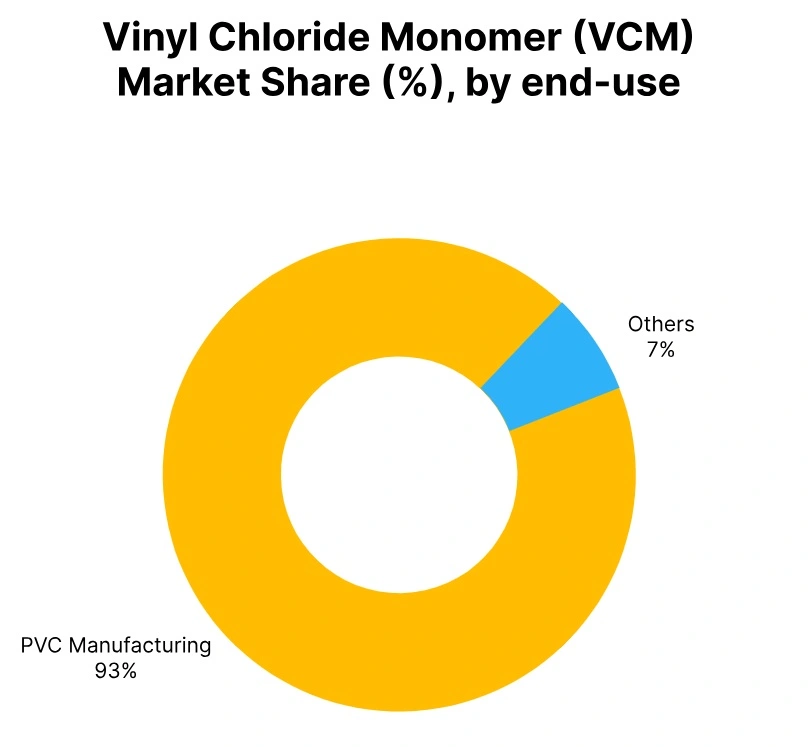
Vinyl Chloride Monomer Market Share end use

Historically, several events have caused significant fluctuations in Vinyl Chloride Monomer (vcm) prices

  • Inflation and Economic Instability (2023): Rising inflation rates and economic instability in various regions have impacted production costs and consumer demand, leading to fluctuations in VCM prices as markets reacted to changing economic conditions.
  • COVID-19 Pandemic (2020): The global pandemic led to widespread lockdowns, disrupting supply chains and reducing demand from industries like construction and automotive. This resulted in price volatility for VCM, with a notable decrease in early 2020 followed by a recovery as demand rebounded.
  • Hurricane Harvey (2017): This major hurricane impacted numerous petrochemical facilities in the Gulf Coast region of the USA, causing temporary shutdowns and leading to significant price spikes in VCM due to supply disruptions.
  • Oil Price Crash (2015-2016): The sharp decline in oil prices affected the cost of feedstocks used in VCM production, leading to fluctuating prices as producers adjusted to the new economic landscape.


These events underscore the VCM market’s vulnerability to global disruptions and highlight the need for continuous monitoring of supply-demand dynamics.

Why Price Watch™?

Price Watch™ is your trusted resource for tracking global vinyl chloride monomer (vcm) price trends. Our platform delivers real-time data and expert analysis, offering deep insights into the key factors driving price fluctuations in the vinyl chloride monomer (vcm) market. By monitoring critical events such as geopolitical tensions, supply chain disruptions, and economic shifts, Price Watch™ keeps you fully informed of market dynamics.

In addition, Price Watch™ provides detailed forecasts and updates on production capacities, enabling you to anticipate market changes and make well-informed decisions. With Price Watch™, you gain a competitive edge in understanding all the elements that influence vinyl chloride monomer (vcm) prices worldwide. Stay ahead of the curve with Price Watch’s™ reliable, accurate, and timely vinyl chloride monomer (vcm) market data.

Track Price Watch's™ vinyl chloride monomer (vcm) price assessment on a weekly basis since 2015 onwards, along with short-term forecasts, and get access to the detailed report in a downloadable format.

Vinyl Chloride Monomer (vcm) Market Price Trend published by 𝐏𝐫𝐢𝐜𝐞 𝐖𝐚𝐭𝐜𝐡™ reflect prevailing spot market conditions, derived from independent research, verified trade inputs, and proprietary market intelligence as of the publication date. Prices are published on the specified Incoterm and represent indicative base market levels, exclusive of applicable taxes, VAT, duties, tariffs, and other statutory charges. Actual transaction values may vary depending on volume, credit terms, contractual structure, and other negotiated conditions. Market prices are inherently subject to volatility, liquidity dynamics, regulatory changes, and evolving trade activity. The information provided is for reference and benchmarking purposes only and does not constitute an offer, recommendation, or guarantee of transactional outcomes. Users should exercise independent commercial judgment and assess their specific contractual, regulatory, tax, and application requirements before making business decisions. 𝐏𝐫𝐢𝐜𝐞 𝐖𝐚𝐭𝐜𝐡™ assumes no liability for decisions taken based on this information.

The pricing of vinyl chloride monomer is influenced by several key drivers, including global demand for PVC, feedstock costs (such as ethylene and chlorine), production capacity, and geopolitical factors that affect supply chains. Additionally, fluctuations in oil prices can indirectly impact VCM prices, as they are closely linked to the costs of raw materials used in its production.

Regulatory changes, such as environmental regulations and safety standards, can significantly impact the pricing of vinyl chloride monomer. Compliance with stricter regulations may lead to increased production costs for manufacturers, which can subsequently result in higher VCM prices. Procurement heads should monitor legislative developments to anticipate potential cost increases and adjust their sourcing strategies accordingly.

Global economic stability plays a crucial role in determining the demand for vinyl chloride monomer. Economic growth typically leads to increased construction and manufacturing activities, driving up the demand for PVC products and, consequently, VCM. Conversely, economic downturns can result in reduced demand, leading to price declines. Procurement professionals should consider macroeconomic indicators when planning their purchasing strategies.

To mitigate risks associated with vinyl chloride monomer price volatility, procurement heads can adopt several strategies, such as establishing long-term contracts with suppliers, diversifying their supplier base, and implementing hedging strategies to lock in prices. Additionally, staying informed about market trends and maintaining open communication with suppliers can help in negotiating better terms and navigating price fluctuations effectively.

Vinyl Chloride Monomer (VCM) is a colorless gas used as a key raw material in producing Polyvinyl Chloride (PVC). Its price directly impacts the cost of downstream products such as pipes, cables, flooring, packaging materials, and construction components. Since PVC is widely used across infrastructure, automotive, and packaging industries, VCM pricing plays a crucial role in global manufacturing economics. 𝐏𝐫𝐢𝐜𝐞 𝐖𝐚𝐭𝐜𝐡™ tracks these prices to help businesses stay informed about market movements.

VCM prices vary across regions and are usually quoted per metric ton. Prices fluctuate based on supply-demand balance, feedstock costs, and energy prices. 𝐏𝐫𝐢𝐜𝐞 𝐖𝐚𝐭𝐜𝐡™ provides real-time price tracking across global markets to support informed decision-making.

VCM prices fluctuate due to feedstock ethylene and chlorine costs, crude oil trends, and energy prices. Demand from PVC production significantly influences pricing movements. Production rates, plant shutdowns, and global trade flows also impact supply. Logistics costs, seasonal construction demand, and macroeconomic conditions further shape the market. Recent volatility has reflected energy price fluctuations and geopolitical disruptions affecting petrochemical supply chains.

The largest consumers of VCM are PVC manufacturers serving construction, infrastructure, and packaging industries. Additional demand comes from automotive, electrical cable, healthcare, and consumer goods sectors. These industries rely heavily on PVC-based products, making VCM demand closely tied to industrial and infrastructure growth. 𝐏𝐫𝐢𝐜𝐞 𝐖𝐚𝐭𝐜𝐡™ monitors demand trends across these sectors.

VCM is produced primarily through the chlorination of ethylene to form ethylene dichloride (EDC), followed by thermal cracking to produce VCM. This process is integrated within large petrochemical complexes. Major producers operate in regions with strong petrochemical infrastructure and access to feedstocks like ethylene and chlorine.

VCM exports are dominated by regions with large-scale petrochemical production, including the United States, the Middle East, and parts of Asia. Countries such as the USA, Qatar, and South Korea play key roles in global trade. Export volumes depend on domestic PVC demand, production economics, and feedstock availability. 𝐏𝐫𝐢𝐜𝐞 𝐖𝐚𝐭𝐜𝐡™ tracks trade flows and export trends to provide market insights.

Global supply generally meets demand, but regional imbalances can occur. Plant maintenance, feedstock shortages, or logistics disruptions may tighten supply temporarily. Sudden increases in PVC demand can also create short-term supply pressure. 𝐏𝐫𝐢𝐜𝐞 𝐖𝐚𝐭𝐜𝐡™ monitors such imbalances to provide early market signals.

VCM is typically available in high-purity industrial grades, such as 99.98%, used for PVC production. Pricing differences arise from purity levels, handling requirements, and transportation conditions. Storage and safety requirements also influence cost variations. 𝐏𝐫𝐢𝐜𝐞 𝐖𝐚𝐭𝐜𝐡™ provides price assessments based on grade and regional specifications.

When VCM demand rises sharply, prices tend to increase due to tighter supply. PVC producers may increase procurement, reducing availability in the spot market. Suppliers may prioritize long-term contracts, leading to higher spot prices. 𝐏𝐫𝐢𝐜𝐞 𝐖𝐚𝐭𝐜𝐡™ captures these real-time market dynamics.

Energy plays a major role in VCM production costs. Rising crude oil, natural gas, and electricity prices increase production and transportation expenses. Feedstock ethylene costs are also linked to energy markets, making VCM pricing sensitive to energy fluctuations. 𝐏𝐫𝐢𝐜𝐞 𝐖𝐚𝐭𝐜𝐡™ analyzes these cost correlations in detail.

VCM prices vary by region due to differences in feedstock availability, energy costs, production capacity, and logistics. Import-dependent regions often face higher prices due to freight costs. Regions with integrated petrochemical complexes typically benefit from lower production costs. 𝐏𝐫𝐢𝐜𝐞 𝐖𝐚𝐭𝐜𝐡™ tracks regional pricing differences globally.

VCM price outlook depends on ethylene feedstock trends, crude oil prices, energy costs, and PVC demand growth. Capacity expansions, plant shutdowns, and global trade flows also influence forecasts. Macroeconomic conditions and infrastructure activity further shape demand. 𝐏𝐫𝐢𝐜𝐞 𝐖𝐚𝐭𝐜𝐡™ provides detailed forecasts based on supply-demand analysis and market trends.

Yes, accurate forecasts help businesses plan procurement, manage costs, and negotiate contracts effectively. Anticipating price movements allows companies to optimize inventory and reduce risk. 𝐏𝐫𝐢𝐜𝐞 𝐖𝐚𝐭𝐜𝐡™ supports strategic decision-making with reliable forecasts.

Global events such as geopolitical tensions, natural disasters, and trade disruptions can affect feedstock supply and logistics. Conflicts impacting oil supply routes can increase energy costs, raising VCM prices. Plant outages and shipping disruptions also contribute to market volatility. 𝐏𝐫𝐢𝐜𝐞 𝐖𝐚𝐭𝐜𝐡™ provides timely updates on such developments.

𝐏𝐫𝐢𝐜𝐞 𝐖𝐚𝐭𝐜𝐡™ gathers data from global producers, suppliers, and buyers to provide accurate price assessments. Regular reports, market insights, and forecasts help businesses understand pricing trends. Its transparent methodology ensures reliable and actionable market intelligence.