Vitamin B3 (niacin) Price Trend and Forecast

Weekly Update
|
Historical Data Since 2015
|
Forecast for 2026
  • Commodity Pricing

vitamin b3 (niacin) Price Trends by Country

cnChina

Global vitamin b3 (niacin) Spot Market Prices, Trend Analysis and Forecast

𝐏𝐫𝐢𝐜𝐞 𝐖𝐚𝐭𝐜𝐡™ provides price assessments for Vitamin B3 (Niacin) across top trading regions:


Asia-Pacific

  • Vitamin B3 (Niacin) Nicotinamide (>99%) (Powder) FOB Shanghai, China
  • Vitamin B3 (Niacin) Nicotinamide (>99%) (Powder) Ex-Zhejiang, China
  • Vitamin B3 (Niacin) Nicotinamide (>99%) (Powder) Ex-Mumbai, India
  • Vitamin B3 (Niacin) Nicotinamide (>99%) (Powder) CIF Nhava Sheva (China), India


Note:
In assessments structured as CIF [Importing Port] (Exporting Country), the country mentioned in brackets indicates the primary origin of supply (exporting country), while the named port refers to the destination port in the importing country. Other Incoterms (FOB, FD, EXW, etc.) should be interpreted in accordance with standard international trade definitions.

Vitamin B3 (Niacin) Price Trend Q4 2025

In Q4 2025, the Vitamin B3 (Niacin) Nicotinamide market in China and India remained largely stable, with prices moving within a narrow range amid balanced supply and subdued downstream demand. Market dynamics in both countries were supported by steady operating rates and comfortable inventory levels, while procurement from the pharmaceutical, nutraceutical, and food-fortification sectors stayed cautious. In China, prices declined within the 0-1% quarter-on-quarter range due to muted domestic consumption and limited export activity. Similarly, in India, prices eased within the 0-1% range reflecting measured trading sentiment and competitive pricing across the broader Asian market. Overall, both markets remained range-bound during the quarter, as the absence of supply disruptions or significant cost pressures prevented any sharp directional shift in pricing.

China: Vitamin B3 (Niacin) Export prices FOB Shanghai, China, Nicotinamide (>99%) (Powder)

In Q4 2025, Vitamin B3 (Niacin) Nicotinamide (>99%) (Powder) prices in China showed marginal softening, reflecting muted downstream demand and steady domestic supply. Prices registered a 0.43% quarter-on-quarter decline. Procurement from pharmaceutical, nutrition and food-fortification sectors remained slow while adequate inventories and stable operating rates across major manufacturers limited price recovery. Export demand also remained modest adding to the subdued market tone. Overall, the market stayed range-bound through the quarter with no clear demand-side trigger to drive a directional shift in pricing in the near term. Despite ongoing supply-side pressure, the absence of aggressive destocking or significant cost volatility helped keep prices largely range bound.

India: Vitamin B3 (Niacin) Domestically Traded prices Ex-Mumbai, India, Nicotinamide (>99%) (Powder)

In Q4 2025, domestic prices of Vitamin B3 (Niacin) in India for Nicotinamide (>99%) powder remained largely steady averaging USD 5,020-5,045 per metric ton and recording a marginal quarter-on-quarter decline of 0.62%. The slight correction reflected balanced supply conditions and stable production levels which were broadly aligned with moderate demand from the pharmaceutical and nutraceutical sectors. Comfortable inventory availability and cautious purchasing kept trading activity measured, while competitive pricing across the wider Asian market prevented any notable upside. Production operations remained consistent throughout the quarter, ensuring uninterrupted supply. Overall sentiment stayed neutral to slightly soft, with prices expected to move within a narrow range unless supported by stronger downstream demand or shifts in upstream cost dynamics in the coming months.

Vitamin B3 (Niacin) Price Trend Analysis: Q4 2025

In the third quarter of 2025, the worldwide market for Vitamin B3 (Niacin) Nicotinamide showed a largely soft sentiment because of weaker downstream demand and stable supply conditions in key producing regions. Vitamin B3 (Niacin) price trends have been impacted by weak buying activity from pharmaceutical, nutrition and food-fortification customers, competitive domestic offers in China, and steady operating rates in plants that kept overall price movements moderate and within 7-9% for most of the quarter.

A generous supply environment, with inventories in a comfortable position, stable raw material prices, and predictable production, managed to hold overall price volatility in check, despite soft consumption trends. While demand continues to be cautious among the professional nutrition and health-products categories, continued demand for baseline, industrial, and formulation requirements has thus far helped to partially stabilize the market.

China: Vitamin B3 (Niacin) Export prices FOB Shanghai, China.

According to Price-Watch, in Q3 2025, Vitamin B3 (Niacin) Nicotinamide (>99%) (Powder) prices in China experienced a clear downward adjustment amid softened demand and steady domestic supply. Vitamin B3 (Niacin) Nicotinamide (>99%) (Powder) price trend in China declined due to muted procurement from pharmaceutical, nutrition, and food-fortification sectors, competitive domestic offers, and stable production rates across major manufacturers, keeping the market within the USD 4,000-4,250 per metric ton range.

Market sentiment remained bearish throughout the quarter, influenced by subdued downstream consumption, adequate inventory levels, and limited export momentum that further constrained price recovery. In September 2025, Vitamin B3 (Niacin) price trends in China decreased by 7.91%, driven by persistent supply-side pressure and restrained purchasing behaviour, with these dynamics expected to guide pricing trends into the next quarter.

By Q1 2025, according to PriceWatch, the Vitamin B3 (Niacin) Nicotinamide (>99%) market experienced another sharp fall, with prices dropping to USD 4883.33/MT, representing a -13.77% quarter-on-quarter decrease. This decline was largely due to ongoing weak demand from the international feed and food additive sectors, coupled with aggressive price undercutting among Chinese exporters to offload accumulated inventories.

The lack of any major bullish triggers, along with bearish sentiment in the global vitamin market, kept the purchasing momentum sluggish. Supply remained robust, and oversupply conditions prevailed, further driving the correction in FOB Shanghai prices.  

Vitamin B3 (Niacin) Price Trend Analysis: Q4 2024

In Q4 2024, the Vitamin B3 (Niacin) Nicotinamide (>99%) prices corrected significantly to USD 5663.33/MT, declining by -12.87%. The correction was expected as the market adjusted from the inflated Q3 highs. Increased production resumption in Chinese plants, along with the liquidation of stockpiles accumulated earlier, contributed to the downturn.

Additionally, demand from key sectors normalized in the post-peak season, reducing the urgency for bulk purchases. Export activity also slowed slightly due to improved global availability, putting further downward pressure on prices as competition increased. 

In Q3 2024, the Vitamin B3 (Niacin) Nicotinamide (>99%) market witnessed a sharp surge, with prices jumping to USD 6500/MT, a significant +36.13% increase from Q2. This steep upward movement was driven by a mix of factors including supply-side constraints due to temporary maintenance shutdowns at some key plants in China, and a global spike in demand from pharmaceutical formulations and premix manufacturers.

Export demand also picked up strongly during this quarter, further tightening available volumes in the domestic market. The surge was exacerbated by speculative buying and restocking across the value chain, pushing FOB prices higher. 

In Q2 2024 saw a modest recovery in Vitamin B3 (Niacin) Nicotinamide (>99%) prices, with the average price increasing to USD 4775/MT, a +1.60% rise quarter-on-quarter. This positive movement was largely supported by replenishment activities from downstream users in both food and pharmaceutical segments, and slight tightening of inventories among traders.

While production levels remained consistent, minor logistical inefficiencies and early summer demand uplift helped keep prices slightly elevated. Nonetheless, the market tone remained conservative as buyers resisted aggressive pricing amid broader macroeconomic caution. 

In Q1 2024, the Vitamin B3 (Niacin) Nicotinamide (>99%) FOB Shanghai market in China experienced a marginal decline, with prices averaging USD 4700/MT, marking a slight -0.91% drop from the previous quarter. The market sentiment during this period remained largely neutral, as a stable supply from domestic manufacturers met moderate demand from both the pharmaceutical and feed additive industries.

There were no significant supply chain disruptions or policy changes during this time, keeping the market relatively steady. However, the slight drop was attributed to cautious downstream buying and the absence of strong demand triggers in the post-winter recovery phase. 

Technical Specifications of Vitamin B3 (niacin) Price Trends

Product Description

Vitamin B3, also known as niacin, is a water-soluble vitamin essential for numerous critical functions in the body. It plays a key role in converting carbohydrates, fats, and proteins into energy, supporting cellular metabolism and overall vitality. Vitamin B3 is also important for maintaining healthy skin, nerves, and digestive system function. As the body cannot store significant amounts of this vitamin, it must be regularly obtained through diet or supplements to ensure proper physiological processes and prevent deficiency-related conditions.

Identifiers and Classification:

  • CAS No – 59-67-6
  • HS Code – 29362400
  • Molecular Formula – C6H5NO2
  • Molecular Weight[g/mol] – 123.1094 g/mol


Vitamin B3 (Niacin) Synonyms:

  • Niacin
  • Niacinamide
  • Vitamin B3 (Niacin) Grades Specific Price Assessment:
  • Nicotinamide (>99%) (Powder) Price Trend


Vitamin B3 (Niacin) Global Trade and Shipment Terms

  • Quotation Terms (Product & Country Specific): 5-6 MT
  • Packaging Type (Product & Country Specific): Bag


Incoterms Referenced in Vitamin B3 (Niacin) Price Reporting

Shipping Term  Location  Definition 
FOB Shanghai  Shanghai, China  Vitamin B3 (Niacin) Export price from China 
Ex-Zhejiang  Zhejiang, China  Domestically Traded Vitamin B3 (Niacin) price in China 

*Quotation Terms refers to the quantity range specified for the Vitamin B3 (Niacin) being quoted or offered in a commercial transaction.

**Packaging Type refers to standard packaging size commonly used for Vitamin B3 (Niacin) packing, ease of handling, transportation, and storage in industrial and commercial applications.

Key Vitamin B3 (Niacin) Producing Regions and Countries

Region  Country 
Shanghai  China 
Zhejiang  China 

Vitamin B3 (niacin) Industrial Applications

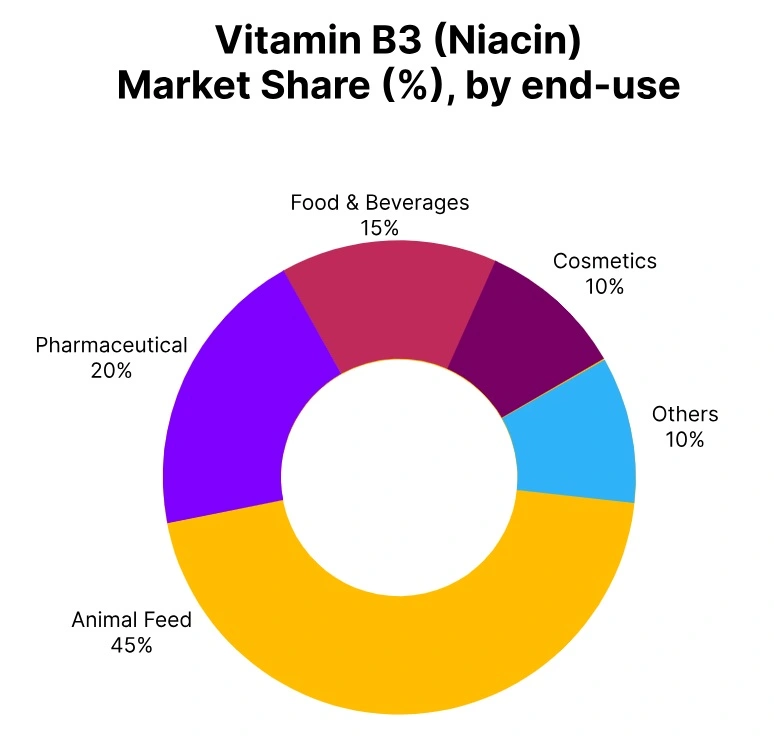
vitamin b3 market share end use

Historically, several events have caused significant fluctuations in Vitamin B3 (niacin) prices

Geopolitical Tensions and Currency Fluctuations (2024): In 2024, the vitamin B3 market was notably impacted by rising geopolitical tensions, particularly between major exporting and importing countries. Trade uncertainties and new tariffs on chemical intermediates led to increased costs for vitamin B3 manufacturers, especially in Asia and Europe. At the same time, significant currency fluctuations affected the purchasing power of buyers in emerging markets, causing erratic shifts in demand and price negotiations. These combined factors resulted in short-term price spikes and forced many companies to re-evaluate their procurement and hedging strategies to manage ongoing volatility 

Pandemic-Driven Demand Surge and Market Tightness (2020-2021): The onset of the COVID-19 pandemic in 2020 triggered a sharp increase in demand for vitamin B3 supplements, as consumers worldwide sought to bolster their immune systems and overall health. This surge in demand coincided with widespread manufacturing slowdowns and transportation restrictions, resulting in temporary shortages and elevated prices for both niacin and niacinamide. The nutraceutical and pharmaceutical sectors, in particular, experienced procurement challenges as supply chains were strained by lockdowns and export controls, highlighting the vulnerability of global vitamin markets to sudden systemic shocks 

Market Expansion and Raw Material Constraints (2018): In 2018, the vitamin B3 market saw robust growth driven by rising health awareness and expanding applications in dietary supplements, animal feed, and cosmetics. However, this expansion also exposed the industry to raw material constraints, as climate anomalies and fluctuating agricultural yields affected the availability of plant-based sources like rice bran. These supply-side pressures led to intermittent price increases and prompted manufacturers to invest in advanced extraction and biosynthesis techniques to ensure consistent quality and output. The period underscored the importance of resilient sourcing strategies and technological innovation in stabilizing vitamin B3 prices amid growing global demand. 

Why Price Watch™?

Price Watch™ is your trusted resource for tracking global vitamin b3 (niacin) price trends. Our platform delivers real-time data and expert analysis, offering deep insights into the key factors driving price fluctuations in the vitamin b3 (niacin) market. By monitoring critical events such as geopolitical tensions, supply chain disruptions, and economic shifts, Price Watch™ keeps you fully informed of market dynamics.

In addition, Price Watch™ provides detailed forecasts and updates on production capacities, enabling you to anticipate market changes and make well-informed decisions. With Price Watch™, you gain a competitive edge in understanding all the elements that influence vitamin b3 (niacin) prices worldwide. Stay ahead of the curve with Price Watch’s™ reliable, accurate, and timely vitamin b3 (niacin) market data.

Track Price Watch's™ vitamin b3 (niacin) price assessment on a weekly basis since 2015 onwards, along with short-term forecasts, and get access to the detailed report in a downloadable format.

Vitamin B3 (niacin) Market Price Trend published by 𝐏𝐫𝐢𝐜𝐞 𝐖𝐚𝐭𝐜𝐡™ reflect prevailing spot market conditions, derived from independent research, verified trade inputs, and proprietary market intelligence as of the publication date. Prices are published on the specified Incoterm and represent indicative base market levels, exclusive of applicable taxes, VAT, duties, tariffs, and other statutory charges. Actual transaction values may vary depending on volume, credit terms, contractual structure, and other negotiated conditions. Market prices are inherently subject to volatility, liquidity dynamics, regulatory changes, and evolving trade activity. The information provided is for reference and benchmarking purposes only and does not constitute an offer, recommendation, or guarantee of transactional outcomes. Users should exercise independent commercial judgment and assess their specific contractual, regulatory, tax, and application requirements before making business decisions. 𝐏𝐫𝐢𝐜𝐞 𝐖𝐚𝐭𝐜𝐡™ assumes no liability for decisions taken based on this information.

Vitamin B3 prices in the global market are influenced by factors such as raw material availability, manufacturing costs, and supply chain disruptions including transportation delays and plant productions. Demand growth driven by rising health awareness, lifestyle diseases, and expansion in nutraceutical, pharmaceutical, and animal feed sectors also supports price increases. Additionally, technological advances, regulatory changes, regional production capacities—especially in Asia Pacific—and competitive market dynamics shape pricing trends worldwide

Supply chain disruptions significantly impact the pricing of Vitamin B3 by reducing the availability of intermediates, increasing transport costs, and causing delays or interruptions in production and delivery. When prompt delivery becomes difficult and lower-priced material is scarce, prices tend to firm up, as seen during periods of plant shutdowns, force majeure events, or logistical bottlenecks. Even if overall demand is stable or weak, such disruptions can temporarily halt price declines or trigger short-term increases, with the market often reacting cautiously as buyers and suppliers adjust to the new supply landscape. In volatile periods, uncertainty about future availability and costs can further drive price fluctuations, making it challenging for industry players to secure stable contracts and predict long-term trends.

Regional price differences for Vitamin B3 are currently modest, with prices stable and relatively low across Asia, Europe, and North America, despite supply disruptions China as the dominant global supplier has played a key role in driving prices downward, with aggressive pricing from leading Chinese producers and increased supply helping to keep global prices soft even after temporary shortages or plant incidents. Procurement heads should adapt by closely monitoring Chinese production trends and supplier strategies, securing contracts in advance for the first and second quarters, and diversifying their supplier base to mitigate risks from unexpected disruptions. Staying agile and responsive to changes in Chinese market dynamics is essential, as shifts in output or export policies from China can quickly influence global and regional price spreads

Vitamin B3 (Niacin) also known as Niacin, is an essential water-soluble vitamin used widely in pharmaceuticals, nutrition, food fortification, and animal feed applications. It is available mainly as Nicotinic Acid and Nicotinamide, both critical for energy metabolism and overall health. Its price directly impacts the cost of vitamin supplements, fortified foods, pharmaceutical formulations, and feed premixes, making Vitamin B3 pricing an important factor for healthcare, nutrition, and feed industries worldwide. 𝐏𝐫𝐢𝐜𝐞 𝐖𝐚𝐭𝐜𝐡™ tracks these prices to help businesses and consumers understand and stay updated with the market trends.

Vitamin B3 (Niacin) prices vary by region and grade. Prices are typically quoted per metric ton and change based on raw material costs, production rates, demand from pharmaceutical, food, and feed sectors, and regional supply conditions. 𝐏𝐫𝐢𝐜𝐞 𝐖𝐚𝐭𝐜𝐡™ provides real-time price assessments across different global markets to help buyers and sellers make informed decisions.

Vitamin B3 prices fluctuate due to changes in production costs, raw material availability, operating rates at manufacturing facilities, and demand from downstream pharmaceutical, nutrition, and feed industries. Additional factors include energy and utility costs, export competition (particularly from China), inventory levels, regulatory requirements and broader economic conditions. Seasonal demand patterns and shifts between Nicotinic Acid and Nicotinamide consumption also influence market trends, with recent outlooks often shaped by soft downstream demand and competitive pricing pressure.

The largest consumers of Vitamin B3 are pharmaceutical manufacturers and nutraceutical producers, followed by food and beverage companies involved in fortification. Significant demand also comes from animal feed and premix manufacturers, especially for poultry, swine, and aquaculture nutrition. Cosmetic and personal care industries represent an additional niche segment. 𝐏𝐫𝐢𝐜𝐞 𝐖𝐚𝐭𝐜𝐡™ analyses demand patterns across all these industries.

Vitamin B3 is produced through chemical synthesis using intermediates derived from petrochemical or agrochemical sources. It is manufactured by specialized vitamin and chemical producers with production concentrated in regions that have strong chemical manufacturing infrastructure and access to key raw materials. Output levels depend on plant operating rates, regulatory compliance and market demand.

Global Vitamin B3 exports are led primarily by China which has extensive production capacity and competitive manufacturing costs. Europe and India also contribute to global supply mainly catering to regulated pharmaceutical and nutrition markets. Export volumes fluctuate based on operating rates, compliance standards, demand cycles and international trade conditions. 𝐏𝐫𝐢𝐜𝐞 𝐖𝐚𝐭𝐜𝐡™ tracks production levels, export flows and trade patterns to help businesses understand global supply chains and identify sourcing opportunities.

Overall supply generally meets global demand but short-term tightness can occur due to plant maintenance shutdowns, environmental inspections or sudden demand increases from pharmaceutical or feed sectors. Regional imbalances may arise from logistics disruptions or regulatory constraints. 𝐏𝐫𝐢𝐜𝐞 𝐖𝐚𝐭𝐜𝐡™ monitors these supply-demand imbalances to alert the market about potential shortages or surpluses.

Vitamin B3 is available in multiple grades, including pharmaceutical grade, food grade, and feed grade, each with distinct purity, particle size, and regulatory requirements. Nicotinamide typically commands prices due to broader pharmaceutical and nutrition usage. Pharma-grade products carry premiums because of stringent quality standards, certifications and traceability requirements, while feed-grade material trades at comparatively lower prices. 𝐏𝐫𝐢𝐜𝐞 𝐖𝐚𝐭𝐜𝐡™ provides separate price assessments for each grade to ensure market transparency.

When demand rises sharply often due to increased supplement consumption, higher feed inclusion rates, or stockpiling by pharmaceutical buyers prices tend to increase. Suppliers may prioritize contract customers while spot buyers face limited availability or higher offers. Such demand surges can create short-term price volatility. 𝐏𝐫𝐢𝐜𝐞 𝐖𝐚𝐭𝐜𝐡™ captures these market dynamics in real-time.

Energy costs play a significant role in Vitamin B3 production as synthesis processes are energy intensive and rely on stable utility supply. Rising electricity, steam or fuel prices increase manufacturing costs which producers may pass on to buyers. Transportation and logistics costs, also linked to energy prices, further influence final pricing. 𝐏𝐫𝐢𝐜𝐞 𝐖𝐚𝐭𝐜𝐡™ analyses in its price assessments & market reports.

Regional price differences arise from variations in production capacity, compliance and regulatory costs, energy prices, labor expenses, logistics, import duties and local demand conditions. Regions dependent on imports typically see higher prices while producing regions with surplus capacity often offer more competitive pricing. 𝐏𝐫𝐢𝐜𝐞 𝐖𝐚𝐭𝐜𝐡™ tracks prices across all major regions to highlight these differences.

The Vitamin B3 market outlook depends on production operating rates, raw material and energy cost trends, pharmaceutical and feed demand growth, regulatory developments and export competition. Inventory levels and macroeconomic conditions also influence price direction. 𝐏𝐫𝐢𝐜𝐞 𝐖𝐚𝐭𝐜𝐡™ regularly publishes detailed forecasts that project price movements for the next 12 months based on comprehensive analysis of supply additions, demand growth in key industries, seasonal patterns, and macroeconomic indicators. Our forecasts help businesses anticipate market conditions and plan accordingly.

Absolutely. Accurate price forecasts enable buyers to plan procurement, manage inventories, negotiate long-term contracts, and control costs more effectively. If 𝐏𝐫𝐢𝐜𝐞 𝐖𝐚𝐭𝐜𝐡™ forecasts predict a price increase in three months, you might choose to stock up now or lock in long-term contracts at current rates, potentially saving thousands of dollars.

Global events such as pandemics, environmental inspections, plant shutdowns, energy shortages, trade restrictions, geopolitical tensions or logistics disruptions can significantly impact Vitamin B3 supply and pricing. Sudden changes in healthcare demand and nutrition demand can also create volatility. 𝐏𝐫𝐢𝐜𝐞 𝐖𝐚𝐭𝐜𝐡™ provides timely alerts when such events affect the market.

𝐏𝐫𝐢𝐜𝐞 𝐖𝐚𝐭𝐜𝐡™ collects data from manufacturers, distributors, and buyers worldwide to publish regular price assessments, market reports, and forecasts. Our transparent methodology and comprehensive coverage make us a trusted source for understanding fair pricing and market trends in the Vitamin B3 (Niacin) industry.