Vitamin B7 (biotin) Price Trend and Forecast

Weekly Update
|
Historical Data Since 2015
|
Forecast for 2026
  • Commodity Pricing

vitamin b7 (biotin) Price Trends by Country

cnChina

Global vitamin b7 (biotin) Spot Market Prices, Trend Analysis and Forecast

𝐏𝐫𝐢𝐜𝐞 𝐖𝐚𝐭𝐜𝐡™ provides price assessments for Vitamin B7 (biotin) across top trading regions:


Asia-Pacific

  • Vitamin B7 (Biotin) D-Biotin_Pure (>98%) (USP) (Powder) FOB Shanghai, China
  • Vitamin B7 (Biotin) D-Biotin_Feed Grade (2%) (Powder) FOB Shanghai, China
  • Vitamin B7 (Biotin) D-Biotin_Pure (>98%) (USP) (Powder) Ex-Zhejiang, China
  • Vitamin B7 (Biotin) D-Biotin_Feed Grade (2%) (Powder) Ex-Zhejiang, China


Note:
In assessments structured as CIF [Importing Port] (Exporting Country), the country mentioned in brackets indicates the primary origin of supply (exporting country), while the named port refers to the destination port in the importing country. Other Incoterms (FOB, FD, EXW, etc.) should be interpreted in accordance with standard international trade definitions

Vitamin B7 (Biotin) Price Trend Q4 2025

In Q4 2025, the Vitamin B7 (Biotin) market in China has displayed a mixed pricing trend across Pure (>98%, USP) and Feed Grade (2%) segments. Prices for D-Biotin Pure have increased by around 1-2%, supported by steady demand from nutraceutical, pharmaceutical, and cosmetic sectors, along with controlled supply and moderate export activity.

In contrast, D-Biotin Feed Grade prices have remained slightly soft, declining by around 0-1%, reflecting cautious procurement from feed and premix manufacturers and sufficient inventory levels in the market. Overall, the market has maintained a balanced tone during the quarter, with stable production rates and moderate downstream demand supporting overall stability.

China: Vitamin B7 (Biotin) Export prices FOB Shanghai, China

According to Price-Watch™, in Q4 2025, Vitamin B7 (Biotin) D-Biotin Pure (>98%) (USP) (Powder) prices in China strengthened, registering a 1.94% quarter-on-quarter increase. The rise was driven by consistent demand from high-value nutraceutical and pharmaceutical applications, along with steady export inquiries and controlled supply.

Meanwhile, Vitamin B7 (Biotin) D-Biotin Feed Grade (2%) (Powder) prices in China showed slight softening, reflecting a 0.82% decline during the quarter. The Vitamin B7 (Biotin) D-Biotin Pure (>98%) (USP) (Powder) price trend in China attributed stable demand and Vitamin B7 (Biotin) D-Biotin Feed Grade (2%) (Powder) price trend in China has been attributed to moderate demand from the feed sector, sufficient availability, and competitive pricing among suppliers.

In December 2025, the Vitamin B7 (Biotin) D-Biotin Pure (>98%) (USP) (Powder) price showed increase of 0.76% and Vitamin B7 (Biotin) D-Biotin Feed Grade (2%) (Powder) remained stable as both grades remained almost stable, the overall market conditions expected to remain balanced in the near term.

Vitamin B7 (Biotin) Price Trend Analysis: Q4 2025

In the third quarter of 2025, the global Vitamin B7 (Biotin) market experienced contrasting sentiment across the Pure (>98%) USP grade and Feed Grade (2%) materials, which has been due to the differences in strength of downstream demand and purchasing patterns for these materials. Overall stability in the market has been supported by stable production levels and manageable raw material prices, however demand and purchase dynamics have been distinct between high-purity and feed-grade segments. As we move forward, changes in global restocking behavior, export competitiveness and changes in consumption in both nutritional and feed applications are expected to indicate Vitamin B7 (Biotin) price trend momentum into the next quarter.

China: Vitamin B7 (Biotin) Export prices FOB Shanghai, China.

According to Price-Watch, in Q3 2025, Vitamin B7 (Biotin) D-Biotin Pure (>98%) (USP) (Powder) and Vitamin B7 (Biotin) D-Biotin Feed Grade (2%) (Powder) exhibited contrasting price movements amid varying demand conditions and stable production availability in China. Vitamin B7 (Biotin) D-Biotin Pure (>98%) (USP) (Powder) price trend showed a modest upward adjustment as steady procurement from nutraceutical, pharmaceutical, and cosmetic sectors, alongside firm export inquiries, supported prices and kept the market within the USD 127,000-131,000 per metric ton range.

In contrast, Vitamin B7 (Biotin) D-Biotin Feed Grade (2%) (Powder) price trend experienced mild downward pressure driven by soft buying interest from feed and premix manufacturers, competitive domestic offers, and sufficient inventories among key producers, pushing prices into the USD 3,900-4,200 per metric ton range. Market sentiment remained mixed, with strong specialty-grade demand balancing weaker feed-grade activity.

In September 2025, Vitamin B7 (Biotin) D-Biotin Pure (>98%) (USP) (Powder) and Vitamin B7 (Biotin) D-Biotin Feed Grade (2%) (Powder) price trend moved by +2.6% and -3.2%, respectively, reflecting the divergence in downstream consumption patterns and purchasing behaviour, with these dynamics expected to shape pricing trends into the next quarter.

According to the PriceWatch, In Q2 2025, the Vitamin B7 (Biotin) market showed a mixed trend across its two key grades. The Pure 98% grade FOB Shanghai declined further to USD 126,766.67/MT, marking a -5.68% drop from Q1. This decrease was largely due to weak international demand from the pharmaceutical and nutraceutical sectors, where buyers continued to hold back amid the global economic slowdown and sufficient inventory levels.

On the other hand, the Feed 2% grade FOB Shanghai witnessed a mild recovery, rising to USD 4,193.89/MT, up +3.28%. This uptick was driven by increased feed formulation activity in Southeast Asia and moderate restocking from global feed mills, while stable supply kept the market balanced without triggering sharp price swings.

In Q1 2025 both grades of Vitamin B7 (Biotin) FOB Shanghai saw a clear price drop, but for different reasons tied to their specific end uses. The Pure 98% grade averaged USD 134,400.83/MT, down -6.63% from Q4, mainly due to weak export interest as major pharmaceutical and nutraceutical companies held back on purchases. Many global buyers already had enough inventory and were cautious due to currency fluctuations and slower economic growth.

On the other hand, the Feed 2% grade slipped more sharply by -9.09% to USD 4,060.83/MT FOB Shanghai, driven by post-holiday slowdown in China’s animal feed sector and soft international demand. Feed formulators stayed away from bulk buying as they relied on earlier stocks, while consistent production from Chinese plants kept supply stable and prices under pressure.

Vitamin B7 (Biotin) Price Trend Analysis: Q4 2024

In Q4 2024, the Vitamin B7 (Biotin) FOB Shanghai market showed mixed movement between the two grades. Vitamin B7 Pure 98% FOB Shanghai declined slightly to USD 143,938.89/MT, down -0.50%, as buyers in pharma and personal care industries slowed down fresh procurement, preferring to use their year-end inventories.

The market also saw increased competition among Chinese suppliers, which limited any price rise. In contrast, Feed 2% FOB Shanghai prices edged up to USD 4,466.67/MT, a +2.98% gain. This was supported by seasonal restocking from livestock feed producers in colder regions, particularly in Asia and Eastern Europe. Despite this mild demand improvement, the overall market tone remained cautious due to abundant availability.

In Q3 2024, Vitamin B7 (Biotin) FOB Shanghai both grades recorded price increases, but again for grade-specific reasons. Pure 98% Biotin FOB Shanghai rose to USD 144,666.67/MT, posting a +3.63% rise, backed by slight recovery in demand from overseas pharmaceutical companies and planned maintenance at a few Chinese production plants, which reduced immediate supply.

Meanwhile, the Feed 2% grade moved up to USD 4,337.30/MT FOB Shanghai, increasing +2.90% quarter-over-quarter as global feed mills, especially in Southeast Asia, began replenishing stocks ahead of the winter season. Although buyers remained cautious, improved trading volumes brought some firmness to the market.

In Q2 2024, Vitamin B7 (Biotin) FOB Shanghai prices for both grades continued to decline. Vitamin B7 Pure 98% FOB Shanghai fell sharply to USD 139,600/MT, down -8.02%, due to reduced export orders and oversupply from Chinese manufacturers who increased output after earlier high prices.

Global demand from the supplement sector also remained slow as buyers preferred cheaper alternatives. Similarly, the Feed 2% grade dropped to USD 4,215.11/MT FOB Shanghai, a -10.58% decrease. Weak interest from feed formulators in Southeast Asia, combined with aggressive pricing from small Chinese exporters led to additional price pressure.

In Q1 2024, the Vitamin B7 (Biotin) FOB Shanghai market saw the steepest fall in both grades as it adjusted from late 2023 highs. The Pure 98% grade averaged USD 151,766.67/MT FOB Shanghai, dipping slightly by -0.48% with balanced supply and demand from pharma and nutraceutical sectors keeping prices mostly steady.

However, Feed 2% FOB Shanghai prices collapsed by -28.76%, settling at USD 4,713.89/MT, due to excessive inventories from Q4 2023 and very weak buying interest from China’s livestock industry. Strong competition and high stock levels in the supply chain left little room for price support.

Technical Specifications of Vitamin B7 (biotin) Price Trends

Product Description

Vitamin B7 also known as Biotin is a water-soluble B-vitamin essential for fatty acid synthesis, amino acid metabolism, and glucose production. It plays a vital role in maintaining healthy skin, hair, and nails, and supports proper nervous system function. In the nutraceutical and pharmaceutical sectors, Biotin is widely used in dietary supplements and fortified foods for its role in energy metabolism and cellular health.

In animal nutrition, Biotin is routinely added to feed formulations for poultry, swine, ruminants, aquaculture, and companion animals to support hoof and skin health, improve feed efficiency, and enhance overall vitality. Its multifunctional benefits make it a key additive across human health, veterinary applications, and functional food industries, underscoring its broad relevance in promoting metabolic and structural well-being.

Identifiers and Classification:

  • HS Code – 29362950
  • CAS No – 58-85-5
  • Molecular Formula – C10H16N2O3S
  • Molecular Weight[g/mol] – 244.31 g/mol


Vitamin B7 (Biotin) Synonyms:

  • Vitamin H
  • Biotin
  • Coenzyme R
  • D-Biotin


Vitamin B7 (Biotin) Grades Specific Price Assessment:

  • Vitamin B7 (Biotin) D-Biotin Pure (>98%, USP) (Powder) Price Trend
  • Vitamin B7 (Biotin) D-Biotin Feed Grade (2%) (Powder) Price Trend


Vitamin B7 (Biotin) Global Trade and Shipment Terms

  • Quotation Terms (Product & Country Specific): 15-16 KGs
  • Packaging Type (Product & Country Specific): Bag


Incoterms Referenced in Vitamin B7 (Biotin) Price Reporting

Shipping Term  Location  Definition 
FOB Shanghai  Shanghai, China  Vitamin B7 (Biotin) Export price from China 
Ex-Zhejiang  Zhejiang, China  Domestically Traded Vitamin B7 (Biotin) price in China 

*Quotation Terms refers to the quantity range specified for the Vitamin B7 (Biotin) being quoted or offered in a commercial transaction.

**Packaging Type refers to standard packaging size commonly used for Vitamin B7 (Biotin) packing, ease of handling, transportation, and storage in industrial and commercial applications.

Key Vitamin B7 (Biotin) Producing Regions and Countries

Region  Country 
Shanghai  China 
Zhejiang  China 

Vitamin B7 (biotin) Industrial Applications

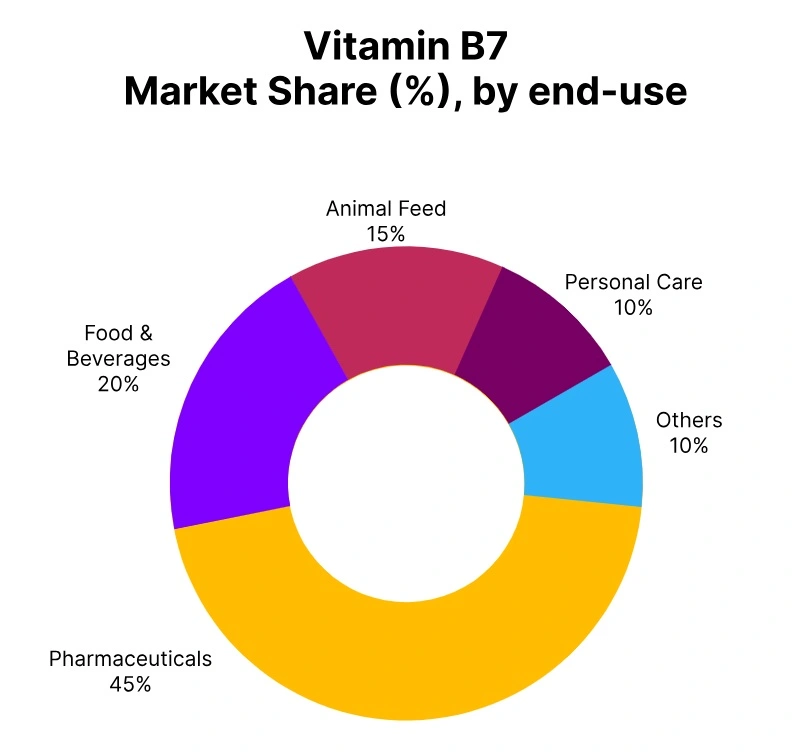
vitamin b7 market share end use

Historically, several events have caused significant fluctuations in Vitamin B7 (biotin) prices

Geopolitical Tensions and Trade Policy Impacts (2024–2025): Between 2024 and 2025, global Vitamin B7 (Biotin) prices experienced intermittent volatility due to shifting geopolitical dynamics and evolving trade policies. The imposition of tariffs and trade restrictions, particularly among key economies, disrupted international supply chains and led to sudden cost escalations for importers. These developments created significant uncertainty in procurement planning. Demand from the nutraceutical, pharmaceutical, and animal feed sectors remained strong, further intensifying market sensitivity to such external shocks. This period underscored the critical importance of proactive geopolitical risk assessment and diversified sourcing strategies for stakeholders across the Vitamin B7 supply chain.

COVID-19 Pandemic and Supply Chain Disruptions (2020–2021): During 2020 and 2021, the COVID-19 pandemic triggered widespread disruptions across global supply chains, significantly affecting Vitamin B7 (Biotin) production and distribution. Initial lockdowns, factory shutdowns, and transportation bottlenecks led to acute supply shortages and erratic price movements. Although industrial demand temporarily softened, a sharp rise in consumer awareness around immunity and preventive health drove a robust rebound in supplement consumption. This resurgence helped stabilize Biotin prices in the latter half of the period. The pandemic exposed critical vulnerabilities in global sourcing models and reinforced the need for supply chain resilience and diversification in the vitamin industry.

Raw Material Volatility and Cost-Push Inflation (2018–2019): Between 2018 and 2019, Vitamin B7 (Biotin) prices faced upward pressure due to sustained volatility in key upstream raw materials such as thiophene, fumaric acid, and hydrocyanic acid. Sharp fluctuations in crude oil prices and tightening environmental norms in China contributed to increased production costs for these intermediates. Additionally, intermittent shutdowns of chemical parks for safety inspections further strained raw material availability. These upstream pressures triggered cost-push inflation across the Biotin value chain, leading to higher offer prices globally. Manufacturers were compelled to pass on the increased costs to downstream sectors, particularly impacting pricing in the feed and pharmaceutical segments.

Impact of Environmental Regulations and Production Cuts in China (2016–2017):
In 2016 and 2017, Vitamin B7 (Biotin) prices surged sharply following stringent environmental regulatory enforcement in China, the dominant global supplier. Government-led crackdowns on pollution and industrial emissions forced the shutdown or production curtailment of several chemical and pharmaceutical manufacturing units, particularly in key provinces like Jiangsu and Zhejiang. The resulting contraction in Biotin output led to significant global supply tightness, causing prices to escalate across all major consuming regions. This episode highlighted China’s critical role in the Biotin supply chain and demonstrated how domestic regulatory shifts can have profound global implications for price stability and product availability.

Why Price Watch™?

Price Watch™ is your trusted resource for tracking global vitamin b7 (biotin) price trends. Our platform delivers real-time data and expert analysis, offering deep insights into the key factors driving price fluctuations in the vitamin b7 (biotin) market. By monitoring critical events such as geopolitical tensions, supply chain disruptions, and economic shifts, Price Watch™ keeps you fully informed of market dynamics.

In addition, Price Watch™ provides detailed forecasts and updates on production capacities, enabling you to anticipate market changes and make well-informed decisions. With Price Watch™, you gain a competitive edge in understanding all the elements that influence vitamin b7 (biotin) prices worldwide. Stay ahead of the curve with Price Watch’s™ reliable, accurate, and timely vitamin b7 (biotin) market data.

Track Price Watch's™ vitamin b7 (biotin) price assessment on a weekly basis since 2015 onwards, along with short-term forecasts, and get access to the detailed report in a downloadable format.

Vitamin B7 (biotin) Market Price Trend published by 𝐏𝐫𝐢𝐜𝐞 𝐖𝐚𝐭𝐜𝐡™ reflect prevailing spot market conditions, derived from independent research, verified trade inputs, and proprietary market intelligence as of the publication date. Prices are published on the specified Incoterm and represent indicative base market levels, exclusive of applicable taxes, VAT, duties, tariffs, and other statutory charges. Actual transaction values may vary depending on volume, credit terms, contractual structure, and other negotiated conditions. Market prices are inherently subject to volatility, liquidity dynamics, regulatory changes, and evolving trade activity. The information provided is for reference and benchmarking purposes only and does not constitute an offer, recommendation, or guarantee of transactional outcomes. Users should exercise independent commercial judgment and assess their specific contractual, regulatory, tax, and application requirements before making business decisions. 𝐏𝐫𝐢𝐜𝐞 𝐖𝐚𝐭𝐜𝐡™ assumes no liability for decisions taken based on this information.

Vitamin B7 (Biotin) prices are heavily influenced by developments in China, which accounts for the majority of global production. Strict environmental regulations, periodic factory inspections, and energy usage controls in key provinces like Jiangsu and Zhejiang often lead to output restrictions, tightening supply and driving up prices worldwide. Additionally, temporary plant closures for safety audits or policy compliance further disrupt manufacturing continuity. Export policies, including quotas or delays at ports, also affect international availability. Since the global market is highly dependent on Chinese supply, even minor regulatory or logistical changes within the country can create significant volatility in Biotin pricing across all regions.

Supply chain disruptions have a significant impact on the pricing of Vitamin B7 (Biotin) by constraining supply, increasing costs, and amplifying market volatility. Disruptions such as port congestion, container shortages, transport delays, or factory shutdowns especially in China, the dominant producer can interrupt the steady flow of Biotin to global markets. This leads to supply-demand imbalances, causing prices to spike, particularly in regions reliant on imports. Additionally, disruptions in the sourcing of key intermediates and raw materials further compound production delays and elevate manufacturing costs. These ripple effects are quickly felt across downstream sectors like nutraceuticals, pharmaceuticals, and animal feed, where consistent supply is critical, making Biotin pricing highly sensitive to logistical and operational disturbances.

Vitamin B7 prices in China and Asia are generally more competitive due to localized production, abundant access to upstream raw materials, and lower manufacturing costs. However, prices within China can still vary based on regional policies, environmental regulations, and production capacities in key provinces. Procurement heads operating in or sourcing from China should closely monitor policy changes, plant operating rates, and local inspections that may lead to temporary supply disruptions. Establishing relationships with multiple certified domestic suppliers, maintaining flexible contracts, and tracking regional price movements across industrial clusters can help ensure stable procurement and minimize exposure to sudden price spikes.

Vitamin B7 (Biotin) is a water-soluble vitamin essential for carbohydrate, fat, and protein metabolism. It plays a key role in maintaining healthy hair, skin, and nails, and is widely used in pharmaceuticals, dietary supplements, food fortification, and animal feed applications. Biotin is also utilized in cosmetic and personal care formulations due to its benefits for hair and skin health. Its price is important because it directly impacts the cost of supplements, fortified foods, pharmaceutical products, and feed premixes. Fluctuations in Biotin pricing can significantly influence production costs and procurement strategies, making it an important commodity in global nutrition and healthcare markets. 𝐏𝐫𝐢𝐜𝐞 𝐖𝐚𝐭𝐜𝐡™ tracks these prices to help businesses and consumers understand and stay updated with the market trends.

Vitamin B7 (Biotin) prices vary depending on grade, concentration ( such as 2%, or pure Biotin), and region. Prices are typically quoted per metric ton and fluctuate based on raw material availability, production rates, and demand from pharmaceutical, food, feed, and cosmetic industries. High-purity Biotin used in pharmaceuticals and cosmetics typically commands higher prices. 𝐏𝐫𝐢𝐜𝐞 𝐖𝐚𝐭𝐜𝐡™ provides real-time price assessments across different global markets to help buyers and sellers make informed decisions.

Vitamin B7 (Biotin), prices are influenced by raw material costs, production operating rates, and demand from nutraceutical, pharmaceutical, feed, and cosmetic sectors. Additional factors include energy and utility costs, environmental regulations, export competition particularly from China and inventory levels. Market trends are also shaped by fluctuations in demand for personal care and dietary supplements.

The largest consumers of Biotin include nutraceutical and pharmaceutical manufacturers, followed by cosmetic and personal care companies. The animal feed industry also contributes to demand, particularly for poultry and swine nutrition. Food and beverage fortification represents an additional segment. 𝐏𝐫𝐢𝐜𝐞 𝐖𝐚𝐭𝐜𝐡™ analyses demand patterns across all these industries.

Vitamin B7 is produced through chemical synthesis, although some quantities may also be derived via biotechnological processes. Manufacturing is carried out by specialized chemical and vitamin producers with advanced processing capabilities and strict quality control standards. Production depends on plant operating rates, raw material availability, and demand conditions.

Global Vitamin B7 exports are led primarily by China which is the leading exporter of Vitamin B7 due to its strong production capacity and cost competitiveness. Other regions, including Europe and India, contribute to global supply, particularly for high-purity pharmaceutical-grade material. Export volumes are influenced by production levels, regulatory standards, and global demand. 𝐏𝐫𝐢𝐜𝐞 𝐖𝐚𝐭𝐜𝐡™ tracks production levels, export flows and trade patterns to help businesses understand global supply chains and identify sourcing opportunities.

Overall supply generally meets global demand but short-term tightness can occur due to plant maintenance shutdowns, environmental inspections or sudden demand increases from pharmaceutical or feed sectors. Regional imbalances may arise from logistics disruptions or regulatory constraints. 𝐏𝐫𝐢𝐜𝐞 𝐖𝐚𝐭𝐜𝐡™ monitors these supply-demand imbalances to alert the market about potential shortages or surpluses.

Vitamin B7 is available in pharmaceutical, food, and feed grades, as well as in various concentrations such as pure Biotin and diluted forms.Pharmaceutical and cosmetic-grade Biotin commands higher prices due to stringent quality standards and higher purity requirements, while feed-grade material is comparatively lower priced. 𝐏𝐫𝐢𝐜𝐞 𝐖𝐚𝐭𝐜𝐡™ provides separate price assessments for each grade to ensure market transparency.

A sudden increase in demand, particularly from supplement and cosmetic industries, can lead to price increases due to limited short-term supply flexibility. Suppliers may prioritize long-term contracts, reducing spot market availability and pushing prices upward. This can create short-term market volatility. 𝐏𝐫𝐢𝐜𝐞 𝐖𝐚𝐭𝐜𝐡™ captures these market dynamics in real-time.

Energy costs play a significant role in Biotin production, as chemical synthesis processes require stable energy inputs. Rising electricity, fuel, and utility costs increase production expenses, which are often passed on to buyers. Transportation and logistics costs further impact final pricing. 𝐏𝐫𝐢𝐜𝐞 𝐖𝐚𝐭𝐜𝐡™ analyses in its price assessments & market reports.

Regional price differences arise from variations in production capacity, compliance and regulatory costs, energy prices, labor expenses, logistics, import duties and local demand conditions. Regions dependent on imports typically see higher prices while producing regions with surplus capacity often offer more competitive pricing. 𝐏𝐫𝐢𝐜𝐞 𝐖𝐚𝐭𝐜𝐡™ tracks prices across all major regions to highlight these differences.

The Vitamin B7 market outlook depends on production operating rates, raw material and energy cost trends, pharmaceutical and feed demand growth, regulatory developments and export competition. Inventory levels and macroeconomic conditions also influence price direction. 𝐏𝐫𝐢𝐜𝐞 𝐖𝐚𝐭𝐜𝐡™ regularly publishes detailed forecasts that project price movements for the next 12 months based on comprehensive analysis of supply additions, demand growth in key industries, seasonal patterns, and macroeconomic indicators. Our forecasts help businesses anticipate market conditions and plan accordingly.

Absolutely. Accurate price forecasts enable buyers to plan procurement, manage inventories, negotiate long-term contracts, and control costs more effectively. If 𝐏𝐫𝐢𝐜𝐞 𝐖𝐚𝐭𝐜𝐡™ forecasts predict a price increase in three months, you might choose to stock up now or lock in long-term contracts at current rates, potentially saving thousands of dollars.

Global events such as pandemics, environmental inspections, plant shutdowns, energy shortages, trade restrictions, geopolitical tensions or logistics disruptions can significantly impact Vitamin B7 supply and pricing. Sudden changes in healthcare demand and nutrition demand can also create volatility. 𝐏𝐫𝐢𝐜𝐞 𝐖𝐚𝐭𝐜𝐡™ provides timely alerts when such events affect the market.

𝐏𝐫𝐢𝐜𝐞 𝐖𝐚𝐭𝐜𝐡™ collects data from manufacturers, distributors, and buyers worldwide to publish regular price assessments, market reports, and forecasts. Our transparent methodology and comprehensive coverage make us a trusted source for understanding fair pricing and market trends in the Vitamin B7 (Biotin) industry.