
Vitamin B9 (folic Acid) Price Trend and Forecast

⟳ Weekly Update
|
Historical Data Since 2015
|
Forecast for 2026
  • Commodity Pricing

vitamin b9 (folic acid) Price Trends by Country

cnChina

Global vitamin b9 (folic acid) Spot Market Prices, Trend Analysis and Forecast

Price Watchâ„¢ provides real-time price assessments and price forecasts for Vitamin B9 (Folic Acid) across top trading regions:

Vitamin B9 (Folic Acid) Regional Coverage Vitamin B9 (Folic Acid) Grade and Country Coverage Vitamin B9 (Folic Acid) Pricing Data Coverage Explanation   
Asia-Pacific Vitamin B9 (Folic Acid) Pricing Analysis Vitamin B9 (Folic Acid Food Grade (>96%) (POWDER) FOB Shanghai Prices at Shanghai Port, China Monthly Price Update on Vitamin B9 (Folic Acid) Real-Time Export Prices from Shanghai Port, China to Global Markets
Vitamin B9 (Folic Acid) Food Grade (>96%) (POWDER) Ex-Zhejiang Domestic Prices, China Real-Time Monthly Price Update of Vitamin B9 (Folic Acid) Domestic Prices in Zhejiang, China

Vitamin B9 (Folic Acid) Price Forecasts & Market Foresight Q3 2026

Outlook: Stable

Confidence: Medium- High

Vitamin B9 (Folic Acid) prices are expected to remain in a correction phase globally during Q3 2026, pressured by softer benzene and phenol feedstock costs, comfortable supply availability, and need-based procurement.

Europe is likely to witness the peak of the correction before stabilizing by September, while Asia may see subdued monsoon-hit demand and competitive export offers. North America is anticipated to follow a milder correction, with balanced fundamentals limiting sharp declines.

Global Vitamin B9 (Folic Acid) Market Overview by Region (July–September 2026)

Country Grade/ Incoterm Outlook
China Food Grade (>96%) (POWDER) FOB Shanghai Stable
China  Food Grade (>96%) (POWDER) Ex-Zhejiang Stable

*Vitamin B9 (Folic Acid) Forecast represents an analytical assessment based on information available at the time of publication. Actual market prices may vary due to unforeseen operational, regulatory, geopolitical, or economic developments.

Explore the Complete Price Watch™ Vitamin B9 (Folic Acid) Forecast

Access comprehensive Vitamin B9 (Folic Acid) market intelligence, including a 3-Month Rolling Forecast, 12-Month Price Forecast, forward price curves, country-wise market outlooks, procurement insights, and monthly forecast updates.

Explore Price Watch™ Vitamin B9 (Folic Acid) Forecasts

What’s Included

The 3-Month Forecast (Updated Monthly)

It reflects changes in vitamin intermediate and raw material feedstock costs, energy prices, producer operating rates, plant outages, inventory levels, trade flows, freight rates, regional demand, and geopolitical developments affecting the global Vitamin B9 (Folic Acid) market.

The 12-Month Forecast (Published Annually)

It provides a strategic outlook based on expected capacity additions, supply-demand balances, feedstock economics, macroeconomic conditions, industrial production trends, trade policies, seasonal demand patterns, and long-term supply chain developments, supporting procurement, budgeting, and strategic planning.

Our Proprietary Hybrid Forecasting Model Evaluates:

  • Feedstock & production economics
  • Plant operating rates & outages
  • Inventory and supply-demand balance
  • Regional trade flows & freight
  • Import-export dynamics
  • Macroeconomic & geopolitical developments

Track Supply Chain Disruptions in Real Time

As geopolitical risks continue to reshape global supply chains, stay ahead of the events that drive price movements by monitoring plant shutdowns, maintenance turnarounds, force majeure events, logistics bottlenecks, trade restrictions, and operational disruptions before they impact Vitamin B9 (Folic Acid) markets.

Access the Price Watch™ GIO Tracker

Vitamin B9 (Folic Acid) Price Trend Q2 2026

During the Vitamin B9 (Folic Acid) Food Grade (>96%) price chart maintained a firm but controlled upward trend, supported by consistent demand from pharmaceutical manufacturers, food fortification companies, and dietary supplement producers.

Purchasing activity remained steady as folic acid continued to be widely used in prenatal formulations, fortified cereals, nutritional beverages, and multivitamin products.

Market participants largely followed contract-based procurement strategies, while stable manufacturing operations and balanced supply conditions prevented excessive price volatility. Overall, the combination of healthy downstream consumption and disciplined supplier pricing contributed to a moderate quarter-on-quarter increase in Vitamin B9 prices.

China: Vitamin B9 (Folic Acid) Export prices FOB Shanghai, China

In Q2 2026, Vitamin B9 (Folic Acid) Food Grade (>96%) (POWDER) prices in China increased by 1.65%, reflecting stable procurement from pharmaceutical companies producing prenatal supplements and multivitamin formulations, as well as sustained demand from food fortification manufacturers.

Export transactions remained healthy as overseas buyers continued securing contract volumes for nutritional products, while producers maintained firm quotations supported by consistent order execution.

The Vitamin B9 (Folic Acid) price trend in China has  been primarily influenced by steady consumption across maternal healthcare, fortified food, and dietary supplement applications, along with stable contract fulfilment and balanced domestic availability, which collectively supported gradual price appreciation during the quarter.

In June 2026, Vitamin B9 (Folic Acid) prices in China increased by 1.39%, driven by improved procurement from nutraceutical manufacturers, higher export shipments for fortified food applications, and continued contract purchases by pharmaceutical companies ahead of scheduled production requirements.
Vitamin B9 (Folic Acid) Price Trend Analysis: Q1 2026

Vitamin B9 (Folic Acid) Price Trend Q1 2026

During Q1 2026, there have been noticeable firm trends in the vitamin b9 price trend movements for the Vitamin B9 (Folic Acid) Food Grade (>96%). The rising prices have been observed quarter-over-quarter due to constant demands from the pharmaceutical industry, nutraceuticals, and the food fortification market, coupled with regular procurement and balanced supplies.

Constant production levels and manageable inventories have helped in managing price increases within a certain limit without causing unnecessary volatility in the market.

China: Vitamin B9 (Folic Acid) Export prices FOB Shanghai, China

According to Price-Watchâ„¢ , in Q1 2026, Vitamin B9 (Folic Acid) Food Grade (>96%) (POWDER) prices in China have increased by 3.66%, driven by steady demand from food and pharmaceutical sectors, stable supply availability, and improved procurement activity.

The vitamin b9 price trend in China has been influenced by consistent downstream consumption, balanced inventory levels, and firm market sentiment, which have collectively supported the upward price movement during the quarter.

In March 2026, folic acid price trend in China increased slightly by 1.18%, primarily due to incremental restocking by buyers, stable export demand and minor tightening in spot availability, leading to a gradual price rise toward the end of the quarter.

Vitamin B9 (Folic Acid) Price Trend Analysis 2025

Vitamin B9 (Folic Acid) Price Trend Q1 2025

In Q1 2025, the global Vitamin B9 (Folic Acid) Food Grade (>96%) market witnessed a sharp upward shift, with FOB Shanghai prices surging by an estimated 40–48% as supply constraints intensified. Stricter environmental inspections significantly tightened availability and reduced spot market liquidity. Strong international demand, especially from fortified food and prenatal supplement manufacturers further escalated competition for the limited cargoes available. The tightness was exacerbated by speculative purchasing from traders, who pushed prices higher amid unclear production restart timelines. Overall, sentiment remained highly bullish throughout the quarter as buyers rushed to secure volumes in an environment of persistent uncertainty.

China

In Q1 2025 the Vitamin B9 (Folic Acid) market brought a significant surge in market pricing, with Folic Acid prices escalating sharply, a notable +45.55% increase from Q4. The spike was primarily driven by constrained supply resulting from unplanned shutdowns at two major Chinese production sites amid stricter environmental inspections. In parallel, robust international demand from the fortified food and prenatal supplement sectors intensified competition for limited spot cargoes. The sharp rally was also amplified by traders’ speculative buying, anticipating further price hikes amid uncertainties over production resumption timelines.

Vitamin B9 (Folic Acid) Price Trend Q2 2025

In Q2 2025, the global Vitamin B9 (Folic Acid) Food Grade (>96%) market extended its upward trend, with FOB Shanghai prices recording an estimated 5–7% increase as supply remained mildly constrained despite steadier production rates. Chinese manufacturers gradually stabilized operations, yet inventories stayed on the tighter side due to controlled output and steady offtake. Export demand remained strong, particularly from North and Latin America, where elevated input costs encouraged continued sourcing from China. Domestic buying from dietary supplements and functional beverage producers added further support. While the tempo of price gains slowed compared with Q1, sentiment stayed firm as buyers maintained proactive coverage ahead of potential Q3 adjustments.

China

In Q2 2025, the Vitamin B9 (Folic Acid) Food Grade >96% FOB Shanghai market extended its bullish trajectory, with prices rising further by +6.40%. Although production activity gradually stabilized, residual tightness in the supply chain persisted. Export inquiries remained strong, particularly from North America and Latin America, where local manufacturers faced input cost pressures. Domestically, increased demand from dietary supplement formulators and functional beverage producers supported price stability. While the pace of increase slowed compared to Q1, sentiment remained firm as buyers continued to secure volumes amid fear of further upward revisions in Q3.

Vitamin B9 (Folic Acid) Price Trend Q3 2025

In Q3 2025, the global Vitamin B9 (Folic Acid) Food Grade (>96%) market reflected a largely stable sentiment, characterized by balanced supply conditions and only mild downward pressure on prices. Vitamin B9 (Folic Acid) Food Grade (>96%) price trend was influenced by consistent production rates in China, adequate inventories, and subdued purchasing from pharmaceutical, nutraceutical, and food-fortification sectors, keeping overall price fluctuations within a very narrow 0-2% range during the quarter.

Stable raw material costs and predictable manufacturing output supported market steadiness, while restrained procurement and moderate export activity limited any potential upward movement. Although downstream demand remained soft, baseline consumption in essential health and nutrition applications provided some support to market stability. Looking ahead, shifts in regional restocking patterns, export competitiveness, and production discipline among major Chinese producers are expected to shape Vitamin B9 (Folic Acid) price trend dynamics into the next quarter.

China: Vitamin B9 (Folic Acid) Export prices FOB Shanghai, China.

According to Price-Watch, In Q3 2025, Vitamin B9 (Folic Acid) Food Grade (>96%, Powder) prices in China experienced a slight downward adjustment amid steady supply and subdued downstream demand. Vitamin B9 (Folic Acid) Food Grade (>96%, Powder) price trend in China softened marginally as muted procurement from pharmaceutical, nutraceutical, and food-fortification sectors, combined with competitive domestic offers and consistent production rates, kept the market within the USD 40,000-41,000 per metric ton range.

Market sentiment remained mildly bearish throughout the quarter, supported by adequate inventories and limited export momentum that prevented any meaningful price recovery. In September 2025, Vitamin B9 (Folic Acid) Food Grade (>96%, Powder) price trend declined by 0.49%, reflecting stable supply conditions and cautious purchasing behaviour, with these dynamics expected to influence pricing trends into the next quarter.

Vitamin B9 (Folic Acid) Price Trend Q4 2025

In Q4 2025, the Vitamin B9 (Folic Acid) Food Grade (>96%) market has shown a modest upward trend, with prices increasing by around 1-2% on a quarter-on-quarter basis.

The improvement has been supported by steady demand from pharmaceutical, nutraceutical, and food-fortification sectors, along with balanced supply conditions and controlled production levels.

Market participants have engaged in moderate restocking activities, while stable raw material costs and manageable inventories have helped sustain the upward momentum.

Overall, the market has maintained a firm yet stable tone during the quarter, with no major disruptions affecting supply-demand balance.

China: Vitamin B9 (Folic Acid) Export prices FOB Shanghai, China

According to Price-Watchâ„¢, in Q4 2025, Vitamin B9 (Folic Acid) Food Grade (>96%) (POWDER) prices in China have increased, registering a 1.65% quarter-on-quarter rise. The increase has been primarily driven by consistent demand from health and nutrition sectors, stable operating rates among producers, and moderate export inquiries.

The Vitamin B9 (Folic Acid) Food Grade (>96%) (POWDER) price trend in China has shown an upward movement, as inventory levels have remained balanced, preventing any supply glut and supporting price stability. In December 2025, Vitamin B9 (Folic Acid) Food Grade (>96%) (POWDER) prices in China have increased by 1.22%, reflecting a slight improvement during the quarter and contributing to the overall positive market sentiment, with current conditions expected to guide pricing trends into the next quarter.

Vitamin B9 (Folic Acid) Price Trend Q1 2024

In Q1 2024, the global Vitamin B9 (Folic Acid) Food Grade (>96%) market registered a moderate softening, with FOB Shanghai prices showing an estimated 6–8% decline amid subdued early-year sentiment. A seasonal slowdown in demand from nutraceutical and pharmaceutical buyers who typically initiate de-stocking cycles in January contributed to reduced purchasing activity. Steady operating rates among Chinese producers kept supply ample, preventing any meaningful upward pressure on prices. Export activity also remained muted, as major international buyers adopted a cautious stance due to broader macroeconomic uncertainties. Overall, the quarter reflected a calm and well-supplied market environment with limited catalysts for price recovery.

China

In Q1 2024, the Vitamin B9 (Folic Acid) market in China witnessed a moderate downturn, reflecting a −7.40% decline from the previous quarter. This downward trend was largely attributed to a seasonal lull in demand from the nutraceutical and pharmaceutical sectors, which typically de-stock at the beginning of the year. Additionally, stable production from domestic manufacturers ensured adequate availability in the spot market, limiting any price support. Export demand also remained lackluster during this period, with key international buyers adopting a cautious procurement approach amid broader economic uncertainties.

Vitamin B9 (Folic Acid) Price Trend Q2 2024

In Q2 2024, the global Vitamin B9 (Folic Acid) Food Grade (>96%) market showed a mild improvement, with FOB Shanghai prices posting an estimated 5–7% increase as overall sentiment strengthened. Renewed buying interest from overseas markets particularly in Southeast Asia and Europe where inventories had tightened helped support the rebound. Domestic demand also improved modestly, driven by steadier uptake in food fortification and health supplement formulations. Additionally, scheduled maintenance at select Chinese plants temporarily reduced availability, creating a slight supply–demand imbalance. These factors collectively provided upward momentum and contributed to a more positive pricing environment through the quarter.

China

In Q2 2024, the Vitamin B9 (Folic Acid) market sentiments improved slightly, as prices rebounded by +5.97%. The uptick was supported by renewed purchasing activity from overseas buyers, particularly in Southeast Asia and Europe, where inventories had started thinning out. Domestic demand also improved modestly with recovery seen in food fortification applications and health supplement formulations. Furthermore, slight tightening in supply due to scheduled maintenance at select production facilities in China led to a marginal supply-demand imbalance, giving prices upward momentum.

Vitamin B9 (Folic Acid) Price Trend Q3 2024

In Q3 2024, the global Vitamin B9 (Folic Acid) Food Grade (>96%) market experienced a slight correction, with FOB Shanghai prices showing an estimated 2–4% decline as seasonal demand softened. The summer slowdown, particularly within the pharmaceutical segment operating on a lean production schedule, contributed to reduced procurement. A modest rise in availability from regional suppliers also eased earlier supply tightness, adding to the mild downward pressure. Even so, overall market fundamentals stayed relatively balanced, as raw material costs and regulatory conditions remained stable. The quarter reflected a calm trading environment with no major disruptions capable of triggering sharper price movements.

China

In Q3 2024, the Vitamin B9 (Folic Acid) market recorded a minor retreat in prices, with the average settling down −2.95% quarter-on-quarter. This softening was influenced by slow-moving demand during the summer season, especially from the pharmaceutical sector which entered a lean production cycle. Moreover, a marginal increase in product availability from regional players helped ease supply constraints. Despite this, market fundamentals remained relatively balanced, with no significant shifts in raw material costs or regulatory dynamics to trigger abrupt changes in pricing.

Vitamin B9 (Folic Acid) Price Trend Q4 2024

In Q4 2024, the global Vitamin B9 (Folic Acid) Food Grade (>96%) market showed renewed firmness, with FOB Shanghai prices registering an estimated 4–6% increase as year-end conditions tightened slightly. Inventory buildup among food and supplement manufacturers supported steady offtake, while consistent international demand added momentum. Suppliers used this window to lift offers modestly, aided by reduced export availability from select Indian and European producers encountering logistical delays. Overall, sentiment turned constructive as both domestic and export channels maintained stable procurement throughout the quarter.

China

In Q4 2024, the Vitamin B9 (Folic Acid) market regained strength, with prices climbing  marking a +5.16% increase. The end-of-year inventory buildup by food and supplement manufacturers contributed to this rise, alongside sustained international demand. Suppliers capitalized on this momentum by slightly raising offers, especially in light of limited exports from certain Indian and European suppliers facing logistical bottlenecks. This quarter also saw moderate price support from increased freight charges and slightly firmer prices of intermediates used in folic acid synthesis.

Technical Specifications of Vitamin B9 (folic Acid) Price Trends

Product Description

Vitamin B9 (Folic Acid) is a water-soluble B-complex vitamin essential for DNA synthesis, cell division, and red blood cell formation. Commonly produced through chemical synthesis or fermentation, it is widely used in pharmaceutical formulations, dietary supplements, fortified foods, and prenatal health products. Folic Acid plays a critical role in maternal health, foetal development, and the prevention of neural tube defects. It is also incorporated into functional foods and beverages to support cognitive and cardiovascular health. Commercially, it is available in various grades such as >96% purity for food and pharma applications.

Identifiers and Classification:

  • HS Code – 29362910
  • CAS No – 59-30-3
  • Molecular Formula – C19H19N7O6
  • Molecular Weight[g/mol] – 441.4 g/mol


Vitamin B9 (Folic Acid) Synonyms:

  • Folate
  • Folic Acid


Vitamin B9 (Folic Acid) Grades Specific Price Assessment:

  • Vitamin B9 (Folic Acid) Food Grade (>99%) (POWDER)Price Trend


Vitamin B9 (Folic Acid) Global Trade and Shipment Terms

  • Quotation Terms (Product & Country Specific): 10-11 MT
  • Packaging Type (Product & Country Specific): Bag


Incoterms Referenced in Vitamin B9 (Folic Acid) Price Reporting

Shipping Term  Location  Definition 
FOB Shanghai  Shanghai, China  Vitamin B9 (Folic Acid) Export price from China 
Ex-Zhejiang  Zhejiang, China  Domestically Traded Vitamin B9 (Folic Acid) price in China 

*Quotation Terms refers to the quantity range specified for the Vitamin B9 (Folic Acid) being quoted or offered in a commercial transaction.

**Packaging Type refers to standard packaging size commonly used for Vitamin B9 (Folic Acid) packing, ease of handling, transportation, and storage in industrial and commercial applications.

Key Vitamin B9 (Folic Acid) Producing Regions and Countries

Region  Country 
Shanghai  China 
Zhejiang  China 

Vitamin B9 (folic Acid) Industrial Applications

vitamin b9 market share end use

Historically, several events have caused significant fluctuations in Vitamin B9 (folic Acid) prices

Why Price Watchâ„¢?

Price Watchâ„¢ is your trusted resource for tracking global vitamin b9 (folic acid) price trends. Our platform delivers real-time data and expert analysis, offering deep insights into the key factors driving price fluctuations in the vitamin b9 (folic acid) market. By monitoring critical events such as geopolitical tensions, supply chain disruptions, and economic shifts, Price Watchâ„¢ keeps you fully informed of market dynamics.

In addition, Price Watch™ provides detailed forecasts and updates on production capacities, enabling you to anticipate market changes and make well-informed decisions. With Price Watch™, you gain a competitive edge in understanding all the elements that influence vitamin b9 (folic acid) prices worldwide. Stay ahead of the curve with Price Watch’s™ reliable, accurate, and timely vitamin b9 (folic acid) market data.

Track Price Watch'sâ„¢ vitamin b9 (folic acid) price assessment on a weekly basis since 2015 onwards, along with short-term forecasts, and get access to the detailed report in a downloadable format.

Vitamin B9 (folic Acid) Market Price Trend published by Price Watchâ„¢ reflect prevailing spot market conditions, derived from independent research, verified trade inputs, and proprietary market intelligence as of the publication date. Prices are published on the specified Incoterm and represent indicative base market levels, exclusive of applicable taxes, VAT, duties, tariffs, and other statutory charges. Actual transaction values may vary depending on volume, credit terms, contractual structure, and other negotiated conditions. Market prices are inherently subject to volatility, liquidity dynamics, regulatory changes, and evolving trade activity. The information provided is for reference and benchmarking purposes only and does not constitute an offer, recommendation, or guarantee of transactional outcomes. Users should exercise independent commercial judgment and assess their specific contractual, regulatory, tax, and application requirements before making business decisions. Price Watchâ„¢ assumes no liability for decisions taken based on this information.

Vitamin B9 (Folic Acid) is a water-soluble vitamin essential for DNA synthesis, cell division, and red blood cell formation. It is especially important in prenatal nutrition and is widely used in pharmaceuticals, dietary supplements, food fortification, and animal feed applications. Folic Acid plays a critical role in preventing neural tube defects and supporting overall growth and development. Its price is important because it directly impacts the cost of supplements, fortified foods, pharmaceutical formulations, and feed premixes. Fluctuations in Vitamin B9 pricing can significantly influence manufacturing costs and procurement strategies, making it a key component in global nutrition and healthcare markets. Price-Watchâ„¢ tracks these prices to help businesses and consumers understand and stay updated with the market trends.

Vitamin B9 (Folic Acid) prices vary depending on grade, purity, and region. Prices are typically quoted per metric ton and fluctuate based on raw material availability, production rates, and demand from pharmaceutical, food, and feed industries. High-purity Folic Acid used in pharmaceuticals and fortified foods typically commands higher prices. Price-Watchâ„¢ provides real-time price assessments across different global markets to help buyers and sellers make informed decisions.

Vitamin B9 (Folic Acid), prices are influenced by raw material costs, production operating rates, and demand from downstream sectors such as pharmaceuticals, nutrition, and animal feed. Additional factors include energy and utility costs, environmental regulations, export competition particularly from China and inventory levels. Government fortification programs and prenatal supplement demand also significantly influence market trends.

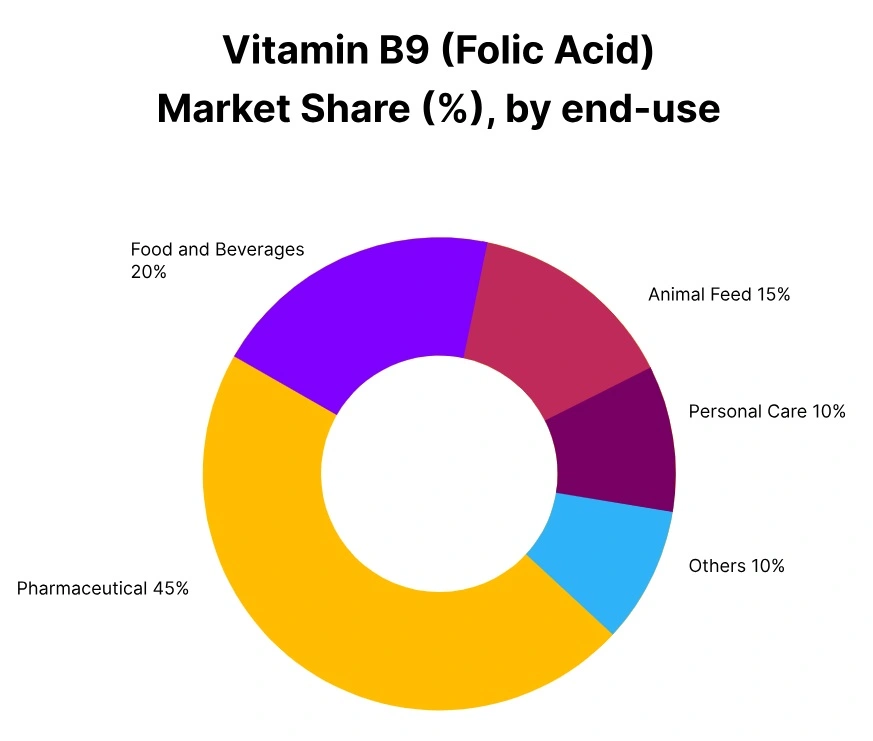
The largest consumers of Vitamin B9 include pharmaceutical and nutraceutical manufacturers, followed by food and beverage companies involved in fortification programs. The animal feed industry also contributes to demand, particularly for livestock nutrition. Public health initiatives further drive demand for fortified staple foods. Price-Watchâ„¢ analyses demand patterns across all these industries.

Vitamin B9 is produced through chemical synthesis using intermediates derived from petrochemical sources. Manufacturing is carried out by specialized chemical and vitamin producers with advanced processing technologies and strict quality control systems. Production depends on plant operating rates, regulatory compliance, and market demand.

Global Vitamin B9 exports are led primarily by China which is the leading exporter of Vitamin B9 due to its strong production capacity and cost competitiveness. Other regions, including Europe and India, contribute to global supply, particularly for high-purity pharmaceutical-grade material.

Export volumes are influenced by production levels, regulatory standards, and global demand. Price-Watchâ„¢ tracks production levels, export flows and trade patterns to help businesses understand global supply chains and identify sourcing opportunities.

Overall supply generally meets global demand but short-term tightness can occur due to plant maintenance shutdowns, environmental inspections or sudden demand increases from pharmaceutical or feed sectors. Regional imbalances may arise from logistics disruptions or regulatory constraints. Price-Watchâ„¢ monitors these supply-demand imbalances to alert the market about potential shortages or surpluses.

Vitamin B9 is available in pharmaceutical, food, and feed grades, each with varying purity levels and regulatory requirements. Pharmaceutical-grade Folic Acid commands higher prices due to strict quality standards, certifications, and traceability requirements, while feed-grade material is comparatively lower priced. Differences in formulation and application also contribute to price variation. Price-Watchâ„¢ provides separate price assessments for each grade to ensure market transparency.

A sudden increase in demand, particularly from pharmaceutical and food fortification sectors, can lead to price increases due to limited short-term supply flexibility. Suppliers may prioritize long-term contracts, reducing spot availability and pushing prices upward. This can create short-term market volatility. Price-Watchâ„¢ captures these market dynamics in real-time.

Energy costs significantly impact Folic Acid production, as the synthesis process requires stable energy and utility inputs. Rising electricity, fuel, and steam costs increase manufacturing expenses, which are often passed on to buyers. Transportation and logistics costs further influence final pricing. Price-Watchâ„¢ analyses in its price assessments & market reports.

Regional price differences arise from variations in production capacity, regulatory compliance costs, energy prices, labor expenses, logistics, and local demand conditions. Import-dependent regions typically face higher prices, while regions with established production capacity offer more competitive pricing. Price-Watchâ„¢ tracks prices across all major regions to highlight these differences.

The price outlook for Vitamin B9 depends on production operating rates, raw material and energy cost trends, demand from pharmaceutical and food fortification sectors, and global trade conditions. Inventory levels and macroeconomic factors also influence price movements.

Price-Watchâ„¢ regularly publishes detailed forecasts that project price movements for the next 12 months based on comprehensive analysis of supply additions, demand growth in key industries, seasonal patterns, and macroeconomic indicators. Our forecasts help businesses anticipate market conditions and plan accordingly.

Absolutely. Accurate forecasts enable businesses to plan procurement strategies, manage inventories, and negotiate favorable contracts. Anticipating price movements helps optimize costs and reduce risks.. If Price-Watchâ„¢ forecasts predict a price increase in three months, you might choose to stock up now or lock in long-term contracts at current rates, potentially saving thousands of dollars.

Global events such as pandemics, environmental inspections, plant shutdowns, energy shortages, trade restrictions, geopolitical tensions or logistics disruptions can significantly impact Vitamin B9 supply and pricing. Sudden changes in healthcare demand and nutrition demand can also create volatility. Price-Watchâ„¢ provides timely alerts when such events affect the market.

Price-Watchâ„¢ collects data from manufacturers, distributors, and buyers worldwide to publish regular price assessments, market reports, and forecasts. Our transparent methodology and comprehensive coverage make us a trusted source for understanding fair pricing and market trends in the Vitamin B9 (Folic Acid) industry.