Xanthan Gum Price Trend and Forecast

âźł Weekly Update
|
Historical Data Since 2015
|
Forecast for 2026
  • Commodity Pricing

xanthan gum Price Trends by Country

cnChina
inIndia
brBrazil
idIndonesia
vnVietnam
trTurkey
usUnited States

Global xanthan gum Spot Market Prices, Trend Analysis and Forecast

Xanthan Gum Price Trend Q3 2025

In Q3 2025, the global Xanthan Gum market showed uneven performance across regions. Chinese export prices for food-grade Xanthan Gum dropped sharply due to weak demand from food processing and oilfield sectors amid inventory accumulation and cautious buyer sentiment. Indian domestic prices similarly fell, pressured by soft demand in food and personal care industries and competitive imports. Import markets including Brazil, Indonesia, Vietnam, Turkey, and the USA also recorded significant price declines driven by oversupply, freight cost fluctuations, and subdued consumption. Overall, the market remained bearish, influenced by global economic uncertainties, ample inventories, and cautious procurement behavior. Regional supply chain dynamics and fragmented downstream demand continued to affect pricing during the quarter.

China

Xanthan Gum Export prices FOB Qingdao, China, Grade- Food Grade.

According to PriceWatch, in Q3 2025, The Xanthan Gum prices in China declined by 14.59%, with a quarterly price range of USD 2000–2290 per MT. The Xanthan Gum price trend in China was influenced by weak demand from food processing, oilfield, and industrial sectors, alongside inventory accumulation and cautious buyer sentiment. Export volumes decreased as buyers delayed procurement, anticipating further price softening amid competitive market conditions.

In September 2025, Xanthan Gum prices in China continued a dip trajectory by 7.21%, mirroring bearish market sentiment driven by global economic uncertainties, oversupply concerns, and ongoing supply chain challenges that persisted throughout the quarter, limiting price recovery and restraining procurement activity across regional and international markets.

India

Domestically Traded Xanthan Gum price in Ahmedabad, India, Grade- Food Grade.

According to PriceWatch, in Q3 2025, The Xanthan Gum prices in India declined by 11.30%, with a quarterly price range of USD 2370–2600 per MT. The Xanthan Gum price trend in India was influenced by softening demand from food, personal care, and industrial sectors, leading to subdued buying activity. Producers adjusted production levels to manage inventories, while buyers adopted cautious procurement strategies amid ample stock and competitive imports.

In September 2025, Xanthan Gum prices in India continued their downward trajectory by 3.71%, mirroring ongoing market pressure, declining price trends, and restrained purchasing behaviour throughout the quarter, which together contributed to muted trading activity and limited upside potential in the regional Xanthan Gum market.

Brazil

Xanthan Gum Import prices CIF Santos, Brazil, Grade- Food Grade.

In Q3 2025, The Xanthan Gum prices in Brazil declined by 9.50%, with a quarterly price range of USD 2140–2510 per MT. The Xanthan Gum price trend in Brazil was pushed by weaker demand from the food, beverage, and industrial sectors, despite sharply rising freight costs from Q2. Buyers limited purchases and carefully managed inventories amid softer consumption and cautious downstream activity.

In September 2025, Xanthan Gum prices in Brazil continued their downward movement by 8.34%, showed subdued market activity, global overcapacity, and persistent weak demand across key end-use industries throughout the quarter, contributing to overall bearish sentiment and restrained trading in the regional Xanthan Gum market.

Indonesia

Xanthan Gum Import prices CIF Tanjung Priok, Indonesia, Grade- Food Grade.

In Q3 2025, The Xanthan Gum prices in Indonesia declined by 14.66%, with a quarterly price range of USD 2045–2335 per MT. The Xanthan Gum price trend in Indonesia was pushed by weaker demand from food, beverage, and industrial sectors, alongside strong price competition that prompted buyers to reduce orders. Abundant supply and cautious downstream purchasing contributed to the sharp decline from Q2. Although freight costs went down, the reduction was insufficient to support prices.

In September 2025, Xanthan Gum prices in Indonesia continued their steep downward trajectory by 7.06%, mirroring bearish market sentiment, ongoing oversupply, and subdued procurement activity throughout the quarter, which together maintained pressure on regional market prices.

Vietnam

Xanthan Gum Import prices CIF Haiphong, Vietnam, Grade- Food Grade.

In Q3 2025, The Xanthan Gum prices in Vietnam declined by 14.39%, with a quarterly price range of USD 2040–2330 per MT. The Xanthan Gum price trend in Vietnam was influenced by global oversupply, despite steady freight costs and a slight increase in demand. Exporters received fewer inquiries from food processing, beverage, and industrial sectors, while buyers moderated purchases to manage inventories amid competitive pricings.

In September 2025, Xanthan Gum prices in Vietnam continued their decline by 7.08%, reflecting a quiet but stable market, reduced procurement activity, and continued pressure from abundant supply, maintaining lower price levels throughout the quarter while supporting measured trading practices across regional markets.

Turkey

Xanthan Gum Import prices CIF Izmir, Turkey, Grade- Food Grade.

In Q3 2025, The Xanthan Gum prices in Turkey declined by 14.06%, with a quarterly price range of USD 2125–2420 per MT. The Xanthan Gum price trend in Turkey was influenced by weak demand from food, cosmetic, and industrial sectors, while stable freight costs provided limited support. Buyers remained selective amid high inventories and competitive import offers, moderating procurement activity.

In September 2025, Xanthan Gum prices in Turkey continued their downward trajectory by 7.02%, reflecting a bearish market stance, controlled supply, and cautious trading behaviour throughout the quarter, which together contributed to persistent price pressure and subdued market sentiment in the regional Xanthan Gum market.

USA

Xanthan Gum Import prices CIF Houston, USA, Grade- Food Grade.

In Q3 2025, The Xanthan Gum prices in the USA declined by 14.93%, with a quarterly price range of USD 2145–2425 per MT. The Xanthan Gum price trend in the USA was driven by less demand from food processing, oilfield, and industrial sectors, despite reductions in freight costs. Buyers focused on inventory drawdowns amid oversupply concerns, while exporters reported softer sales and cautious buyer sentiment.

In September 2025, Xanthan Gum prices in the USA continued their decline by 6.37%, reflecting significant price contractions, subdued procurement, and challenging economic conditions throughout the quarter, which together contributed to persistent downward pressure and limited recovery in the regional Xanthan Gum market.

Xanthan Gum Price Trend Analysis: Q2 2025

During Q2 2025, the cost of Xanthan Gum (Food Grade), FOB Qingdao dropped from the last quarter -8.54% to USD 2,513.5 per MT. The decline primarily was due to weak demand from the food and beverage industry, particularly in the Western markets whose inventory level was already higher than the first stockpiling. Seasonal recession in consumption, together with prudent buys in advance of summer, was added to demand of subordinates.

On the supply side, Chinese producers kept working on high efficiency, where the production smoothly ran. Land – political tension, particularly resulting from regional disputes and interference with global objects, made the Red Sea route, intermittent logistic delay, but did not sufficiently to substantially tighten supply.

Exporters experienced low pressure to lower prices to stay competitive, particularly between expanding variants from Southeast Asian suppliers. Despite the price decline, the market was stable with sufficient availability and no serious supply shock.

In Q2 2025, the prices of Xanthan Gum (Food Grade), CIF Nhava Sheva from China fell to USD 2,570 per metric tonnes by marking a significant -9.00% decline since the last quarter. This price dipped was largely inspired by weak demand from food processing industries in India, which had already created adequate inventions among the previous quarters. The seasonal moderation further slowed down in food production.

On the supply, Chinese producers maintained a stable output level, while reducing the container backlog improved the availability of freight from major Chinese ports. However, the geopolitical instability and trade tension between major economies in some parts of Asia created uncertainty in shipping routes, causing sporadic delays but not enough for stress in supply.

Buyers were cautious, hoped to be softened in prices, adopting a waiting-and-looking approach. Despite the low prices, the market remained stable, supporting uninterrupted downstream activity in food-grade applications with adequate inventory and coherent shipment arrival.

In Q1 2025, the Xanthan Gum market in China (FOB Qingdao) continued to soften, with Food Grade prices declining to USD 2,750/MT reflecting a 2.1% decrease while Oil Drilling Grade settled at USD 2,620/MT, showing a slight decrease of 0.8%. The market was significantly impacted by the Lunar New Year holiday, which led to reduced industrial activity and lower procurement rates across key sectors.

Many manufacturers scaled down production, while temporary factory shutdowns disrupted the supply chain. Additionally, sluggish demand from food processing and oil drilling industries, coupled with global economic uncertainties, further contributed to price softness. However, stable raw material costs and logistical improvements helped prevent a steeper decline.

In Q1 2025, Indian prices (CIF Nhava Sheva) of Xanthan Gum (Food Grade) dropped again to USD 3,050/MT, representing a 4.1% drop. Diminished buying interest during the seasonal slowdown in early-year activity added to decreased market activity. Numerous manufacturers ran lower capacity due to holidays and maintenance cycles. Finally, consistent raw material supply and uneventful logistics prevented sharper price decline.

Xanthan Gum Price Trend Analysis: Q4 2024

According to PriceWatch, In Q4 2024, the Chinese (FOB Qingdao) Xanthan Gum market saw a downturn as Food Grade prices fell to USD 2,810/MT reflecting a sharp decrease of 10.2% and Oil Drilling Grade declined to USD 2,640/MT reflecting a 5.5% decrease. This decrease was largely due to year-end inventory destocking, prompting manufacturers and traders to reduce prices to clear excess stocks.

Weaker demand from the oil drilling industry, influenced by fluctuations in global crude oil prices, further pressured market sentiment. Additionally, abundant raw material availability and increased production efficiency resulted in a more relaxed supply scenario, contributing to the overall price reduction.

In Q4 2024, prices of Xanthan Gum (Food Grade) in India (CIF Nhava Sheva) fell to USD 3,180/MT, indicating an 11.91% fall. It was primarily the result of clearing year-end inventory, as buyers sought to unwind inventories. Demand weakened following the festive period, slowing buying activity. Furthermore, enhanced efficiency in production and plentiful availability of raw materials contributed to the price fall.

In Q3 2024, the Xanthan Gum market in China (FOB Qingdao) experienced a positive trend, with Food Grade prices reaching USD 3,130/MT, reflecting a 9.8% increase, while Oil Drilling Grade prices rose to USD 2,790/MT, marking a 4.5% gain. This surge was mainly driven by strong demand from the food and beverage industry, where the need for stabilizers and thickening agents increased.

Additionally, the oil drilling and cosmetics sectors saw improved procurement, boosting overall market sentiment. Rising raw material costs, particularly Corn Sugar and Soybean derivatives, also played a role in price hikes. Export demand strengthened, and higher freight charges further impacted the pricing structure.

In Q3 2024, the Xanthan Gum (Food Grade) market in India (CIF Nhava Sheva) kept going in an upward direction, with prices growing 8.08% to USD 3,610/MT. Much of this increase was fuelled by robust festive season demand from the food processing sector. Rising input costs like Corn Sugar and energy put pressure on increasing prices. Export demand from neighbouring nations also prompted producers to stick to their price.

Moving into Q2 2024, the Xanthan Gum market saw a positive shift. Prices for Food grade Xanthan Gum in China (FOB Qingdao) rose to USD 2,846/MT, reflecting a 4.1% increase from Q1. Conversely, Oil Drilling Grade prices decreased to USD 2,668/MT, showing a decline of 9.4%.

Contributing factors to these changes included improved demand in the food sector due to seasonal trends and a more stable supply chain, although fluctuations in freight costs continued to impact the market dynamics. The resilience of the food industry was crucial in driving the overall demand for Xanthan Gum.

In Q2 2024, the Xanthan Gum (Food Grade) prices in India (CIF Nhava Sheva) increased slightly to USD 3,340/MT, a 4.05% increase. This increase was aided by seasonal demand from the food and beverage industry, particularly during summer. Sustained procurement by local consumers also helped maintain market stability. In addition, sustained raw material supply allowed Chinese manufacturers to keep production without significant cost variations.

In Q1 2024, the global Xanthan Gum market experienced a mixed trend. In China (FOB Qingdao), the prices for Food grade Xanthan Gum were reported at USD 2,733/MT, while Oil Drilling grade prices stood at USD 2,946/MT. This marked a sharp decrease from the previous quarter by 34% and 31%, respectively.

This significant drop was mainly due to a post-pandemic price correction as the market adjusted from previously elevated levels. A decline in demand from key sectors like food processing and industrial applications also contributed to the downward trend.

During Q1 2024, the Xanthan Gum (Food Grade) market in India (CIF Nhava Sheva) experienced a steep price drop to USD 3,210/MT, marking a 33.13% dip. This decline was primarily attributed to a post-COVID price correction, as previously inflated rates started to level out.

A slowdown in demand from the processed food sector further dented market sentiment. High domestic production in China also contributed to an oversupply, putting additional pressure on prices.

Technical Specifications of Xanthan Gum Price Trends

Product Description

Xanthan Gum is a natural polysaccharide used primarily as a thickening, stabilizing, and emulsifying agent. It is produced through the fermentation of carbohydrates using the bacterium Xanthomonas campestris. Due to its excellent water-solubility and ability to form viscous solutions, it is widely used in various industries.

Identifiers and Classification:

  • CAS No – 11138-66-2
  • HS Code – 39139019 (Food Grade), 39139090 (Oil Drilling Grade)
  • Molecular Formula – C35H49O29
  • Molecular Weight (in gm/mol) – 933.748

Xanthan Gum Synonyms:

  • Corn Sugar Gum
  • Bacterial Polysaccharide
  • Xanthomonas Gum
  • Polysaccharide B1459

Xanthan Gum Grades Specific Price Assessment:

  • Xanthan Gum Food grade, Oil Drilling grade

Xanthan Gum Global Trade and Shipment Terms

*Quotation Terms (Product & Country Specific): 10-15 MT, 25-30 MT

**Packaging Type (Product & Country Specific): 25 Kg Bag

Incoterms Referenced in Xanthan Gum Price Reporting:

Shipping Term  Location  Definition 
FOB Qingdao  Qingdao, China  Xanthan Gum Export price from China 
CIF Nhava Sheva (China)  Nhava Sheva, India  Xanthan Gum Import price in India from China 
Ex-Ahmedabad  Ahmedabad, India  Domestically Traded Xanthan Gum price in Ahmedabad 
CIF Santos (China)  Santos, Brazil  Xanthan Gum Import price in Brazil from China 
CIF Tanjung Priok (China)  Tanjung Priok, Indonesia  Xanthan Gum Import price in Indonesia from China 
CIF Haiphong (China)  Haiphong, Vietnam  Xanthan Gum Import price in Vietnam from China 
CIF Izmir (China)  Izmir, Turkey  Xanthan Gum Import price in Turkey from China 
CIF Houston (China)  Houston, USA  Xanthan Gum Import price in USA from China 

*Quotation Terms refers to the quantity range specified for the Xanthan Gum being quoted or offered in a commercial transaction.

**Packaging Type refers to standard packaging size commonly used for Xanthan Gum packing, ease of handling, transportation, and storage in industrial and commercial applications.

Key Xanthan Gum Manufacturers and their brands

Manufacturers 
Cargill, Incorporated 
CP Kelco 
Deosen Biochemical Ltd. 
Archer Daniels Midland Company 
DuPont 
Fufeng Group 
Hebei Xinhe Biochemical Co. 
Jungbunzlauer Suisse AG 
Unionchem Co., Ltd. 
Solvay S.A. 

Xanthan Gum Industrial Applications

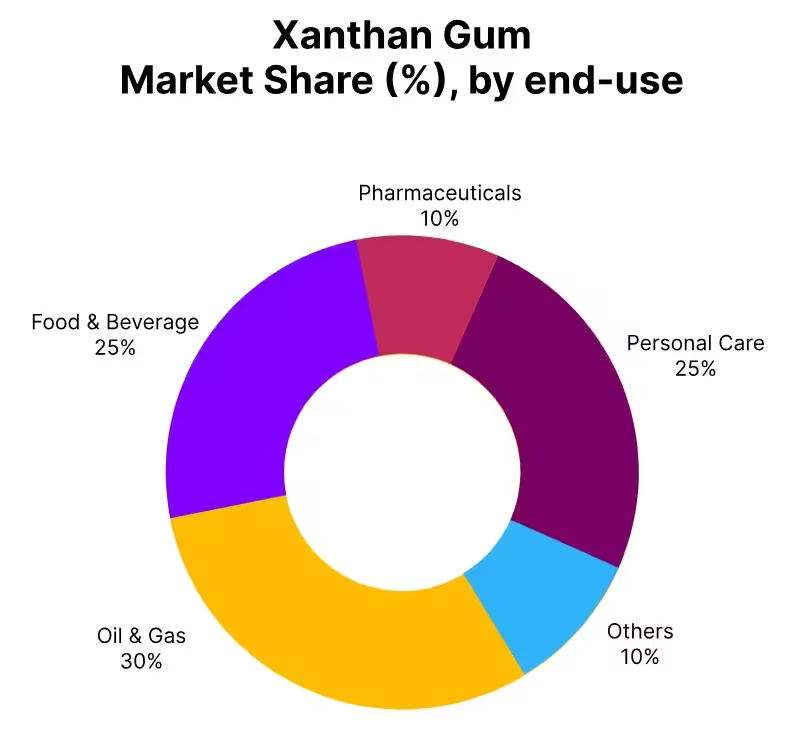
xanthan gum market share end use

Historically, several events have caused significant fluctuations in Xanthan Gum prices

  • China’s Environmental Regulations (2024): Stricter environmental policies in China, the largest Xanthan Gum producer, caused factory shutdowns and production slowdowns, driving supply shortages and price increases globally.
  • Russia-Ukraine Conflict (2022-Present): Though primarily impacting energy markets, this conflict disrupted global logistics and caused price volatility in raw materials essential for Xanthan Gum production, indirectly affecting market prices.
  • COVID-19 Pandemic (2020-2021): The pandemic initially led to reduced demand from the food and beverage industry as global lockdowns slowed consumption. However, demand rebounded sharply in the pharmaceutical and personal care sectors due to increased use in sanitizers and healthcare products, creating price fluctuations.
  • U.S.-China Trade Tensions (2018-2019): Trade wars between the U.S. and China caused instability in the global Xanthan Gum supply chain, leading to increased tariffs and shifting production bases, which contributed to price hikes.

These events highlight the Xanthan Gum market’s sensitivity to global supply chain issues, environmental policies, and geopolitical tensions, underscoring the need for ongoing monitoring of production and trade dynamics.

Why PriceWatch?

PriceWatch is your trusted resource for tracking global xanthan gum price trends. Our platform delivers real-time data and expert analysis, offering deep insights into the key factors driving price fluctuations in the xanthan gum market. By monitoring critical events such as geopolitical tensions, supply chain disruptions, and economic shifts, PriceWatch keeps you fully informed of market dynamics.

In addition, PriceWatch provides detailed forecasts and updates on production capacities, enabling you to anticipate market changes and make well-informed decisions. With PriceWatch, you gain a competitive edge in understanding all the elements that influence xanthan gum prices worldwide. Stay ahead of the curve with PriceWatch’s reliable, accurate, and timely xanthan gum market data.

Track PriceWatch's xanthan gum price assessment on a weekly basis since 2015 onwards, along with short-term forecasts, and get access to the detailed report in a downloadable format.

Data Collection and Sources​

  • Real-Time Market Data: PriceWatch collects real-time pricing data from a wide range of sources, including global commodity exchanges, industry reports, and proprietary databases. This allows our assessments to reflect the latest market conditions for Xanthan Gum accurately.
  • On-the-Ground Intelligence: Our team gathers insights directly from market participants such as producers, suppliers, traders, and end-users in major Xanthan Gum production hubs, especially in China. This on-the-ground intelligence helps us capture localized market dynamics.
  • Supply Chain Monitoring: We closely track the entire Xanthan Gum supply chain, from raw materials like corn, wheat, and soy used in fermentation processes, to production and distribution networks. This includes monitoring feedstock availability, production capacities, and logistical aspects such as transportation.

Event Tracking and Impact Analysis​

  • Geopolitical and Trade Issues: PriceWatch continuously monitors geopolitical developments and trade policies, particularly between China and the rest of the world, which can affect Xanthan Gum prices. Tariffs, export restrictions, and international tensions are assessed for their potential impact on the supply chain and pricing.
  • Environmental and Regulatory Changes: We evaluate the influence of stricter environmental regulations in China, where most Xanthan Gum is produced. These regulations have led to factory shutdowns and production restrictions, impacting global supply and prices.
  • Pandemics and Supply Chain Disruptions: The COVID-19 pandemic caused notable disruptions in the Xanthan Gum market. Our analysis factors in how such events, including freight delays and rising logistics costs, can influence pricing. Additionally, we assess future risks that could disrupt production and supply chains.

Production Capacity and Supply Analysis

  • Current Production Monitoring: PriceWatch maintains a robust database of Xanthan Gum production facilities worldwide, focusing on their operational status, production levels, and any maintenance or downtime schedules. This ensures we provide an accurate view of current supply levels.
  • Future Capacity Projections: We forecast future Xanthan Gum production capacities by tracking new plant developments, expansions, and potential technological advancements in the production process. This helps predict future supply trends and potential price stabilization or shifts.

Demand Forecasting

  • Sectoral Demand Analysis: PriceWatch provides detailed analysis of demand trends across key sectors that use Xanthan Gum, including food & beverages, oil & gas, pharmaceuticals, and cosmetics. We track annual demand growth and forecast future consumption based on economic indicators and industry developments.
  • Global Demand Dynamics: Our methodology considers regional demand variations, particularly how demand in China, the U.S., and Europe influences global Xanthan Gum pricing. This includes evaluating shifts in manufacturing locations, export policies, and changes in environmental or food safety regulations.

Pricing Model Development

  • Dynamic Pricing Models: PriceWatch uses advanced econometric models to forecast Xanthan Gum prices, incorporating real-time data, historical pricing trends, and projected market conditions. Our models are continuously updated to ensure the highest accuracy and reliability in price forecasting.
  • Scenario Analysis: We perform scenario-based assessments to explore potential future market conditions. These assessments cover best-case, worst-case, and most likely scenarios, helping clients prepare for a variety of market outcomes.

Reporting and Client Support

  • Comprehensive Reports: Our clients receive in-depth reports that include current price assessments, future price forecasts, and detailed analysis of market drivers specific to Xanthan Gum. These reports provide actionable insights and recommendations to help clients make well-informed decisions.
  • Ongoing Support: PriceWatch provides continuous updates and personalized client support, ensuring they stay informed with the latest market developments. Our experts are available to discuss specific market changes and offer tailored advice to help clients navigate the evolving Xanthan Gum market.

This research methodology ensures that PriceWatch delivers the most accurate, timely, and actionable Xanthan Gum pricing assessments, helping our clients stay ahead of market trends and make informed business decisions.

Xanthan Gum Market Price Trend provided by PriceWatch is a base price and excludes VAT/Taxes, discounts, or offers. The information herein is accurate to the best of our knowledge as of the date indicated and is provided solely for the convenience of our customers as a reference for xanthan gum. PriceWatch disclaims any warranties or representations regarding the accuracy of results derived from this information. It is the sole responsibility of the user to assess the suitability of the product for their specific application. This document does not constitute an endorsement to use the product in violation of any applicable patent rights.

The pricing of Xanthan Gum is influenced by several key factors, including raw material costs, production capabilities, and market demand from various sectors such as food and beverages, oil drilling, and pharmaceuticals. Supply chain issues, such as transportation costs and logistics challenges, also play a significant role. Additionally, fluctuations in demand during peak seasons, regulatory changes, and geopolitical events can further affect pricing trends.

Supply chain disruptions can significantly impact Xanthan Gum prices by causing delays in production and transportation. Events such as factory closures, equipment shortages, and increased freight rates can create bottlenecks in the supply chain, leading to higher prices. Additionally, disruptions in the availability of raw materials or geopolitical tensions can further strain supply, prompting procurement heads to closely monitor market conditions to make informed purchasing decisions.

The price outlook for Xanthan Gum suggests potential volatility due to fluctuating demand, particularly in the food and oil drilling sectors. Procurement teams should prepare by closely monitoring market trends, considering seasonal demand variations, and exploring long-term contracts with suppliers to secure favorable pricing. Diversifying sourcing options and staying informed about raw material availability will also help mitigate risks associated with sudden price increases.