2-ethyl Hexanoic Acid (eha) Price Trend and Forecast

UNSPC code: 12352100
|
Weekly Update
|
Historical Data Since 2015
|
Forecast for 2026

2-ethyl hexanoic acid (eha) Price Trends by Country

myMalaysia
jpJapan
inIndia
usUnited States
deGermany
trTurkey
idIndonesia
vnVietnam
seSweden

Global 2-ethyl hexanoic acid (eha) Spot Market Prices, Trend Analysis and Forecast

Price Watch™ provides real-time price assessments and price forecasts for 2-Ethylhexanoic Acid across top trading regions:

2-Ethylhexanoic Acid Regional Coverage 2-Ethylhexanoic Acid Grade and Country Coverage 2-Ethylhexanoic Acid Pricing Data Coverage Explanation
Asia 2-Ethylhexanoic Acid Pricing Analysis 2-Ethylhexanoic Acid Industrial Grade (99% min) FOB Prices at Nagoya Port, Japan Weekly Price Update on 2-Ethylhexanoic Acid Real-Time Export Prices from Nagoya Port, Japan to Global Markets
2-Ethylhexanoic Acid Industrial Grade (99% min) CIF Prices at Haiphong Port, Vietnam, Importing from Japan Weekly Price Update on 2-Ethylhexanoic Acid Real-Time Import Prices at Haiphong Port, Vietnam, Importing from Japan
2-Ethylhexanoic Acid Industrial Grade (99.5% min) FOB Prices at Klang Port, Malaysia Weekly Price Update on 2-Ethylhexanoic Acid Real-Time Export Prices from Klang Port, Malaysia to Global Markets
2-Ethylhexanoic Acid Industrial Grade (99% min) CIF Prices at Nhava Shiva Port, West India, Importing from Japan Weekly Price Update on 2-Ethylhexanoic Acid Real-Time Import Prices at Nhava Shiva Port, West India, Importing from Japan
2-Ethylhexanoic Acid Industrial Grade (99.5% min) CIF Prices at Jakarta Port, Indonesia, Importing from Malaysia Real-Time Weekly Price Update of 2-Ethylhexanoic Acid Import Prices at Jakarta Port, Indonesia, Importing from Malaysia
North America 2-Ethylhexanoic Acid Pricing Analysis 2-Ethylhexanoic Acid Industrial Grade (99.5% min) CIF Prices at Houston Port, USA, Importing from Germany Weekly Price Update on 2-Ethylhexanoic Acid Real-Time Import Prices at Houston Port, USA, Importing from Germany
Europe 2-Ethylhexanoic Acid Pricing Analysis 2-Ethylhexanoic Acid Industrial Grade (99.5% min) FOB Prices at Hamburg Port, Germany Weekly Price Update on 2-Ethylhexanoic Acid Real-Time Export Prices from Hamburg Port, Germany to Global Markets
2-Ethylhexanoic Acid Industrial Grade (99.5% min) FOB Prices at Gothenburg Port, Sweden Weekly Price Update on 2-Ethylhexanoic Acid Real-Time Export Prices from Gothenburg Port, Sweden to Global Markets
2-Ethylhexanoic Acid Industrial Grade (99.5% min) CIF Prices at Mersin Port, Turkey, Importing from Germany Weekly Price Update on 2-Ethylhexanoic Acid Real-Time Import Prices at Mersin Port, Turkey, Importing from Germany

2-Ethyl Hexanoic Acid (EHA) Price Trend Q1 2026

In the first quarter of 2026, the world market for 2-Ethyl Hexanoic Acid experienced varied pricing patterns among the regions, with substantial rises in Europe and the United States and less aggressive pricing in some regions of Asia.

Markets within Europe, such as those in Germany and Sweden, experienced considerable rises in prices because of high demand from critical industries like the automotive and chemicals industries, with favorable supply conditions. The United States also experienced an increase in prices as the demand recovered within the manufacturing sector.

On the other hand, the Asian market in places like Malaysia and Indonesia witnessed minor decreases in prices due to weak demand in the industry and slow recovery. In addition, the geopolitical situation involving the Iran-Israel war affected the market by increasing the price of crude oil and, thus, affecting production cost.

Japan: 2-Ethylhexanoic Acid Export prices FOB Nagoya, Japan; Grade- Industrial Grade (99% min, 99.5% min)

In the first quarter of 2026, the 2-Ethyl Hexanoic Acid price in Japan has been relatively stable without any notable change witnessed since the conclusion of the year 2025. In the first two months of the year, the demand from the automotive and chemical industries remained highly constant leading to no volatility in the 2-Ethyl Hexanoic Acid price trend in Japan.

The first two months in the first quarter of 2026 in Japan have brought stability in the pricing of the product due to the balance between the supply and demand in the market. However, this stability is short-lived as the end of the quarter is drawing closer.

In Japan, 2-Ethyl Hexanoic Acid price in March 2026 experienced a sharp increase following various shocks to the market. The major cause is an eruption of tensions between Iran and Israel, which resulted in rising prices of crude oil hence rising manufacturing costs. With the fear that prices would further skyrocket, consumers are forced to buy in large quantities causing the shortage of the product.

Malaysia: 2-Ethylhexanoic Acid Export prices FOB Klang, Malaysia; Grade- Industrial Grade (99% min, 99.5% min)

The first quarter of 2026 kicked off on a quiet note for the 2-Ethyl Hexanoic Acid price in Malaysia, which dipped by 1% at the start. This slight softening happened mainly because the heavy-hitting sectors like automotive and chemicals are slow to find their footing, leaving many buyers hesitant to pull the trigger on big orders.

For the first two months, the 2-Ethyl Hexanoic Acid price trend in Malaysia stayed flat and muted, as everyone seemed to be waiting for a real sign of industrial life. That sense of calm vanished the moment March arrived.

Even though local demand hasn’t suddenly taken off, in Malaysia, 2-Ethyl Hexanoic Acid prices in March 2026 shot up by a staggering 14%. The key reason has been the sudden flare-up in the Iran-Israel conflict, which put the Strait of Hormuz the world’s most critical oil artery, directly in the line of fire.

As crude oil prices spiked and shipping costs began to pile up, chemical manufacturers are hit with massive production overhead almost overnight. These global pressures left producers with no choice but to hike their rates, meaning that despite a stable local supply, the energy crisis forced the market to end the quarter on a higher and more expensive note.

Sweden: 2-Ethylhexanoic Acid Export prices FOB Gothenburg, Sweden; Grade- Industrial Grade (99% min, 99.5% min)

During the first quarter of 2026, the 2-Ethyl Hexanoic Acid price in Sweden kicked off with a steady 9% climb. This early boost mostly came from a solid comeback in the automotive and chemical sectors, which really helped get industrial gears turning again.

This upward 2-Ethyl Hexanoic Acid price trend in Sweden is a promising sign at first, signaling that local factories are busy and supply chains have been holding their own. However, the market sentiments shifted completely as March hit.

In Sweden, 2-Ethyl Hexanoic Acid prices in March 2026 suddenly skyrocketed by 25%. While local demand is healthy, the real hammer blow came from overseas. Sharp escalations in the Iran-Israel conflict caused a major crisis at the Strait of Hormuz, sending global crude oil prices through the roof.

Since oil is a massive factor in the cost of making this acid, production expenses just go vertical. Manufacturers really don’t have a choice-they must hike prices just to keep their heads above water. By the time the quarter wrapped up, the market is in a totally different world, leaving buyers scrambling to figure out how to handle the new, higher price tags.

Germany: 2-Ethylhexanoic Export prices FOB Hamburg, Germany; Grade- Industrial Grade (99% min, 99.5% min)

During the first quarter of 2026, the 2-Ethyl Hexanoic Acid price in Germany saw a clear shift, climbing by 8%. This growth has been fuelled by a synchronized comeback from heavy consumption sectors like the automotive, chemical, and textile industries.

For most of the quarter, the 2-Ethyl Hexanoic Acid price trend in Germany stayed on a steady, positive path, backed by reliable factory output and a manufacturing sector that finally seemed to be finding its rhythm again.

However, in Germany, 2-Ethyl Hexanoic Acid prices in March 2026 took a massive 24% leap. While domestic demand is already solid, the crucial reason has been the sudden escalation of the Iran-Israel conflict.

With the Strait of Hormuz, the world’s most critical energy chokepoint, under threat, crude oil prices go into orbit. This sent production costs for chemical makers through the roof almost overnight.

Manufacturers are left with no choice but to pass these skyrocketing energy and feedstock expenses down the chain. By the end of March, the market is in a full-blown volatility, with buyers rushing to lock in orders before prices climbed any higher.

India: 2-Ethylhexanoic Acid Import prices CIF Nhava Sheva, India; Grade- Industrial grade (99% min,

As early as Q1 of 2026, the 2-Ethyl Hexanoic Acid price in India started off strong with an increase of 4% owing to an increased demand for 2-Ethyl Hexanoic Acid from Indian textile and chemical industries.

The continuous and favorable rise in 2-Ethyl Hexanoic Acid price trend in India can be attributed to increasing activities in industries, including the need for chemicals for the textile industry. For the quarter, the manufacturing sector is stable with momentum maintained positively by the market. As Q1 ended, there are major changes in the price trends.

In India, 2-Ethyl Hexanoic Acid price in March 2026 saw a rise of up to 19% owing to the effects of Iran-Israel war on prices. With the risk of the interruption of shipping through the Strait of Hormuz, oil prices rose sharply, increasing the cost of production and transportation of imports.

Vietnam: 2-Ethylhexanoic Acid Import prices CIF Haiphong, Vietnam; Grade- Industrial grade (99% min, 99.5% min)

In Q1 2026, the 2-Ethyl Hexanoic Acid price in Vietnam stayed almost flat, ticking up by just 0.1%. Because of the major supply is imported from Japan, the local market remained stable, with only tiny adjustments made to keep things balanced.

This steady 2-Ethyl Hexanoic Acid price trend in Vietnam has been backed by consistent demand from regular buyers, though there isn’t enough momentum to really push prices in either direction for the first two months.

However, the situation shifted dramatically as the quarter wrapped up. In Vietnam, 2-Ethyl Hexanoic Acid prices in March 2026 jumped by 13%, triggered largely by the fallout from the Iran-Israel conflict. While Vietnam’s pricing doesn’t skyrocket as fast as some other regions, the chaos in the Middle East still hit home by driving up global crude oil and feedstock costs.

The threat to shipping through the Strait of Hormuz which saw an effective closure starting in late February forced manufacturers to pass on higher production and energy expenses. Even with cautious procurement strategies in place, the market eventually has bent to these global pressures, ending the quarter with a sharper increase than anyone expected at the start of the year.

Indonesia: 2-Ethylhexanoic Acid Import prices CIF Jakarta, Indonesia; Grade- Industrial grade (99% min, 99.5% min)

In Q1 2026, the 2-Ethyl Hexanoic Acid price in Indonesia started off slightly weak, dipping by 1% as important sectors like chemicals and automotive hit a bit of a slow patch. With industrial recovery moving at a snail’s pace, the 2-Ethyl Hexanoic Acid price trend in Indonesia has been quiet for a while, as buyers stayed cautious and mostly stuck to the sidelines.

The market sentiments changed quickly as the quarter ended as in Indonesia, 2-Ethyl Hexanoic Acid prices in March 2026 jumped by 13%. This isn’t because demand suddenly took off it is due to the chaos between Iran and Israel. When the Strait of Hormuz is threatened, crude oil prices go through the roof, which made it way more expensive for companies to produce this acid.

USA: 2-Ethylhexanoic Acid Import prices CIF Houston, USA; Grade- Industrial grade (99% min, 99.5% min)

In Q1 2026, the 2-Ethyl Hexanoic Acid price in the USA started gaining momentum, climbing by 8% as demand from the automotive and textile sectors began a steady recovery. This upward 2-Ethyl Hexanoic Acid price trend in the USA is a clear sign that industrial activity is finally picking up, with consistent consumption across key manufacturing hubs keeping the market active.

However, the market sentiment took a sharp turn as the quarter came to an end. In the USA, 2-Ethyl Hexanoic Acid prices in March 2026 jumped by another 13%, but this time, the pressure is coming from halfway across the world. The escalation of the Iran-Israel conflict and the resulting paralysis of the Strait of Hormuz sent global crude oil prices soaring.

Since this acid relies heavily on propylene feedstocks, which are directly tied to oil costs, production expenses for imports from Germany and other regions have gone through the roof. With spot availability tightening and shipping surcharges piling up, American converters must pivot quickly, adjusting their buying strategies to stay ahead of these rising costs and supply chain delays.

Turkey: 2-Ethylhexanoic Acid Import prices CIF Mersin, Turkey; Grade- Industrial grade (99% min, 99.5% min)

During the first quarter of 2026, the 2-Ethyl Hexanoic Acid price in Turkey began a steady climb, rising by 7% as this is powered by consistent interest from Turkey’s textile and automotive sectors, which kept local manufacturers busy and demand high.

For most of the quarter, the 2-Ethyl Hexanoic Acid price trend in Turkey reflected this healthy industrial momentum, supported by a reliable flow of imports from Germany. However, the situation took a sharper turn as March arrived.

In Turkey, 2-Ethyl Hexanoic Acid prices in March 2026 surged by 22% as global pressures began to outweigh local stability. The main driver has been the escalating Iran-Israel conflict, which led to the closure of the Strait of Hormuz in early March and sent shockwaves through the energy market.

As crude oil prices spiked, the cost of making and shipping chemical intermediates skyrocketed. Major regional producers, such as Perstorp Oxo AB, are forced to implement significant price hikes to cover these soaring raw material and energy expenses.

2-Ethyl Hexanoic Acid (EHA) Price Trend Analysis: Q4 2025

The international prices for 2-Ethyl Hexanoic Acid witnessed fluctuations during Q4 2025; however, the price changes varied from moderate rise to a slight drop. The price change in Germany and Sweden, which belong to Europe, registered an upward price movement on account of consistent demand from various industries such as automobile, chemicals, and textile manufacturing.

At the same time, the USA witnessed a slight price rise on account of rising demand from important industries due to imports from Germany. In contrast, the prices declined in Asia, particularly Malaysia, Indonesia, and Japan, because of weak demand and industrial recovery rates.

Japan: 2-Ethylhexanoic Acid Export prices FOB Nagoya, Japan; Grade- Industrial Grade (99% min, 99.5% min)

The 2-Ethyl Hexanoic Acid price in Japan witnessed a fall of 5.5% during Q4 2025. The reasons for the fall are mainly weak demand from the auto sector, chemicals, and slow growth in the industrial sector. In addition to that, the 2-Ethyl Hexanoic Acid price trend in Japan is marked by conservative buying behavior as the converters kept their procurement behavior modest.

There is stability in the availability of 2-Ethyl Hexanoic Acid while its demand is still weak. Thus, prices are under pressure due to weak demand and conservative procurement behavior. In December 2025, 2-Ethyl Hexanoic Acid price in Japan continued to fall by 2%, owing to low restocking and low industrial consumption.

Malaysia: 2-Ethylhexanoic Acid Export prices FOB Klang, Malaysia; Grade- Industrial Grade (99% min, 99.5% min)

The fourth quarter of 2025 is a tough quarter for the 2-Ethyl Hexanoic Acid price in Malaysia, resulting in its fall of approximately 6%. It is difficult to maintain the prices due to the downturn faced by the industries, including the automotive and chemical industries, that serve as the main contributors to the demand.

It is expected that the poor industrial performance would continue to impact the 2-Ethyl Hexanoic Acid price trend in Malaysia because of the poor economic recovery; hence, many businesses decided to refrain from placing orders until the economic condition improved. Despite the steady supply in the quarter, the constant lack of purchasing demand has led to the declining price trend.

In December 2025, 2-Ethyl Hexanoic Acid price in Malaysia saw another decline of nearly 1.5%. Rather than gearing up for a new year with fresh inventory, manufacturers spent their time clearing their inventories, causing minimal transactions.

Sweden: 2-Ethylhexanoic Acid Export prices FOB Gothenburg, Sweden; Grade- Industrial Grade (99% min, 99.5% min)

In the fourth quarter of 2025, the 2-Ethyl Hexanoic Acid price in Sweden rose marginally by around 1% due to strong backing from the automotive and chemical industries. The marginal rise in the 2-Ethyl Hexanoic Acid price trend in Sweden can be attributed to the robust performance of manufacturing activities and the steady flow in the supply chain, which ensured a smooth operation of manufacturing industries in Sweden.

For the entire quarter, the trend of 2-Ethyl Hexanoic Acid price in Sweden is well-balanced despite consumers being conservative with their finances. Nonetheless, consistent demand for the product from manufacturers ensured that the price trend does not waver significantly. At the end of the year, however, prices fell slightly.

In December 2025, 2-Ethyl Hexanoic Acid price in Sweden fell slightly by almost 0.5%. This can be attributed to the typical seasonal downturn experienced at the end of the year characterized by low spot availability and minimal demand growth, which saw many companies adopt lean procurement practices.

Germany: 2-Ethylhexanoic Export prices FOB Hamburg, Germany; Grade- Industrial Grade (99% min, 99.5% min)

In the last three months of 2025, the 2-Ethyl Hexanoic Acid price in Germany has been observed to rise marginally by 1.5% due to the robust interest of the automotive, chemical, and textile sectors in the commodity.

Such an upward movement can be attributed to the stability of supply chain logistics coupled with a consistent production level within the country’s industrial sectors, resulting in a favorable state of balance in the market. Although caution is exercised in purchasing activities by consumers from the key sectors, the 2-Ethyl Hexanoic Acid price trend in Germany is positive for the quarter.

Towards the end of the year, however, the market showed signs of slowing down. In Germany, 2-Ethyl Hexanoic Acid price in December 2025 fell by almost 0.5% due to stable levels of demand and decreasing supply in the spot market. Nevertheless, the general professional view is quite positive during the period. Industrial buyers have managed to implement a cautious buying policy throughout the fourth quarter of 2025.

India: 2-Ethylhexanoic Acid Import prices CIF Nhava Sheva, India; Grade- Industrial grade (99% min, 99.5% min)

The final quarter of 2025 witnessed a bearish sentiment in the 2-Ethyl Hexanoic Acid price in India, especially for material imported from Japan, as prices fell by 3.0%. The market has been hit by a noticeable dip in demand from the textile and chemical industries, which is further complicated by a sluggish industrial recovery across the country.

This downward 2-Ethyl Hexanoic Acid price trend in India has been driven by a general air of caution, with most businesses avoiding large restocking efforts and sticking to essential purchases only.

Even though supply from Japan remained reliable, there simply hasn’t been enough buying momentum to keep the market afloat. By the time the year wrapped up, In India, 2-Ethyl Hexanoic Acid prices in December 2025 slipped another 0.5%, highlighting the ongoing lack of industrial urgency.

This softer outlook is a direct result of manufacturers and converters playing it safe due to economic uncertainty, leading to very limited price movement. Ultimately, the quarter ended on a quiet note, with the market reflecting the broader challenges facing India’s industrial sectors.

Vietnam: 2-Ethylhexanoic Acid Import prices CIF Haiphong, Vietnam; Grade- Industrial grade (99% min, 99.5% min)

In Q4 2025, 2-Ethyl Hexanoic Acid prices in Vietnam, importing from Japan, decreased by 5%. This decline has been driven by weak demand from key sectors such as chemicals and automotive, coupled with a slower-than-expected industrial recovery. The 2-Ethyl Hexanoic Acid price trend in Vietnam is characterized by cautious buying behavior and limited restocking activities.

Despite a stable supply, the market remained subdued, with reduced industrial consumption putting downward pressure on prices. In Vietnam, 2-Ethyl Hexanoic Acid prices in December 2025 continued to decrease by nearly 1.5%, reflecting ongoing low demand and limited procurement activity.

The overall market trend pointed to a softer outlook, with converters showing restraint in their purchasing decisions due to market uncertainties. This cautious sentiment and reduced consumption led to the continuation of downward price trends across the quarter.

Indonesia: 2-Ethylhexanoic Acid Import prices CIF Jakarta, Indonesia; Grade- Industrial grade (99% min, 99.5% min)

The final quarter of 2025 witnessed bearish trend in 2-Ethyl Hexanoic Acid price in Indonesia, with prices of 2-EHA imports from Malaysia sliding by 6%. The market observed the squeeze as key sectors like chemicals and automotive hit a significant slump, and the broader industrial recovery moved slower than anticipated.

This downward 2-Ethyl Hexanoic Acid price trend in Indonesia has been marked by a heavy air of caution, with buyers becoming far more selective and keeping their inventories as lean as possible. Even though supply lines from Malaysia remained steady, the persistent lack of local buying interest kept dragging the market lower throughout the period.

As the year wrapped up, In Indonesia, 2-Ethyl Hexanoic Acid prices in December 2025 dipped by another 1%, reflecting a general lack of urgency and very little restocking activity. Most manufacturers and converters are hesitant to commit to fresh volumes while the economic outlook felt so shaky, leading to a softer, more conservative market.

USA: 2-Ethylhexanoic Acid Import prices CIF Houston, USA; Grade- Industrial grade (99% min, 99.5% min)

The final quarter of 2025 saw the 2-Ethyl Hexanoic Acid price in the USA edge up by 0.5%, largely due to a moderate recovery in demand from the automotive and textile sectors. This slight uptick is supported by steady industrial activity, which kept the market on firm footing despite a generally cautious approach from buyers.

For the quarter, the 2-Ethyl Hexanoic Acid price trend in the USA remained stable as manufacturers balanced their demand against a consistent flow of imports from Germany. However, the market cooled slightly as the year came to an end. In the USA, 2-Ethyl Hexanoic Acid prices in December 2025 dipped by nearly 0.5%, a shift triggered by short-term restocking and a tightening of spot market availability.

Even with this minor decrease, procurement remained disciplined, with converters carefully navigating the market rather than rushing into large commitments. Overall, the quarter wrapped up with a balanced outlook, as businesses stayed selective and adapted to the small fluctuations in supply and demand.

Turkey: 2-Ethylhexanoic Acid Import prices CIF Mersin, Turkey; Grade- Industrial grade (99% min, 99.5% min)

The final quarter of 2025 saw the 2-Ethyl Hexanoic Acid price in Turkey edge up by 1.0%, largely supported by reliable interest from the textile and automotive industries. This modest growth has been underpinned by a steady supply chain and consistent industrial output, which helped keep the market in a healthy state of equilibrium.

Even though buyers across these key sectors are being careful with their procurement, the overall 2-Ethyl Hexanoic Acid price trend in Turkey remained on a positive trajectory for the period. As the year ended, the market saw continued moderate gains. In Turkey, 2-Ethyl Hexanoic Acid prices in December 2025 rose by nearly 1%, a shift influenced by short-term restocking activities and tightening availability in the spot market.

Despite the general air of caution, the broader industrial outlook remained steady. Local converters stuck to a strategy of prudent buying, ensuring that the market stayed resilient even as manufacturing activity adjusted for the season. Overall, the Turkish market maintained its stability, with controlled price growth reflecting balanced supply-demand dynamics.

According to Price-Watch™, In Q3 2025, the global 2-Ethyl Hexanoic Acid (EHA) price trend showed mixed results, with declines observed in several regions and modest increases in a few others.

The overall demand for 2-EHA softened due to slower industrial activity in key sectors such as plasticizers, paints and coatings, adhesives, construction, and automotive. As a result, 2-EHA prices dropped in markets like Japan, Malaysia, and Indonesia, reflecting weaker consumption across these industries.

However, regions like Sweden and India saw slight price increases, indicating more stable demand. 2-EHA prices in September 2025 continued to reflect a general global slowdown, with subdued industrial activity contributing to the price declines.

Japan: 2-Ethyl Hexanoic Acid (EHA) Export prices FOB Nagoya, Japan, Grade- Industrial Grade (99% min, 99.5% min).

2-EHA prices in Japan decreased by 2.4%, reaching 1144 USD/MT in Q3 2025. The decline was primarily driven by weaker demand in key industries such as automotive and construction, both of which experienced lower production during this period. The 2-EHA price trend in Japan followed the global pattern of reduced consumption, particularly in the plasticizers and paints and coatings sectors.

Despite a stable supply, 2-EHA prices in September 2025 in Japan reflected minimal price recovery due to the sustained downturn in industrial activity. Overall, the lack of demand growth across these critical sectors contributed to the continued price decline in Japan.

Malaysia: 2-Ethyl Hexanoic Acid (EHA) Export prices FOB Klang, Malaysia, Grade- Industrial Grade (99% min, 99.5% min).

2-EHA prices in Malaysia saw a significant 5.4% decrease, which dropped to 1148 USD/MT in Q3 2025. The reduction was largely due to soft demand from key industries, including plasticizers, paints and coatings, and automotive.

The 2-Ethylhexanoic Acid price trend in Malaysia was heavily influenced by a global slowdown, with weaker consumption of 2-EHA in flexible PVC applications and coatings.

As a result, 2 Ethyl hexanoic Acid prices in September 2025 in Malaysia remained subdued, reflecting the continued lack of significant demand recovery. The lower demand from these industries meant that prices stayed at a lower level throughout the quarter, contributing to the overall price decrease.

Sweden: 2-Ethyl Hexanoic Acid (EHA) Export prices FOB Gothenburg, Sweden, Grade- Industrial Grade (99% min, 99.5% min).

2-EHA prices in Sweden increased by 1.0%, reaching 1224 USD/MT in Q3 2025. The slight increase was supported by relatively stable demand in the construction and automotive sectors, which continued to show moderate activity despite global slowdowns.

The 2-Ethyl Hexanoic Acid (EHA) price trend in Sweden was more positive compared to other regions, as the ongoing infrastructure projects and steady consumption in plasticizers helped to stabilize prices.

As a result, 2-EHA prices in September 2025 in Sweden were slightly higher than the previous quarter. This positive movement indicated a more resilient market in Sweden, where localized demand was less affected by the global economic downturn.

Germany: 2-Ethyl Hexanoic Acid (EHA) Export prices FOB Hamburg, Germany, Grade- Industrial Grade (99% min, 99.5% min).

2-EHA prices in Germany decreased by 1.5%, reaching 1246 USD/MT in Q3 2025. The price reduction was largely due to weaker demand from the automotive and plasticizer industries, which were affected by slower production and consumption. The 2-Ethyl Hexanoic Acid (EHA) price trend in Germany reflected a general industrial slowdown, with reduced activity in key sectors such as construction and coatings.

Despite stable supply, 2-Ethylhexanoic Acid prices in September 2025 in Germany showed continued weakness as industrial demand remained muted. The lack of significant recovery in demand across multiple sectors led to the downward pressure on prices throughout the quarter.

India: 2-Ethyl Hexanoic Acid (EHA) Import prices CIF Nhava Sheva, India, Grade- Industrial grade (99% min, 99.5% min).

2-EHA prices in India experienced a slight 0.3% increase, reaching 1201 USD/MT in Q3 2025. This modest increase in 2-EHA prices was driven by relatively steady demand from the plasticizers and paints and coatings sectors, although the automotive industry remained weak. The 2-Ethyl Hexanoic Acid (EHA) price trend in India showed resilience in specific markets, despite the broader global slowdown.

2-EHA prices in September 2025 in India reflected this regional stability, as plasticizers demand remained stable, and the impact of the weaker automotive sector was less pronounced. The slight price increase indicated a modest recovery in India’s demand despite global challenges.

Vietnam: 2-Ethyl Hexanoic Acid (EHA) Import prices CIF Haiphong, Vietnam, Grade- Industrial grade (99% min, 99.5% min).

2-Ethyl Hexanoic Acid (EHA) prices In Vietnam decreased by 2.3%, falling to 1194 USD/MT in Q3 2025. The reduction was primarily driven by weaker demand from the plasticizers and paints and coatings sectors, which saw lower activity amid slower construction and automotive production. The 2-EHA price trend in Vietnam mirrored the global slowdown, with reduced consumption from key downstream industries.

2 Ethyl hexanoic acid prices in September 2025 in Vietnam remained lower than earlier in the quarter, as the market continued to feel the impact of reduced industrial output. The price decline reflected the ongoing struggles in these critical end-use sectors.

Indonesia: 2-Ethyl Hexanoic Acid (EHA) Import prices CIF Jakarta, Indonesia, Grade- Industrial grade (99% min, 99.5% min).

2 EHA prices in Indonesia saw a sharp 5.1% decrease, dropping to 1182 USD/MT in Q3 2025. The primary cause of this decline was weak demand in the plasticizers, paints and coatings, and automotive sectors. The 2-Ethyl Hexanoic Acid (EHA) price trend in Indonesia was significantly impacted by lower consumption in these industries, which are traditionally strong consumers of 2-EHA.

2-EHA prices in September 2025 in Indonesia were notably lower, reflecting the continued weakness in production and consumption. The reduction in industrial activity across key sectors led to the overall price decline throughout the quarter in Indonesia.

USA: 2-Ethyl Hexanoic Acid (EHA) Import prices CIF Houston, USA, Grade- Industrial grade (99% min, 99.5% min).

2-EHA prices in the USA fell by 1.9%, reaching 1344 USD/MT in Q3 2025. The decline was attributed to reduced demand from sectors such as automotive and construction, which experienced production delays and lower sales. However, the 2-Ethyl Hexanoic Acid (EHA) price trend in the USA remained relatively stable in some areas, as the plasticizers market continued to see steady consumption.

2-EHA prices in September 2025 in USA were slightly lower compared to earlier in the quarter, reflecting slower growth in demand across key sectors. The overall market showed a modest decline in prices, which followed the global downturn in industrial activity.

Türkiye: 2-Ethyl Hexanoic Acid (EHA) Import prices CIF Mersin, Türkiye, Grade- Industrial grade (99% min, 99.5% min).

2-EHA prices in Türkiye decreased by 1.4%, reaching 1310 USD/MT in Q3 2025. The reduction in prices was due to weaker demand in the automotive and construction sectors, which saw lower activity during this period. The 2-Ethyl Hexanoic Acid (EHA) price trend in Türkiye mirrored the global slowdown, with decreased consumption in major industries like plasticizers and paints.

2-EHA prices in September 2025 in Türkiye were lower than in the previous quarter, following the overall market trend of reduced demand. The decline was mainly driven by reduced production and consumption in downstream industries, contributing to the overall price decrease.

According to PriceWatch, In Q2 2025, Japan saw a slight 0.5% increase in 2-Ethyl Hexanoic Acid (2-EHA) prices, reaching USD 1172 per metric ton. This modest price trend was driven by a minor recovery in industrial production, particularly in sectors like electronics and machinery, where there was an uptick in demand.

However, the recovery was somewhat restrained by ongoing supply chain disruptions, rising raw material costs, and continued global economic uncertainty, which limited the overall market rebound.

On the other hand, Sweden experienced the largest growth in Q2 2025, with a 2.7% increase in prices, reaching USD 1212 per metric ton. This price trend was fueled by stronger demand from key sectors like chemicals and manufacturing, where production levels began to pick up.

The recovery in industries such as automotive and construction, combined with easing supply chain challenges, contributed to the positive market performance. Additionally, regional manufacturing improvements further supported the rise in 2-EHA prices, despite broader global economic challenges.

According to PriceWatch, In Q2 2025, India, as an importing country, saw a 1.2% decrease in the price trend for 2-Ethyl Hexanoic Acid (2-EHA) from Japan, reaching USD 1245 per metric ton. This decline in demand was driven by several factors, including slower industrial production and weaker demand in key sectors such as automotive, chemicals, and manufacturing.

Economic uncertainties and rising inflation also contributed to a reduction in industrial activity, which affected the consumption of industrial chemicals like 2-EHA. Additionally, ongoing global supply chain disruptions and higher raw material costs further exacerbated the situation, leading to lower import volumes and decreased demand for 2-EHA in India during the quarter.

In Q1 2025, the 2-Ethyl Hexanoic Acid (2-EHA) market continued to show significant declines across various regions, influenced by ongoing global economic challenges and weaker industrial demand. Germany saw a notable decrease of 11.0%, with prices falling to $1317/MT, due to reduced demand in key industrial sectors.

Indonesia recorded a 12.0% decrease, with prices falling to $1192/MT, reflecting slower industrial production and weakening demand in major sectors. Japan experienced the largest drop of 16.0%, with prices falling to $1166/MT, as industrial consumption and manufacturing output weakened significantly.

Malaysia also saw a decline of 12.3%, with prices reaching $1159/MT, influenced by reduced demand from regional industries. Turkey recorded a 11.0% decrease, with prices dropping to $1376/MT, impacted by weaker demand in both domestic and export markets. The USA experienced a 10.5% drop, with prices falling to $1438/MT, reflecting slower demand from the chemicals and manufacturing industries.

Finally, Vietnam saw a significant decline of 15.8%, with prices falling to $1215/MT, driven by reduced demand from the automotive and chemicals sectors. Overall, Q1 2025 was marked by widespread price declines across regions due to softer demand, global economic uncertainties, and continued supply chain challenges.

In Q1 2025, the 2-Ethyl Hexanoic Acid (2-EHA) market in India (CIF Japan) experienced a significant decline of 13.5%, with prices dropping to $1,267/MT. This was mainly driven by reduced export activity and logistical challenges that affected the supply chain.

The decline reflects the ongoing global economic uncertainties and softer demand from key sectors such as chemicals and automotive, which significantly impacted India’s export performance.

2-Ethyl Hexanoic Acid (EHA) Price Trend Analysis: Q4 2024

In Q4 2024, the 2-Ethyl Hexanoic Acid (2-EHA) market saw substantial declines across most regions, reflecting weaker demand and ongoing economic challenges. Germany experienced a decrease of 6.1%, with prices dropping to $1480/MT, influenced by slowing industrial activity and lower demand from key sectors. Indonesia recorded the largest drop of 20.8%, with prices falling to $1354/MT, primarily due to oversupply and reduced consumption.

Japan saw a 15.4% decrease, with prices reaching $1388/MT, driven by reduced industrial demand and weaker consumption in the automotive and chemical sectors. Malaysia also experienced a steep decline of 20.9%, with prices falling to $1321/MT, influenced by weaker regional demand and reduced industrial production.

Türkiye recorded a 6.1% drop, with prices falling to $1546/MT, as both domestic and export demand weakened. The USA saw a more moderate decline of 3.8%, with prices dropping to $1606/MT, impacted by reduced demand from the manufacturing and chemical industries.

Vietnam experienced a 15.1% drop, with prices falling to $1444/MT, as demand from the chemical and automotive sectors slowed. Overall, Q4 2024 was characterized by widespread price declines due to weakened demand, oversupply, and broader economic challenges in several key markets.

In Q4 2024, India saw a substantial decline of 15.3%, with prices falling to $1,466/MT. This drop was largely attributed to weaker export demand, particularly from Japan, as well as persistent logistical and supply chain disruptions. Additionally, overall economic slowdown affected demand, leading to a reduction in industrial consumption and a decrease in export volumes.

In Q3 2024, the 2-Ethyl Hexanoic Acid (2-EHA) market experienced mixed trends, with significant price changes across various regions. Germany saw a notable increase of 8.8%, with prices rising to $1575/MT, driven by stronger demand in key industrial sectors.

Indonesia recorded a sharp decline of 8.2%, with prices falling to $1709/MT, as weaker demand and oversupply affected the market. Japan experienced a decrease of 2.3%, with prices dropping to $1641/MT, due to a slowdown in consumption in the chemical and automotive industries.

Malaysia saw a significant drop of 8.9%, with prices falling to $1669/MT, influenced by lower regional demand and softer industrial activity. Türkiye saw a solid increase of 10.0%, with prices rising to $1646/MT, reflecting strong domestic consumption and export demand.

The USA experienced the largest increase of 11.0%, with prices reaching $1669/MT, driven by robust demand in the manufacturing and chemical sectors. Vietnam saw a slight decline of 1.2%, with prices falling to $1701/MT, as demand from key sectors like chemicals and automotive slowed.

Overall, Q3 2024 was marked by strong price growth in certain regions, especially in Türkiye and the USA, while other markets like Indonesia, Japan, and Malaysia faced declines due to weaker demand and oversupply.

In Q3 2024, India (CIF Japan) experienced a modest increase of 0.3%, with prices reaching $1,731/MT. This slight rise reflected steady demand from Japan, although it was not enough to offset broader market pressures. The increase was mainly driven by stable demand in key export markets, but it was also limited by softer industrial production in India and the ongoing supply chain issues.

In Q2 2024, the 2-Ethyl Hexanoic Acid (2-EHA) market saw significant price increases across several regions, driven by robust demand and regional market dynamics. Germany experienced a slight decline of 0.1%, with prices falling to $1448/MT, reflecting stable but unremarkable demand.

Indonesia recorded a notable increase of 22.6%, with prices rising to $1861/MT, due to higher demand from both domestic and regional markets. Japan experienced a substantial increase of 26.0%, with prices reaching $1679/MT, fuelled by strong domestic consumption and higher demand from the chemical industry.

Malaysia saw a 22.8% increase, with prices reaching $1832/MT, reflecting a recovery in regional consumption. Türkiye saw a modest rise of 0.2%, with prices increasing to $1496/MT, indicating stable market conditions.

The USA recorded a slight increase of 0.3%, with prices rising to $1505/MT, driven by consistent demand. Vietnam experienced a significant price jump of 25.6%, with prices rising to $1721/MT, due to growing consumption in the chemicals and pharmaceutical sectors.

Overall, Q2 2024 saw strong price increases across most regions, particularly in Asia, due to heightened demand and market recovery in key sectors.

In Q2 2024, India recorded a sharp increase of 25.8%, with prices reaching $1,724/MT. This growth was driven by robust export demand, particularly from Japan, as well as an overall recovery in industrial activity.

The increase also reflected regional market dynamics, where India benefited from stronger demand in the chemical and manufacturing sectors, particularly those related to automotive and pharmaceuticals.

In Q1 2024, the 2-Ethyl Hexanoic Acid (2-EHA) market showed mixed price movements across various countries. Germany saw a slight increase of 0.6%, with prices rising to $1449/MT, reflecting steady demand in the European market. Indonesia recorded a slight decline of 1.1%, with prices falling to $1517/MT, primarily due to weaker domestic demand and softer economic conditions.

Japan saw a significant increase of 7.4%, with prices reaching $1333/MT, supported by higher demand from the domestic chemical industry. Malaysia experienced a decline of 2.1%, with prices falling to $1492/MT, influenced by reduced demand in the regional market. Türkiye saw a 2.3% rise, with prices reaching $1493/MT, driven by stable demand from local industries.

The USA experienced a 2.6% increase, with prices rising to $1500/MT, supported by consistent demand from various sectors. Lastly, Vietnam saw a 4.8% drop, with prices falling to $1370/MT, due to slower consumption in key sectors.

Overall, the Q1 2024 market for 2-Ethyl Hexanoic Acid displayed a combination of price increases in some regions and declines in others, influenced by regional demand fluctuations and broader market conditions.

In Q1 2024, India saw a notable increase of 10.7%, with prices rising to $1,372/MT. This was mainly driven by stronger export demand from Japan and increased export activity. The rise in prices reflected a steady increase in demand from key industrial sectors, particularly the chemical industry, which boosted India’s performance in the global market for 2-Ethyl Hexanoic Acid. The growth was also supported by favourable market conditions and recovery in regional consumption.

Technical Specifications of 2-ethyl Hexanoic Acid (eha) Price Trends

Product Description

2-Ethylhexanoic Acid is a colourless liquid used as an intermediate in plasticizers, lubricants, and coatings. It plays a key role in metal stearate production, synthetic resins, and fuel additives. Feedstock includes butyraldehyde and ethylene or propylene, with applications in esters like 2-ethylhexyl acetate for perfumes and flavourings.

Identifiers and Classification:

  • CAS No – 149-57-5
  • HS Code – 29159090
  • Molecular Formula – C8H16O2
  • Molecular Weight (in gm/mol) – 144.21 g/mol


2-Ethylhexanoic acid Synonyms:

  • Octoic acid
  • 2-Ethylhexoic acid
  • 2-Ethylcaproic acid


2-Ethylhexanoic Acid Grades Specific Price Assessment:

  • Industrial Grade (99% min)
  • Industrial Grade (99.5% min)


2-Ethylhexanoic Acid Global Trade and Shipment Terms

  • Quotation Terms (Product & Country Specific): 25-28 MT
  • Packaging Type (Product & Country Specific): ISO Tank


Incoterms Referenced in 2-Ethylhexanoic Acid Price Reporting

Shipping Term  Location  Definition 
FOB Nagoya  Nagoya, Japan  2-Ethylhexanoic Acid Export Price from Japan 
FOB Klang  Klang, Malaysia  2-Ethylhexanoic Acid Export Price from Malaysia 
FOB Hamburg  Hamburg, Germany  2-Ethylhexanoic Acid Export Price from Germany 
FOB Gothenburg  Gothenburg, Sweden  2-Ethylhexanoic Acid Export Price from Sweden 
CIF Haiphong (Japan)  Haiphong, Vietnam  2-Ethylhexanoic Acid Import prices in Vietnam from Japan 
CIF Jakarta (Malaysia)  Jakarta, Indonesia  2-Ethylhexanoic Acid Import prices in Indonesia from Malaysia 
CIF Houston (Germany)  Houston, USA  2-Ethylhexanoic Acid Import prices in USA from Germany 
CIF Mersin (Germany)  Mersin, Türkiye  2-Ethylhexanoic Acid Import prices in Türkiye from Germany 
CIF Nhava Sheva (Japan)  Nhava Sheva, India  2-Ethylhexanoic Acid Import prices in India from Japan 

**Quotation Terms refers to the quantity range specified for the 2-Ethylhexanoic Acid being quoted or offered in a commercial transaction.**

**Packaging Type refers to standard packaging size commonly used for 2-Ethylhexanoic Acid packing, ease of handling, transportation, and storage in industrial and commercial applications.**


Key 2-Ethylhexanoic Acid Manufacturers

Manufacturer 
KH Neochem Co. Ltd
BASF Petronas Chemicals Sdn. Bhd. 
Perstorp Oxo Chemicals AB 
BASF 
Eastman Chemical Company 

2-ethyl Hexanoic Acid (eha) Industrial Applications

2 ethyl hexanoic acid (EHA) is commonly used as a plasticizer in the production of polyvinyl chloride (PVC) and other polymers. It enhances the flexibility, durability, and workability of plastic products, making it ideal for various consumer and industrial applications.

In the coatings and paints industry, 2-EHA serves as a solvent due to its ability to dissolve a wide range of organic materials. It helps improve the application properties and finish of paints, varnishes, and lacquers. 2-EHA is Surfactants Used in detergents and cleaners to enhance emulsification and wetting properties.

Lubricants Employed in automotive and industrial lubricants to improve performance and stability. In agrochemicals, 2-EHA is used in the formulation of pesticides and herbicides. It helps in enhancing the solubility and effectiveness of active ingredients, improving their performance in agricultural applications.

2 ethyl hexanoic acid (EHA) is found in certain cosmetic formulations and personal care products, where it acts as an emollient and skin-conditioning agent, contributing to product texture and performance.

As an intermediate in pharmaceutical manufacturing, 2-EHA plays a role in the synthesis of various drugs, enhancing their effectiveness and stability. In the adhesive industry, 2-EHA is used to improve the bonding properties and flexibility of formulations, making it suitable for diverse applications in construction and automotive sectors.

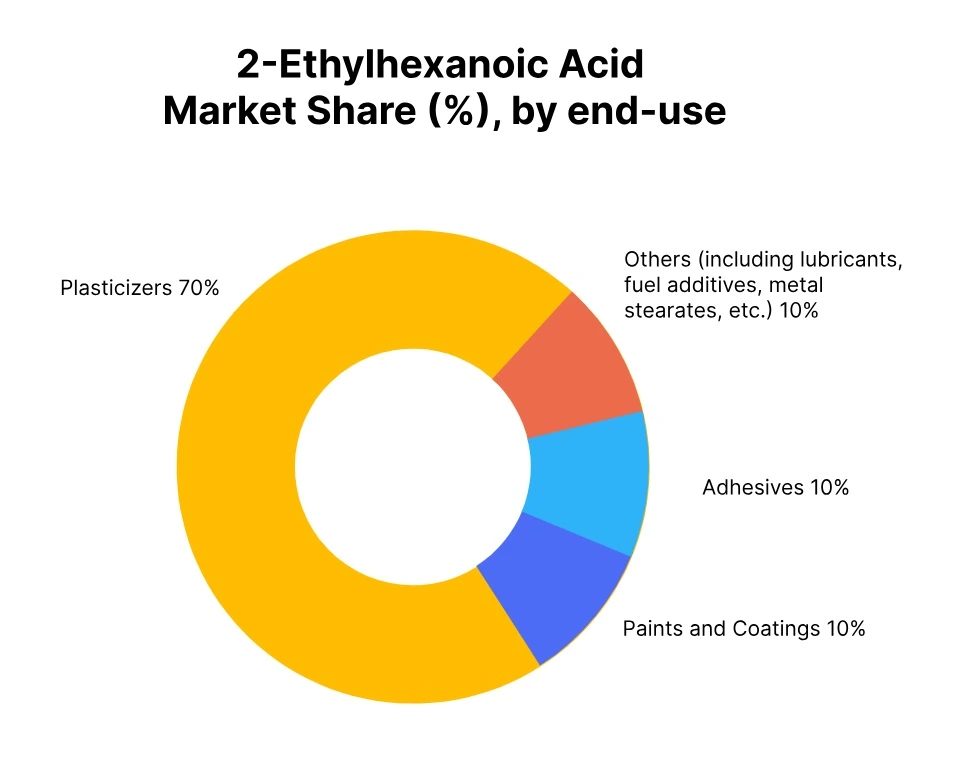
2-ethyl hexanoic acid market share End use

Historically, several events have caused significant fluctuations in 2-ethyl Hexanoic Acid (eha) prices

  • Russia-Ukraine Conflict (2022): As manufacturers seek to mitigate risks associated with disrupted supplies, there may be a shift towards sourcing alternative materials or suppliers. This increased demand can drive up prices, especially if alternative sources are limited or less efficient. Uncertainty surrounding the conflict has led to speculation in the commodities markets. Traders reacting to news about the situation can influence pricing through buying and selling pressure, often leading to short-term volatility in 2-EHA prices.
  • Texas Winter Storm (2021): The severe cold weather led to widespread power outages and infrastructure failures across Texas, a major hub for chemical manufacturing. Many facilities had to shut down or reduce operations, leading to decreased production capacity for chemicals, including 2-EHA. This reduction in supply contributed to upward pressure on prices.
  • COVID-19 Pandemic (2020):  The availability of raw materials for producing 2-EHA was impacted as sourcing became more challenging. Disruptions in logistics and transportation hampered the delivery of critical feedstocks, leading to increased production costs for manufacturers, which were often passed on to customers. Demand for 2-EHA varied significantly during the pandemic. While some sectors, such as pharmaceuticals and personal care products, saw increased demand, others, like automotive and construction, experienced slowdowns. This variability led to uncertainty in pricing as manufacturers adjusted to shifting market needs.
  • Geopolitical Tensions (2018-2019): In 2018, the U.S.-China trade war escalated, leading to the imposition of tariffs on various chemical products and raw materials. This created uncertainty in pricing and availability, as manufacturers faced increased costs for imported materials essential for producing 2-EHA. Geopolitical tensions often resulted in disruptions to supply chains. Conflicts and sanctions affected logistics and transportation routes, leading to delays in the delivery of raw materials. Such disruptions increased lead times and contributed to higher production costs for 2-EHA.
  • Shale Gas Boom (2010): The shale gas boom led to a significant increase in the availability of natural gas and ethane, which are critical feedstocks for the production of many petrochemicals, including those used to manufacture 2-EHA. The increased supply of these raw materials helped lower production costs, positively impacting 2-EHA prices.
  • Global Financial Crisis (2008-2009): During the financial crisis, many industries, including automotive, construction, and consumer goods, faced significant downturns. This reduction in economic activity led to decreased demand for 2-EHA, which is used in various applications like plastics, coatings, and lubricants. As demand waned, prices of 2-EHA tended to decline.
  • Hurricane Katrina (2005): Hurricane Katrina caused extensive damage to numerous chemical plants and refineries in the Gulf Coast region. Many facilities were forced to shut down or operate at reduced capacity due to flooding and infrastructure damage. This disruption led to a decrease in the production of 2-EHA and other chemicals, contributing to supply shortages. The storm impacted the supply of raw materials critical for producing 2-EHA. With many suppliers affected by the hurricane, the availability of essential feedstocks became limited. This shortage drove up production costs and, consequently, the prices of 2-EHA.

Why Price Watch™?

Price Watch™ is your trusted resource for tracking global 2-ethyl hexanoic acid (eha) price trends. Our platform delivers real-time data and expert analysis, offering deep insights into the key factors driving price fluctuations in the 2-ethyl hexanoic acid (eha) market. By monitoring critical events such as geopolitical tensions, supply chain disruptions, and economic shifts, Price Watch™ keeps you fully informed of market dynamics.

In addition, Price Watch™ provides detailed forecasts and updates on production capacities, enabling you to anticipate market changes and make well-informed decisions. With Price Watch™, you gain a competitive edge in understanding all the elements that influence 2-ethyl hexanoic acid (eha) prices worldwide. Stay ahead of the curve with Price Watch’s™ reliable, accurate, and timely 2-ethyl hexanoic acid (eha) market data.

Track Price Watch's™ 2-ethyl hexanoic acid (eha) price assessment on a weekly basis since 2015 onwards, along with short-term forecasts, and get access to the detailed report in a downloadable format.

2-ethyl Hexanoic Acid (eha) Market Price Trend published by Price Watch™ reflect prevailing spot market conditions, derived from independent research, verified trade inputs, and proprietary market intelligence as of the publication date. Prices are published on the specified Incoterm and represent indicative base market levels, exclusive of applicable taxes, VAT, duties, tariffs, and other statutory charges. Actual transaction values may vary depending on volume, credit terms, contractual structure, and other negotiated conditions. Market prices are inherently subject to volatility, liquidity dynamics, regulatory changes, and evolving trade activity. The information provided is for reference and benchmarking purposes only and does not constitute an offer, recommendation, or guarantee of transactional outcomes. Users should exercise independent commercial judgment and assess their specific contractual, regulatory, tax, and application requirements before making business decisions. Price Watch™ assumes no liability for decisions taken based on this information.

The pricing of 2-Ethyl Hexanoic Acid is influenced by several factors, including raw material costs, production capacity, and global demand trends. Additionally, geopolitical stability in producing regions, transportation costs, and the availability of sustainable production methods also play significant roles. Regular monitoring of these factors can help procurement heads make informed purchasing decisions.

To forecast future pricing trends for 2-Ethyl Hexanoic Acid, procurement heads should analyze historical pricing data, monitor supply chain dynamics, and stay updated on industry news. Additionally, following trends in raw material prices and technological advancements in production can provide insights. Engaging with market analysts and subscribing to industry reports can also enhance forecasting accuracy.

Yes, sustainable sourcing options for 2-Ethyl Hexanoic Acid, such as bio-based feedstocks, are becoming more prevalent and can impact pricing. While initial costs for sustainable options may be higher, they often lead to long-term savings and compliance with environmental regulations. As demand for eco-friendly products rises, exploring these sustainable alternatives could provide procurement heads with competitive pricing strategies and enhance their corporate sustainability initiatives.

2-Ethylhexanoic acid is a versatile chemical compound primarily used in the production of plasticizers, lubricants, and coatings. It serves as a key ingredient in the manufacturing of metal stearates and is essential in industries such as automotive, plastics, and chemicals, where it is used to enhance the flexibility and performance of polymers.

2-Ethylhexanoic acid is also utilized in the production of catalysts, additives for paints and coatings, and as a stabilizer in various chemical processes. It plays a critical role in industries like automotive, chemicals, and plastics, where it contributes to the production of high-performance materials.

The pricing of 2-ethylhexanoic acid directly impacts the cost of plasticizers, lubricants, and industrial chemicals, making it a key focus for manufacturers in the automotive, plastics, and chemical sectors. Price-Watch™ tracks these prices to help businesses and consumers understand and stay updated with the market trends.

2-Ethylhexanoic acid prices vary by region and delivery basis. Prices are typically quoted per metric ton and change based on supply, demand, feedstock costs, and production capacity. Price-Watch™ provides real-time price assessments across different global markets to help buyers and sellers make informed decisions.

2-Ethylhexanoic acid prices fluctuate due to several factors, including changes in raw material costs (such as isooctene, butanol, and various feedstocks), energy price movements, and production capacity utilization. Demand from industries such as automotive, plastics, chemicals, and coatings significantly influences price trends.

Seasonal demand in sectors like plasticizers, lubricants, paints, and industrial chemicals, as well as inventory levels, transportation and logistics costs, and competition with alternative chemical products, also impact pricing. Additionally, trade policies, tariffs, and fluctuations in the availability of key raw materials, including isooctene and butanol, play crucial roles in shaping price movements.

Plant turnarounds, maintenance schedules, and broader economic conditions, such as global supply chain disruptions or geopolitical tensions, further contribute to price volatility. Recent market trends have been affected by fluctuating raw material costs, manufacturing outputs, and demand cycles in key industrial sectors.

The biggest buyers of 2-ethylhexanoic acid are manufacturers in the automotive, plastics, coatings, and chemical industries. 2-ethylhexanoic acid is widely used as a key ingredient in the production of plasticizers, which enhance the flexibility and durability of plastics, especially in the automotive and construction sectors.

It also plays a critical role in the manufacturing of lubricants, coatings, and stabilizers, where it improves the performance and longevity of industrial materials. Additional substantial demand comes from industries such as paints and coatings, where it is used as a stabilizer, and in the production of catalysts and additives for various chemical processes.

2-ethylhexanoic acid is also essential in the production of metal stearates and is utilized in a variety of applications across multiple sectors, including automotive, plastics, and chemicals. Price-Watch™ analyzes demand patterns across these diverse industries to provide valuable insights into market trends.

2-Ethylhexanoic acid is primarily produced through the aldol condensation of n-butyraldehyde and acetic acid, a process that takes place in specialized reactors. N-butyraldehyde is typically derived from the oxidation of n-butene, while acetic acid is commonly produced by the methanol carbonylation process or through fermentation.

The resulting 2-ethylhexanoic acid is then purified and used across various industries. Alternative, more sustainable production routes are being explored, including the use of bio-based feedstocks and renewable energy sources in the production process.

2-Ethylhexanoic acid is manufactured by major chemical companies that operate integrated production facilities, catering to industries such as automotive (plasticizers), coatings, lubricants, and industrial chemicals. These companies aim to meet the growing demand for 2-ethylhexanoic acid in sectors like automotive manufacturing, plastics production, and coatings industries.

2-Ethylhexanoic acid trade is influenced by production capacity, raw material availability, and regional demand in key industries such as automotive, plastics, coatings, and chemicals.

Countries like the United States, China, and major European producers are key exporters of 2-ethylhexanoic acid, with significant production facilities for feedstocks like n-butyraldehyde and acetic acid. In Asia, countries like Malaysia and Japan play critical roles in the global 2-ethylhexanoic acid market, driven by their large-scale automotive, plastics, and coatings industries.

Europe, particularly countries such as Germany and Italy, also plays an essential role in meeting the demand from automotive manufacturing, coatings, and plasticizer production. Export volumes fluctuate based on production capacity, raw material costs, seasonal demand, shipping expenses, and regional supply-demand dynamics.

Trade flows are also impacted by factors like competition from alternative chemicals, trade policies, tariffs, and market-specific pricing conditions. Price-Watch™ tracks production levels, export flows, and trade patterns to help businesses understand global supply chains and identify sourcing opportunities.

Supply generally matches demand for 2-ethylhexanoic acid, but regional shortages can occur due to production disruptions such as plant shutdowns, raw material supply constraints, and transportation issues.

Planned and unplanned maintenance in key manufacturing facilities, limitations in the availability of feedstocks like n-butyraldehyde and acetic acid or shifts in production focus (such as changes in the types of chemicals produced) can temporarily tighten markets.

Sudden spikes in demand from industries like automotive, plastics, and coatings can also strain supply, leading to short-term imbalances. These disruptions can result in tighter availability and increased prices, especially during periods of high demand or when production capacity is limited.

Price-Watch™ monitors these supply-demand imbalances to alert the market about potential shortages or surpluses, helping businesses stay informed about market conditions and make proactive sourcing decisions.

2-Ethylhexanoic acid prices vary based on application grades, delivery terms, and contract structures. 2-Ethylhexanoic acid is produced in different grades depending on its purity and intended use.

Lower-grade 2-ethylhexanoic acid (typically 90-95% purity) is commonly used in the production of plasticizers, lubricants, and coatings, while higher-grade 2-ethylhexanoic acid (greater than 99% purity) is used in specialized applications such as catalysts, coatings, and stabilizers. Higher purity grades typically command premium prices due to their suitability for more demanding or specialized processes.

Pricing also varies based on delivery terms (truck, rail, marine, or bulk shipments), contract structures (spot vs. long-term agreements), and geographic location, with regional supply and demand dynamics influencing costs. Price-Watch™ provides separate price assessments for different delivery bases and contract types, ensuring market transparency for businesses and consumers.

When 2-ethylhexanoic acid demand rises quickly, often due to increased automotive production, plasticizer requirements, or higher needs in coatings and lubricants, prices typically increase. Suppliers may prioritize long-term contract customers, while spot buyers face tighter availability, longer lead times, or significant premium pricing to secure supplies.

Production flexibility is constrained by raw material availability, manufacturing capacity limits, and the time required to restart or ramp up production facilities. Market conditions such as seasonal demand spikes, especially in the automotive and construction industries, or supply chain disruptions can further impact availability and contribute to price increases.

Additionally, fluctuations in feedstock costs, like n-butyraldehyde and acetic acid, can influence production costs, further impacting the price of 2-ethylhexanoic acid. Price-Watch™ captures these market dynamics in real-time.

Energy and feedstock costs are the dominant factors in 2-ethylhexanoic acid pricing. When crude oil, natural gas, or electricity prices rise, the cost of producing 2-ethylhexanoic acid increases, as raw materials like n-butyraldehyde and acetic acid become more expensive.

The production of 2-ethylhexanoic acid is energy-intensive, particularly in the condensation and purification processes, making it highly sensitive to fluctuations in energy prices. The pricing of 2-ethylhexanoic acid is closely tied to raw material costs, such as n-butyraldehyde for the condensation reaction and acetic acid as a key feedstock.

Increases in energy prices or disruptions in the supply of these raw materials can lead to higher production costs, directly impacting 2-ethylhexanoic acid prices. This relationship is analyzed in real-time by Price-Watch™, which tracks energy costs and feedstock trends to provide accurate price assessments and market insights.

2-Ethylhexanoic acid prices vary by region based on local production capacity, feedstock availability, manufacturing infrastructure, energy costs, and regional supply-demand balances. Differences in feedstock types, such as n-butyraldehyde and acetic acid, influence production costs, with regions relying on different raw materials or processes affecting 2-ethylhexanoic acid pricing.

Local energy prices, transportation costs, and logistics also play a significant role in price variations. Additionally, the concentration of key industries, such as automotive, plastics, coatings, and chemicals, as well as the level of 2-ethylhexanoic acid import/export activity, influence regional pricing dynamics.

Regions with stronger automotive sectors, plastics production, and chemical industries tend to experience different pricing trends compared to regions with less industrial concentration. Price-Watch™ tracks 2-Ethylhexanoic acid prices across all major regions to highlight these differences and provide detailed market insights.

The 2-ethylhexanoic acid market outlook depends on factors such as n-butyraldehyde and acetic acid feedstock price trends, production rates in key manufacturing sectors, capacity expansions (including 2-ethylhexanoic acid production units), and maintenance schedules. Industry demand from automotive, plastics, coatings, and chemicals, as well as growth in plasticizers, lubricants, and industrial applications, are critical drivers of price trends.

Changes in feedstock availability, particularly n-butyraldehyde and acetic acid, and transportation or shipping costs can also influence 2-ethylhexanoic acid pricing. Additionally, regional supply-demand balances, import/export dynamics, and broader macroeconomic conditions affecting automotive production, plastics manufacturing, and chemical industries will play a key role in shaping market trends.

Price-Watch™ regularly publishes detailed forecasts, analyzing supply-demand patterns, seasonal trends, and economic indicators to help businesses anticipate market conditions and plan accordingly for 2-Ethylhexanoic acid prices over the next 12 months.

Absolutely. Accurate forecasting allows you to time your purchases better, negotiate contracts more effectively, and budget more accurately. If Price-Watch™forecasts predict a price increase in three months, you might choose to stock up now or lock in long-term contracts at current rates, potentially saving thousands of dollars.

Global events can significantly impact 2-ethylhexanoic acid supply and prices. Disruptions such as natural disasters, accidents at production facilities, feedstock supply shortages, planned and unplanned maintenance shutdowns, and geopolitical tensions affecting raw material markets can lead to supply shortages and price volatility.

For example, disruptions like hurricanes or floods affecting chemical plants, unplanned plant shutdowns in key production regions, geopolitical tensions in areas critical for n-butyraldehyde or acetic acid production, or labor strikes in major manufacturing hubs can create significant market volatility for 2-ethylhexanoic acid. Economic downturns or changes in demand from key sectors like automotive, plastics, and coatings can also influence pricing.

These global events often lead to fluctuations in availability and pricing, impacting industries that rely on 2-ethylhexanoic acid for their products. Price-Watch™ provides timely alerts when such global events affect 2-Ethylhexanoic acid market conditions, helping businesses anticipate price fluctuations.

Price-Watch™ collects data from manufacturers, distributors, and buyers worldwide to publish regular price assessments, market reports, and forecasts for 2-Ethylhexanoic acid. Our transparent methodology and comprehensive coverage make us a trusted source for understanding fair pricing and market trends in the 2-Ethylhexanoic acid industry.