Acetic Acid Price Trend and Forecast

UNSPC code: 51113400
|
Weekly Update
|
Historical Data Since 2015
|
Forecast for 2026

acetic acid Price Trends by Country

cnChina
saSaudi Arabia
usUnited States
beBelgium
inIndia

Global acetic acid Spot Market Prices, Trend Analysis and Forecast

Price-Watch™ provides real-time price assessments and price forecasts for Acetic Acid across top trading regions:

Acetic Acid Regional Coverage   Acetic Acid Grade and Country Coverage   Acetic Acid Pricing Data Coverage Explanation  


Asia Acetic Acid Pricing Analysis  

Glacial Acetic Acid (99% min) FOB Prices at Shanghai Port, China   Weekly Price Update on Acetic Acid Real-Time Export Prices from Shanghai Port, China to Global Markets  
Acetic Acid – Industrial Grade (80% min) FOB Prices at Shanghai Port, China  Weekly Price Update on Acetic Acid Real-Time Export Prices from Shanghai Port, China to Global Markets  
Industrial Grade Glacial Acetic Acid (99% min) CIF Prices at Nhava Sheva Port, West India, Importing from China   Weekly Price Update on Acetic Acid Real-Time Import Prices at Nhava Sheva Port, West India from China  
Industrial Grade Glacial Acetic Acid (99% min) Ex-Mumbai Domestic Prices, West India   Real-Time Weekly Price Update of Acetic Acid Domestic Prices in Mumbai, West India  
Industrial Grade Glacial Acetic Acid (99% min) Ex-Bharuch Domestic Prices, West India   Real-Time Weekly Price Update of Acetic Acid Domestic Prices in Bharuch, West India  
North America Acetic Acid Pricing Analysis   Industrial Grade Acetic Acid (80% min) FOB prices at Houston Port, USA  Weekly Price Update on Acetic Acid Real-Time Export Prices from Houston Port, USA to Global Markets 
Europe Acetic Acid Pricing Analysis   Industrial Grade Glacial Acetic Acid (80% min) CIF Prices at Antwerp Port, Belgium, Importing from USA  Weekly Price Update on Acetic Acid Real-Time Export Prices from Shanghai Port, China to Global Markets 
Middle East & Africa Acetic Acid Pricing Analysis   Industrial Grade Glacial Acetic Acid (99% min) FOB Prices at Jubail Port, Saudi Arabia  Weekly Price Update on Acetic Acid Real-Time Export Prices from Jubail Port, Saudi Arabia to Global Markets  


Note: In assessments structured as CIF [Importing Port] (Exporting Country), the country mentioned in brackets indicates the primary origin of supply (exporting country), while the named port refers to the destination port in the importing country. Other Incoterms (FOB, FD, EXW, etc.) should be interpreted in accordance with standard international trade definitions.

Acetic Acid Price Trend Q1 2026

In Q1 2026, Acetic acid prices accelerated more strongly, driven by rising feedstock costs and tighter supply conditions. March saw sharp acetic acid price trend increases due to supply disruptions caused by geopolitical tensions in the Middle East, which affected raw material availability and freight logistics.

The quarter highlights how external geopolitical factors can quickly amplify short-term price volatility despite stable fundamentals earlier in the period.

China: Acetic Acid Export prices FOB Shanghai, China; Grade- Industrial Grade Glacial Acetic Acid (99% min)

During the Q1 2026, the glacial acetic acid price trend in China has escalated by 16.00% compared to the average of the previous quarter. Glacial acetic acid price trend in China is attributed to higher upward pressures arising from reduced supplies of the product in the global market and high feedstock prices. Increased purchase activities for the commodity have been experienced due to supply fears.

In China, Glacial Acetic Acid price in March 2026 has risen by 13.00% compared to the average of the previous month. This price escalation has mainly been attributed to supply problems resulting from the ongoing crisis in the Middle East region. Increased energy and freight prices have also played a significant role in raising the commodity price.

China: Acetic Acid Export prices FOB Shanghai, China; Grade- Industrial Grade Acetic Acid (80% min)

In Q1 2026, the Glacial Acetic Acid price trend in China experienced an increase of 16.00% compared to the average price of the previous quarter. Glacial Acetic Acid price in China is supported by growing upward pressure caused by the limited availability of Glacial Acetic Acid on the international level and high production costs. An increase in purchases has been observed during the period due to supply shortages.

In China, Glacial Acetic Acid price in March 2026 has also risen by 13.00% compared to the average price of the previous month. Such a change is attributed to disruptions caused by geopolitical issues in the Middle East, leading to problems in supplying the raw materials.

Additionally, higher shipping expenses and energy prices have contributed to the trend’s increase. Thus, the quarter under review showed high dependence on geopolitical factors and supply problems on the market.

India: Acetic Acid Domestic traded prices Ex-Mumbai; Grade- Industrial Grade Glacial Acetic Acid (99% min)

For Q1 2026, the glacial acetic acid price trend in India has sharply risen by 39.00% from the average price level in the previous quarter. Glacial acetic acid price in India is a result of the positive turnaround brought about by reduced supply levels coupled with higher feedstock costs.

There have been high purchases due to fears over availability and rising raw material prices around the globe. In India, Glacial Acetic Acid price in March 2026 has also risen by 39.00% from the average price level of the previous month.

This has mainly been attributed to supply issues arising out of the Middle East war, which has resulted in scarcity and high freight costs. This has been another period characterized by a great influence of geopolitics on market prices.

Saudi Arabia: Acetic Acid Export prices FOB Jubail, Saudi Arabia; Grade- Industrial Grade Glacial Acetic Acid (99% min)

In Q1 2026, the Glacial acetic acid price trend in Saudi Arabia increased by 3.00% as compared to the previous quarter average, reflecting gradually improving demand and tighter supply fundamentals.

The market showed cautious optimism with measured procurement activity amid global cost pressures. The Glacial Acetic Acid price in Saudi Arabia maintained a steady upward trajectory during the quarter.

In Saudi Arabia, Glacial Acetic Acid price in March 2026 surged by 11.00% as compared to the previous month average, largely driven by supply disruptions caused by the Middle East war. These disruptions affected raw material sourcing, increased freight costs, and tightened overall availability.

The quarter highlights the growing impact of geopolitical tensions on pricing dynamics and supply security.

USA: Acetic Acid Export prices FOB Houston, China; Grade- Industrial Grade Acetic Acid (80% min)

In Q1 2026, the acetic acid price trend in the USA increased by 6.00% as compared to the previous quarter average, driven by rising feedstock costs and stronger downstream demand. The market showed firm momentum with buyers increasing procurement amid supply concerns. The Acetic Acid price in the USA rose steadily during the quarter.

In the USA, the acetic acid price in March 2026 surged by 11.00% as compared to the previous month average, primarily due to supply chain disruptions related to geopolitical tensions in the Middle East.

These disruptions caused higher freight costs and tighter supply, leading to accelerated restocking. Overall, the quarter highlights the sensitivity of prices to external supply shocks and cost pressures.

Belgium: Acetic Acid Export prices CIF Antwerp, Belgium; Grade- Industrial Grade Acetic Acid (80% min)

According to Price-Watch™, in Q1 2026, the Acetic Acid (80% min) price trend in Belgium increased by 6.00% as compared to the previous quarter average, reflecting rising feedstock costs and firm downstream demand.

The acetic acid market showed a steady upward trajectory as buyers adjusted procurement strategies to secure supply amid tighter global conditions. The acetic acid  price in Belgium continued to rise throughout the quarter.

In Belgium, Acetic Acid price in March 2026 surged by 10.00% as compared to the previous month average, largely driven by supply disruptions caused by geopolitical tensions in the Middle East, which affected feedstock availability and increased freight costs.

Overall, the quarter highlighted how external factors can sharply influence short-term price dynamics despite stable fundamentals earlier in the period.

Acetic Acid Price Trend Analysis: Q4 2025

In Q4 2025, Acetic Acid prices showed moderate growth across key markets, supported by steady industrial and chemical demand and balanced supply conditions.

Procurement activity remained generally stable, and slight easing in some regions toward December led to minimal monthly fluctuations. Overall, the quarter reflected a stable market with controlled inventory levels and gradual price movements.

China: Acetic Acid Export prices FOB Shanghai, China; Grade- Industrial Grade Glacial Acetic Acid (99% min)

For Q4 2025, Glacial Acetic Acid price trend in China rose by 3.00% against the previous quarter’s average, buoyed by the constant demand from the chemical industry and favorable supply circumstances.

Manufacturers have kept up with their production levels, while consumers continued with their regular purchases to fulfil their consumption. Glacial Acetic Acid price in China is characterized by a relatively strong market situation, affected by the equilibrium between supply and demand and modest logistic expenses.

In China, Glacial Acetic Acid price in December 2025 went up by 4.00% against the previous month’s average due to increased buyer interest and higher freight expenses at the end of the year.

Overall, acetic acid prices have been rising steadily during the quarter due to stable market dynamics and constant consumption.

China: Acetic Acid Export prices FOB Shanghai, China; Grade- Industrial Grade Acetic Acid (80% min)

Acetic Acid price trend in China in Q4 2025 has been seen rising by 1.00% relative to the average price in the prior quarter due to the steady demand from the chemicals and industries sector, coupled with balanced supply.

Suppliers have continued their production levels without change, while consumers have bought Acetic Acid in a prudent manner to control inventory. Acetic Acid (80% min) price in China has been noted to be strong yet gentle.

In China, Acetic Acid price in December 2025 has been noted to rise by 4.00% in relation to the average price level during the preceding month due to increased purchases ahead of the end-of-year period, as well as an increase in logistics costs.

India: Acetic Acid Domestic traded prices Ex-Mumbai, Ex-Bharuch; Grade- Industrial Grade Glacial Acetic Acid (99% min)

The Glacial Acetic Acid price trend in India for Q4 2025 has decreased by 10.00% on a quarter-over-quarter basis, mainly owing to reduced demand and higher stock levels in the domestic market.

Consumers have opted for conservative purchase strategies in view of excess availability and aggressive pricing by substitutes. The Glacial Acetic Acid price in India has mirrored bearish market trends in the current quarter, impacted by weak demand from industries using Glacial Acetic Acid as an input material.

In India, Glacial Acetic Acid price in December 2025 has reversed its direction and witnessed an increase of 8.00% from the previous month average, mainly attributed to revived buying sentiments and tighter supply situations towards the end of the year.

Saudi Arabia: Acetic Acid Export prices FOB Jubail, Saudi Arabia; Grade- Industrial Grade Glacial Acetic Acid (99% min)

In Q4 2025, the Glacial Acetic Acid price trend in Saudi Arabia declined by 2.00% as compared to the previous quarter average, reflecting softer regional demand and ample supply availability. Producers maintained steady output, but cautious buying from downstream industries weighed on prices.

The Glacial Acetic Acid price in Saudi Arabia showed a mild downward trend during the quarter, influenced by balanced supply and subdued procurement activity.

However, in Saudi Arabia, Glacial Acetic Acid price in December 2025 increased by 1.00% as compared to the previous month average, supported by slight improvements in demand and stable logistics costs toward the year-end. Overall, the quarter experienced modest price weakening followed by stabilization.

USA: Acetic Acid Export prices FOB Houston, China; Grade- Industrial Grade Acetic Acid (80% min)

In Q4 2025, the Acetic Acid price trend in the USA increased by 3.00% as compared to the previous quarter average, supported by steady demand from chemical and industrial sectors and balanced supply conditions.

Producers maintained consistent output, while buyers engaged in regular procurement to meet production needs. The Acetic Acid price in the USA remained stable throughout the quarter, with minimal fluctuations.

In the USA, Acetic Acid price in December 2025 is almost stable compared to the previous month, reflecting balanced market fundamentals and controlled inventory levels. Overall, the quarter experienced moderate price growth supported by steady consumption and manageable supply dynamics.

Belgium: Acetic Acid Export prices CIF Antwerp, Belgium; Grade- Industrial Grade Acetic Acid (80% min)

In Q4 2025, the Acetic Acid price trend in Belgium increased by 2.00% as compared to the previous quarter average, supported by steady demand from industrial and chemical sectors and adequate supply conditions.

Buyers maintained regular procurement to meet production needs, while suppliers ensured consistent availability. The Acetic Acid price in Belgium showed moderate growth during the quarter, reflecting balanced supply-demand dynamics.

In Belgium, the Acetic Acid price in December 2025 declined by 1.00% as compared to the previous month average, driven by slower buying activity and mild easing of logistics costs toward the year-end. Overall, the quarter experienced moderate price movement, underpinned by stable market fundamentals and controlled supply.

In Q3 2025, the Acetic Acid price trend showed a declining pattern across the Asia region and the Middle East, driven by subdued demand, ample supply, and softened upstream costs. The Acetic Acid price in key Asian markets, including China, India, and Southeast Asia fell steadily as downstream consumption in sectors such as textiles, packaging, and chemicals remained muted.

Similarly, in the Middle East, buyers adopted a cautious stance amid steady inflows and competitive offers from Asian exporters. Weakened methanol and carbon monoxide feedstock prices also contributed to the bearish sentiment.

By September, regional markets had absorbed the oversupply, and Acetic Acid price continued to reflect downward pressure across both regions, pointing to a soft outlook heading into Q4.

China: Acetic Acid Export prices FOB Shanghai, China, Grade- Industrial Grade Glacial Acetic Acid (99% min).

In Q3 2025, Glacial Acetic Acid price trend in China basis experienced a noticeable decrease, with prices settling in the range of approximately 300 to 320 USD per ton by the end of the quarter. This downward adjustment was primarily driven by weak demand from downstream industries, including textiles, chemicals, and packaging, alongside a supply environment that remained stable to slightly oversupplied.

The decline in feedstock costs, especially methanol, also played a key role in easing production expenses and enabling exporters to offer more competitive pricing. in September 2025, Glacial Acetic Acid prices in China had adjusted to reflect bearish market sentiment and subdued global demand, marking a softening Glacial Acetic Acid price in China as the quarter closed.

China: Acetic Acid Export prices FOB Shanghai, China, Grade- Industrial Grade Acetic Acid (80% min).

During Q3 2025, Acetic Acid (80% min) price trend in China declined by about 3% due to weakened demand from major downstream industries alongside steady supply levels. The Acetic Acid (80% min) price in the China export market softened as buyers exercised caution amid ample stock availability and subdued market confidence.

Additionally, falling feedstock prices, especially methanol, helped lower production costs, enabling suppliers to reduce their offers. In September 2025, Acetic Acid (80% min) prices in China had moderately dropped from the previous quarter, indicating a controlled but downward movement in the market.

India: Acetic Acid Domestic traded prices Ex-Mumbai, Ex-Bharuch, Grade- Industrial Grade Glacial Acetic Acid (99% min).

According to Price-Watch AI, In Q3 2025, Glacial Acetic Acid (99% min) price trend in India for Ex-Mumbai and Ex -Bharuch market exhibited a notable decrease, with prices settling at approximately 32,000 INR per ton by the end of the quarter.

This downward movement in Glacial Acetic Acid price in India was primarily influenced by a combination of factors including softened domestic demand, steady production output, and moderate fluctuations in raw material costs such as methanol and acetaldehyde.

Glacial Acetic Acid price adjustment reflected cautious buying behaviour from key end-use sectors including pharmaceuticals, textiles, and chemical manufacturing, which experienced slower order flows amid broader economic uncertainties.

Despite these headwinds, supply availability remained balanced, preventing any sharp price volatility. Currency stability and competitive import offer also played a role in tempering price increases, as importers evaluated cost effective sourcing options.

In September 2025, Glacial Acetic Acid price in India had absorbed these dynamics, resulting in a relatively stable yet modestly bearish pricing environment compared to the previous quarter.

The overall price trend suggests continued sensitivity to raw material feedstock pricing, currency fluctuations, and downstream demand patterns, with expectations of a cautiously steady market moving into Q4.

Saudi Arabia: Acetic Acid Export prices FOB Jubail, Saudi Arabia, Grade- Industrial Grade Glacial Acetic Acid (99% min).

In Q3 2025, Glacial Acetic Acid (99% min) price trend in Saudi Arabia saw a moderate increase of approximately 1.5%, driven by improving demand from regional downstream industries and tighter supply conditions.

Glacial Acetic Acid price in Saudi Arabia rise was supported by heightened activity in sectors such as pharmaceuticals, adhesives, and chemical manufacturing, which fuelled stronger procurement requirements.

Additionally, stable yet slightly firming feedstock costs contributed to upward pressure on pricing. The price in the Saudi export market benefited from favourable currency conditions and improved logistics efficiencies, helping to sustain the upward momentum through the quarter.

In September 2025, Glacial Acetic Acid price in Saudi Arabia had adjusted to these factors, reflecting a cautiously optimistic outlook with prices edging higher compared to the previous quarter. This trend indicates growing regional consumption and a balanced supply-demand dynamic, suggesting potential for further moderate gains heading into Q4.

USA: Acetic Acid Export prices FOB Houston, China, Grade- Industrial Grade Acetic Acid (80% min).

In Q3 2025, Acetic Acid (80% min) price trend in USA experienced a notable increase of approximately 5%, driven by rising demand from key downstream industries including adhesives, textiles, and chemical manufacturing.

Acetic Acid price in USA hike was supported by tightening supply conditions amid operational constraints at some production facilities, leading to reduced availability in the export market. Additionally, higher feedstock costs, particularly methanol, contributed to upward pricing pressure.

Acetic Acid price in the Houston export market strengthened throughout the quarter, with buyers willing to pay premiums to secure volumes. In September 2025, Acetic Acid price in USA, exhibited firm pricing momentum, reflecting a bullish sentiment that may continue into the next quarter if supply-demand dynamics persist.

Belgium: Acetic Acid Export prices CIF Antwerp, Belgium, Grade- Industrial Grade Acetic Acid (80% min).

In Q3 2025, Acetic Acid (80% min) price trend in Belgium showed a moderate increase of around 3%, driven by firmer demand from European downstream industries such as textiles, coatings, and adhesives.

Acetic Acid price in Belgium uptick was influenced by tightening supply in the regional market, compounded by higher feedstock costs and logistical challenges, including increased freight and energy expenses.

In September 2025, Acetic Acid price in Belgium market strengthened steadily throughout the quarter as buyers sought to secure material amid ongoing supply uncertainties.

Acetic Acid price in Belgium, reflects that market participants adjusted their expectations to reflect this upward momentum, signaling a cautiously optimistic outlook for the remainder of the year.

According to the PriceWatch, In Q2 2025, acetic acid price trend for FOB Shanghai basis recorded a clear decrease, driven primarily by a combination of robust supply and weakened downstream demand and the price stood at 336 USD per ton by the end of June for Glacial Acetic Acid.

Chinese producers operated at high utilization rates throughout the quarter, ensuring ample availability in the export market. However, demand from key consuming sectors such as vinyl acetate monomer (VAM), acetate esters, and other derivatives remained subdued, as buyers adopted a cautious procurement strategy amid economic uncertainties and soft market sentiment.

With feedstock methanol prices and freight rates remaining largely stable, the downward pressure on acetic acid prices was primarily demand-driven.

The overall acetic acid market tone during the quarter was bearish, reflecting an oversupplied environment and limited buying interest, which together contributed to the sustained decline in FOB Shanghai acetic acid prices.

According to the PriceWatch, In Q2 2025, acetic acid price trend FOB Saudi Arabia basis exhibited a mixed trend, with the quarterly average declining despite intermittent increases during the period.

The acetic acid price trend stood at 455 USD per ton. While some weeks saw modest price upticks driven by temporary tightening in local supply or minor bursts in demand from downstream users like ester and solvent manufacturers, these gains were offset by more sustained downward pressure.

Overall, the quarter closed lower due to softer export and domestic demand amid global economic uncertainties. Supply remained broadly adequate, with no significant logistical disruptions, and feedstock and freight costs stayed relatively stable suggesting that price movements were primarily demand-driven.

Consequently, the average acetic acid price for Q2 declined, but the market was characterized by alternating increases and decreases, reflecting a cautious and responsive buying environment.

According to the PriceWatch, In Q2 2025, acetic acid price trend on an FOB Houston, USA basis decreased compared to the previous quarter. The decline was primarily driven by weakened demand from downstream sectors such as vinyl acetate monomer (VAM), purified terephthalic acid (PTA), and other industrial solvents. The acetic acid price stood at USD 444 per ton by the end of Q2.

While supply remained steady from U.S. producers, buyers across both domestic and export markets were cautious in their procurement strategies due to sufficient inventories and uncertain economic conditions.

Feedstock costs and freight rates remained relatively stable, reinforcing that the price drop was largely demand-led. Overall, the market showed a bearish trend throughout the quarter, with FOB Houston prices trending lower than Q1 levels.

According to the PriceWatch, In Q2 2025, price trend for CIF Nhava Sheva India and Ex-Mumbai Glacial Acetic Acid prices experienced volatility. Acetic acid price trend stood at around INR 36000 and 37000 per ton by the end of June, experiencing a decline in price as compared to previous quarter.

The uptrend was supported by tightening supply conditions, including plant maintenance shutdowns in key production regions, and a marginal improvement in demand from acetate and food-grade end-users.

While consumption was not robust, supply-side constraints helped maintain a bullish sentiment in the market during this period. The decline was primarily driven by weakened demand from downstream sectors such as vinyl acetate monomer (VAM), purified terephthalic acid (PTA), and other industrial solvents.

In Q1 2025, the Asia-Pacific region will experience increased volatility in Acetic Acid prices. Key factors driving these price fluctuations include differing demand trends across various countries, particularly influenced by China’s strong performance.

At the end of the march the FOB prices Glacial Acetic Acid of China stood at 365 USD per Ton with a slight increase in the price as compared to previous quarter.

The first quarter of 2025 witnessed significant fluctuations in Ex-Mumbai Acetic Acid prices. At the end of the quarter, month end of March Glacial Acetic Acid price stood at INR 39800 per ton for Ex-Mumbai, as downstream demand from sectors like Vinyl Acetate Monomer (VAM) and Purified Terephthalic Acid (PTA) remained robust.

Acetic Acid Price Trend Analysis: Q4 2024

In Q4 2024, the Asia-Pacific region will experience increased volatility in acetic acid prices. At the quarter end the glacial acetic acid price trend stood at USD 383 per ton. Key factors driving these price fluctuations include differing demand trends across various countries, particularly influenced by China’s strong performance.

Additionally, rising crude oil prices will affect production costs, while ongoing trade tensions will disrupt regional supply chains. In the short term, the acetic acid market will experience growth primarily due to rising demand from the paints and coatings sectors. This trend is one of the key factors fuelling the market’s expansion.

In the fourth quarter of 2024, Ex-Mumbai Glacial Acetic Acid prices experienced volatility. Acetic acid prices end at INR 45000 per ton by the end of December 2024 experiencing a decline in price as compared to previous quater.

The uptrend was supported by tightening supply conditions, including plant maintenance shutdowns in key production regions, and a marginal improvement in demand from acetate and food-grade end-users.

While consumption was not robust, supply-side constraints helped maintain a bullish sentiment in the market during this period.

In Q3 2024, the acetic acid market will continue to experience upward price pressure due to ongoing supply limitations. The growing demand for adhesives, paints, and coatings will expect to boost the acetic acid market in the APAC region.

The acetic acid market in India is on the rise, driven by factors like industrial growth and the expansion of manufacturing sectors. The acetic acid market in the Middle East will experience growth, largely fuelled by advancements in the pharmaceutical industry and a rising demand for medicines.

In Saudi Arabia, the food and beverage sector will also play a significant role, using acetic acid for preserving meat and other food products. This combination of factors will contribute to a robust demand for acetic acid in the region.

In the third quarter of 2024, Ex-Mumbai Glacial Acetic Acid prices saw first experienced increase then decrease, maintaining a stable overall quarter change difference in price.

In Q2 2024, the Asian acetic acid market experienced a decline in prices and this market decline was attributed to the availability of sufficient inventories, which were more than enough to meet the demands of downstream industries both domestically and internationally.

In June, a maintenance shutdown took place, which also impacted acetic acid prices. Seasonal trends have also influenced the market. As the second quarter finish Glacial Acetic Acid price of China stood at 415 USD per ton.

The acetic acid market in the MEA region has encountered notable fluctuations, shaped by a range of complex factors, primarily driven by higher production costs resulting from a spike in upstream crude oil prices.

During the second quarter of 2024, Ex-Mumbai Glacial Acetic Acid prices experienced a slight bullish trend where price stood at INR 51500 per ton by the end of month of June.

The uptrend was supported by tightening supply conditions, including plant maintenance shutdowns in key production regions, and a marginal improvement in demand from acetate and food-grade end-users.

While consumption was not robust, supply-side constraints helped maintain a bullish sentiment in the market during this period.

In Q1 2024 the Asian countries acetic acid prices remained relatively stable. This flat trend in the market was largely due to high inventory levels and increased production cost driven by rising crude oil prices.

In India, acetic acid spot prices have been fluctuating at the lower end of the spectrum. This trend has been influenced positively by the end-user industry, which is contributing to the overall pricing patterns.

The first quarter of 2024 acetic acid price stood at INR 47000 per ton for Glacial Acetic Acid for Ex-Mumbai. The uptrend was supported by tightening supply conditions, including plant maintenance shutdowns in key production regions, and a marginal improvement in demand from acetate and food-grade end-users.

While consumption was not robust, supply-side constraints helped maintain a bullish sentiment in the market during this period.

Technical Specifications of Acetic Acid Price Trends

Product Description

Acetic Acid is a clear, colourless organic liquid with a sharp, pungent vinegar-like odour. It is a weak carboxylic acid with the chemical formula CH₃COOH, widely used as a key building block in the chemical industry.

Industrial-grade acetic acid is primarily produced through methanol carbonylation. It serves as an essential raw material in the manufacture of acetate esters, vinyl acetate monomer (VAM), acetic anhydride, and various solvents and polymers.

In addition to its use in chemical synthesis, it is also employed in textiles, plastics, food preservation (as a food-grade additive E260), and cleaning agents. Acetic acid is highly miscible with water and many organic solvents, and while it is biodegradable and naturally occurring, it is corrosive in concentrated forms and should be handled with proper safety precautions.

Identifiers and Classification:

  • CAS No – 64-19-7
  • HS Code – 29152100
  • Molecular Formula – CH3COOH
  • Molecular Weight[g/mol] – 60.052


Acetic Acid Synonyms:

  • Ethanoic acid
  • Ethylic Acid


Acetic Acid Grades Specific Price Assessment:

  • Industrial Grade Glacial Acetic Acid (99% min)
  • Industrial Grade Acetic Acid (80% min)


Acetic Acid Global Trade and Shipment Terms

  • Quotation Terms: 25-28 MT
  • Packaging Type: ISO Tank


Incoterms Referenced in Acetic Acid Price Reporting

Shipping Term  Location  Definition 
FOB Shanghai  Shanghai, China  Acetic Acid Export price from China 
CIF Nhava Sheva (China)  Nhava Sheva, India  Acetic Acid import price in India from China 
Ex-Mumbai  Mumbai, India  Domestically Traded Acetic Acid price in Mumbai 
Ex-Bharuch  Bharuch, India  Domestically Traded Acetic Acid price in Bharuch 
FOB Jubail  Jubail, Saudi Arabia  Acetic Acid Export price from Saudi Arabia 
FOB Houston  Houston, USA  Acetic Acid Export price from USA 
CIF Antwerp (USA)  Antwerp, Belgium  Acetic Acid import price in Belgium from USA 

*Quotation Terms refers to the quantity range specified for the Acetic Acid, being quoted or offered in a commercial transaction.

**Packaging Type refers to standard packaging size commonly used for Acetic Acid packing, ease of handling, transportation, and storage in industrial and commercial applications.


Key Acetic Acid Manufacturers

Manufacturer 
Celanese Corporation 
Eastman 
INEOS 
Jiangsu SOPO Chemical Group 
Sinopec  
Hualu Hengsheng
Shanghai Wujing Chemical 
Gujarat Narmada Valley Fertilizers & Chemicals Limited 
Jubilant Ingrevia 

Acetic Acid Industrial Applications

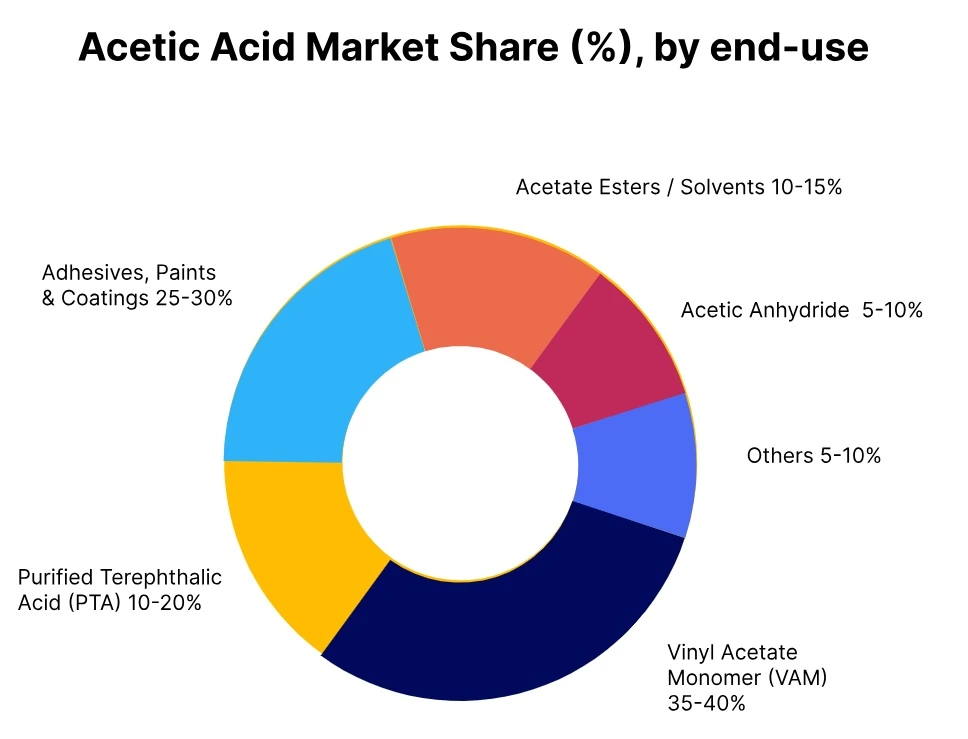
Acetic Acid Market Share End use

Historically, several events have caused significant fluctuations in Acetic Acid prices

  • Russia-Ukraine Conflict (2022-Present): Disruptions in supply chains, particularly from key suppliers in the region, have created shortages and increased production costs. Additionally, the conflict has caused instability in trade relationships, resulting in delays and increased shipping costs. Consequently, companies reliant on Acetic Acid are facing uncertainty in pricing and availability, making it challenging to manage budgets and production schedules.
  • COVID-19 Pandemic (2020): The pandemic caused disruptions in supply chains and led to a decline in industrial activity, which temporarily affected demand for Acetic Acid. It had a significant negative impact on the Acetic Acid market in the Asia-Pacific region. China was particularly affected, leading to production stoppages. However, in the post-pandemic period, the market has rebounded, driven by rising demand from various industries, including adhesives, paints and coatings, as well as food and beverages.
  • Geopolitical Tensions (2018-2019): Trade disputes, particularly between major economies, led to uncertainty in global markets. Tariffs and sanctions imposed during this time disrupted supply chains, increasing costs for raw materials and production. These tensions resulted in reduced availability of Acetic Acid, as manufacturers faced challenges in sourcing necessary components and maintaining stable operations.

These events underscore the Acetic Acid market’s vulnerability to global disruptions and highlight the need for continuous monitoring of supply-demand dynamics.

Why Price Watch™?

Price Watch™ is your trusted resource for tracking global acetic acid price trends. Our platform delivers real-time data and expert analysis, offering deep insights into the key factors driving price fluctuations in the acetic acid market. By monitoring critical events such as geopolitical tensions, supply chain disruptions, and economic shifts, Price Watch™ keeps you fully informed of market dynamics.

In addition, Price Watch™ provides detailed forecasts and updates on production capacities, enabling you to anticipate market changes and make well-informed decisions. With Price Watch™, you gain a competitive edge in understanding all the elements that influence acetic acid prices worldwide. Stay ahead of the curve with Price Watch’s™ reliable, accurate, and timely acetic acid market data.

Track Price Watch's™ acetic acid price assessment on a weekly basis since 2015 onwards, along with short-term forecasts, and get access to the detailed report in a downloadable format.

Acetic Acid Market Price Trend published by Price Watch™ reflect prevailing spot market conditions, derived from independent research, verified trade inputs, and proprietary market intelligence as of the publication date. Prices are published on the specified Incoterm and represent indicative base market levels, exclusive of applicable taxes, VAT, duties, tariffs, and other statutory charges. Actual transaction values may vary depending on volume, credit terms, contractual structure, and other negotiated conditions. Market prices are inherently subject to volatility, liquidity dynamics, regulatory changes, and evolving trade activity. The information provided is for reference and benchmarking purposes only and does not constitute an offer, recommendation, or guarantee of transactional outcomes. Users should exercise independent commercial judgment and assess their specific contractual, regulatory, tax, and application requirements before making business decisions. Price Watch™ assumes no liability for decisions taken based on this information.

The cost of Acetic Acid may be determined by the following factors: First, the cost of the raw materials and especially the feedstocks utilised in producing HDPE for example, propylene and butylene, is a major factor. Firm cost inputs such as raw material costs can rise or drop which will affect Acetic Acid outputs.

Also, other factors regard to the supply chain such as transportation cost and availability of capacities for production play a huge role. Due to this, factors such as demand from priority segments like paints and coatings, personal care and cleaning commodities, have an impact on pricing as a result of a higher demand.

Finally, the fluctuations in the global economy, and shift in the regulatory policies, may again disturb the price trends of Acetic Acid.

To achieve this goal of getting the right price that is OMG, it is advisable for procurement heads to be customer oriented. Effective and close communication with several suppliers can help to create competition that will improve the pricing structure.

A key to strategic pricing is to track the market on a regular basis in order to identify both the trends and the rates. Novelty is another idea; here, buyers may engage in long-term agreements to ensure optimal prices that can prevent the issue of unfavorable market forces affecting buyer institutions.

Also, thinking through the options for diversification in suppliers, for example, local ones, may have cost benefits. The ability to be flexible in the strategies used in procurement will help teams respond to the market challenges more effectively.

Pricing risks associated with Acetic Acid are numerous they include; Increased production and purchasing costs reduced profitability due to variations in the prices of Acetic Acid.

However, these risks can be managed by the procurement heads putting in place the following strategic activities such as engaging in hedging in order to lock the price of raw materials.

It is common knowledge that sourcing from multiple suppliers is less risky than relying on a single supplier due to market fluctuations.

It also acts as a shock absorber to price changes in that organisations can hold inventory while they wait for prices to drop. Moreover, market analysis and economic factors would be constantly observed so that procurement strategies could be changed promptly.

Acetic acid (CH₃COOH) is a colorless, corrosive liquid organic acid widely used in chemical manufacturing, food processing (as vinegar), solvents, and the production of polymers like polyethylene terephthalate (PET) and vinyl acetate monomer (VAM).

Its price matters because it is a key raw material for multiple industries, and fluctuations directly affect production costs and profit margins.

Additionally, as a petrochemical derivative (especially VAM-linked grades), acetic acid prices reflect feedstock costs, supply-demand dynamics, and global chemical market trends, making it an important economic indicator.

Price Watch monitors acetic acid prices to keep businesses informed about market movements.

Acetic acid prices vary by region, grade, and delivery basis, typically quoted per metric ton. Prices fluctuate depending on supply-demand balance, feedstock availability (methanol, ethylene), production capacity, and logistics costs. Price-Watch™ provides real-time assessments across global markets to guide purchasing and sales decisions.

The acetic acid market has recently been relatively stable, with occasional price firmness due to feedstock volatility or downstream demand from PET, VAM, and chemical industries.

Acetic acid prices are primarily influenced by methanol and ethylene prices, production capacities, inventory levels, trade flows, and global industrial activity. Seasonal demand, logistics challenges, and environmental regulations also impact short-term fluctuations.

Overall, trends reflect steady downstream demand and balanced production, with major price changes typically linked to feedstock availability or energy cost shifts.

The largest consumers of acetic acid are the chemical and polymer industries, particularly for producing VAM, PET, acetic anhydride, and synthetic fibers. Food processing (vinegar and preservatives), textile, pharmaceutical, and solvent industries also use significant volumes.

Globally, chemical intermediates and polymer production account for the majority of consumption, making acetic acid a critical raw material in high-volume industrial processes.

Acetic acid is primarily produced through methanol carbonylation (the Monsanto or Cativa process) using methanol and carbon monoxide, or by oxidation of acetaldehyde. It can also be obtained via fermentation for food-grade or specialty applications.

As an industrial chemical, its supply and pricing are closely linked to methanol and petrochemical feedstock availability, production capacity, and global demand.

China is currently the largest exporter of acetic acid, supplying significant volumes to Asia, Europe due to its extensive petrochemical manufacturing base.

Other key exporters include the United States, Saudi Arabia, and USA. Price-Watch™ tracks production levels, trade flows, and export patterns to assist businesses in sourcing strategies.

At present, global acetic acid supply is generally sufficient to meet industrial demand. Production largely keeps pace with consumption, though temporary tightness can occur due to plant maintenance or feedstock disruptions.

Inventory levels in major regions support stable pricing, while long-term forecasts show modest demand growth from polymer and chemical industries. Price-Watch™ monitors these supply-demand dynamics to identify potential shortages or surpluses.

Acetic acid comes in various grades: glacial (≥99.8% purity) for industrial chemicals and specialty applications, food-grade for vinegar and preservatives, and technical grades for solvents and intermediates.

Acetic acid prices differ because higher purity levels require more refining and quality control, while standard technical grades are less expensive due to simpler production and larger-scale manufacturing.

If acetic acid demand spikes, prices generally rise due to limited immediate supply. Short-term shortages can occur, especially in high-demand polymer or chemical sectors. Over time, production may increase to stabilize prices.

Higher acetic acid costs can affect downstream industries, potentially leading to higher product prices or substitution with alternative chemicals. Market speculation can also amplify volatility. Price-Watch™ tracks these dynamics in real time.

Energy prices impact acetic acid production because the methanol carbonylation process is energy-intensive. Increases in crude oil, natural gas, or electricity costs raise feedstock and operational expenses, pushing acetic acid prices up.

Conversely, lower energy costs reduce production costs and market prices. Energy price volatility can also cause short-term fluctuations in acetic acid pricing, linking it closely to broader petrochemical and energy trends that Price-Watch™ monitors.

Regional price variations arise from differences in supply availability, local industrial demand, proximity to production facilities, transportation costs, energy expenses, tariffs, taxes, and environmental regulations.

Import-dependent regions often face higher prices, while areas near chemical hubs benefit from lower logistics costs. Price-Watch™ tracks these regional differences to highlight local market variations.

Industry analysis indicates acetic acid prices are likely to remain stable to slightly firm in the near term, with limited upside unless feedstock costs rise sharply or downstream demand surges. Balanced supply and inventories in Asia, Europe, and North America keep pricing muted, while seasonal demand or plant maintenance may support moderate price gains.

Longer-term forecasts suggest gradual price growth driven by expanding polymer, VAM, and chemical applications. Price-Watch™ provides detailed projections based on supply-demand trends, energy costs, and macroeconomic indicators.

Yes. Accurate forecasting helps businesses optimize procurement, budget effectively, and negotiate contracts. If Price-Watch™ predicts a price rise, companies can purchase in advance or secure long-term contracts, reducing costs and protecting margins.

Global events such as feedstock supply disruptions, refinery or chemical plant outages, natural disasters, geopolitical tensions, energy price spikes, transportation issues, or sudden demand changes in polymer, VAM, or food industries can cause supply shortages and price volatility. Price-Watch™ monitors these events and provides timely updates on their effects.

Price-Watch™ collects data from global manufacturers, distributors, and buyers to publish comprehensive price assessments, market reports, and forecasts.

Its methodology and coverage make it a trusted source for understanding acetic acid pricing trends, regional differences, and market developments, enabling businesses to make informed procurement and investment decisions.