
Bitumen Price Trend and Forecast

UNSPC code: 301216
|
Weekly Update
|
Historical Data Since 2015
|
Forecast for 2026

bitumen Price Trends by Country

inIndia
caCanada
irIran
iqIraq

Global bitumen Spot Market Prices, Trend Analysis and Forecast

Price Watch™ provides real-time price assessments and price forecasts for Bitumen across top trading regions:

Bitumen Regional Coverage Bitumen Grade and Country Coverage Bitumen Pricing Data Coverage Explanation
Asia-Pacific Bitumen Pricing Analysis Bitumen (VG-10) Ex-East India Domestic Prices Weekly Price Update on Bitumen Real-Time Domestic Prices in Ludhiana, North India
Bitumen (VG-10) Ex-Haldia Domestic Prices, East India Weekly Price Update on Bitumen Real-Time Domestic Prices in Haldia, East India
Bitumen (VG-10) Ex-Kochi Domestic Prices, South India Weekly Price Update on Bitumen Real-Time Domestic Prices in Kochi, South India
Bitumen (VG-10) Ex-Mathura Domestic Prices, North India Weekly Price Update on Bitumen Real-Time Domestic Prices in Mathura, North India
Bitumen (VG-10) Ex-Mumbai Domestic Prices, West India Weekly Price Update on Bitumen Real-Time Mumbai Domestic Prices, West India
Bitumen (VG-10) Ex-North India Domestic Prices Weekly Price Update on Bitumen Real-Time North India Domestic Prices
Bitumen (VG-10) Ex-South India Domestic Prices Weekly Price Update on Bitumen Real-Time South India Domestic Prices
Bitumen (VG-10) Ex-West India Domestic Prices Weekly Price Update on Bitumen Real-Time West India Domestic Prices
Bitumen (VG-30) Ex-East India Domestic Prices Weekly Price Update on Bitumen Real-Time Domestic Prices in Ludhiana, North India
Bitumen (VG-30) Ex-Haldia Domestic Prices, East India Weekly Price Update on Bitumen Real-Time Domestic Prices in Haldia, East India
Bitumen (VG-30) Ex-Kochi Domestic Prices, South India Weekly Price Update on Bitumen Real-Time Domestic Prices in Kochi, South India
Bitumen (VG-30) Ex-Mathura Domestic Prices, North India Weekly Price Update on Bitumen Real-Time Domestic Prices in Mathura, North India
Bitumen (VG-30) Ex-Mumbai Domestic Prices, West India Weekly Price Update on Bitumen Real-Time Mumbai Domestic Prices, West India
Bitumen (VG-30) Ex-North India Domestic Prices Weekly Price Update on Bitumen Real-Time North India Domestic Prices
Bitumen (VG-30) Ex-South India Domestic Prices Weekly Price Update on Bitumen Real-Time South India Domestic Prices
Bitumen (VG-30) Ex-West India Domestic Prices Weekly Price Update on Bitumen Real-Time West India Domestic Prices
Bitumen (VG-40) Ex-East India Domestic Prices Weekly Price Update on Bitumen Real-Time Domestic Prices in Ludhiana, North India
Bitumen (VG-40) Ex-Haldia Domestic Prices, East India Weekly Price Update on Bitumen Real-Time Domestic Prices in Haldia, East India
Bitumen (VG-40) Ex-Kochi Domestic Prices, South India Weekly Price Update on Bitumen Real-Time Domestic Prices in Kochi, South India
Bitumen (VG-40) Ex-Mathura Domestic Prices, North India Weekly Price Update on Bitumen Real-Time Domestic Prices in Mathura, North India
Bitumen (VG-40) Ex-Mumbai Domestic Prices, West India Weekly Price Update on Bitumen Real-Time Mumbai Domestic Prices, West India
Bitumen (VG-40) Ex-North India Domestic Prices Weekly Price Update on Bitumen Real-Time North India Domestic Prices
Bitumen (VG-40) Ex-South India Domestic Prices Weekly Price Update on Bitumen Real-Time South India Domestic Prices
Bitumen (VG-40) Ex-West India Domestic Prices Weekly Price Update on Bitumen Real-Time West India Domestic Prices

Note: In assessments structured as CIF [Importing Port] (Exporting Country), the country mentioned in brackets indicates the primary origin of supply (exporting country), while the named port refers to the destination port in the importing country. Other Incoterms (FOB, FD, EXW, etc.) should be interpreted in accordance with standard international trade definitions.

Bitumen Price Trend Q1 2026

In the first quarter of 2026, prices for Bitumen in various global markets have been displaying a predominantly mixed to bearish movement that is a result of the volatility of crude oil, pressure on refining margins, and adjustment of regional supplies.

In India, prices for VG-10 Ex-Mathura have been showing a weakening trend despite increasing crude oil benchmark prices due to improved logistics after the US-Iran conflict disruption, high production from refineries, and reduced demand for road construction in the country.

India: Bitumen Domestic Prices Ex-Mathura, India, Grade- VG-10

According to Price-Watch™, in Q1 2026, Bitumen VG-10 prices in India have been recording an upward movement of approximately 10.58% QoQ, as rising crude oil benchmarks and logistical cost escalations stemming from US-Iran conflict disruptions have been exerting persistent upward forces on the market, with supply constraints having been broadly amplifying emerging input pressures.

The Bitumen VG-10 price trend in India has been reflecting a cautious procurement environment where buyers and producers have been navigating tightening refinery availability and global energy volatility with notable net price escalation during the quarter.

Bitumen VG-10 prices have been trending higher as domestic refining margins and import dependencies have been facilitating sharper adjustments. In India, Bitumen VG-10 prices in March 2026 have been rising by around 3.32% MoM, as crude price surges have been intensifying supply tightness and have been beginning to transmit more forcefully into spot pricing during the month.
Bitumen Price Trend Analysis: Q4 2025

In Q4 2025, Bitumen prices have shown a consistent decline within all global markets owing to a combination of seasonal declines in demand, stockpiling, and surplus supply conditions.

India has experienced the largest price drop owing to post-monsoon road construction cessation, excessive refinery stockpiling, and seasonal effects that have created a major disruption within its local market.

The Bitumen price trends by region have highlighted the increasing importance of seasonal cost pressures and surplus supply conditions on pricing in global markets.

India: Bitumen Domestic Prices Ex-Mathura, India, Grade- VG-10

According to Price-Watch™, in Q4 2025, Bitumen VG-10 prices in India have been recording a downward movement of approximately −5.83% QoQ, as seasonal demand slowdowns and excess refinery inventory buildup stemming from post-monsoon road construction halts have been exerting persistent downward forces on the market, with ample supply availability having been broadly amplifying emerging price pressures.

The Bitumen VG-10 price trend in India has been reflecting a cautious procurement environment where buyers and producers have been navigating softening infrastructure activity with notable net price declines during the quarter. Bitumen VG-10 prices have been trending lower as domestic refinery production continuity has been facilitating deeper adjustments.

In India, Bitumen VG-10 prices in December 2025 have been falling by around 4.61% MoM, as seasonal factors have been intensifying inventory pressures and have been beginning to transmit more forcefully into spot pricing during the month.

India: Bitumen market update – Grade VG-10 (Ex-Mathura Refinery)

In Q3 2025, Bitumen (Grade VG-10 Ex-Mathura) prices in North India continued a downward trajectory across consecutive months, reflecting weaker seasonal demand and easing crude oil values.

The monsoon period curtailed infrastructure construction, reducing contractor purchases and slowing refinery offtake. Sellers focused on liquidity management through selective discounts, while steady refinery output contributed to localized oversupply conditions.

Prices moved between USD 490 – 515 per metric ton during the quarter, marking a consistent softening trend. The decline was led by lower infrastructure offtake, delayed public project payments, and cautious purchasing sentiment among traders.

Despite ample supply, competitive pricing kept trade active at moderate levels within the regional market. By September 2025, prices had fallen by 3.52% month-on-month, closing the quarter with subdued sentiment.

A mild recovery is anticipated in the coming term as the post-monsoon resumption of infrastructure activity and improved payment cycles could lend moderate upward support to VG-10 bitumen prices.

India: Bitumen market update Grade VG-10 (Ex-Mathura Refinery)

In Q3 2025, Bitumen prices in North India continued a downward trajectory across consecutive months, reflecting weaker seasonal demand and easing crude oil values. The monsoon period curtailed infrastructure construction, reducing contractor purchases and slowing refinery offtake. Sellers focused on liquidity management through selective discounts, while steady refinery output contributed to localized oversupply conditions.

According to Price-Watch AI, Bitumen Price trend moved between USD 490 – 515 per metric ton during the quarter, marking a consistent softening trend. The decline was led by lower infrastructure offtake, delayed public project payments, and cautious purchasing sentiment among traders. Despite ample supply, competitive pricing kept trade active at moderate levels within the regional market.

In September 2025, prices had fallen by 3.52% month-on-month, closing the quarter with subdued sentiment. A mild recovery is anticipated in the coming term as the post-monsoon resumption of infrastructure activity and improved payment cycles could lend moderate upward support to VG-10 Bitumen prices.

In Q2 2025, Bitumen markets reflected a mix of regional stability and cautious optimism driven by infrastructure and construction trends. Iraq registered a modest 1% price increase as political negotiations showed progress, hinting at potential infrastructure revitalization and renewed demand. Iran experienced a slight 1% decline, underscoring ongoing trade bottlenecks and logistical constraints despite efforts to diversify export routes. Canada maintained a firm pricing outlook with a 1.5% rise, supported by resilient road construction activity and steady crude oil benchmarks.

In contrast, the UAE continued its upward trajectory with a 2.5% gain, propelled by accelerated mega-projects in Dubai and sustained investment flows, reinforcing its role as a key regional construction hub. According to PriceWatch, Bitumen prices in the last week of June 2025 were assessed at USD 320/MT FOB Jebel Ali 

In the second quarter of 2025, bitumen prices in India registered a marginal increase of 0.97%, signaling a more stabilized market following the sharp rise observed in the previous quarter. The slight upward movement was primarily supported by steady demand from ongoing infrastructure and road development projects.

However, the pace of consumption moderated with the onset of the monsoon season, which typically slows construction activity. Government spending on highways and urban development persisted but was tempered by tighter budget allocations and cautious procurement ahead of heavy rains.

While global crude oil benchmarks remained firm, improved domestic supply chain efficiencies helped contain further cost escalation. According to PriceWatch, by the end of Q2 2025, VG 30 grade bitumen prices stood at approximately USD 580 per MT in the Indian market. 

In the first quarter of 2025, Bitumen markets have been in transitional phases. Iraq’s flatlining prices tell the tale of a nation waiting for political stability before committing to major projects. Iran’s 2% gain in Bitumen prices suggested some success in finding new export channels, albeit at compromised margins.

Canada’s bitumen market is quietly confident, with early spring demand and crude price support preventing declines. And the UAE’s steady 2% climb in bitumen prices continues as Dubai’s cranes swing into action for what promises to be a transformative decade of development. 

In the first quarter of 2025, bitumen prices in India surged by around more than 10%. This notable rise was fueled by several factors, primarily the increased demand stemming from the launch of major infrastructure initiatives, especially in road construction and seasonal uptick in demand. Government funding for national highway upgrades and urban development projects significantly boosted consumption levels.

Furthermore, a notable increase in global crude oil prices raised production costs for bitumen, contributing to the overall price hike. Additionally, regional supply limitations and logistical challenges further exacerbated the upward trend in prices nationwide. After the conclusion of Q1 of 2025, Bitumen prices have been assessed at USD 640 per MT in the Indian domestic market for VG 40 grade.  

Bitumen Price Trend Analysis: Q4 2024

The final quarter of 2024 brought nuanced shifts to global bitumen pricing, shaped by fiscal cycles, geopolitical undercurrents, and seasonal transitions. In Iraq, a 2% price uptick reflected the annual year-end budget surge, as ministries accelerated spending—an expected but influential driver. Iran saw a 3% rise, leveraging regional pre-winter stockpiling despite the persistent shadow of sanctions.

Canada’s bitumen prices eased by 2%, a typical seasonal dip, though tempered by consistent U.S. demand. The standout, however, was the UAE, where prices surged 5%, fueled by Expo 2030 infrastructure push, planned refinery maintenance, and a rare weather window that finally favored large-scale construction. 

The last quarter of 2024 continued the upward trend in bitumen prices, with a 1% increase. This rise was attributed to ongoing infrastructure development and increased government investment in road construction as preparations for the new year commenced.

Despite steady demand, the price increase remained modest, as supply chains were stable, and the market began to show signs of balancing after the more significant fluctuations earlier in the year. 

The post-summer period in Q3 2024 brought cautious optimism in the bitumen market. Iraq’s bitumen prices finally stabilized (just 1% down) as some infrastructure projects crawled forward, though bureaucratic delays remained the norm. Iran managed a 1% uptick in Bitumen pricesnot a victory, but a reprieve from freefall.

Across the Atlantic, Canada enjoyed a 4% surge as peak construction demand met refinery maintenance bottlenecks. The UAE market found its footing with a 1% gain, thanks to savvy exporters redirecting cargo to Africa and South Asia where demand was heating up. 

In the third quarter of 2024, bitumen prices experienced a more pronounced rise of approximately 3%. This increase was driven by a surge in demand for road construction following the end of the monsoon season, which spurred infrastructure activity.

Both government road initiatives and private sector projects contributed to the heightened consumption of bitumen. Additionally, a moderate rise in global crude oil prices further influenced production costs, leading to higher bitumen prices nationwide.  

As the second quarter progressed, the divergence in regional bitumen markets became more pronounced. In Iraq, the sector faced mounting headwinds—tender delays and the disruptive effects of monsoon rains converged to suppress demand further, leading to a 3% decline. Meanwhile, Iran intensified its export-driven approach, opting to cut prices by another 5% to sustain refinery throughput. However, this strategy increasingly strained domestic margins, highlighting a growing trade-off between volume and value.

In contrast, North America presented a more resilient picture. Canada posted a 2% uptick, buoyed by seasonal construction activity and a steady pull from U.S. demand, offering a modest but welcome reprieve. The UAE, however, grappled with the extremes of its climate; soaring temperatures and saturated storage capacity contributed to a 3% drop, as midday pours became impractical, and contractors hesitated to move product. 

The second quarter of 2024 witnessed a slight rebound, with bitumen prices rising by 1%. This increase was primarily fueled by the seasonal uptick in demand for road construction materials as infrastructure projects gained momentum after the monsoon season.

However, the growth in prices was limited due to stable supply conditions and logistical challenges in certain areas that restrained further price escalation.  

Bitumen prices entered Q1 2024 under pressure, shaped by a mix of political, economic, and seasonal forces across key markets in the first quarter. In Iraq, a 5% price decline reflected reduced infrastructure spending amid ongoing political deadlock—an all-too-familiar drag on development. Iranian producers, constrained by sanctions, slashed prices by 4% to clear surplus inventories, prioritizing cash flow over profitability.

Canada saw a 3% dip as an unusually mild winter stalled roadwork, delaying seasonal demand. In the UAE, prices fell 4%, driven by a slowdown in construction activity and intensified competition from discounted Iranian exports. These movements highlight how geopolitics and weather continue to override broader global supply-demand fundamentals. 

During the first quarter of 2024, bitumen prices in India experienced a notable decline of around 8%. This drop was influenced by several factors, including a slowdown in construction activities following the holiday season and a fall in global crude oil prices, which helped reduce production costs.

The early months of the year saw a decrease in demand for road construction materials, combined with an oversupply, resulting in a significant price reduction across various regions in India.  

Technical Specifications of Bitumen Price Trends

Product Description

Bitumen is a black, highly viscous, sticky, and waterproof substance that is present in some natural deposits or is obtained as a residual product from petroleum refining (typically from the vacuum distillation of crude oil). It acts as a binder or adhesive and is primarily composed of hydrocarbons. Its main application is in road construction, where it is used to bind aggregates together to create asphalt concrete (asphalt pavements). It is also widely used for roofing and waterproofing applications due to its excellent water-repellent properties.

Identifiers and Classification:

  • CAS No – 8052-42-4
  • HS Code – 271320


Bitumen Grades Specific Price Assessment:

  • BITUMEN VG-10
  • BITUMEN VG-30
  • BITUMEN VG-40


Bitumen Global Trade and Shipment Terms

  • Quotation Terms (Product & Country Specific): 25-30MT
  • Packaging Type (Product & Country Specific): ISO Tank


Incoterms Referenced in BITUMEN Price Reporting

Shipping Term  Location  Definition 
Ex-Haldia  Haldia, India  Domestically Traded Bitumen price Haldia. 
Ex-Kochi  Kochi, India  Domestically Traded Bitumen price Kochi. 
Ex-Mathura  Mathura, India  Domestically Traded Bitumen price Mathura. 
Ex-Mumbai  Mumbai, India  Domestically Traded Bitumen price Mumbai. 
Ex-North India  North India  Domestically Traded Bitumen price North India. 
Ex-South India  South India  Domestically Traded Bitumen price South India. 
Ex-West India  West India  Domestically Traded Bitumen price West India. 
Ex-East India  East India  Domestically Traded Bitumen price East India. 

*Quotation Terms refers to the quantity range specified for the Bitumen being quoted or offered in a commercial transaction.

**Packaging Type refers to standard packaging size commonly used for Bitumen packing, ease of handling, transportation, and storage in industrial and commercial applications.


Key Bitumen Manufacturers

Manufacturer 
China Petroleum and Chemical Corporation (Sinopec) 
Exxon Mobil Corporation 
Shell plc 
BP p.l.c. 
Gazprom Neft 
TotalEnergies SE 
Indian Oil Corporation Ltd 

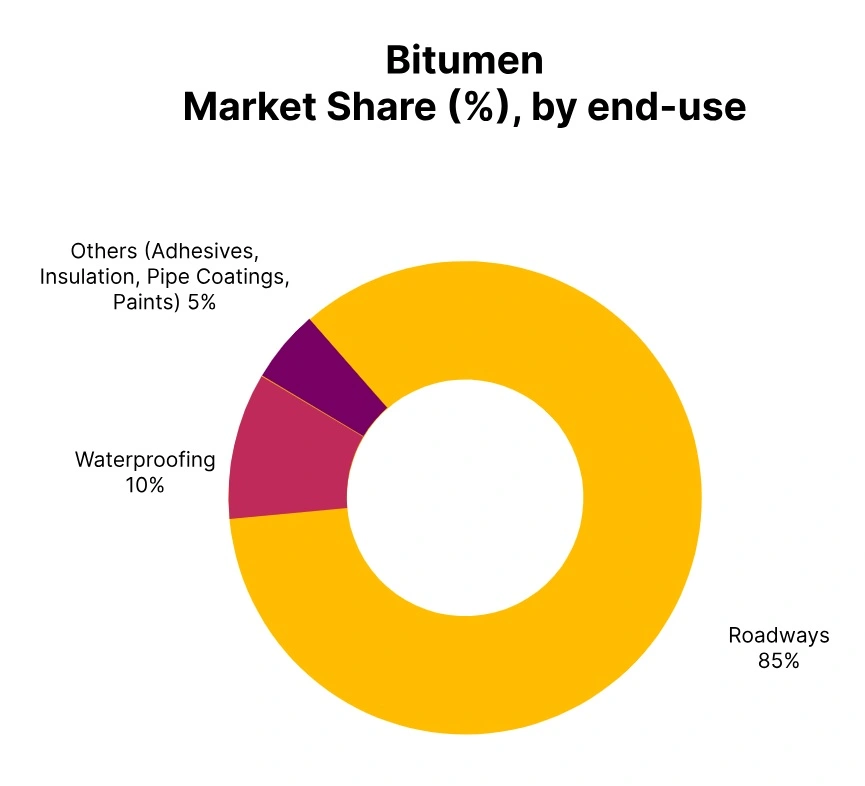
Bitumen Industrial Applications

bitumen market share end use

Historically, several events have caused significant fluctuations in Bitumen prices

  • 2023: Sustained High Input Costs and Strong Infrastructure Push While crude oil prices eased slightly from their 2022 peaks, they remained elevated compared to historical levels. Persistent global inflation also kept operational and logistical costs high. Simultaneously, the Indian government continued its strong push for infrastructure development, particularly road construction under programs like Bharatmala, ensuring robust demand for bitumen. This sustained high demand, coupled with still-high input costs, kept bitumen prices firm and significantly above pre-pandemic levels throughout 2023. 
  • 2022: Surge in Crude Oil Prices due to Russia-Ukraine Conflict The outbreak of the Russia-Ukraine conflict in February 2022 caused extreme volatility and a significant surge in global crude oil prices, with Brent crude crossing well over $100 per barrel. This dramatic increase in the primary input cost directly resulted in sharp hikes in bitumen prices in India. Oil marketing companies implemented multiple price increases, making bitumen significantly more expensive and impacting the budgets of road construction projects nationwide. 
  • 2021: Economic Recovery and Rising Crude Oil Prices As economic activities resumed more broadly in 2021 and governments renewed focus on infrastructure projects delayed by the pandemic, demand for bitumen saw a significant revival. Concurrently, global crude oil prices steadily increased throughout the year due to recovering global demand and OPEC+ supply management. This combination of recovering domestic demand and rising feedstock (crude oil) costs led to a consistent upward trend in bitumen prices in India during 2021. 
  • 2020: The Effects of COVID-19 Pandemic and Global Crude Oil Crash The onset of the COVID-19 pandemic and subsequent nationwide lockdowns in India brought road construction activities to a near standstill in the second quarter of 2020. Simultaneously, global crude oil prices crashed due to plummeting demand worldwide. Since bitumen is a crude oil derivative, this dual impact led to a sharp decrease in bitumen prices due to both collapsed demand from the construction sector and significantly lower input costs. Later in the year, as lockdowns eased and crude oil prices began to recover, bitumen prices started to rebound, though demand recovery was initially gradual. 

Why Price Watch™?

Price Watch™ is your trusted resource for tracking global bitumen price trends. Our platform delivers real-time data and expert analysis, offering deep insights into the key factors driving price fluctuations in the bitumen market. By monitoring critical events such as geopolitical tensions, supply chain disruptions, and economic shifts, Price Watch™ keeps you fully informed of market dynamics.

In addition, Price Watch™ provides detailed forecasts and updates on production capacities, enabling you to anticipate market changes and make well-informed decisions. With Price Watch™, you gain a competitive edge in understanding all the elements that influence bitumen prices worldwide. Stay ahead of the curve with Price Watch’s™ reliable, accurate, and timely bitumen market data.

Track Price Watch's™ bitumen price assessment on a weekly basis since 2015 onwards, along with short-term forecasts, and get access to the detailed report in a downloadable format.

Bitumen Market Price Trend published by Price Watch™ reflect prevailing spot market conditions, derived from independent research, verified trade inputs, and proprietary market intelligence as of the publication date. Prices are published on the specified Incoterm and represent indicative base market levels, exclusive of applicable taxes, VAT, duties, tariffs, and other statutory charges. Actual transaction values may vary depending on volume, credit terms, contractual structure, and other negotiated conditions. Market prices are inherently subject to volatility, liquidity dynamics, regulatory changes, and evolving trade activity. The information provided is for reference and benchmarking purposes only and does not constitute an offer, recommendation, or guarantee of transactional outcomes. Users should exercise independent commercial judgment and assess their specific contractual, regulatory, tax, and application requirements before making business decisions. Price Watch™ assumes no liability for decisions taken based on this information.

The pricing of bitumen is shaped by several important factors, primarily the cost of crude oil, since bitumen is a byproduct of petroleum. Changes in global oil prices have a direct effect on the expenses associated with bitumen production. Additionally, the demand for bitumen, particularly from construction projects like road building and infrastructure development, significantly influences pricing. Transportation expenses, which are affected by fuel costs and logistical considerations, also play a role in the overall pricing structure. Moreover, government regulations, including taxes and subsidies, can impact bitumen prices. Lastly, the competitive landscape among bitumen suppliers and the availability of alternative materials can further affect pricing trends.

To secure better pricing for bitumen from suppliers, it’s vital to build strong, trustworthy relationships. Consider consolidating your orders with one supplier to take advantage of bulk discounts. Look into establishing long-term contracts to stabilize prices and ensure a reliable supply. Keep yourself informed about market trends and competitor pricing to strengthen your negotiating stance. Emphasize the advantages of a long-term partnership, such as increased order volumes and steady revenue, to motivate suppliers to provide more attractive pricing. Additionally, explore alternative payment options, like discounts for early payments, to further enhance cost efficiency.

Bitumen procurement carries several risks, including fluctuations in oil prices, disruptions in the supply chain, quality assurance challenges, and compliance with environmental regulations. To address these risks, it’s important to diversify your supplier network to minimize dependence on a single source. Implement strong quality control protocols to ensure that the bitumen meets your standards. Stay informed about market conditions and regulatory changes to proactively manage potential issues.

Bitumen (also known as Asphalt Binder, Penetration Grade 60/70 or VG-30) is a viscous, black semi-solid hydrocarbon product derived from crude oil refining, widely used in road paving, asphalt mixes, roofing felts, waterproofing membranes, airport runways, and industrial coatings.

Its price directly impacts the cost of highway construction, urban infrastructure projects, roofing materials, and maintenance works, making Bitumen pricing a critical factor for construction firms, governments, and infrastructure developers worldwide. Price-Watch™ tracks these prices to help businesses and consumers understand and stay updated with the market trends.

Bitumen prices vary by region, grade (e.g., 60/70, 80/100), and specification. Prices are typically quoted per metric ton and change based on crude oil benchmarks, refining margins, supply logistics, and seasonal demand. Price-Watch™ provides real-time price assessments across different global markets to help buyers and sellers make informed decisions.

Bitumen prices fluctuate due to changes in crude oil prices (as the primary feedstock), refining capacity utilization, vacuum distillation yields, and demand from road construction, roofing, and infrastructure sectors.

Global oil benchmarks (Brent/Dubai), heavy crude differentials, refinery maintenance schedules, transportation fuel costs, seasonal road paving demand (peak in summer), supply chain disruptions, environmental regulations on emissions, competition with other petroleum products, and broader economic conditions further shape price trends, with recent outlooks reflecting volatility driven by oil prices, infrastructure spending, and geopolitical tensions.

The biggest buyers of Bitumen are road construction and highway paving companies (for hot-mix asphalt), followed by roofing manufacturers and waterproofing specialists who use it for shingles and membranes. Additional demand comes from airport runway builders, bridge and dam waterproofing projects, pipeline coatings, adhesives producers, and industrial flooring applications. Price-Watch™ analyses demand patterns across all these industries.

Bitumen is produced primarily through vacuum distillation of crude oil in refineries, where heavy residues are further processed via air blowing, de-asphalting, or blending to achieve desired penetration grades and viscosity. It is manufactured by oil refineries and integrated petrochemical companies worldwide, with production concentrated in regions rich in heavy crude oil supplies.

Bitumen trade is driven by refining capacity, crude oil availability, regional infrastructure demand, and logistics infrastructure. Middle East producers (Saudi Arabia, UAE, Iran), Russia, India, and Venezuela are among the world’s largest exporters of Bitumen, serving global markets with established port facilities.

Export volumes fluctuate based on road construction cycles, crude price swings, refinery output, shipping rates, and regional demand from emerging markets. Price-Watch™ tracks production levels, export flows, and trade patterns to help businesses understand global supply chains and identify sourcing opportunities.

Supply generally matches demand, but regional shortages can occur due to refinery outages, crude oil supply constraints, shipping disruptions, or surges in infrastructure projects. Bitumen production is tied to refinery runs, making markets susceptible to tightness during maintenance seasons. Price-Watch™ monitors these supply-demand imbalances to alert the market about potential shortages or surpluses.

Bitumen is available in various penetration grades (e.g., 60/70 for hot climates, 80/100 for cold regions) and performance grades (VG-10, VG-30, VG-40). Penetration Grade 60/70 is the most common for road paving, balancing cost and durability.

Polymer-modified bitumen (PMB) for high-traffic roads and oxidized bitumen for roofing command premiums due to additives, testing standards, and performance specs. Bulk liquid vs. drum-packed forms differ in pricing based on handling and transport. Price-Watch™ provides separate price assessments for each grade to ensure market transparency.

When Bitumen demand rises quickly, often due to government infrastructure stimulus, peak road paving seasons, urban expansion, or post-disaster reconstruction, prices typically increase.

Suppliers prioritize long-term contracts, while spot buyers face tighter availability, longer lead times, or premium pricing. Refinery capacity limits and tanker shipping constraints amplify volatility. Price-Watch™ captures these market dynamics in real-time.

Crude oil prices are the dominant cost driver for Bitumen, as it comprises 40-60% of refinery heavy residue yields. Rising Brent or Dubai crude benchmarks directly inflate production costs, with refiners passing them on.

Heating fuel for transport and storage adds to expenses. Regions with cheap heavy crude access enjoy cost edges, a correlation Price-Watch™ analyses in its price assessments & market reports.

Bitumen prices vary by region based on local refinery capacity, crude oil import costs, heavy residue yields, shipping and port handling expenses, infrastructure project concentration, environmental regulations on refining, quality specs, and import duties.

Oil-rich exporters like the Middle East have advantages, while import-dependent regions pay premiums due to freight and storage. Price-Watch™ tracks prices across all major regions to highlight these differences.

The Bitumen market outlook depends on crude oil price trends, refinery capacity expansions, infrastructure spending cycles, road construction demand, roofing market growth, shipping rates, OPEC+ decisions, geopolitical risks in oil-producing regions, environmental shifts to low-carbon alternatives, and macroeconomic indicators.

Price-Watch™ regularly publishes detailed forecasts projecting price movements for the next 12 months based on supply changes, demand from key projects, seasonal patterns, and macro indicators. Our forecasts help businesses anticipate market conditions and plan accordingly.

Absolutely. Accurate forecasting allows you to time your purchases better, negotiate contracts more effectively, and budget more accurately. If Price-Watch™ forecasts predict a price increase in three months, you might choose to stock up now or lock in long-term contracts at current rates, potentially saving thousands of dollars.

Events like oil supply shocks, refinery fires or hurricanes, crude export sanctions (e.g., on Russia or Venezuela), tanker shortages, infrastructure booms, trade tariffs, or economic slowdowns can cause supply tightness and price spikes.

Crude price surges from Middle East tensions, refinery outages, peak-season paving demand, and logistics disruptions have fueled volatility. Price-Watch™ provides timely alerts when such events affect the market

Price-Watch™ collects data from refiners, traders, and buyers worldwide to publish regular price assessments, market reports, and forecasts. Our transparent methodology and comprehensive coverage make us a trusted source for understanding fair pricing and market trends in the Bitumen industry.