

China’s caustic soda prices have drifted lower for weeks, and the easy explanation is oversupply. That explanation is only half right, and it misses the more interesting structural story underneath.
China’s Caustic Soda Market Faces a Structural Demand Imbalance
Most commentary treats this as a supply problem: too many plants, too much capacity, prices grinding lower. China’s numbers back that up on paper.
Total caustic soda production capacity reached approx. 53.21 million tonnes by the end of 2025, with actual output topping around 42 million tonnes, up roughly 3.5% year on year. But capacity utilization is not really the constraint here. Demand concentration is.
Unlike the caustic soda industry itself, which is deeply fragmented (the top five producers combined control barely 12% of the market), the buyer side is not.
Alumina refining absorbs 30 to 40% of China’s total caustic soda demand, and that refining capacity sits overwhelmingly in the hands of a small number of vertically integrated giants: Chalco (CHINALCO), the state-backed group with close to 20 million tonnes of alumina capacity; China Hongqiao’s Shandong Weiqiao unit, with roughly 17.5 million tonnes; and Xinfa Group, China’s third-largest alumina producer at over 10 million tonnes a year.
A market with dozens of caustic sellers and a handful of alumina buyers is not really a balanced market. It is a standoff, and the buyer holds the stronger hand.
Regional Prices Tell Three Different Stories
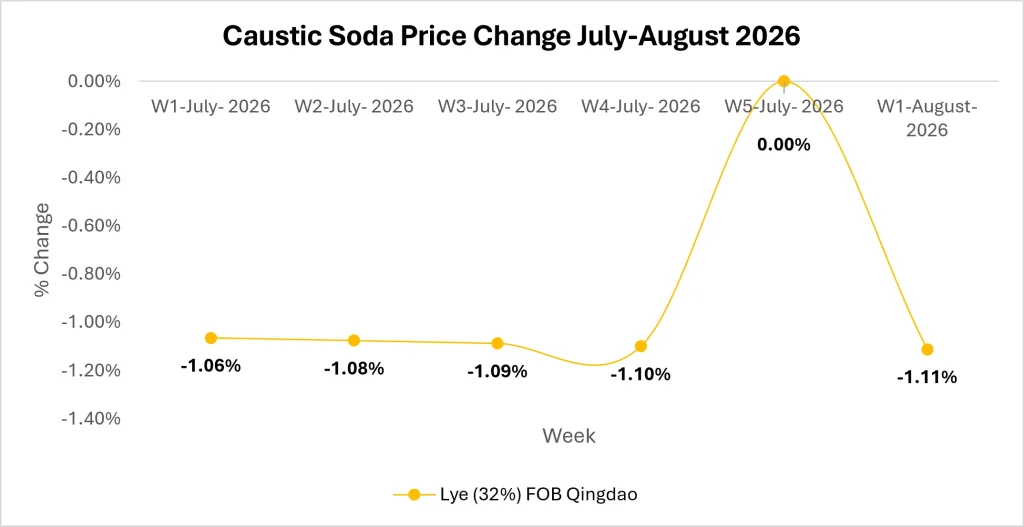
That imbalance is exactly what is playing out in the regional data right now. Shandong, the heart of Hongqiao and Xinfa’s operations, sits at the softer end of the pricing range. Zhejiang, with a more diversified buyer base, has stayed comparatively stable.
Inner Mongolia, where supply is more concentrated and logistics costs are higher, quotes well above both. Same country, same product, three different stories, and the common thread is how exposed each region is to a handful of alumina buyers choosing not to show up.
Weak Alumina Economics Keep Buyers on the Sidelines
And they are choosing not to show up. Alumina prices have stayed weak, alumina producer margins have been squeezed, and most of the giants are buying only enough caustic soda to cover immediate needs, not to rebuild inventory. Some plants have topped up on opportunistic dips, but that is inventory management, not a demand signal.
Source: Price Watch™ Caustic Soda
The Capacity-Cut Wildcard
Here is the part that gets lost in the day-to-day price commentary. Beijing’s Ministry of Industry and Information Technology has floated an anti-overcapacity policy that would target roughly 6 million tonnes of outdated caustic soda capacity, plants that have been running for over 20 years.
That is more than 11% of China’s current caustic soda capacity. If that policy moves from proposal to enforcement, the fragmented seller side of this market could consolidate fast, closing the leverage gap that alumina’s giants currently enjoy.
Separately, China is expected to bring another 15 million tonnes of new alumina capacity online between 2025 and 2027, though tight bauxite supply means actual output is likely to lag the headline capacity number for a while yet, keeping any demand recovery slower than the capacity build would suggest.
China Caustic Soda Market Outlook
This is not a clean supply story like the ones driving copper or lithium right now. It is a two-sided standoff between a fragmented producer base with no pricing power and a concentrated buyer base that can simply wait.
Two things could break it: a faster-than-expected alumina demand recovery, tied to how quickly bauxite supply eases and margins improve for Chalco, Hongqiao, and Xinfa; or a capacity cut on the caustic side that is large and fast enough to shift the leverage before alumina demand ever recovers.
Until one of those two things happens, expect the range-bound grind to continue, not because the market lacks direction, but because neither side has a reason to move first.
For granular, region-by-region pricing, Price Watch™ tracks the weekly divergence this article is built on, updated as the standoff between alumina buyers and caustic soda sellers plays out. If you’re positioning around chlor-alkali, alumina, or the broader aluminium value chain, it’s worth having on your radar.
Follow Price Watch™ on LinkedIn for real-time Caustic Soda market insights, regional price trends, supply chain intelligence, and global commodity updates.