

India’s Evolving Crude Sourcing Strategy
India’s crude oil procurement strategy has undergone one of the most significant transformations in recent years.
A combination of geopolitical conflicts, sanctions on Russia, disruptions in the Red Sea, changing OPEC+ production policies and rising freight volatility has fundamentally altered how Indian refiners purchase crude oil.
Price remains an important factor, but it is no longer the only one. Procurement decisions today increasingly balance economics with supply security, logistics, refinery compatibility and geopolitical resilience.
Instead of relying on a handful of traditional suppliers, India is steadily building one of the world’s most diversified crude import portfolios.
Source: Price Watch Crude Oil Prices
From Middle East Dependence to a Global Portfolio
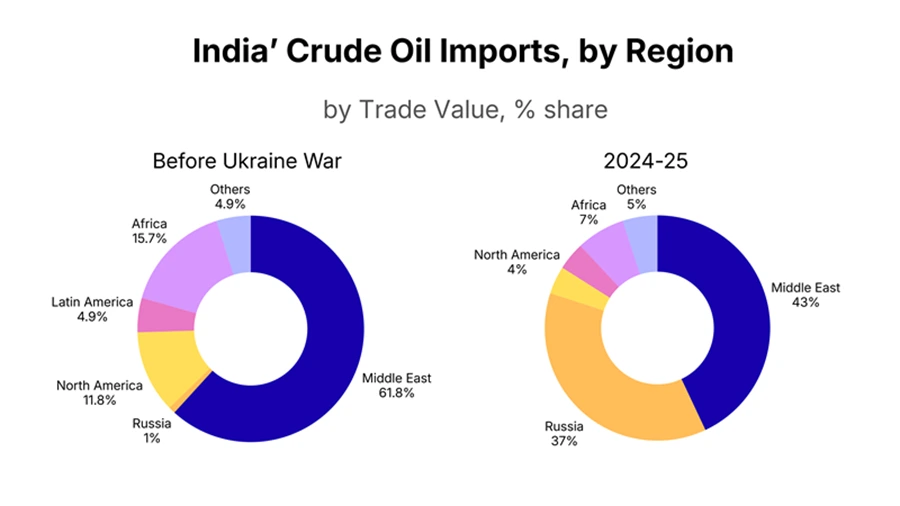
Only a few years ago, India’s crude imports were overwhelmingly concentrated in the Middle East. Before 2022, nearly 60 to 65 percent of India’s crude oil imports originated from Gulf producers such as Iraq, Saudi Arabia, the UAE and Kuwait.
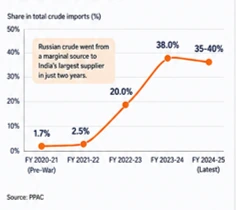
The Russia Ukraine conflict dramatically reshaped global oil trade. As European buyers reduced purchases of Russian crude following Western sanctions, Russia redirected large volumes toward Asian markets. India responded quickly, taking advantage of substantial price discounts.
Russian crude, which accounted for less than 2 percent of India’s imports before 2022, now contributes roughly 35 to 40 percent of total crude imports, making Russia India’s largest individual supplier in recent years.
Meanwhile, imports from the United States, Brazil, Guyana, Nigeria and Angola have also increased whenever freight costs and pricing created attractive opportunities.
Rather than replacing one supplier with another, India has shifted towards maintaining multiple sourcing options. This flexibility allows refiners to adapt quickly whenever market conditions change.
Core Suppliers Still Provide Stability
Despite Russia’s growing importance, the Middle East remains the foundation of India’s crude procurement strategy.
Countries such as Iraq, Saudi Arabia, the UAE and Kuwait continue to offer advantages that are difficult to replace.
These include established commercial relationships, reliable production capacity, shorter shipping distances, lower freight costs and long-term supply agreements that provide predictable monthly deliveries.
For many Indian refiners, these suppliers remain the backbone of operational planning.
Russian crude has become an important complement rather than a substitute. At the same time, occasional cargoes from the United States, Brazil, Guyana, Nigeria and Angola provide additional flexibility whenever arbitrage opportunities emerge.
Russian Crude Has Become Part of the System
Initially, India’s purchases of Russian crude were driven almost entirely by exceptionally large discounts.
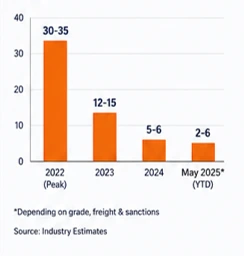
In some cases during 2022, Russian grades traded at discounts exceeding 30 dollars per barrel compared with international benchmarks.
Those extraordinary discounts have narrowed significantly. Today, discounts typically range between 2 and 6 dollars per barrel, depending on crude grade, shipping costs and prevailing sanctions.
Even so, Russian crude has become deeply integrated into India’s refining system.
Indian refiners have invested in adapting refinery operations, optimizing shipping routes and establishing alternative payment mechanisms.
As a result, Russian crude is no longer viewed as an opportunistic purchase but as a structural component of India’s import basket.
Procurement Decisions Extend Far Beyond Price
Buying crude oil today involves much more than identifying the cheapest available cargo.
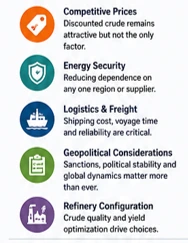
Procurement teams evaluate the total landed cost, which includes freight charges, shipping duration, insurance premiums, financing costs, sanctions compliance, political risks and refinery performance.
They also assess whether a particular crude grade matches refinery configurations and whether it can maximize yields of high value products such as diesel, aviation fuel and petrochemical feedstocks.

A cargo offering a lower headline price may ultimately prove less attractive if transportation delays, compliance challenges or payment restrictions increase operational risks.
The objective is to secure the lowest overall cost while maintaining reliable and uninterrupted supplies.
Long Term Contracts Continue to Anchor Imports
Long term contracts remain the foundation of India’s sourcing strategy.
These agreements with Middle Eastern producers provide refiners with assured monthly supply, pricing transparency and greater certainty for operational planning. They also reduce exposure to sudden market disruptions during periods of geopolitical instability.
Alongside these contracts, refiners actively participate in the spot market whenever attractive opportunities arise, particularly for Russian and Atlantic Basin cargoes.
This combination of long-term stability and spot market flexibility has become the defining feature of India’s procurement model.
Russian Discounts Are Becoming Smaller
The financial advantage that initially attracted Indian buyers has gradually declined.
Higher freight rates, insurance restrictions, evolving sanctions and increased competition from other Asian importers have reduced the size of Russian discounts.
Nevertheless, Russian crude remains commercially attractive for many Indian refiners. Large complex refineries such as Jamnagar, Vadinar and Paradip are well equipped to process
heavier crude grades efficiently, allowing them to continue benefiting from available discounts.
As long as price advantages outweigh the additional logistical and compliance costs, Russian crude is likely to remain an important part of India’s sourcing strategy.
Russia Will Remain Important Without Dominating
Over the next three to five years, Russia is expected to remain one of India’s largest crude suppliers.
However, few industry analysts expect India to become structurally dependent on Russian imports.
Instead, procurement strategies are increasingly built around maintaining balance through four major pillars.
- Stable Middle Eastern supplies
- Competitive Russian cargoes
- Flexible Atlantic Basin imports
- Emerging production from countries such as Guyana and Brazil
This diversified approach reduces vulnerability to geopolitical disruptions while improving India’s negotiating position with suppliers.
New Suppliers Are Expanding India’s Options
Latin America
Brazil continues to increase offshore production while Guyana has emerged as one of the fastest growing oil producers in the world. Guyana’s production has already exceeded 650,000 barrels per day and is projected to surpass 1.3 million barrels per day before 2030, creating significant export opportunities for Asian buyers.
United States
American shale production remains close to record levels of around 13.5 million barrels per day, providing abundant supplies of light sweet crude that complement India’s refining system.
West Africa
Nigeria and Angola continue to serve as valuable swing suppliers. Their production flexibility allows Indian refiners to respond quickly whenever market conditions change.
Middle East
Despite diversification, Gulf producers will remain India’s closest long term partners because of geographical proximity, competitive freight economics and reliable production capacity.
Diversification Will Continue Even if Russian Oil Remains Cheap
Even if Russian crude continues to offer attractive pricing, India is unlikely to concentrate imports from a single country.
Recent years have demonstrated how quickly sanctions, shipping disruptions, payment restrictions and geopolitical conflicts can reshape global energy markets.
Maintaining multiple sourcing options improves operational resilience while also strengthening India’s bargaining power during commercial negotiations.
Diversification has evolved from a commercial strategy into an energy security strategy.
Emerging Risks to India’s Energy Security
Several long term risks could influence India’s procurement decisions during the remainder of this decade.
These include rising geopolitical tensions across the Middle East, disruptions in major shipping routes such as the Strait of Hormuz and the Bab el Mandeb, changes in OPEC+ production policy, increasing freight market volatility, exchange rate fluctuations, climate related disruptions to global shipping and growing competition from China and other Asian importers.
Managing these uncertainties will require procurement strategies that remain both flexible and geographically diversified.
Government Policy Will Continue to Shape Procurement
Although individual refiners make commercial purchasing decisions, government policy plays an increasingly important role in strengthening India’s overall energy security.
India currently maintains approximately 39 million barrels of strategic petroleum reserve capacity across Visakhapatnam, Mangaluru and Padur. Additional reserve expansion has been proposed to strengthen protection against future supply disruptions.
Other policy priorities include expanding energy diplomacy, negotiating bilateral supply agreements, improving domestic shipping and insurance capabilities and encouraging greater use of local currency settlement mechanisms.
Together, these initiatives aim to reduce external vulnerabilities while improving long term supply security.
What to Watch Between 2026 and 2028
Several developments are likely to shape India’s procurement strategy over the next few years.
Investors, refiners and policymakers should closely monitor:
- Future sanctions affecting Russian energy exports
- OPEC+ production decisions
- Geopolitical developments in the Middle East
- Production growth in Guyana and Brazil
- Global freight market trends
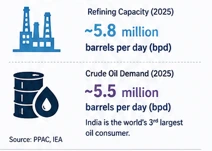
- Expansion of India’s refining capacity beyond the current 5.8 million barrels per day
- Strategic petroleum reserve expansion
- New bilateral energy partnerships
- Growth in alternative payment systems and local currency trade
Looking Ahead
India’s crude procurement strategy is no longer centred on simply buying the cheapest available barrel.
It has evolved into a sophisticated system that balances commercial efficiency with geopolitical risk management and long-term energy security.
As global oil markets become increasingly fragmented, India’s ability to source crude from multiple regions, adapt to changing geopolitical realities and maintain procurement flexibility will become one of its greatest strategic strengths.
In the years ahead, diversification is unlikely to be viewed merely as a procurement preference. It will increasingly serve as the foundation of India’s energy security policy, ensuring that the world’s third largest oil consumer remains resilient in an increasingly uncertain global energy landscape.
Subscribe to Price Watch™ today to get weekly updates and stay informed on FD Hamburg unbleached kraftliner price movements.
Follow Price Watch™ on LinkedIn for real-time raw material insights, pricing trends, supply chain intelligence, and market updates shaping global commodity markets.