

The Global PET market closed July 2026 on a distinctly two-track note. European bottle-grade PET resin (IV 0.800 ± 0.02) softened across Amsterdam, Hamburg, Le Havre, and Immingham, while Asian markets Shanghai, Kaohsiung, Jakarta, and Manila trended firmer, and India, South Korea, and the US import market (HOUSTON) stayed largely flat.
This split captures where the Synthetic Rubber price trend’s cousin commodity, PET, now stands: a market being pulled in opposite directions by feedstock costs on one side and regional demand and freight dynamics on the other.
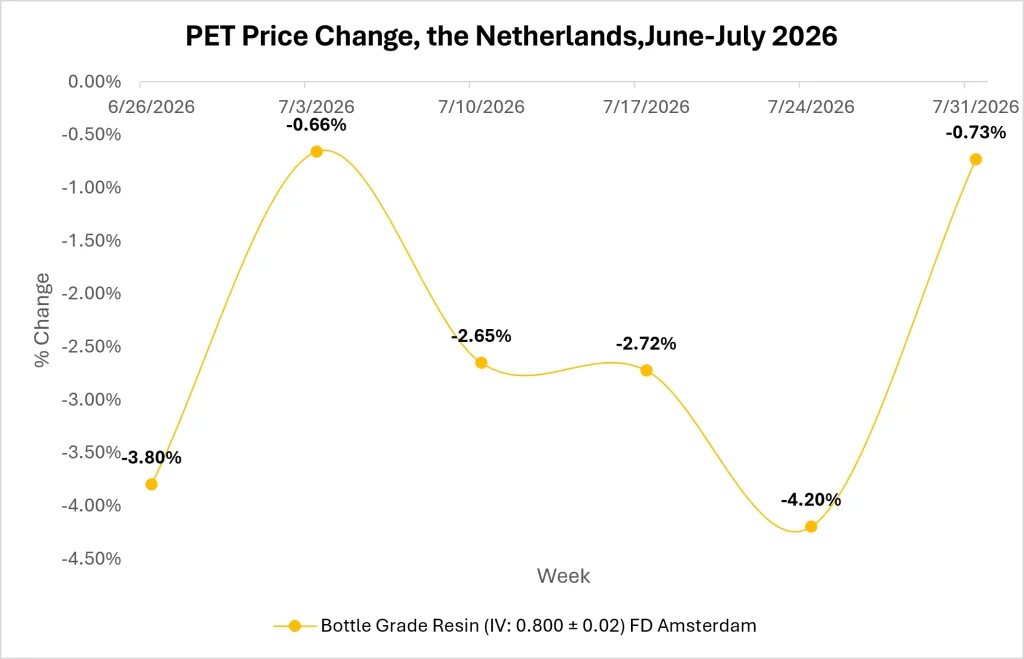
Source: Price Watch™ PET Prices
Feedstock Backdrop
PET’s cost base runs through naphtha, paraxylene (PX), PTA, and MEG, with raw materials making up roughly 70-80% of total production cost. As of end-July 2026, China PTA and MEG both ticked higher, and Japan-delivered naphtha also moved up, reversing some of the feedstock relief seen in June.
This modest late-month uptick in Asian feedstocks helps explain why Shanghai, Kaohsiung, and China-origin cargoes into Jakarta and Manila firmed even as European resin eased European producers, buying on different contract cycles and still working through cheaper June-priced feedstock, have more room to pass through lower costs to bottlers.
Geopolitical and Crude Oil Drivers
The larger backdrop remains the unwinding of the Iran-related crude oil premium. Earlier in 2026, feedstock costs across PX, PTA, and MEG had run well above prior-year levels, driven largely by disruption risk at the Strait of Hormuz, through which a significant share of Middle Eastern petrochemical exports flow.
The reopening of the Strait and the US-Iran sanctions rollback through June steadily eased naphtha and crude costs into Europe, and that relief is now visibly showing up in softer European PET offers.
However, the late-July uptick in Chinese PTA, MEG, and naphtha suggests this cost relief is not moving in a straight-line Asian feedstock markets have found some renewed firmness even as the broader crude complex remains well below its wartime peak.
Regional PET Market Developments
Northeast Asia’s PET complex has been shaped by a recovery in Chinese output through Q2 2026, with integrated complexes such as Yizheng and Jiangyin running disciplined operating rates that kept inventories lean and removed the supply overhang that had earlier pressured values.
Export order books from Southeast Asian buyers added incremental volume, supporting the Shanghai and Kaohsiung uptrend.
Southeast Asia itself, however, has told a more cautious story demand from packaging converters and bottlers stayed subdued through the first half of the year, with balanced PTA/MEG supply and ample regional availability capping upside, which is consistent with the flat-to-mild-gain readings now seen in Jakarta and Manila.
North America, by contrast, has been supported by steady beverage and packaging-sector procurement, keeping the Houston import price stable rather than following Europe lower.
Regional Demand Creates Diverging Market Trends
Downstream, PET demand continues to be shaped by beverage bottling and food packaging restocking cycles, alongside a structural push toward recycled content (rPET) integration in Europe and North America under tightening sustainability mandates.
Freight remains an underappreciated cost layer:
Asia-Europe container rates have stayed well above pre-2023 baseline levels, meaning even as feedstocks ease, delivered costs into Europe don’t fall as fast as spot naphtha alone would suggest.
PET Market Outlook
Heading into August, the Global PET market looks set to stay regionally fragmented rather than move on a single global trend.
European bottle-grade resin should remain biased lower near-term as cheaper crude-linked feedstocks continue filtering through, barring any flare-up in US-Iran relations or renewed Strait of Hormuz risk.
Asian pricing, meanwhile, will likely stay more sensitive to Chinese operating rates, export competitiveness, and the recent firming in PTA, MEG, and naphtha, keeping the PET price trend on a modest upward footing across Shanghai, Kaohsiung, and China-linked Southeast Asian markets even as Europe eases.
Follow Price Watch™ on LinkedIn for real-time PET market insights, PET price trends, supply chain intelligence, and global commodity updates.