

The Indian methanol market is undergoing a significant structural adjustment as domestic production constraints, permanent capacity rationalization, and widespread Asian plant maintenance reshape regional supply dynamics.
The shutdown of uneconomic domestic assets, combined with temporary outages across major Chinese and Middle Eastern producers, is tightening availability and increasing India’s dependence on imported methanol.
With India already reliant on overseas supplies to meet a substantial portion of its consumption requirements, these disruptions are reinforcing supply vulnerabilities and creating renewed price sensitivity across downstream sectors including formaldehyde, acetic acid, dimethyl ether (DME), biodiesel, and chemical intermediates.
Supply Disruptions Across Key Producing Regions
India’s domestic methanol landscape has witnessed further capacity erosion following the permanent shutdown of Deepak Fertilizers and Petrochemicals’ Taloja methanol plant.
The 100 KTPA facility was initially mothballed due to high natural gas costs, loss of competitiveness against imported methanol, and unfavorable economics associated with smaller-scale production.
In January 2026, the plant was permanently closed as the company moved toward site redevelopment, removing approximately 274 tons per day of domestic methanol capacity from the market.
The loss of Taloja capacity adds to India’s existing structural import dependency, leaving domestic consumers increasingly exposed to international pricing cycles and freight fluctuations.
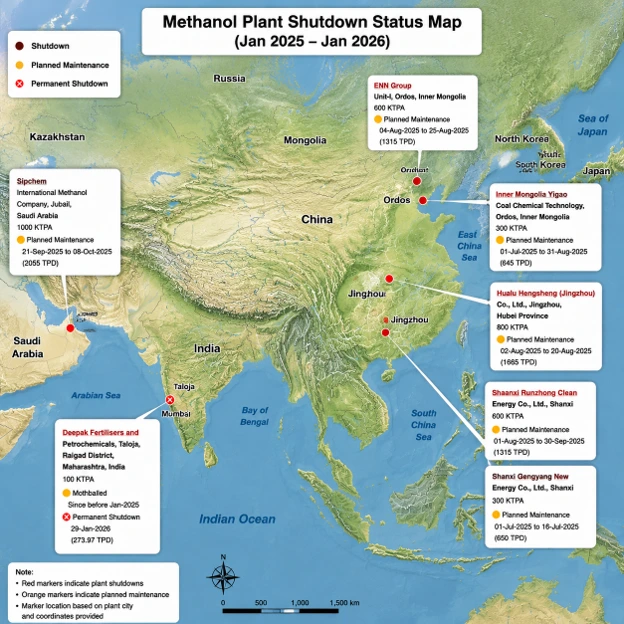
Meanwhile, global methanol supply availability has been affected by multiple planned and operational shutdowns across Asia and the Middle East:
Source: Price Watch™ Methanol Prices
- ENN Group Unit-I, Ordos, China: The 600 KTPA coal-based methanol unit underwent planned maintenance from 4 August to 25 August 2025, temporarily removing approximately 1,315 TPD of production.
- Hualu Hengsheng (JINGZHOU), China: The 800 KTPA methanol facility was shut for scheduled servicing between 2 August and 20 August 2025, affecting around 1,665 TPD of supply.
- Inner Mongolia Yigao Coal Chemical Technology, China: The 300 KTPA unit underwent maintenance from July through August 2025, restricting approximately 645 TPD of output.
- Shaanxi Runzhong Clean Energy, China: The 600 KTPA methanol plant entered planned maintenance from August to September 2025, impacting around 1,315 TPD of production.
- Shanxi Gengyang New Energy, China: The 300 KTPA coke oven gas-to-methanol facility underwent maintenance during July 2025, reducing approximately 650 TPD of availability.
- Sipchem International Methanol Company, Jubail, Saudi Arabia: The 1,000 KTPA natural gas-based methanol plant underwent planned maintenance from September to October 2025, temporarily affecting approximately 2,055 TPD of supply.
Together, these shutdowns represented a temporary withdrawal of more than 7,600 TPD of methanol capacity, tightening spot availability during maintenance periods and increasing regional supply sensitivity.
Structural Pressure on Indian Methanol Supply
The Indian market remains particularly exposed due to the imbalance between domestic production economics and demand growth.
High natural gas prices have challenged the competitiveness of domestic steam-reforming methanol plants, while imported methanol from regions with lower-cost feedstock has maintained a cost advantage.
The permanent closure of Deepak Fertilisers’ Taloja facility highlights the broader challenge facing smaller-scale Indian methanol producers. Plants dependent on expensive natural gas feedstock face increasing pressure from global producers utilizing coal-based routes in China or low-cost natural gas resources in the Middle East.
As a result, Indian buyers are increasingly dependent on imports from suppliers in the Middle East, Southeast Asia, and China. Any disruption in these exporting regions can quickly translate into tighter domestic availability and higher replacement costs.
Price Implications and Market Dynamics
Methanol prices in India are being influenced by a combination of supply constraints, import dependency, freight movements, and global feedstock economics.
During periods of concentrated maintenance activity in China and the Middle East, Indian buyers have faced increased competition for spot cargoes. Traders have reported stronger buying interest as consumers seek to secure inventories ahead of potential supply interruptions.
The market is also experiencing greater volatility due to:
- Reduced domestic production following permanent capacity rationalization.
- Higher exposure to international methanol benchmarks.
- Freight and logistical uncertainty affecting import economics.
- Changing natural gas and coal-based production costs across major exporting regions.
Downstream industries operating with limited inventory buffers are particularly vulnerable, as any delay in cargo arrivals or unexpected extension of overseas shutdowns can rapidly tighten availability.
Short-Term Outlook
The Indian methanol market is expected to remain sensitive in the near term as supply availability adjusts following recent shutdowns. Planned maintenance completions in China and Saudi Arabia should gradually restore some production volumes, potentially easing spot market pressure.
However, structural challenges remain. India’s reduced domestic production base means the market will continue to rely heavily on imports, leaving prices vulnerable to global supply disruptions, feedstock cost movements, and geopolitical developments.
Any unexpected outage at major exporting facilities, changes in freight availability, or further domestic capacity closures could quickly reverse improving supply conditions and support higher price levels.
Conclusion and Strategic Takeaways
The methanol market is entering a period of increased supply sensitivity, driven by declining domestic capacity in India and coordinated shutdown activity across major global producers.
The permanent closure of Deepak Fertilisers’ Taloja unit underscores the challenges facing high-cost domestic production, while international maintenance cycles highlight the fragility of global supply chains.
For Indian consumers, the current environment reinforces the need for proactive procurement strategies, diversified supplier portfolios, and close monitoring of global operating conditions.
Companies should focus on:
- Maintaining flexible import sourcing options.
- Tracking production restarts across China and the Middle East.
- Building inventory strategies aligned with supply risk.
- Monitoring feedstock trends affecting global methanol economics.
For detailed analysis, real-time plant outage monitoring, and strategic market intelligence, subscribe to Price Watch™ G.I.O. Tracker your essential tool for navigating volatility and making informed procurement decisions in the evolving methanol market.
Follow Price Watch™ on LinkedIn for real-time raw material insights, supply chain intelligence, plant outage updates, and market developments shaping global commodity markets.