

Methylene dichloride FOB Shanghai gained 8.49% in the third week of July, its sharpest move in over a month, then added 3.19% the week after. The jump landed as Middle East tensions and a fresh EPA compliance deadline hit from opposite directions.
Three Forces Colliding at Once
Zhejiang Juhua, the world’s largest methane chloride producer at roughly 440,000 tonnes a year, and Zhejiang Sanmei Chemical anchor the China export market this benchmark tracks.
China shipped 213,000 tonnes of dichloromethane abroad in 2025, up 40.9%, and that momentum is now meeting a cost shock: tension around the Strait of Hormuz, which carries close to 20% of global crude trade, pushed feedstock costs higher as buyers stayed cautious on freight.
In the US, OxyChem and other producers face tighter compliance costs as the EPA rolls out stricter TSCA rules this July.
The Import Substitution Story Nobody Is Pricing In
India extended duty free imports for select feedstocks through July 15, read as support for import dependent buyers. But India’s own methane chlorides capacity has expanded, cutting into Chinese export volumes since 2025.
The window may matter less than it looks if India increasingly does not need the imports it is making cheaper.
Methylene Dichloride Demand Dynamics
Pharmaceutical manufacturing takes 35 to 40% of global demand, with polyurethane foam adding another 20 to 25%. Electronics cleaning, coatings, and adhesives fill most of the rest, a demand base that has held steady even as prices swing.
Watch These Two Signals
- Whether India’s own output keeps closing the gap on Chinese imports despite the duty-free extension
- Whether Hormuz risk holds or fades, since that decides if this week’s 8.49% jump was a trend or a one-week spike
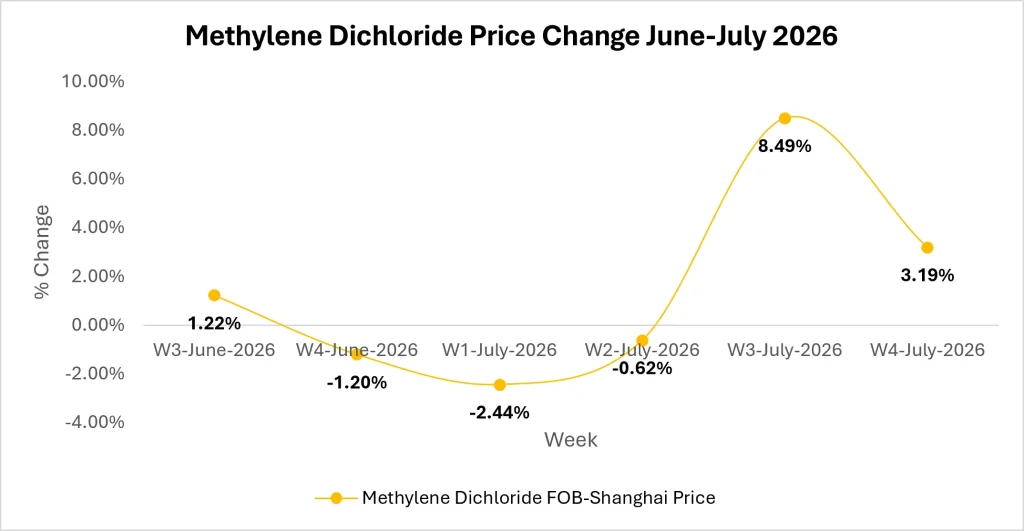
Source: Price Watch™ Methylene Dichloride Prices
Methylene Dichloride Market Outlook
The near-term outlook for China’s Methylene Dichloride market remains cautiously firm as market participants monitor crude oil prices, chlor-alkali operating rates, geopolitical developments in the Middle East, freight costs, regulatory implementation, and downstream industrial demand.
Continued feedstock volatility and elevated logistics costs are expected to support producer pricing, while improving domestic production capacity in importing countries could gradually reshape regional trade flows.
The key question facing market participants is whether higher production costs and geopolitical uncertainty will sustain the recent price rally or whether easing energy markets and increasing regional self-sufficiency will moderate price momentum during the coming months.
Follow Price Watch™ on LinkedIn for real-time Methylene Dichloride market insights, Methylene Dichloride price trends, supply chain intelligence, and global commodity updates.