

While gold continues to dominate investment headlines and copper remains central to the energy transition, Palladium has quietly become one of the most strategically important industrial precious metals.
Despite relatively stable prices in recent months, the market is being shaped by a complex mix of weakening automotive demand, concentrated global mine supply, evolving industrial applications, and improvements in price transparency.
For manufacturers, traders, and procurement teams, palladium remains a market where supply-side risks continue to offset softer long-term demand.
Automotive Demand Is Evolving, Not Disappearing
The automotive industry remains the largest consumer of palladium, accounting for nearly 80% of global demand through catalytic converters used in gasoline-powered vehicles.
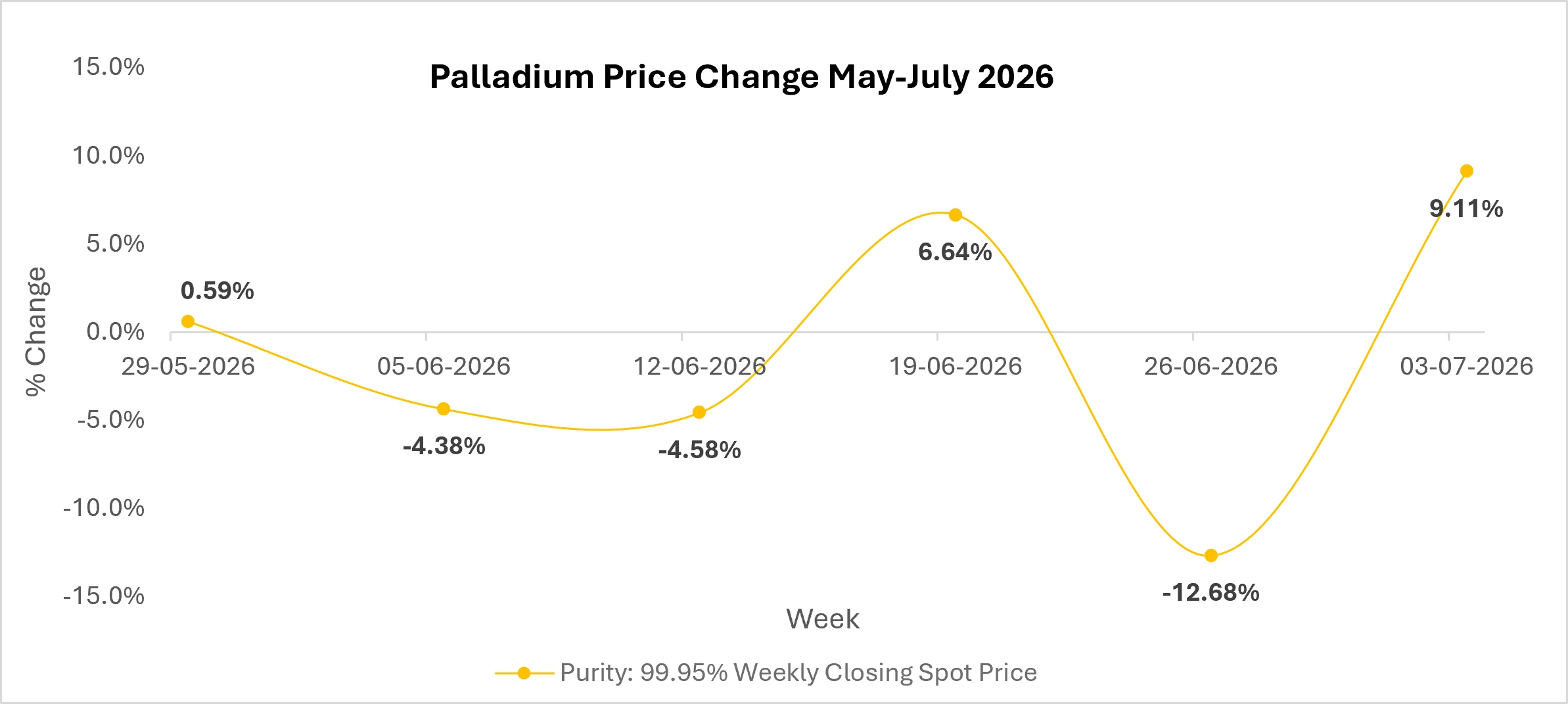
Source: Price Watch™ Palladium Prices
However, the rapid adoption of electric vehicles (EVS), slower global vehicle production, and increased substitution with platinum have gradually reduced consumption growth. At the same time, continued production of hybrid vehicles has provided some support, preventing a sharper decline in demand.
As a result, the market is transitioning rather than collapsing, with changing automotive technologies reshaping long-term consumption patterns.
Concentrated Supply Keeps the Market Sensitive
Despite softer demand, palladium’s supply chain remains highly concentrated. Russia and South Africa account for the majority of global mine production, leaving the market vulnerable to geopolitical tensions, mining disruptions, labour issues, power shortages, and operational challenges.
Recycled palladium recovered from end-of-life catalytic converters has become an increasingly important secondary supply source, helping improve market balance. Nevertheless, primary supply remains concentrated enough that even localized disruptions can quickly influence global pricing.
Greater Transparency Strengthens Market Confidence
A significant development for the industry occurred in July 2026, when responsibility for administering the LBMA Platinum and Palladium Price benchmark transitioned to the ICE Benchmark Administration (IBA).
The move is expected to enhance transparency, governance, and confidence in global price discovery, strengthening the benchmark used across physical transactions, industrial contracts, and financial markets. For market participants, improved pricing infrastructure represents an important step toward greater market efficiency.
Palladium Market Outlook
Looking ahead, the Palladium market is expected to remain balanced between structural demand headwinds and persistent supply risks.
While the global shift toward electric mobility is likely to moderate long-term automotive demand, concentrated mine production, geopolitical developments, recycling trends, and evolving industrial applications will continue to influence price direction.
Recent expectations of lower interest rates have improved sentiment across precious metals, but sustained price gains will ultimately depend on the balance between automotive consumption and supply disruptions. In a market where production remains concentrated and substitution continues to evolve, palladium is likely to remain one of the more closely watched, and potentially volatile, industrial precious metals over the coming years.
Follow Price Watch™ on LinkedIn for real-time precious metals insights, industrial commodity trends, supply chain intelligence, and global market updates.