

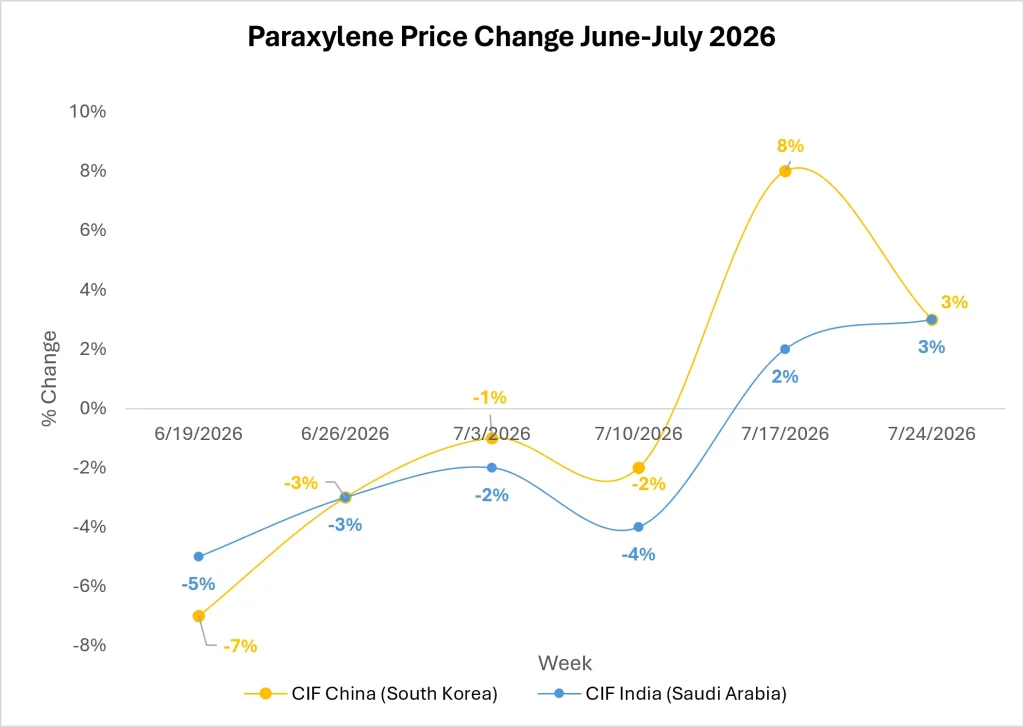
Asia’s Paraxylene market is splitting by hub. China, India, and South Korea are reacting differently to feedstock swings, outages, and polyester demand, and the price data confirms it, the two main import benchmarks moved apart by six points in a single week this July.
China’s Paraxylene Trade Flows Are Being Reshaped
China’s PX imports fell roughly a third month on month in May as Middle East feedstock disruptions cut operating rates outside China, though requirements should recover into June.
The supply picture stays tight into the second half of 2026. A cluster of outages, including Indonesia’s TPPI unit, China’s Fuhai Chuang plant, and the fire-delayed restart at Sinopec Yangzi, is keeping requirements elevated.
The CIF China benchmark, sourced largely from South Korea, fell 7 percent in a single week before rebounding 8 percent in mid July, the sharpest swing of the window.
India Emerges as the Key Q3 Demand Driver
PX capacity growth across Asia is lagging downstream PTA expansion, and a large share of new PTA capacity is being built in India, creating a structural supply gap.
GAIL’s new Mangalore PTA plant will lean heavily on imported PX, drawing volumes from the Middle East and wider Asia.
The CIF India benchmark, sourced largely from Saudi Arabia, moved more cautiously, down 5 percent before recovering just 2 percent that same week, a softer rebound than China’s. India could compete harder with Chinese buyers as Asian production stays constrained.
Source: Price Watch™ Paraxylene
Key Signals to Watch
- Whether TPPI, Fuhai Chuang, and Sinopec Yangzi outages resolve on schedule
- Whether India’s benchmark starts closing the recovery gap with China as GAIL Mangalore ramps up
Paraxylene Market Outlook for Q3 2026
Supply stays constrained by unresolved outages and war-risk freight premiums, while demand stays cautious as PTA and polyester buyers manage margins.
Asian PX prices are likely to stay range bound but supported, tilted toward tighter Q3 availability. South Korea stays firm on cost support, and China and India keep competing for the same Middle Eastern cargoes.
Two questions are worth sitting with. If India and China both chase the same Q3 cargoes, which market offers sellers the better netback. And since China’s benchmark already rebounds faster, does India’s slower recovery mean GAIL pays a premium just to secure volume.
Follow Price Watch™ on LinkedIn for real-time Paraxylene market insights, Paraxylene price trends, supply chain intelligence, and global commodity updates.