

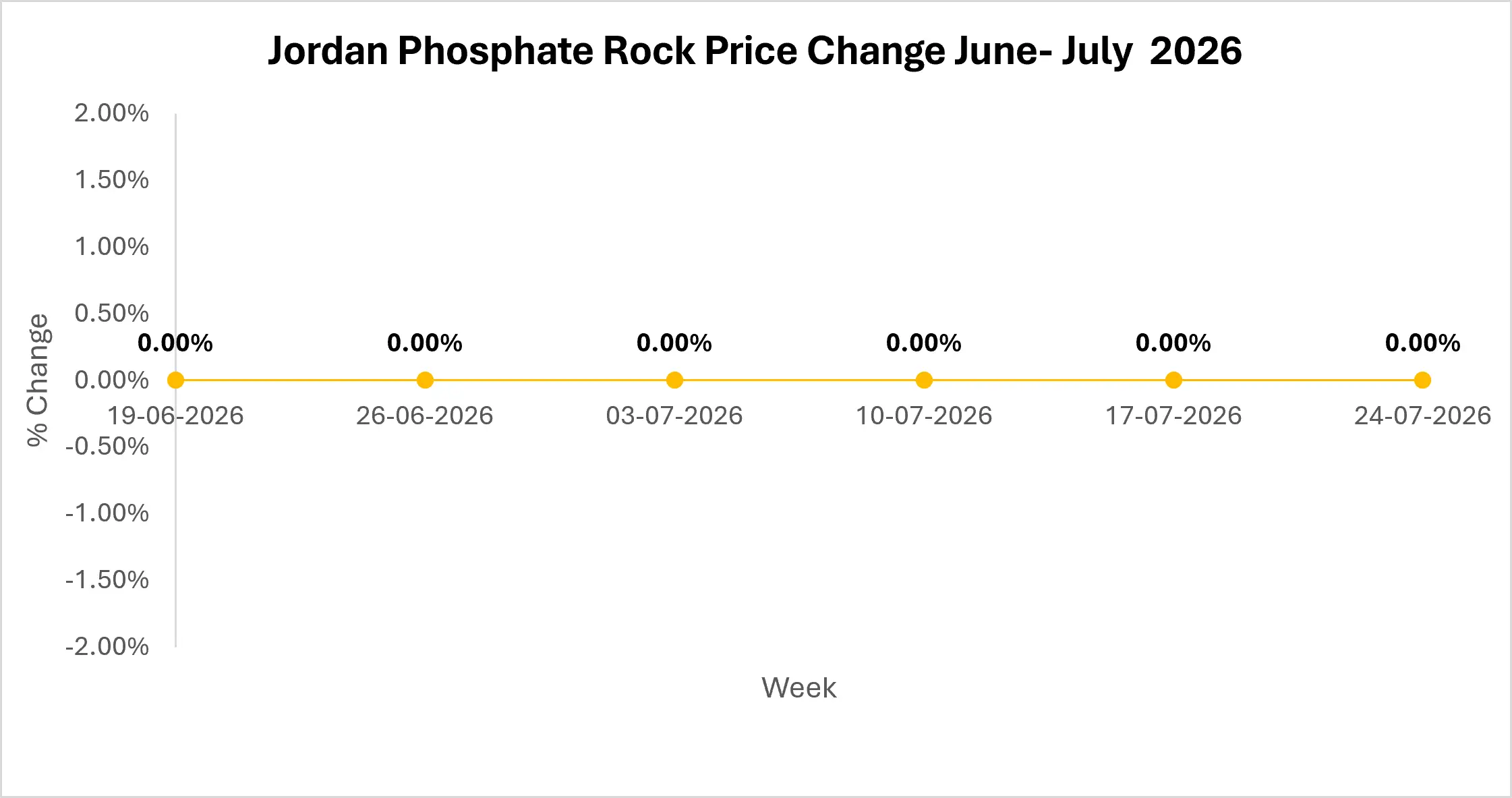
Jordan’s phosphate rock market remained remarkably stable throughout June and July 2026, with weekly prices being stable for last six weeks. While the absence of price fluctuations may suggest a balanced market, underlying fundamentals indicate that stability was primarily supported by disciplined supply management, steady export demand, and limited changes in production economics rather than an improvement in overall market conditions.
Jordan Phosphate Rock Market Remains Supported by Balanced Supply
Here is what six consecutive weeks of zero price movement actually means in the phosphate rock market it means two equally matched forces have been cancelling each other out, and the moment one of them blinks, the price moves sharply.
Jordan has not seen a single week of price movement in phosphate rock from19th June 2026. That is not equilibrium. That is a coiled spring. The chart tells you nothing about what comes next but understanding the forces behind the flatline tells you everything.
Source: Price Watch™ Phosphate Rock Prices
Why Aren’t Prices Moving Despite Global Fertilizer Uncertainty?
The unchanged pricing reflects a market where supply and demand remained carefully balanced rather than exceptionally strong. Global phosphate fertilizer producers continued to face sulphur supply constraints, limiting their ability to significantly increase phosphoric acid production even when phosphate rock remained readily available.
Meanwhile, major fertilizer-importing countries largely fulfilled immediate procurement requirements through earlier purchases, reducing the urgency for additional spot cargoes from Jordan. Long-term contractual shipments continued to dominate trade activity, while buyers avoided aggressive inventory accumulation amid persistent geopolitical uncertainty and cautious demand expectations.
What Is the Current Market Scenario?
Jordan’s long-term export contracts with key importers in India, Southeast Asia, and Europe helped maintain predictable shipment volumes despite geopolitical uncertainty in the Middle East. At the same time, global sulphur shortages continued to restrict downstream phosphoric acid and phosphate fertilizer production rather than phosphate rock mining itself.
Since fertilizer manufacturers were operating cautiously because of constrained sulphur availability, fresh spot buying of phosphate rock remained measured, keeping prices unchanged.
Phosphate Rock Market Outlook
Over the next three months, phosphate rock market is expected to remain stable with a slight upward bias. Existing export contracts, healthy international demand, and disciplined production are likely to continue supporting current price levels.
However, the primary near-term risk remains the availability of sulphur and sulphuric acid. Any improvement in global sulphur supply could encourage phosphate fertilizer producers to increase operating rates, leading to stronger phosphate rock procurement and firmer prices.
Conversely, if fertilizer demand remains deferred due to seasonal purchasing patterns or geopolitical uncertainty, phosphate rock prices are expected to remain broadly unchanged.
Overall, the market appears fundamentally balanced, but tighter downstream raw material availability and renewed fertilizer production could gradually shift sentiment toward modest price strengthening in the coming months.
Follow Price Watch™ on LinkedIn for real-time phosphate rock market insights, phosphate rock price trends, supply chain intelligence, and global commodity updates.