

Renewed US-Iran tensions around the Strait of Hormuz have created a new wave of cost pressure for India’s Polyolefin Elastomer (POE) market. Since early July, rising geopolitical risks have disrupted shipping activity in the region, leading to higher freight rates, increased war-risk insurance premiums, and delays in cargo movement.
The Strait of Hormuz remains a critical energy trade route, with around 20–25% of global seaborne crude oil trade and nearly 20% of global LNG shipments passing through the corridor.
Any slowdown in transit has a direct impact on Asian petrochemical supply chains, tightening the availability of key POE feedstocks such as ethylene and alpha olefins. Producers are passing this through as shipments are delayed, spot cargoes become scarcer, and freight and insurance costs on Asia-linked routes move higher.
The combined effect has been firmer downstream petrochemical prices and a higher production-cost floor for POE converters across the region, including in India, which remains heavily dependent on imported material from South Korea and Thailand.
Duty-Free Window on Critical Petrochemicals Closes
Duty-free benefits on key petrochemical imports have ended, adding another layer of cost pressure to India’s POE market. India’s temporary nil customs duty exemption on more than 40 critical petrochemical products, including polymers, intermediates, methanol, and styrene, expired on 15 July 2026 without further extension.
The exemption, introduced in April as a short-term relief measure following disruptions in global petrochemical supply chains, was extended once until mid-July to support industries during the transition period.
With the waiver now withdrawn, importers of polymer-based materials, including POE, are once again facing applicable customs duties, adding to already elevated costs from higher freight rates, and logistics challenges linked to geopolitical uncertainty.
India Polyolefin Elastomer (POE) Market Faces Higher Import Costs
For India’s POE market, the timing of the duty reinstatement has increased pressure on import costs as supply-side challenges continue.
However, some market participants indicate that current CIF offers remain relatively competitive as suppliers are still clearing inventories that were booked before the latest disruption and policy changes.
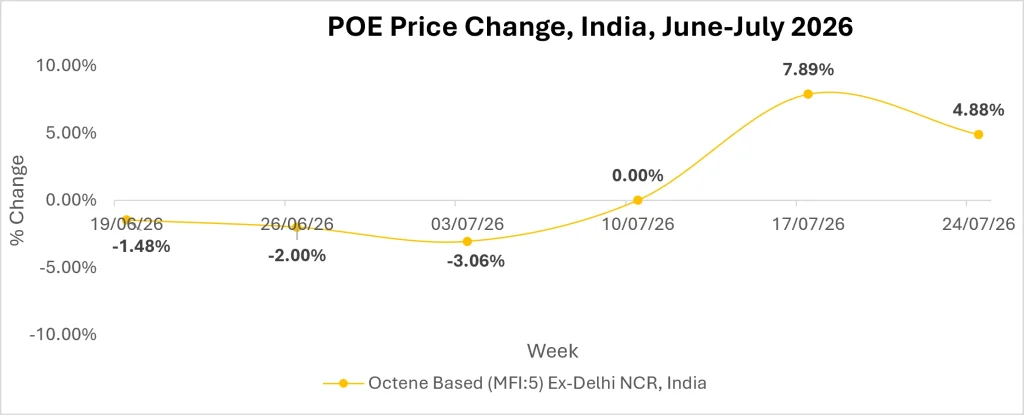
Source: Price Watch™ POE Prices
India POE Market Outlook
India’s POE market is set to stay on a firm footing in the coming weeks. Supply pressures aren’t letting up tight feedstocks, rising freight and insurance costs, reinstated import duties, and a fluctuating rupee are keeping landed costs high.
With the country still relying heavily on imports, buyers are expected to move cautiously, watching every shipment and price signal closely. Demand, meanwhile, is holding strong. But with supply expected to stay constrained, sellers are likely to keep prices firm, leaving buyers bracing for higher offers before any relief hits the market.
Follow Price Watch™ on LinkedIn for real-time polymer market insights, POE price trends, supply chain intelligence, and global commodity updates.